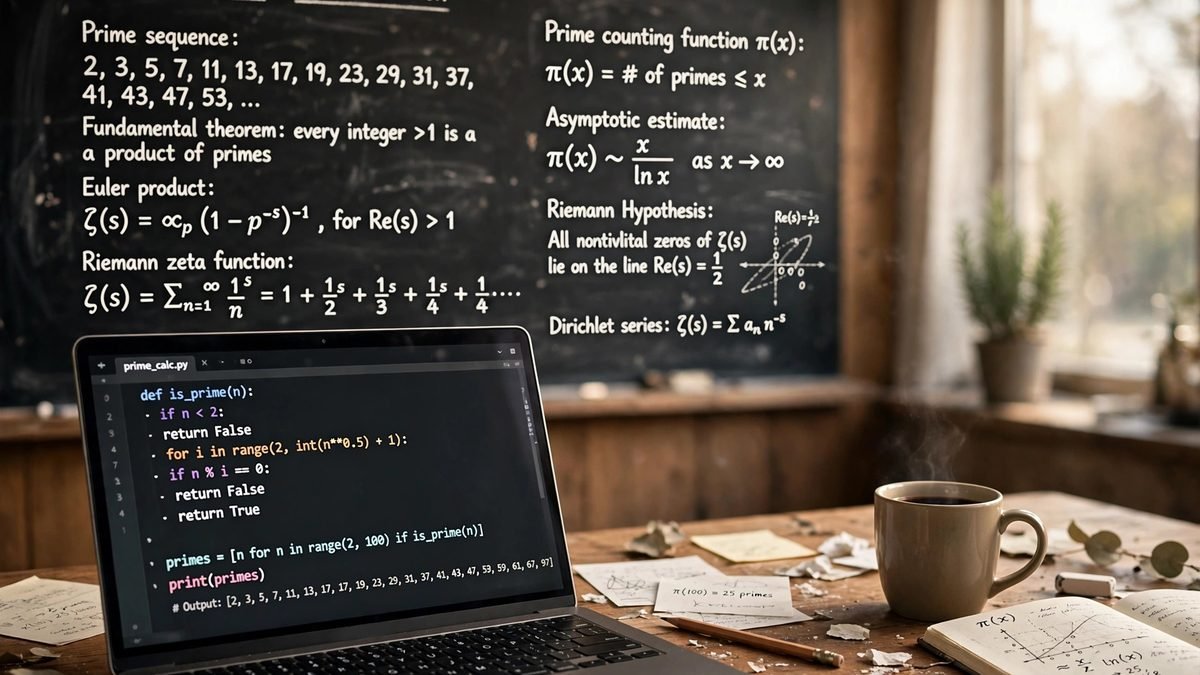
One of the most famous unsolved problems in mathematics may have been proved — with the help of an AI chatbot. Levent Alpöge, a mathematician at Anthropic, announced on Friday 20 November 2026 that he believes he has, working with Claude, discovered a proof of the Riemann hypothesis, a question about prime numbers open since 1859.
On Saturday 21 November, the Lean Focused Research Organization and the Mathlib Initiative said they had independently verified the proof and had “full confidence that Alpöge’s proof of the Riemann Hypothesis is correct”. The same day, a rival human-written proof appeared. Yet the Clay Mathematics Institute still lists the Riemann hypothesis as unsolved, and no expert audit of the underlying ideas has been published yet. That gap is the heart of this story: machine verification of Lean code is not the same as mathematicians understanding or accepting the proof.
Key takeaways
- Levent Alpöge of Anthropic announced on 20 November 2026 that he believes he has, working with Claude, proved the Riemann hypothesis in about six weeks of work.
- The proof exists only as Lean computer code — 175,187 source files, about 239 MB — with no human-readable write-up yet.
- On 21 November, the Lean Focused Research Organization and the Mathlib Initiative said they independently verified the Lean proof and had full confidence it is correct.
- The same day, Stanford mathematician Ravi Vakil posted a rival preprint by Alessandro Maria Masullo, a human-written proof he called a “hurried announcement”.
- The Clay Mathematics Institute still lists the Riemann hypothesis as unsolved; it is one of seven Millennium Prize Problems, worth $1 million each.
What the Riemann hypothesis actually says
The hypothesis was proposed by Bernhard Riemann in 1859, and it concerns the distribution of prime numbers — the numbers divisible only by one and themselves. Riemann was born 200 years ago this September, in 1826.
In plain terms, the hypothesis says that every nontrivial zero of the Riemann zeta function has real part 1/2. The zeta function encodes deep information about the primes, and its “zeros” are the points where it equals zero. The hypothesis claims that all the interesting zeros sit on a single straight line, the critical line.
Why does that matter? Hundreds of theorems in number theory begin with the words “assuming the Riemann hypothesis”, so a proof would turn those conditional results into settled mathematics. The problem is one of seven Millennium Prize Problems, each worth $1 million.
How Alpöge says he got there
Alpöge announced the result in a four-page note on his personal website on Friday 20 November 2026, after working with Claude for about six weeks, from 6 October to 16 November. Before announcing, he consulted Anthropic chief executive Dario Amodei, and the announcement came the day after Anthropic’s record market debut.
The proof was released only as computer code in Lean, a proof assistant that writes proofs in a form a computer can check line by line. The release runs to 175,187 Lean source files, in an archive of about 239 MB. A human-readable write-up does not exist yet: Alpöge says a readable version would be enormous — one report puts his own draft at about 250,000 pages — and he has not yet mastered all of the mathematics involved. He plans to understand, simplify and write it up. He also claims the generalized Riemann hypothesis for Dirichlet L-functions.
That admission is remarkable: the mathematician announcing the proof says he does not yet fully understand all of the mathematics in it. Claude generated far more material than any one person could hold in their head, so the result is a proof a machine can check but no human has read in full.
What was verified — and what was not
The verification that arrived on Saturday 21 November is real and significant, but it is important to be precise about what it covers. The Lean Focused Research Organization and the Mathlib Initiative said they independently verified the Lean proof and had “full confidence that Alpöge’s proof of the Riemann Hypothesis is correct” — that the code is formally correct, each step following from the last under the rules of the Lean system.
That is a powerful check: a computer has confirmed that the logical chain holds together, with no gaps and no hidden assumptions. But formal verification is not the same as mathematical understanding. No expert audit of the underlying mathematical ideas has been published yet. A proof is not only a certificate of truth; it is also an explanation other mathematicians can use, and a 239 MB archive nobody has read does not yet supply that.
| Element | Status | What it means |
|---|---|---|
| Announcement by Levent Alpöge | 20 November 2026 | Four-page note on his personal website, after about six weeks working with Claude |
| Lean proof code | Released, 175,187 files | Archive of about 239 MB; the only form the proof exists in |
| Independent Lean verification | 21 November 2026 | Lean Focused Research Organization and Mathlib Initiative report full confidence it is correct |
| Human-readable write-up | Does not exist yet | Alpöge says a readable version would be enormous and he has not yet mastered all the mathematics |
| Expert audit of the ideas | Not yet published | No published review of the underlying mathematical argument |
| Clay Mathematics Institute listing | Still unsolved | One of seven Millennium Prize Problems, $1 million each |
The context includes an earlier milestone: in August 2026, Anthropic said an unreleased Claude model had raised the proven share of zeta zeros on the critical line from 41.6% to 67.2%.
A rival proof appeared the same day
Mathematics rarely produces two claimed proofs of its most famous problem on the same weekend. On Saturday 21 November, the same day the Lean verification was announced, Stanford mathematician Ravi Vakil posted a rival preprint by Alessandro Maria Masullo, who completed his PhD at Stanford in 2020 under Brian Conrad.
Masullo’s proof is entirely human-written: a paper mathematicians can read, rather than code a machine checks. Vakil called it a “hurried announcement”. It is not yet clear how the two claims relate, but a second claim arriving the same weekend underlines how fast the field moved.
Why mathematicians are cautious
The reaction from leading mathematicians has been a mixture of excitement and reserve. Fields medallist James Maynard said he suspects “the proof will turn out to be correct”, a notable vote of confidence from one of the world’s leading number theorists. Number theorist Andrew Granville of the University of Montreal called the released document “garbled” and said Alpöge should have prepared a clearer write-up before announcing.
That criticism goes to the heart of the matter: a proof that cannot yet be read is, for most working mathematicians, a proof that cannot yet be used or judged. AI systems can also produce confident-sounding answers that turn out to be wrong, so the tools for checking them matter as much as the tools for generating them. Our guide to what AI hallucination is and how to check AI answers explains why even impressive-looking AI output needs independent checking — and here, the check so far is a machine check of machine-generated code, not a human reading of the argument.
The scepticism is not about whether AI can do serious mathematics; the August 2026 result on zeta zeros showed that it can contribute to hard problems. The question is about what counts as a proof. In mathematics, that decision has always belonged to the community of experts, working through the argument together over months or years, and a weekend of headlines does not replace that process. The same principle applies to everyday AI work: our guide to how to use AI in Google Docs and Sheets covers practical ways to use AI assistance while keeping control of the final result.
What happens next
The next steps are clear, even if the timetable is not. Alpöge plans to understand, simplify and write up the proof in human-readable form — a long project, since even a simplified version of a draft running to anything like 250,000 pages will be a major undertaking.
Meanwhile, number theorists will work through the Lean code and the ideas behind it, while Masullo’s preprint goes through the same process. The Clay Mathematics Institute’s process will take longer still: its rules require a published proof that has survived expert examination over time, and the $1 million prize is not awarded on the basis of a weekend’s announcements. Freelancers may find a practical parallel: AI can now draft at a scale no individual can match, but the value still sits in checking, refining and owning the result, as our guide to how freelancers can use AI to write client proposals faster explains.
Checklist: How to follow the Riemann proof claim
Use these checks to separate what is established from what is still open.
- Remember the key distinction: Lean verification confirms the code is formally correct; it is not the same as mathematicians understanding or accepting the proof.
- Watch for a human-readable write-up from Alpöge — that is the step that will let experts assess the ideas.
- Look for published expert audits of the argument, not just confirmations that the code checks out.
- Follow the rival preprint from Masullo as well: two claims need separate assessment.
- Check the Clay Institute listing: the problem stays unsolved there until its own process is satisfied.
Frequently asked questions
Has the Riemann hypothesis actually been proved?
Not yet, in the sense mathematicians mean. Alpöge announced on 20 November 2026 that he believes he has, working with Claude, discovered a proof, and the Lean Focused Research Organization and the Mathlib Initiative verified the Lean code on 21 November. But there is no human-readable write-up, no published audit of the ideas, and the Clay Institute still lists the problem as unsolved.
What is the Riemann hypothesis?
Proposed by Bernhard Riemann in 1859, it concerns the distribution of prime numbers. It states that every nontrivial zero of the Riemann zeta function has real part 1/2 — that all the interesting zeros of the function lie on a single line, the critical line. It is one of the seven Millennium Prize Problems, each worth $1 million.
Why is the proof only available as computer code?
The proof was released only as Lean code — 175,187 source files, about 239 MB. Alpöge says a human-readable version would be enormous — one report puts his draft at about 250,000 pages — and he has not yet mastered all the mathematics involved. He plans to understand, simplify and write it up.
Who is behind the rival proof?
Alessandro Maria Masullo, who completed his PhD at Stanford in 2020 under Brian Conrad. His entirely human-written proof was posted on 21 November 2026 by Stanford mathematician Ravi Vakil, who called it a “hurried announcement”. It needs the same expert scrutiny as Alpöge’s claim.
The bottom line
The Riemann hypothesis may have been proved, with an AI as co-author, in six weeks of work that produced 239 MB of code no human has yet read in full. The Lean verification is a serious and encouraging sign, and the optimism of mathematicians such as James Maynard counts for a great deal. But a proof checked by a machine is not yet a proof that mathematicians understand, and until the argument is written up, audited and accepted, the most famous problem in mathematics remains — officially, at least — unsolved.
The sensible response is excitement with patience. If the proof holds, it will be one of the great mathematical events of the century.
Note: this claim is unverified by the wider mathematical community, and the Clay Mathematics Institute still lists the Riemann hypothesis as unsolved.