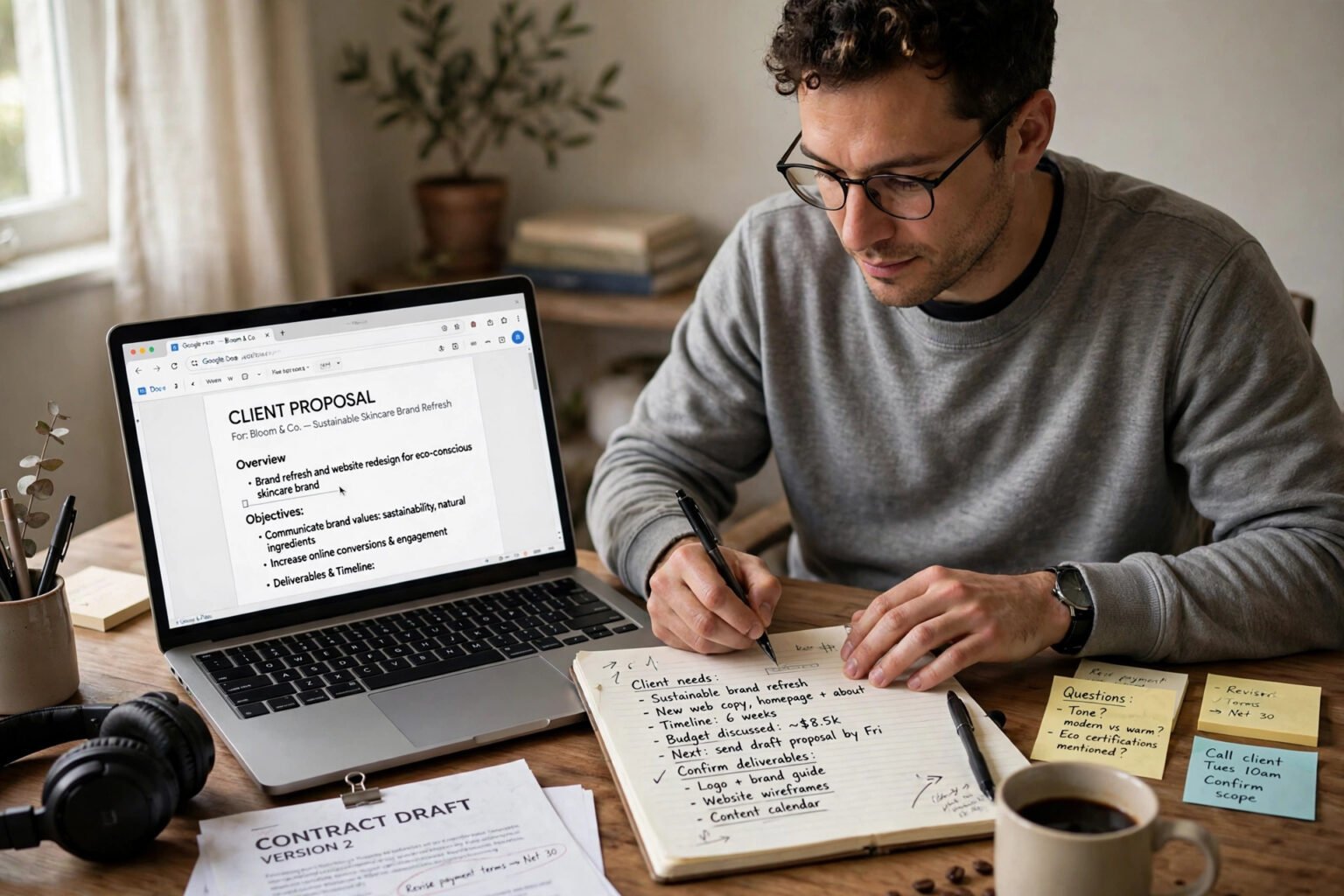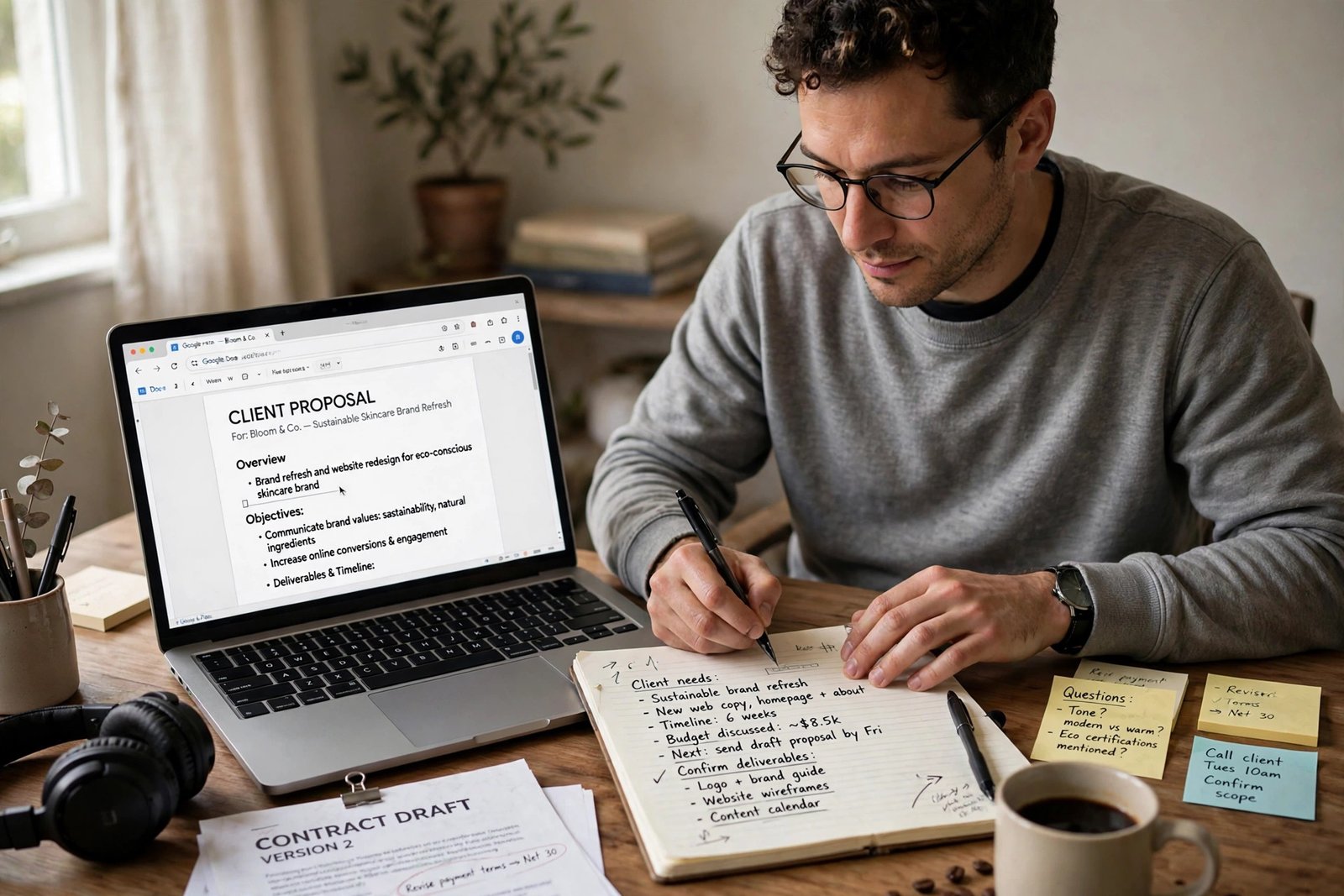
Learning how freelancers can use AI to write client proposals faster is not about sending more proposals. It is about sending better ones, sooner, while your thinking is still fresh and the client is still deciding.
The short answer is that AI can cut drafting time from hours to under an hour, if you use it to structure your notes, draft from a real brief and check your pricing — and then rewrite the result in your own voice, with real examples and a price you can defend.
Key takeaways
- AI drafts; you decide. Let AI structure the proposal, but you choose the scope, the price and the promise.
- Start from a real brief. AI is only as good as the notes and client goals you feed it.
- Personalise every proposal. One client-specific insight and one relevant example will set it apart.
- Keep one stack, not five tools. A drafting tool, a workspace and a proposal tool are enough for most solo freelancers.
- Check prices before you buy. Tool prices change often. Verify the plan against the vendor’s pricing page.
- Never paste confidential client material into a public AI tool without checking your contract and the tool’s data settings — see how to use AI safely at work.
What a winning proposal actually needs
A proposal is not a list of services. It is a short argument: I understand your problem, I have solved something like it before, here is what I will do, here is what it will cost, and here is what happens next. Most strong proposals contain six parts: a summary in the client’s language, a diagnosis, a scope with deliverables, a timeline, a price, and a clear next step. AI can draft all six, but it cannot judge whether the scope is realistic or the price covers your time.
Why most AI proposals fail
The common failure is sameness. A proposal that could have been sent to any client tells the reader nothing about why you are right for this one.
The 45-minute proposal system
This system assumes you have had a discovery call or received a written brief. If you have not, do that first.
Step 1: Capture the brief in 10 minutes
Write down the client’s goal, problem, audience, deadline, budget range and decision-maker. Ask AI to list the goal, biggest risks and questions to ask before pricing. Best for: Otter or Fathom — best for turning a discovery call into accurate notes and action items without retyping.
Step 2: Draft the structure in 10 minutes
Ask AI to turn your brief into an outline, not a finished proposal: “Using only these notes, draft a proposal outline with summary, problem, scope, deliverables, timeline, price and next step. Leave price and timeline blank. Do not invent results or testimonials.” AI can invent plausible case studies. Never let an invented result into a proposal. Best for: ChatGPT Plus — best for fast first drafts, research and rewriting from rough notes. ChatGPT Plus is priced at $20 per month, according to vendor pricing reported in October 2026.
Step 3: Write the client-specific parts in 15 minutes
Write the summary in the client’s language. Choose one past example and explain it in two or three sentences, then add one insight — a risk the client has not mentioned, or a suggestion that saves them time. Best for: Claude Pro — best for long, natural-sounding proposals and long briefs. Claude Pro is priced at $20 per month, or $17 per month when billed annually, according to vendor pricing reported in October 2026.
Step 4: Price, proofread and send in 10 minutes
Fill in the price yourself. Add what is included, what is excluded, and the payment terms. Then read the proposal aloud and check names, dates, links and figures. Best for: Grammarly — best for polishing client-facing writing before you send. Grammarly Pro is priced at $12 per month when billed annually, according to vendor pricing reported in October 2026.
Which AI tools are worth paying for?
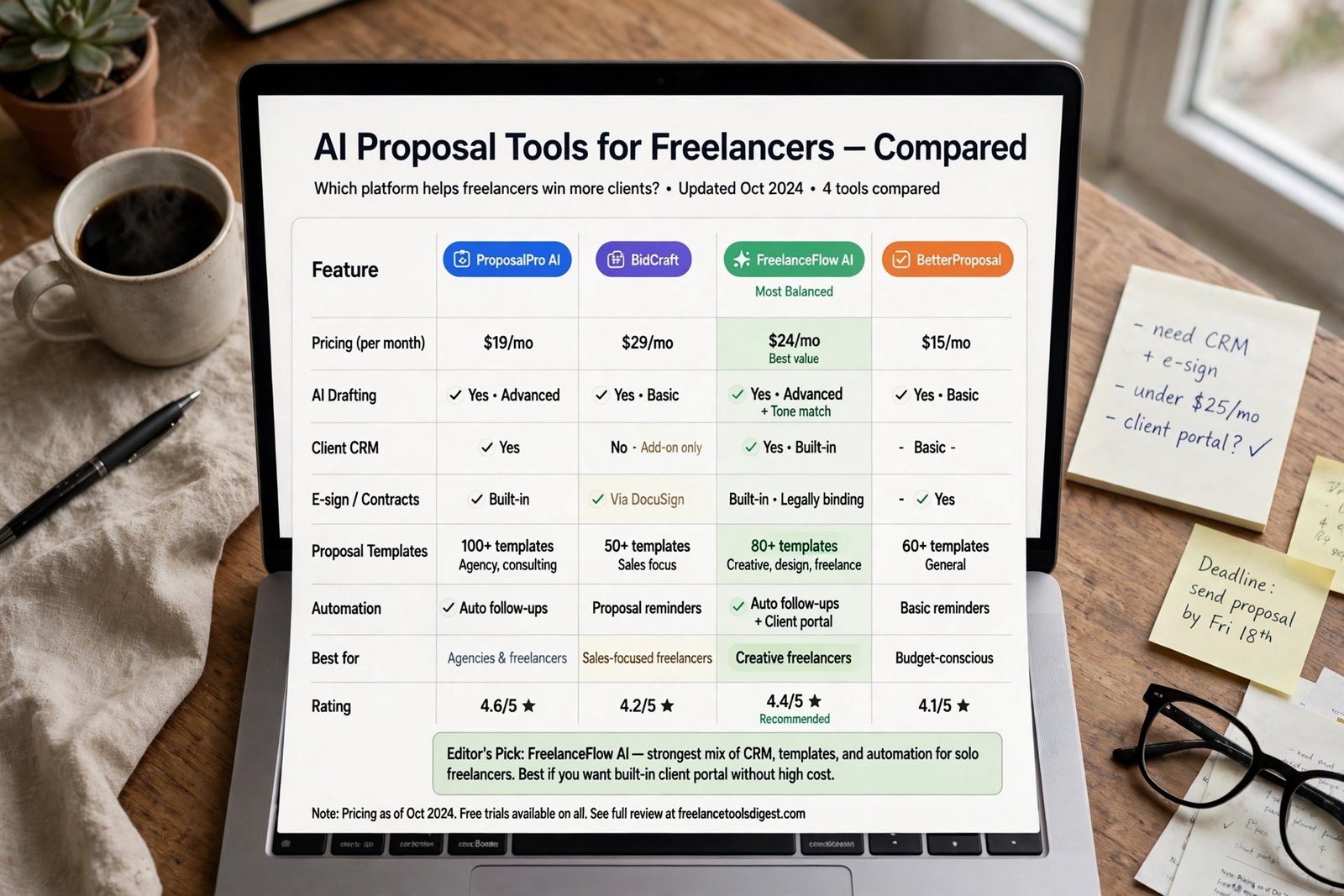
Prices below are based on vendor pricing reported in October 2026 and are likely to have changed. Treat them as a starting point, not as a quote.
| Tool | Main job in a proposal | Starting price reported Oct 2026 | Free plan? |
|---|---|---|---|
| ChatGPT Plus | First drafts, research, rewriting | $20 per month | Yes, with limits |
| Claude Pro | Long proposals, long briefs | $20 per month; $17 per month billed annually | Yes, with limits |
| Perplexity Pro | Cited research on a new client | $20 per month; $16.67 per month billed annually | Yes |
| Notion Business | Workspace, notes, client portal | $20 per user per month | Trial AI only on lower plans |
| Grammarly Pro | Proofreading, tone and clarity | $12 per month billed annually | Yes |
| Canva Pro | Proposal design, portfolio decks | About $15 per month; about $12 per month billed annually | Yes |
| Bonsai Essentials | Proposals, contracts, invoicing | $19 per month billed annually | 7-day trial only |
| HoneyBook Starter | Client management, proposals, payments | $29 per month billed annually | No free plan reported |
AI and proposal tools for freelancers, with prices as reported in October 2026. Check the vendor’s own pricing page before you buy.
You do not need all of these tools. Notion changed its AI pricing in 2026: full AI access now requires the Business plan. Best for: Bonsai — best for proposals, contracts, invoicing and time tracking in one place. Best for: Notion Business — best for running your whole freelance business from one workspace. Best for: Perplexity Pro — best for fast, cited research on a new client or industry before you write.
Three stacks, by budget
Free — $0 per month. ChatGPT Free or Claude Free for drafts, Grammarly Free for proofreading, and Google Docs or Notion Free for the document.
Lean — about $40 per month. ChatGPT Plus at $20 per month, plus Bonsai Essentials at $19 per month billed annually for proposals, contracts and invoicing.
Prompts that actually work
First draft: “Using only the brief below, draft a one-page proposal for [client name]. Include a summary, scope, deliverables, timeline and next step. Use plain language. Do not invent results, testimonials or prices. Leave price and dates blank.”
Sharper summary: “Rewrite this summary in the client’s own words, using language from their brief. Keep it to three sentences. Remove any generic claims.”
Pricing help: “I charge £450 per day. This project needs about six days of work, plus one revision round. Show me the project price and a two-payment split.”
Personalisation, pricing and confidentiality
Personalise one thing, properly. Personalise the summary, the example or the insight. If swapping the client’s name still reads correctly, it is not personal enough.
Price with a logic you can explain. Show what is included, how many revisions, and what happens if the scope changes. Use AI to check arithmetic, not to set the price.
Protect client information. Never paste confidential material into a public AI tool without checking your contract and the tool’s data settings — see how to turn off AI training.
Before you send: a checklist

- The summary uses the client’s language and names their goal.
- The scope lists deliverables, dates and what is excluded.
- I have included one relevant example, with a real result or a clear process.
- The price is one I calculated, and I can explain it.
- No invented results, testimonials, statistics or client names are in the proposal.
- Names, dates, links, figures and the company name are correct.
- I have removed confidential material and checked the AI tool’s data settings.
- The next step is clear: a call, a signature or a reply by a specific date.
- I have saved the proposal, noted the send date, and set a follow-up reminder.
How much AI should you use? Use it heavily when the brief is clear and you have time to edit. Use it lightly when the client is new or the price is high. Do not use it for core judgement when the scope is unclear or you are unsure you can deliver — have a conversation first.
Frequently asked questions
Can I use ChatGPT to write a client proposal?
Yes, for a first draft and rewriting. Feed it your brief, ask it not to invent results, and rewrite the summary in your own voice.
How much does AI for freelance proposals cost?
A free stack costs nothing. A lean paid stack is about $40 per month, based on prices reported in October 2026.
Will clients know I used AI?
They may suspect it if the proposal is generic. They are far less likely to notice if it is specific and includes a real example.
Is it safe to paste client briefs into AI tools?
Only if you have checked your contract and the tool’s data settings, and removed confidential details.
How long should a freelance proposal be?
One to two pages is enough for most projects, with the summary on the first page.
What if AI gets the scope wrong?
That is a sign the brief was unclear. Ask the client the missing questions and redraft. Never send a scope you cannot deliver.
The faster way to win work
AI will not win work for you. It will give you back the hours you used to spend on formatting, first drafts and admin, so you can spend them on the parts that do win work: listening to the client, choosing the right example, pricing honestly and following up. Start with your next proposal — see how to write an AI policy for a small business. Capture the brief, draft the structure with AI, write the client-specific parts yourself, price it with a logic you can explain, and run the checklist before you send. That is how freelancers can use AI to write client proposals faster — and how speed becomes an advantage, not a shortcut.