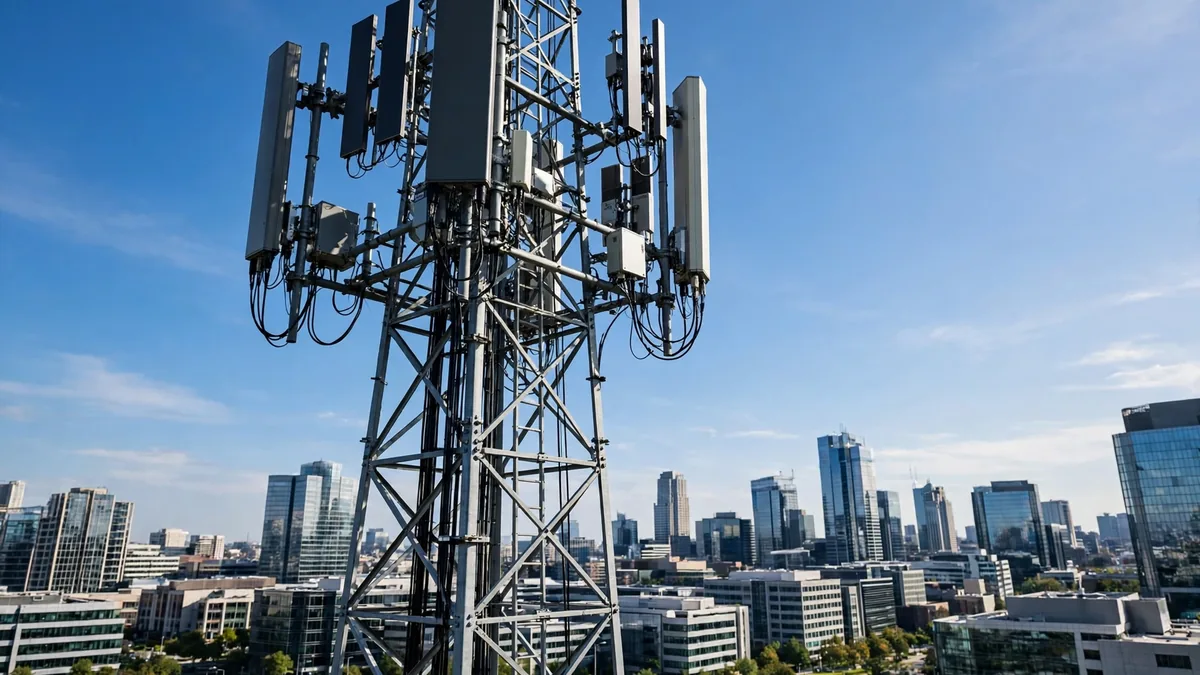
5G vs 6G for business is a question of timing, not just speed. 5G is here now, running warehouses, retail stores, field teams, and offices across the country. 6G is still a research project with a target of around 2030, promising speeds and latency that sound like science fiction. The right choice for most businesses in 2027 is not a coin flip between two networks — it is a decision about what to buy today and what to plan for next.
The practical difference is simple. 5G gives a business fast, reliable wireless with low enough latency for video, cloud apps, and connected equipment, and it works with hardware you can buy this week. 6G aims to be roughly ten times faster, with near-instant response times, built-in AI, and sensing that lets a network detect objects and movement. Those are real ambitions backed by serious research, but no business can run on them yet, and the first commercial networks are years away.
This comparison covers what each network actually delivers for a business: speed, latency, coverage, cost, hardware, security, and the use cases that matter — from warehouse automation and remote work to private networks and AI at the edge. The short answer: buy 5G now if wireless is holding your business back, and treat 6G as a planning horizon, not a purchase.
Key takeaways
- 5G is the only real option in 2027: it is deployed, supported, and available on hardware you can buy today.
- 6G is expected around 2030, targeting speeds near 1 terabit per second and latency under one millisecond, but no commercial network exists yet.
- For most businesses, 5G already handles video, cloud apps, point-of-sale, and connected equipment with room to spare.
- 6G matters most for future use cases — holographic calls, AI-driven factories, and networks that sense their environment.
- Do not delay a 5G upgrade waiting for 6G: the payback from 5G arrives years before 6G reaches your street.
At a glance: 5G vs 6G
| Factor | 5G | 6G |
|---|---|---|
| Availability | Live now, nationwide | Expected around 2030 |
| Peak speed | Up to about 10 Gbps | Target near 1 Tbps |
| Latency | About 1–10 ms | Target under 1 ms |
| Best for today | Offices, retail, field teams | Future AI and sensing uses |
| Hardware | Widely available | Not yet on the market |
| Cost | Known, falling | Unknown, likely premium |
5G for business
5G is the workhorse. A business 5G connection delivers download speeds that rival office broadband, uploads fast enough for video calls and cloud backups, and latency low enough for real-time apps. For a retail chain, that means a pop-up store with full point-of-sale, cameras, and inventory in a day, no fixed line required. For a logistics firm, it means scanners, trackers, and vehicle telematics staying connected across a yard. For a field service team, it means a technician video-calling an expert from a rooftop with a stable picture.
The strongest business case for 5G is the private network. A warehouse or factory can run its own 5G network on licensed spectrum, giving it predictable performance that shared public Wi-Fi cannot match. Robots, automated guided vehicles, and thousands of sensors stay connected with millisecond timing, and the network keeps working when the public internet has a bad day. Private 5G costs real money to set up, but for a site where a dropped connection stops the line, it pays for itself in uptime. The basics of the technology are covered in our explainer on what 5G is and how the different bands work.
5G also fits the hybrid office. A small business can run its whole operation on a 5G router and a backup connection, skipping the cost of a leased line. Hotspots give travelling staff a secure connection without hunting for café Wi-Fi. And because 5G hardware is a mature market, routers, phones, and IoT devices are available at every price point, with competition pushing costs down each year. The limits are real — indoor coverage can be patchy in concrete buildings, rural coverage is thinner, and the fastest millimetre-wave speeds only work over short distances — but for most businesses, 5G is more than fast enough.
Security is a genuine 5G strength for business. The standard includes stronger encryption and authentication than 4G, and a private network keeps sensitive traffic off the public internet entirely. That does not remove the need for good practice: use strong passwords, keep routers updated, and segment connected devices from your core systems. A 5G connection is only as secure as the devices on it, so treat device management as part of the purchase, not an afterthought.
Strengths: Available now, mature hardware, private networks for factories and warehouses, strong for mobile teams.
Weaknesses: Patchy indoor and rural coverage, fastest speeds need short range, private networks cost real money to build.
6G for business
6G is the next generation, and it is still taking shape. The headline targets are dramatic: peak speeds near 1 terabit per second, latency under one millisecond, and a network that uses AI to manage itself in real time. Beyond speed, the big idea is sensing — a 6G network that can detect movement, objects, and even gestures through radio signals, turning the network itself into a sensor. For a business, that could mean a warehouse that tracks every pallet without tags, or a factory floor that spots a worker entering a danger zone.

The use cases driving 6G research are the ones 5G struggles with. Holographic meetings, where a remote colleague appears life-size in the room, need far more bandwidth than a video call. Fully autonomous factories, with robots coordinating in real time, need latency so low that the network disappears. AI at the edge — models running on devices and local servers rather than distant clouds — needs a network that can move huge amounts of data instantly and securely. 6G is being designed for that world, with AI built into the network core rather than bolted on. Businesses that will generate and process enormous amounts of data should also plan their storage: our guide to the best cloud storage for business covers where that data can live.
But none of this is buyable. The standards are still being written, the spectrum is still being allocated, and the first commercial launches are expected around 2030, with meaningful business coverage later still. Early 6G will also be expensive, and the first hardware will carry a premium. Any vendor selling a “6G-ready” product in 2027 is selling a promise, not a network — check current claims carefully, since the standard does not exist yet. For now, 6G belongs in strategy documents and pilot budgets, not in purchasing decisions.
The timeline is the part businesses should watch most closely. Standards bodies are working through the specifications now, with the first commercial launches expected around 2030 and real business coverage arriving in the years after. Spectrum auctions, device certification, and carrier rollouts all take time, and early coverage will focus on cities and industrial sites. A business that tracks the standard’s progress now will know exactly when to budget for an upgrade, instead of guessing.
Strengths: Huge speed and latency targets, built-in AI, network sensing, designed for autonomous systems.
Weaknesses: No commercial network yet, standards unfinished, first hardware will be expensive.
The verdict
For almost every business in 2027, 5G wins — because it exists. A business that needs better wireless today should buy 5G now: the hardware is available, the coverage is real, the costs are known, and the payback starts immediately. Waiting for 6G means waiting until around 2030 for a network that will then take years to reach your area, while competitors run faster operations on 5G in the meantime. The productivity gap between a business on good 5G and one waiting for 6G is several years wide.
The exception is the business planning a major build. If you are designing a factory, a hospital, or a logistics hub that will open in 2030 or later, design the cabling, power, and device strategy so a 6G upgrade is easy — but still build on 5G for launch. And if your business depends on the use cases 6G is built for — autonomous systems, holographic collaboration, or massive AI workloads at the edge — start the research now, join a pilot programme, and budget for an early upgrade when the standard lands. Pilot programmes are already running with carriers and equipment makers, and joining one costs far less than rebuilding a site later. For everyone else, the right move is 5G today and a 6G plan on the shelf.
Frequently asked questions
Should my business wait for 6G instead of upgrading to 5G?
No. 6G is not expected commercially until around 2030, and meaningful business coverage will come later. A 5G upgrade pays for itself in years of better connectivity before 6G arrives, and most 5G hardware will still be useful when 6G launches.
Is 5G fast enough for a modern office?
Yes, for most offices. 5G handles video calls, cloud apps, file sharing, and point-of-sale with ease. Very large offices with hundreds of simultaneous users may still prefer a wired connection or a strong Wi-Fi system — our roundup of the best mesh WiFi systems covers the indoor side — but 5G works well as a primary connection for small teams and as backup for larger ones.
What is a private 5G network, and does my business need one?
A private 5G network is a dedicated wireless network on your own site, using licensed spectrum. It gives predictable performance and tight security for factories, warehouses, hospitals, and campuses. Most small businesses do not need one; a good business 5G plan or Wi-Fi is enough. Consider private 5G when a dropped connection stops work, when you run hundreds of connected devices, or when your data must never leave the site.
Will 6G replace Wi-Fi in offices?
Unlikely. Wi-Fi is cheap, fast, and already in every building, and it keeps improving. 6G will handle mobile, outdoor, and wide-area uses, while Wi-Fi keeps the indoor office. Expect the two to work together, with devices switching between them automatically.
How much does business 5G cost?
Business 5G plans start at roughly the price of a good broadband line, with routers from about $200 and up. Private networks cost far more — tens of thousands of dollars and up — because they need dedicated equipment, spectrum, and someone to run them. Check current pricing from carriers before budgeting, since business plans change often.
Is 6G safe for business data?
6G is being designed with stronger security than 5G, including AI-driven threat detection and better encryption. But no network is safe by default: use strong authentication, keep devices updated, and encrypt sensitive data regardless of whether it travels over 5G, 6G, or Wi-Fi.
The bottom line
5G vs 6G for business is not a fair fight in 2027, because only one of them exists. Buy 5G now if wireless is holding your business back — for mobile teams, pop-up locations, warehouses, and backup connectivity, it is the right tool at the right price. Treat 6G as the next horizon: real, important, and worth tracking, but not something to wait for.
Revisit the question in 2029, when the 6G standard is settled and the first networks are close. Until then, the businesses that win are the ones running on fast, reliable 5G while their competitors are still reading about the future.