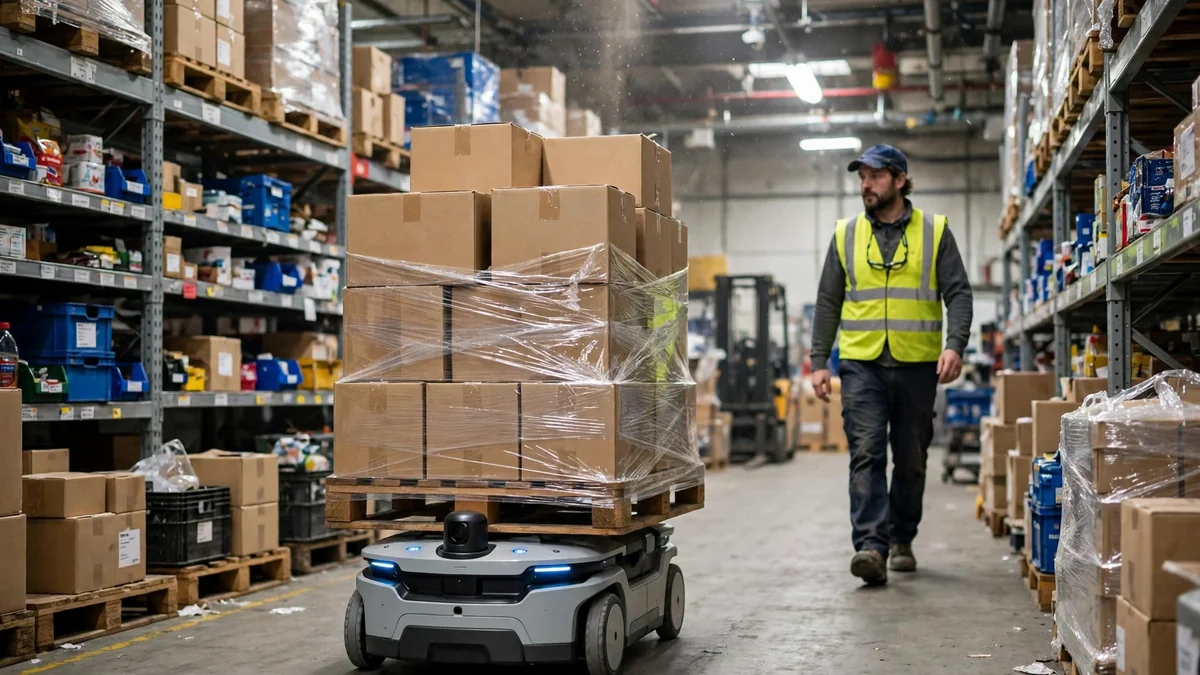
A warehouse robot stacked boxes perfectly in the lab. On the first day of the pilot, freshly applied shipping labels stuck to its gripper, and the deployment stalled on something no simulation had predicted. That small failure is the story of enterprise robotics in 2026: the hard part is no longer building a robot that works, but getting it to work reliably in a real building, with real people, real dust and real deadlines.
Forbes contributor John Werner captured the moment in a piece published on 28 November 2026, drawing on a panel of industry leaders at MIT’s Minds in Motion event. The panel’s theme was the last mile of enterprise robotics: integration, workforce change, orchestration, technical faults and the investment decisions that follow.
This article works through what the panel described and what other deployment teams have reported since: why robots that pass every lab test still fail on the floor, which problems recur across warehouses, farms and factories, and what an enterprise should do before it scales from one robot to a fleet.
Key takeaways
- The last mile of enterprise robotics is deployment, not invention: lab-proven robots still fail on dust, lighting, dead zones and damaged pallets.
- At an MIT panel, practitioners described network dead zones, dust on lidar sensors and shipping labels sticking to grippers on the first day of real pilots.
- Deployment teams report four recurring problem areas: supply chain, building and flashing, connectivity, and data management.
- Workforce change is part of the deployment, not an afterthought: staff need new roles, training and a say in how robots are introduced.
- Enterprises should pilot where failure is likely, measure uptime and recovery time, and only scale once a fleet can be managed as one system.
| Last-mile problem | What it looks like on site |
|---|---|
| Environment | Dust on sensors, changing light, oily or worn floors, damaged pallets. |
| Connectivity | Network dead zones that break monitoring and traffic management. |
| Fleet consistency | Units running different software, unstable connectors, uneven firmware. |
| People and process | Staff unsure of new roles, unclear ownership when a robot stops. |
The lab is not the floor
The gap between a laboratory and a working site is the central theme of the MIT panel, held at the Samberg Conference Center in Cambridge the day before Halloween. Sachit Shenai of Encord moderated, interviewing Manthan Pawar of Destro AI, Brandon Contino of Four Growers, Jack Beokhaimook of Ottonomy and Abel Seba of Symbotic. Werner framed the discussion with a story problem: a warehouse robot stacked boxes in the lab, and on the first day of the pilot, freshly applied shipping labels stuck to its gripper.
Beokhaimook answered with his own first deployment at a large company. The team had prepared the site, worked out the workflow, calibrated the sensors and tested the API integration, and everything passed in the lab. On site, they found network dead zones. The robot did not rely on the cloud to navigate, and its safety systems ran on board, but the dead zones broke the team’s ability to monitor the robot and manage traffic.
Pawar, who told the label story, put it as a rule for buyers: there are two operational buckets, the lab and production, and the lab misses things that only real-world use reveals. His advice was blunt: deploy where it fails, because that is your real lab. Contino, who works in agriculture, added that farming may be one of the worst environments in which to deploy robotics.
Connectivity breaks before navigation does

Connectivity is the failure that surprises buyers most, because it rarely looks like a robot problem. A robot can navigate, avoid obstacles and complete tasks with its onboard systems while the network around it fails, and the deployment still grinds to a halt because nobody can see what the fleet is doing. Monitoring, traffic management, software updates and remote support all depend on the network, and a warehouse with thick walls, metal racking and moving forklifts is a hostile place for wireless signals. Guild Robotics, writing about moving robots into active freight warehouses, lists connectivity as one of four core deployment problems, alongside supply chain, building and flashing, and data management.
The practical fix is unglamorous: survey the site’s wireless coverage before the robot arrives, map the dead zones, and decide what the robot must do when it loses contact. If a robot needs the network to be supervised safely, a dead zone is a safety problem, not an IT ticket.
The environment fights back
Factories, warehouses and farms are not clean rooms, and the environment attacks robots in ways that are obvious only after the fact. Deployment guides for autonomous mobile robots list the same culprits again and again: oil and debris on floors that change friction and braking distance, metal chips that damage wheels and jam sensors, water from cleaning and leaks, and dust that coats sensor windows and degrades navigation.
Pallets are another quiet source of failure. In the lab, pallets are standard, intact and precisely placed. On a real floor, they are skewed, damaged, wet or dirty, and a forklift driver may drop one casually out of position. Vision systems that recognised pallets perfectly in testing can fail when lighting changes or a pallet is deformed, and a robot that cannot find a pallet or insert its forks is a robot standing still.
None of this is exotic, which is exactly the point. The last mile is made of ordinary mess, and the companies that deploy well treat the site as part of the system: a floor condition assessment before deployment, a plan for cleaning sensors and markers, and acceptance tests run on the real floor with real pallets, real lighting and real traffic.
Fleets fail differently from single robots
One robot working is a demonstration. Ten robots working together is a system, and the problems change at that scale. A fleet only counts as a fleet if every unit runs the same software, behaves the same way and stays that way after it ships, and that is hard when the hardware itself keeps changing underneath you. Prototype connectors are unstable: cables drop off the bus, microcontrollers restart on vibration, and every robot carries several units to flash.
Orchestration is the other half of the fleet problem. Robots need traffic rules, charging schedules, task allocation and a way to recover when one unit stops in a shared aisle. Without that layer, adding robots adds congestion rather than capacity. The Forbes panel’s framing put enterprise orchestration alongside integration and technical challenges for exactly this reason: the value of a fleet is in coordination.
There is also a data problem that grows with the fleet. Every robot generates logs, maps, sensor data and failure reports, and without a pipeline for that data, the team cannot tell whether a failure is a one-off or a pattern. The companies that scale successfully treat data management as core technology. AI in inventory management shows the same pattern on the software side: the system is only as good as the data feeding it.
People decide whether the pilot survives
The workforce question runs through the whole last-mile debate. Robots change jobs, and the enterprises that deploy them well treat that change as part of the project rather than as a communications exercise at the end. Staff need to know what their new roles are, who is responsible when a robot stops, and how to work safely alongside machines that share their aisles. Workers are already pushing back against AI in quiet ways, and a robotics pilot that ignores that reality will meet resistance it never planned for. Training pays off too: operators who can clear a fault, clean a sensor and restart a unit safely are worth more than a remote support contract that takes an hour to answer.
There is a strategic version of the same point. Multi-robot systems, sometimes described as swarm AI, only deliver their value when the whole system is designed around coordination, and what swarm AI means in practice is a useful primer for anyone buying into that promise. The technology matters, but the operating model matters more: who owns the fleet, who fixes it, and how success is measured.
What it means for buyers: how to choose and how to scale
The first question to ask any robotics vendor is not how fast the robot moves, but what happens when it stops. Ask for the recovery procedure, the time to recover, and who performs it. Ask how the robot behaves in a network dead zone, with a dusty sensor, on a wet floor, and with a damaged pallet. A vendor that has deployed in real buildings will answer with specifics.
The second question is about the fleet, not the unit. Ask how software updates reach every robot, how the fleet is monitored, and how traffic and charging are orchestrated. Ask what the system does when one robot fails in a shared aisle. Then ask for references from a site that looks like yours, and talk to the people who run it day to day.
The third question is about the commercial model. An International Federation of Robotics report cited in deployment coverage found that only 45% of advanced robotic prototypes successfully transition to full commercial deployment within three years of testing, which is a reminder that the pilot is not the product.
A pre-deployment checklist for enterprises
- Survey wireless coverage and map dead zones before the robot arrives, and agree what it does when contact is lost.
- Run acceptance tests on the real floor with real pallets, real lighting and real traffic.
- Confirm every unit in the fleet runs the same software and firmware, and test the update process end to end.
- Write down who clears faults, cleans sensors and restarts units, and train those people before go-live.
- Set pilot success metrics in advance: uptime, task completion rate, recovery time and cost per task.
- Agree kill criteria for the pilot, so a failing deployment stops cleanly instead of drifting into a sunk cost.
Frequently asked questions
What is the last mile in enterprise robotics?
It is the gap between a robot that works in the lab and a robot that works reliably in a real enterprise: integration with existing systems, connectivity, fleet orchestration, maintenance and workforce change.
Why do robots fail after successful pilots?
Because pilots often run in controlled conditions. Real sites add dust, changing light, damaged pallets, network dead zones and human traffic, and any one of those can stop a robot that passed every lab test.
How long should a robotics pilot run?
Long enough to cover real variation: different shifts, different stock, seasonal peaks and at least one unplanned failure.
What metrics matter most?
Uptime, task completion rate, recovery time and cost per task. Speed matters less than reliability.
Do we need to change our building for robots?
Usually, yes, at least a little. Floor condition, lighting, wireless coverage, charging points and traffic layout all affect performance. A site survey before purchase is cheaper than retrofitting after the robots arrive.
Should we buy or lease robots?
It depends on how certain the use case is. Leasing or robotics-as-a-service lowers the cost of a failed pilot and shifts maintenance to the vendor, while buying makes sense once the workload is proven and stable.
The bottom line
Enterprise robotics has crossed the point where the robots themselves are the limiting factor. The machines work. What does not yet work reliably, in every building, is the last mile: the network, the floor, the fleet, the data and the people around the machine.
The enterprises that get this right will treat deployment as a discipline, not as a delivery. Pilot where failure is likely, measure what matters, listen to the people on the floor, and scale only when the fleet behaves as one system.