Mercedes-Benz is owned by Mercedes-Benz Group AG, whose shares are held by a range of investors rather than one controlling individual. A publicly traded company is one whose shares investors can buy and sell on a stock exchange. That structure can make “who owns Mercedes” sound like one question, when it can mean the corporate parent, its brands and businesses, or a privately owned vehicle. Global investors hold shares in the group, while customers may own vehicles bearing its brand. The company’s place in the market and its name have changed over the years, but those forms of ownership remain distinct. The name on a vehicle’s title identifies its owner, not the owners of the automotive group.
Key Takeaways
- Mercedes-Benz Group AG is the corporate parent of the Mercedes-Benz brand.
- Investors own shares in the publicly traded company.
- Germany is the group’s home country, not its owner.
- Volkswagen and BMW do not own Mercedes-Benz Group AG.
- A vehicle title identifies the owner of a specific car.
- Mercedes-Benz Group AG and Daimler Truck are separate companies today.
Who Owned Benz: From Its Founders to Public Shareholders
Mercedes-Benz is German by corporate home, but Germany does not own the company. Investors own shares in Mercedes-Benz Group AG, the automotive group based in Stuttgart, Germany. The group is publicly traded on the Frankfurt Stock Exchange under ticker MBG.
Germany is the company’s home country, while its shares belong to investors. That distinction matters because a company’s nationality does not tell you who owns its shares. European, U.S. and other international investors can hold them.
Corporate ownership belongs to the listed group’s shareholders, not to a country, brand name, or vehicle owner.
The group’s corporate home does not make the German government its owner. Nor does a car’s place of manufacture or sale determine who owns the group.
- The listed group: shareholders own interests in Mercedes-Benz Group AG.
- Its brands and businesses: the group operates them through companies and partnerships.
- A customer’s vehicle: the person or business named on its title owns it.
The official company profile describes its German base and its international investors. That distinction helps explain why the Mercedes-Benz name appears across many countries and markets.
For corporate ownership, the relevant unit is the listed group, not the country where a car is built or sold.
How Is Mercedes-Benz Group AG’s Ownership Divided?
Mercedes-Benz Group AG has several notable shareholders, but none of the three largest named stakes is close to a majority. No single investor among them controls more than half of the company’s registered share capital.
As of June 30, 2026, the three disclosed stakes listed below add up to 25%. BAIC Group held 9.98%, Li Shufu held 9.69%, and the Kuwait Investment Authority held 5.33%.
Three major named shareholders
| Shareholder | Stake | Holding route or identity |
|---|---|---|
| BAIC Group | 9.98% | Direct named holding |
| Li Shufu | 9.69% | Through Tenaciou3 Prospect Investment Limited |
| Kuwait Investment Authority | 5.33% | Named investment authority |
Li Shufu’s disclosed interest is associated with him through Tenaciou3 Prospect Investment Limited. The company’s filing describes that holding through the named investment company.

Mercedes-Benz Group AG is separate from Volkswagen and BMW, and neither company owns it. The three names above are not the company’s only investors.
What the share count tells you
Mercedes-Benz Group AG had 962,903,703 shares of capital stock from December 13, 2024. That is a dated capital-stock figure, not a count of shareholders.
The share count describes units of capital, while a shareholding describes an investor’s portion. A person can hold many shares, and many investors can own shares.
Stakes may shift as investors buy or sell shares. Check the date beside any ownership percentage, because shareholder stakes can change.
How Did Daimler Become Mercedes-Benz Group AG?
Daimler AG is a former name, not the current name of Mercedes-Benz Group AG. The company’s name changed several times as its business structure changed. The February 2022 change followed the commercial vehicle spin-off.
Daimler Truck is separate from Mercedes-Benz Group AG today. The new name marked the car and van group’s focus after the truck business separated.
From Daimler-Benz to Daimler AG
| Period | Company name | Change |
|---|---|---|
| 1926-1998 | Daimler-Benz AG | Formed through the merger |
| 1998-2007 | DaimlerChrysler AG | Chrysler merger |
| 2007-2022 | Daimler AG | Chrysler separation |
| February 2022 onward | Mercedes-Benz Group AG | Name change after commercial vehicle spin-off |
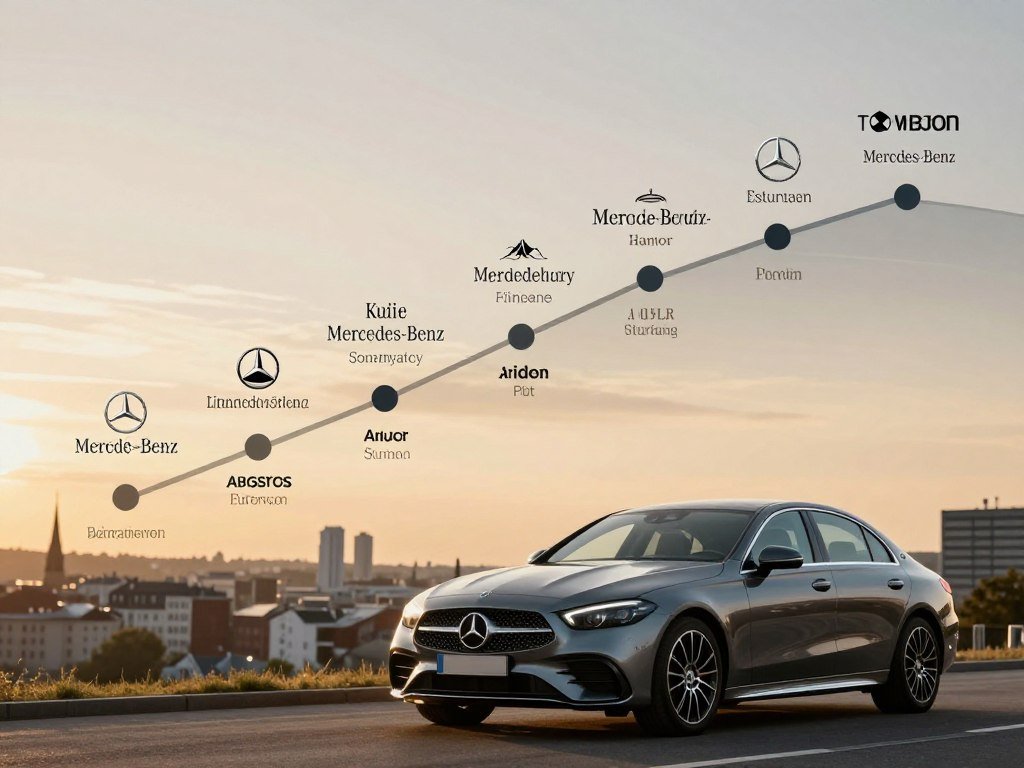
Daimler-Benz AG was the name from 1926 to 1998. The company became DaimlerChrysler AG in 1998, then Daimler AG in 2007.
The 2022 name change and truck separation
In February 2022, Daimler AG adopted the Mercedes-Benz Group AG name after the commercial vehicle spin-off. Daimler Truck became a separate company.
The split gave the two businesses distinct corporate identities. Mercedes-Benz Group AG now covers the car and van operating company, Mercedes-Benz AG, while Daimler Truck operates separately.
The phrase Daimler Truck Holding can refer to the truck business’s holding structure, but it does not make that business part of the current car group.
The 2022 change made the company name match its best-known passenger-car marque, while Daimler Truck became a separate listed business.
Which Companies Created the Foundation for Mercedes-Benz?
The modern group’s roots lie in two German companies, Benz & Cie. and Daimler Motoren Gesellschaft. Carl Benz and Gottlieb Daimler built separate automotive businesses before those firms joined. Their work helped shape early automotive engineering.
The founders’ companies merged in 1926, creating Daimler-Benz. The founder’s names connect to today’s history, but they did not personally own the modern listed company.
Carl Benz and Benz & Cie.
| Company | Founded | Key founder or founders |
|---|---|---|
| Benz & Cie. | 1883 | Carl Benz |
| Daimler Motoren Gesellschaft | 1890 | Gottlieb Daimler and Wilhelm Maybach |
| Daimler-Benz | 1926 | Merged successor to both predecessors |
Benz & Cie. was founded by Carl Benz in 1883. Its work focused on automotive engineering and early motor vehicles.
The company’s corporate history traces the two predecessor firms and their later merger. The Mercedes-Benz corporate history also records the separate paths of the early businesses.
Gottlieb Daimler, Wilhelm Maybach and DMG
Daimler Motoren Gesellschaft, often shortened to DMG, was founded in 1890 by Gottlieb Daimler and Wilhelm Maybach. Its engineers pursued automotive technology through their own business.
The two firms developed separately, with different founders and company structures. Their shared interest in cars did not mean one company owned the other before their merger.
Daimler-Benz formed in 1926 as the merged successor to both predecessors. Their 1926 merger joined the companies, not the two founders’ personal ownership in a company that still exists unchanged.
What Was Carl Benz’s Patent-Motorwagen?
Carl Benz’s Patent-Motorwagen was an early practical automobile powered by an internal combustion engine. It used an engine that burned fuel inside the engine to create motion. That design helped set the car apart from horse-drawn travel.
Development, patent filing, and production happened across different years. The patent date marks a legal step, not the first day the vehicle existed.
The early vehicle and its patent
Benz developed the Patent-Motorwagen between 1884 and 1887. He filed the patent application on January 29, 1886.
The vehicle’s internal combustion engine made it a self-powered automobile. The technology linked the engine, fuel and vehicle design in a working machine.
From prototype to production
Benz & Cie. built the Patent-Motorwagen from 1885 to 1893. Its production range overlapped both development and the patent process.
The patent filing is one clear date in a longer story. A prototype can take shape before a patent application, and production can continue afterward.
- 1884-1887: Carl Benz developed the Patent-Motorwagen.
- January 29, 1886: Benz filed its patent application.
- 1885-1893: Benz & Cie. built the vehicle.
- Benz & Cie.: the company that produced it.
These milestones show how invention, legal protection and building cars are separate parts of automotive history. The patent date does not prove the vehicle first appeared that day.
Keep the patent date separate from the longer development and production periods when telling this history.
Where Did the Mercedes Name Come From?
Mercedes began as a personal name, not the name of either founding engineer. It is a Spanish female name meaning “mercies.” The car name honored Mercédès Jellinek.
Daimler-Motoren-Gesellschaft began using Mercedes for a car line in 1901. The Mercedes 35 hp model was part of that first naming step.
Mercédès was the daughter of Emil Jellinek, who had ties to the Daimler business. The name was not the surname of Carl Benz or Gottlieb Daimler.
The Mercedes 35 hp helped establish the name as a car brand. A model name and a protected trademark are related, but they are not the same event.
Daimler-Motoren-Gesellschaft registered Mercedes as a trademark in 1902. That registration came after the company had begun using the name for cars.
The distinction matters because company names, model names and trademarks have different roles. A model can introduce a name before the firm registers it as a trademark.
The 1901 model and 1902 trademark mark separate steps in the name’s history.
How Did Mercedes and Benz Become One Brand?
Mercedes was already the name of a Daimler car line before it joined Benz in a company name. The two businesses first agreed to work together, then formally merged. The dates mark two separate steps.
The companies signed an Agreement of Mutual Interest on May 1, 1924, then merged on June 28, 1926. The first date did not itself create the merged company.
Daimler Motoren Gesellschaft had already used Mercedes for its cars. Benz & Cie. brought the Benz name and its own engineering history into the combination.
The formal merger created Daimler-Benz AG. The merged company used Mercedes-Benz for its automobiles, joining both names in one marque.
The deal brought two German companies under one corporate structure. Before the merger, their cars and businesses had developed along separate paths.
The 1924 agreement showed cooperation, while the 1926 merger brought the companies together. That distinction helps explain why the brand’s history and the company’s legal history do not begin on the same date.
The 1926 merger combined the two businesses and gave their cars the shared Mercedes-Benz name.
Which Brands and Automotive Businesses Sit Under the Group?
Mercedes-Benz Group AG’s brand portfolio includes five named marques, while some manufacturing and motorsports interests are structured separately. Not every connection is a wholly owned company.
Mercedes-Benz, Mercedes-EQ, Mercedes-Maybach, Mercedes-AMG and Smart are listed among the group’s brands. A brand name is not the same thing as an operating company or joint venture.
The group’s vehicle marques
- Mercedes-Benz
- Mercedes-EQ
- Mercedes-Maybach
- Mercedes-AMG
- Smart
The group’s cars and vans serve different needs, from luxury vehicles to commercial transport. A Mercedes-Benz Sprinter 144, for example, is about 19.5 feet long and can serve as a camper-van chassis.
Joint ventures and other interests
Some businesses use shared ownership. Beijing Benz is a 49% subsidiary, while Fujian Benz is a 34% subsidiary.
Smart is a 50% joint venture, so it is not wholly owned by Mercedes-Benz Group AG. The group’s Mercedes-AMG Petronas Formula One Team interest is 33.3%.
That motorsports stake is an ownership interest, not another standalone group brand. The same distinction applies to partner companies that manufacture vehicles under a Mercedes-Benz marque.
In China, Beijing Benz and Fujian Benz show how a company can connect with the group without being fully owned by it. A joint venture can share ownership between separate partners.
The portfolio includes brands, subsidiaries and partnerships with different structures. Check the ownership percentage before describing a partner business as wholly owned.
Who Leads Mercedes-Benz Group AG Today?
Ola Källenius leads Mercedes-Benz Group AG as chairman of its Board of Management. That executive role makes him the group’s chief executive. His job is to lead company management.
Källenius has chaired the Board of Management since May 22, 2019. The Board of Management handles executive leadership and the company’s day-to-day direction.
The Board of Management is different from the Supervisory Board. Martin Brudermüller chairs the Supervisory Board, which has a supervisory role rather than running daily operations.
The title chairman board management refers to Källenius’s executive post. It does not mean he personally owns the group or all its brands.
The leadership structure keeps executive work distinct from oversight. A chief executive can lead the business without being its sole shareholder.
Källenius’s appointment runs until May 2029. That date is the stated end of his current term.
How Did Chrysler Affect Mercedes-Benz’s U.S. Ownership History?
The U.S. connection most relevant to Mercedes-Benz corporate ownership was the 1998 merger with Chrysler. Daimler-Benz and Chrysler combined to form DaimlerChrysler. The U.S. link was corporate, not a transfer of ownership to Chrysler today.
The 2007 sale separated Chrysler from Daimler, but Daimler kept a minority stake. The sale was completed on August 3, 2007.
The 1998 DaimlerChrysler merger
The merger joined a German automaker with a U.S. car company. The new DaimlerChrysler name reflected that combination of businesses.
The corporate connection later changed, as the two firms no longer operated as one company. Chrysler’s presence in the combined company did not mean it owned the Mercedes brand.
Chrysler’s 2007 separation
Daimler completed the sale of Chrysler on August 3, 2007. The transaction separated the U.S. company from Daimler’s main automotive business.
Daimler retained a 19.9% stake in the separated Chrysler company. That remaining interest was a minority shareholding, not full ownership.
The later separation also differs from the Daimler Truck split. Daimler Truck Holding and Mercedes-Benz Group AG are part of a different corporate story than Chrysler’s sale.
The Frankfurt Stock Exchange listing belongs to the current German group, not to the old DaimlerChrysler structure. Chrysler does not own Mercedes-Benz Group AG today.
Daimler’s remaining 19.9% interest was a minority stake in the separated Chrysler company, not ownership of the current Mercedes-Benz Group.
Who Owns an Individual Mercedes-Benz Vehicle in the United States?
The person or company that owns an individual Mercedes-Benz is identified through that vehicle’s title and financing arrangement. The vehicle owner is generally the person or business named on the title.
A corporate shareholding does not make an investor the vehicle owner of a customer’s car. BAIC Group, Li Shufu and Mercedes-Benz Group AG do not own a particular SUV simply because of their corporate ties.
With an outright purchase, the buyer generally holds the title. A financed purchase also names the buyer, though the lender usually records a lien until the loan is paid.
A lease works differently because the leasing company generally retains title. The person leasing the vehicle has use of it under the lease, but is not usually the title holder.
- Outright purchase: the buyer generally holds title.
- Financed purchase: the buyer generally holds title, with a lender lien.
- Lease: the leasing company generally retains title.
The answer to who owned a Benz SUV depends on that individual vehicle’s title and arrangement. The title holder owns that vehicle, not the investors in its manufacturer.
National theft numbers describe risk across all vehicles, not the theft rank of one Mercedes model.
The United States recorded 659,880 vehicle thefts in 2025, a 23% decline from 2024. One vehicle was stolen every 48 seconds that year.
Those national totals do not identify which Mercedes model was stolen most. Treat a national theft count as context for vehicle security, not as proof that a particular Mercedes model leads thefts.
Conclusion
The clearest answer is that Mercedes-Benz Group AG owns the Mercedes-Benz brand, while investors own shares in the group. A customer’s individual vehicle has its own title holder, separate from the corporate parent and its shareholders.
For a specific vehicle, check its title and loan or lease agreement to confirm who holds ownership.
FAQ
Who actually owns Mercedes?
Mercedes-Benz Group AG owns the Mercedes-Benz brand, and multiple shareholders own interests in the listed company. Its major named investors include BAIC Group, Li Shufu through Tenaciou3 Prospect Investment Limited, and the Kuwait Investment Authority. Those investors hold shares in the corporate parent, not ownership of every car wearing its badge. A vehicle’s title names the owner of that individual car.
Which car companies are owned by Mercedes-Benz?
Mercedes-Benz Group AG has operating companies, subsidiaries and joint ventures, each with its own ownership structure. Beijing Benz is a 49% subsidiary, and Fujian Benz is a 34% subsidiary. Smart is a 50% joint venture, so it is shared rather than wholly owned by the group. These examples show why a brand, a subsidiary and a partner company should not be treated as the same thing.
What was the first car company in the world?
Benz & Cie., founded by Carl Benz in 1883, is widely regarded as the oldest car company. That company-history claim is separate from the date of the Patent-Motorwagen patent application. Benz filed that application on January 29, 1886, after developing the vehicle over several years. A patent date marks a legal step, not necessarily the first day a car existed.
What is the meaning and origin of the name Mercedes?
Mercedes is a Spanish female name meaning “mercies.” The car name honored Mercédès Jellinek, and Daimler-Motoren-Gesellschaft used it for the Mercedes 35 hp in 1901. The company registered Mercedes as a trademark in 1902. So the name came from a person honored by a car line, not from either founding engineer’s surname.
Who is the CEO of Mercedes-Benz?
Ola Källenius is the chief executive of Mercedes-Benz Group AG as chairman of its Board of Management. He has held that role since May 22, 2019, and his appointment runs until May 2029. Martin Brudermüller chairs the Supervisory Board, a separate body with an oversight role. The Board of Management leads the company’s executive work.