The Rolls-Royce name belongs to two separate businesses today, so the answer depends on whether you mean the luxury automaker or the aerospace company. That distinction matters when news, sales information, or company records use the same famous name. One business makes luxury motor cars; the other works in aerospace and defense. They do not share one owner simply because they share a name. This article explains how the businesses differ and where the carmaker fits in the world’s auto industry. Identifying which business someone means is the first step to getting the ownership answer right.
Key Takeaways
- BMW AG owns Rolls-Royce Motor Cars Limited outright.
- Rolls-Royce Holdings plc is a separate, publicly traded company.
- The carmaker is based in West Sussex, England.
- Volkswagen Group owns Bentley Motors, not BMW AG.
- The full company name helps show which business a story means.
Who Owns the Rolls Royce Company?
BMW AG, a German automotive group, owns Rolls-Royce Motor Cars Limited outright. The company is the exclusive maker of Rolls-Royce-badged motor cars, and its sole parent is BMW AG.
A wholly owned subsidiary is a company whose parent owns all of its shares. In this case, the subsidiary BMW controls is the carmaker, not every business that uses the Rolls-Royce name. BMW AG has owned Rolls-Royce Motor Cars as a wholly owned subsidiary since 2003.
BMW AG owns the carmaker, not the separate aerospace company that shares its name.
That ownership answers the question, “Rolls-Royce owned by which country?” at the corporate level: BMW AG is German. The cars themselves come from a company headquartered in West Sussex, England.
The difference between corporate nationality and the place of production can be easy to miss. A parent company can own a British carmaker without moving its headquarters or car production to Germany.
Rolls-Royce Motor Cars Limited builds the cars under its own company name and carries out its work in England. BMW AG provides the parent-company link, while the carmaker remains a distinct legal company.
The name also appears on aircraft engines and other products, but those do not come from this automaker. The company’s car-making role is specific: it makes Rolls-Royce-branded automobiles, not aircraft engines or defense systems.
A reader checking an ownership record should look for the full legal name. “Rolls-Royce” alone may refer to either the carmaker or the publicly traded aerospace business.
The crucial distinction is that BMW owns the carmaker, not the separate aerospace company that shares the Rolls-Royce name.
How Did BMW Get the Rolls-Royce Name?
The ownership story turns on a split between the right to use the Rolls-Royce name on cars and the separate aerospace business. The automotive trademark rights and the aircraft-engine business did not move together.
BMW AG secured the right to use the automotive name and logo through an agreement with Rolls-Royce Holdings plc. That agreement set the stage for BMW’s own car company to begin production under the name.
The key change came in 2003, when BMW’s carmaker began making Rolls-Royce-badged vehicles. The years before that start explain why older cars and today’s models can have different corporate histories.
- In 1998, BMW AG established Rolls-Royce Motor Cars Limited as a subsidiary.
- Rolls-Royce Holdings licensed the automotive name and logo to BMW AG for £40 million, or $66 million.
- In 2003, BMW’s carmaker began making vehicles under the Rolls-Royce name.
- Today, Rolls-Royce Motor Cars is the exclusive manufacturer of Rolls-Royce-badged cars.
The list separates two things that can sound like one deal: running a car company and holding the rights to a car brand. BMW built the current automaker, while the aerospace company licensed the automotive name and logo.
The distinction matters for company records, news reports, and questions about who makes a particular car. A Rolls-Royce-badged vehicle built before 2003 belongs to an earlier period of the marque’s history.
The early BMW company could exist before it began building cars under that name. Establishing the subsidiary in 1998 did not mean that BMW’s production began that year.
That timeline also explains why a search for Rolls-Royce components or car production may lead to records from different firms. The name connects those records, but the legal business behind them changed.
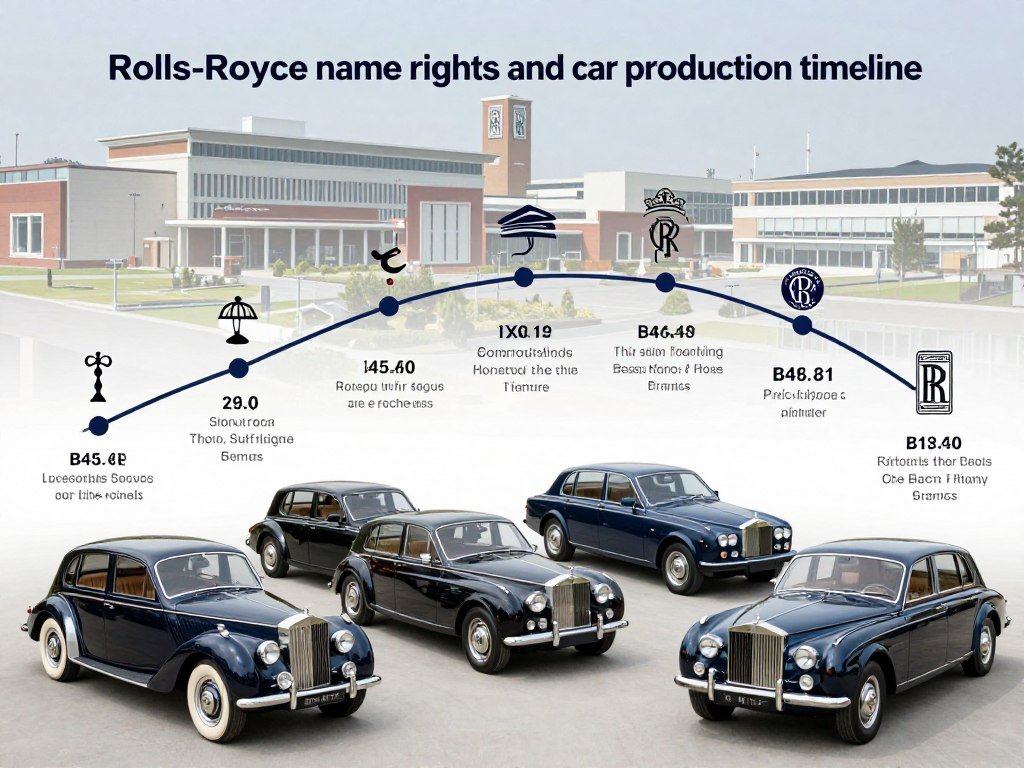
The 2003 start of BMW’s own production is the clearest dividing line between the present-day carmaker and earlier Rolls-Royce-badged vehicles.
What Does Rolls-Royce Holdings Make?
Rolls-Royce Holdings plc is a publicly traded British aerospace and power-systems company, not the BMW-owned carmaker. Its formal name is Rolls-Royce Holdings plc, though people often call it Rolls-Royce plc. Its work is industrial, not luxury car production.
Rolls-Royce Holdings has three divisions: Civil Aerospace, Defence, and Power Systems. Its shares trade on the London Stock Exchange as RR, and no single owner holds a majority of the company.
In this context, Rolls-Royce products and services mean aerospace, defense, and power-system offerings. They do not mean the luxury cars made by BMW’s subsidiary.
Civil Aerospace and Power Systems
Civil Aerospace handles aircraft-engine work for commercial aviation. That work can include developing and making engines, then supporting them while airlines operate their aircraft.
Power Systems is a separate division, with products used for power generation and other industrial needs. Together, these operations show why a story about Rolls-Royce engines may concern aircraft or power equipment rather than a motor car.
The company’s three business areas serve different markets:
- Civil Aerospace: aircraft engines and related support.
- Defence: military, naval, and submarine power systems.
- Power Systems: engines and equipment for power needs.
For a closer look at public companies and share prices, readers can also review an explanation of how share prices work. A stock-market listing identifies who can trade shares; it does not make the company part of a carmaker.
Defence work beyond aircraft engines
Defence includes military aero engines, but its work reaches beyond aircraft. The division also makes naval engines and nuclear power plants for submarines.
Its services continue after equipment enters use. Aftermarket support helps military and naval customers maintain engines and other systems over time.
Those offerings can include work on aircraft, ships, and submarine power plants. A public-company ownership record helps distinguish this business from a privately owned car subsidiary.
The word “Rolls-Royce” on an aircraft-engine or defense story does not mean the story concerns a luxury car.
How Large Is Rolls-Royce Holdings Financially?
Rolls-Royce Holdings reported £20,059 million in underlying revenue and £3,462 million in underlying operating profit for 2025. These figures measure the aerospace company, not Rolls-Royce Motor Cars. Revenue and profit describe different parts of its finances.
Revenue records income from sales and services. Operating profit measures what remains from operations after related costs, before other items affect the final result.
Its 2025 underlying operating margin was 17.3%, with £3,270 million in free cash flow. The table gives both revenue measures because underlying and statutory revenue use different reporting bases.
2025 revenue and operating performance
| Measure | 2025 result | Basis |
|---|---|---|
| Revenue | £20,059 million | Underlying |
| Revenue | £21,207 million | Statutory |
| Underlying operating profit | £3,462 million | Underlying |
| Underlying operating margin | 17.3% | Underlying |
| Free cash flow | £3,270 million | Underlying |
At December 31, 2025, Rolls-Royce Holdings reported net cash of £1,895 million. Its underlying operating margins varied by division: Civil Aerospace reached 20.5%, Defence reached 14.4%, and Power Systems reached 17.4%.
The company’s 2025 annual report sets out these results and the way its divisions report performance. An underlying figure and a statutory figure should not be treated as interchangeable.
A person asking about Rolls-Royce net worth may mean the company’s market capitalization. Market capitalization is the share price multiplied by the number of shares, so it changes as the share price moves.
It is not a personal net-worth figure or the value of BMW’s car subsidiary. Rolls-Royce Holdings had an intraday market capitalization of 101.63B on October 30, 2026.
That number is a stock-market valuation at a particular time, not the company’s revenue or cash balance. Readers comparing figures should check which measure and date a report uses.
2026 guidance and shareholder returns
For 2026, Rolls-Royce Holdings projected underlying operating profit of £4.0 billion to £4.2 billion. Its free-cash-flow guidance was £3.6 billion to £3.8 billion.
The company also announced a £7 billion to £9 billion share buyback for 2026 through 2028. It planned to complete £2.5 billion of that program in 2026.
A share buyback uses company funds to repurchase its own shares. The planned schedule is separate from a dividend and from the company’s reported cash position.
Readers comparing this company with private firms can learn how a private valuation differs from a public share price in this OpenAI valuation overview. A public market value shifts with trading, while private valuations come from other measures.
The 2025 reported financial results describe what the company achieved, while the 2026 figures describe a future target.
Its 2026 guidance is a projection, while the 2025 figures are reported results.
Who Owns Bentley, and How Is It Linked to Rolls-Royce?
Volkswagen Group owns Bentley Motors, while BMW AG owns Rolls-Royce Motor Cars. The two luxury brands have a shared history, but they now belong to different corporate parents.
Volkswagen Group has owned Bentley Motors since 1998. Since 2022, Bentley has been consolidated under Audi, Volkswagen’s premium brand arm. Audi’s role does not make BMW the owner of Bentley.
That distinction answers who owns Rolls-Royce and Bentley today: BMW AG owns the carmaker, while Volkswagen Group owns Bentley Motors. Their present-day ownership paths are separate.
The Rolls-Royce and Bentley names often appear together because both have long histories in British luxury motoring. Their connection includes earlier periods when the marques sat within related corporate structures.
A shared past does not mean one current company makes both brands’ cars. Bentley Motors and Rolls-Royce Motor Cars operate as separate businesses under separate parent groups.
That history can make the phrase “Rolls-Royce Bentley” sound like one company or one brand. It is better understood as a reference to two marques with a past connection, not a single automaker.
Readers comparing the companies should use their current legal names, rather than relying on old group ties or familiar pairings in car history. Volkswagen Group’s account of Bentley’s history traces the marque’s earlier links and later ownership changes.
The companies also serve luxury car buyers with distinct designs and product ranges. Their shared history does not erase those differences or change who owns them now.
Treat the two luxury marques as separately owned companies when comparing their present-day corporate parents.
Who Founded Rolls-Royce, and What Came Before BMW?
Henry Royce and Charles Rolls founded the partnership behind the original Rolls-Royce marque. Royce built the cars, and Rolls agreed to sell them. Their partnership came first, decades before BMW’s present-day car company.
The original company’s history helps explain why the name reaches back much further than BMW’s ownership. It does not change which company owns the modern carmaker.
Henry Royce’s engineering work
Henry Royce was an engineer who built a 10hp car in 1904. His work formed the starting point for the cars that later carried the Rolls-Royce name.
The 10hp car was an early product, not a model from the current range. Royce’s role centered on design and engineering, with close attention to quality and how a car performed.
His work gave the partnership a car to sell. The name that followed became known for motor cars, but its early story belongs to a different company structure.
Charles Rolls and the early company
Charles Rolls and Henry Royce met on May 4, 1904. They agreed that Rolls would sell the cars Royce built.
Rolls-Royce Limited was registered on March 15, 1906. The name of the car-making company later changed, but its early years belong to the founders’ original business.
Rolls-Royce Limited made cars from 1906 to 1973. Rolls-Royce Motors made them from 1973 to 2003, before BMW’s present-day operation began production under the name.
Those dates mark three distinct stages in the marque’s car history. They prevent the founders’ company from being confused with the modern company that BMW owns.
The early partnership answers who founded Rolls-Royce, while a current ownership question needs the newer company name. The founders’ story is historical, not a statement about today’s parent company.
That distinction also matters when older company names appear in records or car histories. The legal identity and the name on the vehicle may point to different periods.
The founders’ company history reaches back to 1904, but BMW’s Rolls-Royce Motor Cars began making cars under the name in 2003.
What Does Rolls-Royce Motor Cars Make Today?
Rolls-Royce Motor Cars makes four current models at its Goodwood headquarters in West Sussex. The site combines production and administrative work on a 42-acre property. Its cars are built in England.
The automaker began in March 1998 and had about 2,500 employees in 2026. Its Goodwood site covers 42 acres, or 17 hectares. The current lineup includes four vehicles, from an electric coupe to a large SUV.
The company delivered about 5,660 automobiles worldwide in 2025. The United States made up about 30 percent of sales, and China was its second-largest market.
Goodwood headquarters and production
Goodwood sits in West Sussex, England, and serves as the company’s production and administrative headquarters. The 42-acre site gives staff space for both office work and car assembly.
Production at Goodwood is tied to the current automaker, not to Rolls-Royce Holdings’ aircraft-engine business. That difference helps when “Rolls-Royce production” appears in a report without a clear company name.
The scale of the operation is also distinct from the number of cars delivered. About 2,500 people worked for the carmaker in 2026, while deliveries reached about 5,660 automobiles worldwide in 2025.
Four current models and their buyers
The four models cover different body styles and power choices. The Spectre is the first all-electric Rolls-Royce car, while the Cullinan is an SUV.
- Spectre: the first all-electric model, with a coupe body.
- Phantom: a large saloon built for formal travel.
- Ghost: a saloon with a more understated profile.
- Cullinan: the brand’s SUV.
A buyer interested in electric cars may also enjoy this update on the Tesla Roadster reveal. The Spectre gives Rolls-Royce Motor Cars an electric option within its own model range.
Available buyer data offers a narrow view of who buys these cars. The reported average customer age in the United States and worldwide was 43 in 2021.
A 2021 comparison by IHS Markit found a higher share of Rolls-Royce buyers under 45 than buyers of Mercedes-Benz, Audi, Lexus, or Lamborghini. That comparison describes age groups, not tastes or income for each person.
Those measures challenge the idea that every buyer fits one age stereotype. Sales also differ by market, and no single average can describe each owner’s reason for choosing a model.
A reported average age describes a customer group, not the age or priorities of any individual buyer.
What Do Rolls-Royce Cars Cost?
The listed 2026 MSRPs range from $355,000 for a Ghost to about $550,000 for a Phantom EWB. These prices refer to Rolls-Royce Motor Cars, not its aerospace namesake. Model and version matter when comparing the listed amounts.
The table gives base reference points for four model families. It does not list every longer-wheelbase or Black Badge version. A buyer’s final specification can change the price.
The figures below are approximate MSRPs, not a quote for a specific build. Personal choices and a car’s final configuration can move the cost beyond the starting figure.
| Model | 2026 price description | Approximate MSRP |
|---|---|---|
| Spectre | Starting MSRP | $420,000 |
| Phantom | Approximate MSRP | $460,000 |
| Cullinan | Starting MSRP | $441,250 |
| Ghost | MSRP | $355,000 |
The Phantom EWB is the highest priced listed version in these 2026 examples, at about $550,000.
The Phantom EWB price is about $550,000. The Ghost EWB is $400,000, and the Black Badge Ghost is $442,000.
Those versions show why a single model name may not point to one price. EWB identifies an extended-wheelbase version, while Black Badge names a distinct Ghost variant.
Rolls-Royce cars can also be ordered with a range of personal choices. A buyer’s specification changes the final price, so a base MSRP does not set the cost of every car.
For a useful comparison, keep the exact model and version beside its price. A Phantom and Phantom EWB are related models, but the listed amounts differ by about $90,000.
The same care applies when a dealer lists a starting figure. It may describe the entry point for a model family, not the car shown with added features.
Compare the exact model and version, then confirm the specification-specific price with an authorized dealer.
Conclusion
The simplest way to keep the ownership straight is to separate the carmaker from the aerospace company. BMW AG owns Rolls-Royce Motor Cars, while Rolls-Royce Holdings is a separate, publicly traded aerospace and defense company.
The full legal name matters more than the shared brand name. That small check can prevent a stock-market story from being mistaken for a luxury car company update.
When reading company news or comparing ownership, check the name in the headline, report, or business record. Check whether a document names Rolls-Royce Motor Cars Limited or Rolls-Royce Holdings plc before drawing conclusions about ownership.
FAQ
Who owns Rolls-Royce?
BMW AG owns Rolls-Royce Motor Cars Limited, while Rolls-Royce Holdings is a separate publicly traded company. BMW’s ownership covers the luxury carmaker, not the aerospace and defense business. The carmaker is based in England, even though its parent company is German. Checking the full legal name helps show which company a report means.
What type of person buys a Rolls-Royce?
There is no single type of Rolls-Royce buyer, though the reported average customer age was 43 in 2021. That average applied to customers in the United States and worldwide. A separate comparison found a higher share of buyers under 45 than several other luxury brands. A group average cannot describe one person’s age, income, or reason for buying a car.
What is the most expensive Rolls-Royce?
Among the listed 2026 MSRPs here, the Phantom EWB is the most expensive at about $550,000. That figure describes a listed version, not every possible car. Personal specifications can change the final price, and a bespoke build may differ from standard examples. The Ghost EWB and Black Badge Ghost have lower listed prices of $400,000 and $442,000.
Who founded Rolls-Royce?
Henry Royce and Charles Rolls formed the founding partnership after meeting on May 4, 1904. Royce built a 10hp car that year, and Rolls agreed to sell the cars Royce made. Rolls-Royce Limited was registered in 1906. That early partnership explains the marque’s start, while BMW’s present-day car company began making cars under the name in 2003.
Does BMW own Rolls-Royce Holdings?
No, BMW does not own Rolls-Royce Holdings plc. BMW AG owns Rolls-Royce Motor Cars Limited, the luxury automaker. Rolls-Royce Holdings is a separate publicly traded aerospace and defense company whose shares trade in London under RR. The two businesses share a name, but one is not the parent of the other.
Who owns Bentley?
Volkswagen Group has owned Bentley Motors since 1998. Since 2022, Bentley has been consolidated under Audi, Volkswagen’s premium brand arm. BMW does not own Bentley, and Volkswagen Group does not own Rolls-Royce Motor Cars. Their shared history can cause confusion, but the current parent companies are separate.



