
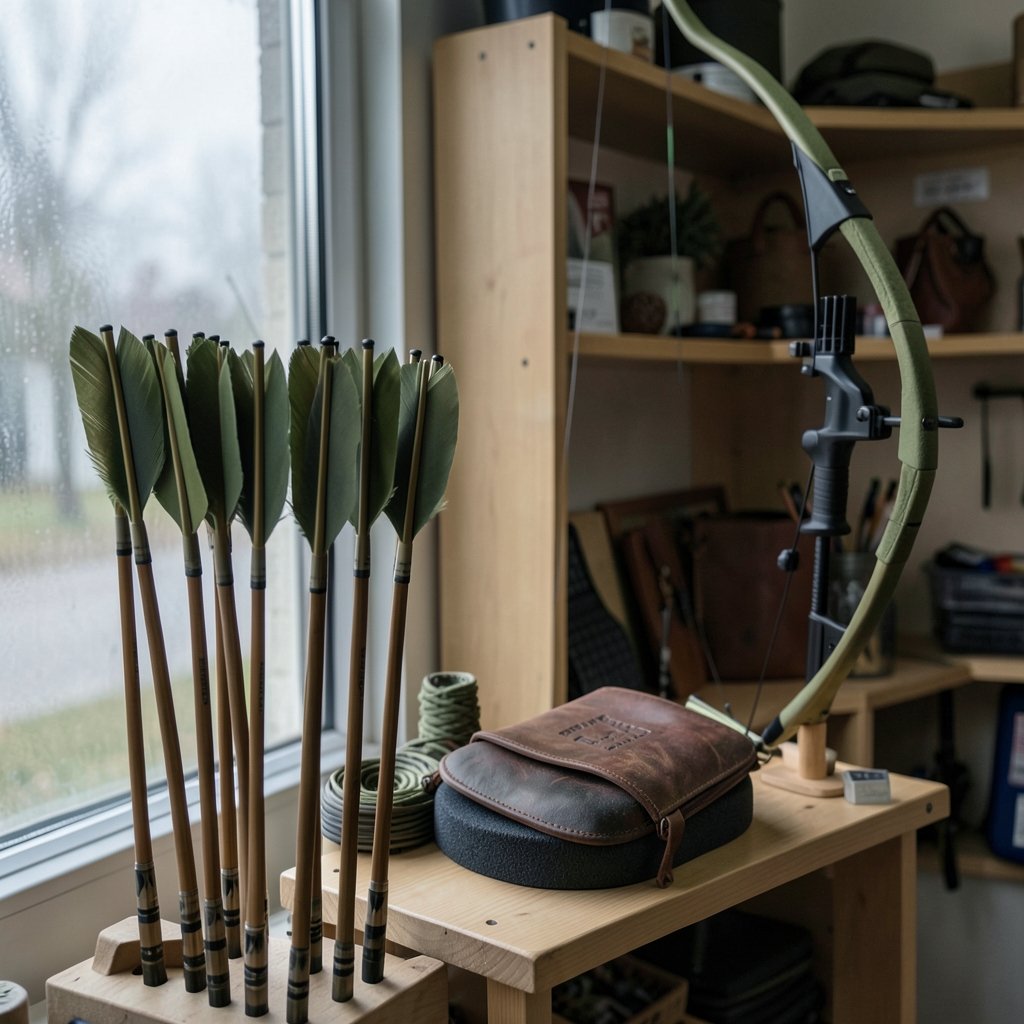
What do you call the thing you shoot at, the thing you shoot, and the group of arrows you shoot before walking to pull them? If three archers answer that question, you may get three different words. That is the practical problem behind “archery talk.” The phrase describes no single dictionary term. It covers the private vocabulary of a niche sport, the busy forums where that vocabulary gets argued over, and the podcasts and videos that have pushed archery slang into everyday speech. Understanding it saves newcomers months of confusion and helps experienced archers explain themselves to the outside world.
What “Archery Talk” Actually Refers To
The phrase splits into two main uses, and mixing them up causes real confusion.
The first is generic. Archery talk means the words archers use among themselves: spine, nock, end, boss, clicker, let-off. This is trade language, not formal English. No dictionary or standards body fixes it as a term, and it shifts by region and discipline.
The second is a proper noun. Archery Talk is the name of one of the largest online archery forums, a community where bowhunters, target shooters, and tuners swap advice. When you see the phrase capitalized or written as a web address, it likely points to that community rather than to vocabulary.
A third, newer layer is spoken media. Podcasts and video channels have popularized conversational archery talk since roughly the 2010s, covering bow tuning, shooting form, and hunting setups. That spoken style borrows from both the jargon and the forum culture.
Why the Vocabulary Is Harder Than It Looks

Most hobbies have jargon. Archery’s is unusually slippery for three reasons.
First, the sport has several governing bodies and regions, and each codifies terms slightly differently. The international federation, World Archery (once called FITA), publishes the official rulebook that defines core competition terms. National bodies such as USA Archery and Archery GB add their own coaching language and local usage. The rules get revised regularly, so any definition should name the edition it comes from.
Second, target archery and bowhunting use different word sets. A competitive target archer may never say “let-off” in a match context, while a bowhunter uses it constantly. Media aimed at hunters leans on terms like brace height and peep sight that a pure target shooter might not use at all.
Third, general dictionaries often skip archery-specific senses entirely. Look up “boss” in a standard dictionary and you will find employers, not target backings. That gap is exactly why newcomers get lost.
The Core Terms, Translated
Here is a working glossary of the words that come up most in archery talk. Treat it as a starting map, not a rulebook.
| Term | What it means | Where you hear it |
|---|---|---|
| Spine | How stiff an arrow shaft is; matched to bow weight | Everywhere, especially tuning talk |
| Nock | The slotted end of an arrow, or the act of setting an arrow on the string | Target and hunting |
| End | A group of arrows shot in one round, often 3 or 6 | Competition scoring |
| Round | A fixed course made up of several ends | Competition scoring |
| Boss | The target backing that stops arrows (common in the UK) | British and club shooting |
| Target face | The printed scoring face on the target | US and international |
| Clicker | A spring device that clicks when the arrow is drawn to the right length | Recurve target shooting |
| Let-off | The reduction in holding weight at full draw on a compound bow | Bowhunting and compound talk |
A few of these deserve extra attention because they cause the most friction.
Spine is the term that trips up beginners hardest. It measures an arrow shaft’s stiffness, and archers match spine to bow weight using manufacturer charts rather than a general dictionary. Shoot an arrow that is too weak or too stiff for your bow and accuracy suffers in ways that are hard to diagnose. This is why spine dominates tuning conversations.
End and round are straightforward once explained but baffling in context. An end is a small cluster of arrows, commonly three or six. A round is the whole fixed course of ends. When a competitor says “I shot a 720 round,” they mean a specific competition format, not a casual afternoon.
Boss versus target face is the regional split worth memorizing. UK archers talk about the boss, meaning the backing that stops the arrows. US and international shooters talk about the target face, meaning the printed scoring surface. Both are correct; they describe different parts of the same setup.
Clout, Flight, and Field: Disciplines With Their Own Dialects
Archery is not one sport. It is a family of disciplines, and each has its own vocabulary.
Clout shooting involves lobbing arrows at long distance toward a ground marker, with scoring based on proximity to that marker rather than a vertical target. Flight archery is about pure distance: how far can an arrow fly? Field archery takes place on uneven terrain with targets set at varying distances, closer to a hike than a range session.
These disciplines are historical and well established, and each carries terms that rarely appear in the others. An archer fluent in target talk may be lost at a clout shoot, and vice versa. If you are reading archery content and a word makes no sense, check which discipline the writer shoots before assuming you have missed something basic.
Where the Talk Happens: Forums, Podcasts, and Video
Community is a huge part of archery talk. The largest hub is the Archery Talk forum, a long-running discussion board where members debate equipment, tuning, hunting tactics, and form. It functions as both a knowledge base and a social club, and its archive is deep enough that a specific question often has an answer from years ago.
Beyond forums, podcasts and video channels have made archery talk more conversational. Hosts explain tuning and form in plain speech rather than rulebook language, which has pulled new people into the sport. The trade-off is accuracy: spoken archery talk is informal and sometimes contradicts the official rulebook, so cross-check competition-specific claims against a governing body’s current rules.
The same pattern shows up in other enthusiast communities, where rumor and speculation travel faster than confirmed fact. Anyone who has watched gaming or business chatter spiral knows the feeling; the same dynamic that drives breathless Valheim 1.0 PS5 and Switch 2 launch speculation shapes how archery gear rumors spread online. The lesson transfers: separate what a community repeats from what a source actually states.
Practical Tips for Decoding Archery Talk
Newcomers make the same handful of mistakes. Here is what actually helps.
- Start with a governing body glossary, not a general dictionary. World Archery’s rulebook and national bodies like USA Archery and Archery GB define competition terms properly. General dictionaries usually lack archery senses entirely.
- Ask which discipline the speaker shoots. Target, field, clout, flight, and bowhunting vocabularies overlap but do not match. A term that confuses you may simply belong to another branch.
- Note the region. Boss versus target face is the clearest example, but grip, stance, and equipment names also vary between UK and US usage.
- Check the rulebook edition. Rules are revised regularly. A definition from an old forum post may be out of date.
- Treat forum advice as peer knowledge, not gospel. Community tuning tips are often excellent and occasionally wrong. Verify safety-critical and competition-critical claims against official sources.
- Learn spine charts early. Matching arrow spine to bow weight is the single most useful piece of equipment literacy a new archer can build.
A common mistake is assuming there is one correct word for everything. There is not. Another is dismissing forum talk as noise. In practice, the community layer is where a lot of practical, field-tested knowledge lives, and the official layer is where definitions and rules live. Use both.
The Same Pattern in Other Communities
Archery talk is a case study in how specialist language works online. Enthusiasts build shared vocabulary, communities argue over it, and media popularizes it. The pattern repeats across hobbies and industries.
Consider how corporate and financial chatter gets dissected in public. When a major studio faces uncertainty, fans and analysts build their own vocabulary around it, much like archers do; the discussion around BioWare closure talk and what EA economy veterans signal shows the same mix of insider terms and outside speculation. Money advice works the same way, which is why plain talk beating finance jargon resonates with readers who are tired of decoding. Even high-stakes business rumors follow the pattern, as with the Tesla and SpaceX merger talk surrounding Musk’s fortune claims. The takeaway for archery readers is simple: every niche has its dialect, and the fastest way in is to learn the core terms and then ask questions in the community.
How to Talk Archery Without Sounding Lost
If you want to hold your own in archery conversation, a few habits go a long way.
Use the right word for the right part. Say target face when you mean the printed scoring surface and boss when you mean the backing, and you will immediately sound more experienced in mixed company.
Describe spine in terms of match, not quality. A stiff arrow is not better than a flexible one; it is better matched or worse matched to a given bow. That framing is how experienced archers actually think.
Ask about discipline before offering advice. Telling a clout shooter about your target-range routine is a fast way to confuse everyone.
And when you cite a rule, name the source and edition. “According to the current World Archery rulebook” carries more weight than “someone on a forum said.” That single habit separates reliable archery talk from rumor.
Conclusion
Archery talk is two things at once: a living vocabulary shared by a niche sport and the name of a community where that vocabulary gets hammered out. Neither is fixed. Terms shift by region, discipline, and era, and the official rulebooks are revised on a rolling basis. The practical path through it is straightforward. Learn the core terms, note which discipline and region they come from, lean on governing-body glossaries for definitions, and treat community advice as valuable peer knowledge that still deserves a check. Do that, and the jargon stops being a wall and becomes what it was always meant to be: a shared language for people who love sending arrows downrange.
What does “archery talk” mean?
It has two main uses. Generically, it means the vocabulary and jargon archers use among themselves, such as spine, nock, end, and boss. As a proper noun, it refers to Archery Talk, one of the largest online archery forums. Context usually makes clear which one is meant.
What is arrow spine in archery talk?
Spine measures how stiff an arrow shaft is. Archers match spine to their bow’s weight using manufacturer charts, and a poor match hurts accuracy in ways that are hard to diagnose. It is one of the most frequently discussed terms in tuning conversations.
What is the difference between an end and a round?
An end is a group of arrows shot before archers collect them, commonly three or six. A round is a fixed course made up of several ends. Both are defined in competition rulebooks, so check the current edition if you are citing them officially.
Why do UK and US archers use different words for the target?
Regional usage differs. UK archers commonly say boss for the backing that stops arrows, while US and international shooters say target face for the printed scoring surface. Both terms are correct and describe related but distinct parts of the setup.
Are archery forums a reliable source?
They are useful but informal. Forums hold deep practical knowledge from experienced shooters, yet advice can be outdated, discipline-specific, or simply wrong. For competition rules and safety-critical details, verify against a governing body’s current rulebook.
Do I need to learn bowhunting terms if I only shoot targets?
Not strictly, but it helps. Target archery and bowhunting use different vocabularies, with hunting media leaning on terms like let-off, brace height, and peep sight. Knowing both makes it easier to follow mixed archery talk and to ask better questions in community discussions.



