AtlasBase DNA storage could change how humanity keeps its history. The South San Francisco startup has built a system that writes digital information into synthetic DNA, dries it, and seals it in small stainless steel cans filled with helium, where the company says it can last for centuries and beyond. It tackles one of the quietest problems in computing: the world generates more data than it can afford to keep, and the tapes and disks we store it on wear out, need power, and must be replaced every few years.
The system was described by Forbes contributor Thomas Coughlin, who visited AtlasBase in South San Francisco in November 2026 to talk with chief executive Jeff Treuhaft and chief technology officer Bill Banyai and tour the laboratories. Coughlin has covered synthetic DNA storage before, including startups such as IRIDIA, Biomemory and Twist Bioscience, and first wrote about AtlasBase, then a spinout from Twist, in late 2025.
The numbers are startling and need careful reading. AtlasBase says one chipset can write 250 gigabytes in 24 hours, a synthesis cycle can produce hundreds of gigabytes, and DNA can potentially hold hundreds of petabytes per gram. It says one cubic inch of DNA can store a petabyte, so a shelf of 100 steel cans could hold several petabytes. Those are company claims about an early system, not independently verified specifications, and writing and reading remain considerably slower than magnetic tape.
Key takeaways
- AtlasBase, a spinout from Twist Bioscience, stores digital data in synthetic DNA, described in Forbes after a November 2026 visit to its South San Francisco laboratories.
- The write process uses a chip built on 300mm silicon with millions of nano-scale electrochemical synthesis sites, developed with research centre imec in Belgium.
- The company says one chipset can write 250 gigabytes in 24 hours, and that DNA can potentially hold hundreds of petabytes per gram.
- Finished DNA is dried and sealed in small stainless steel cans filled with helium, with 100 cans fitting in a shell the size of an LTO tape cartridge.
- AtlasBase says its DNA storage can last indefinitely in dried form, versus tape replaced every 7 to 10 years, but writing and reading remain slower than tape.
At a glance: AtlasBase DNA storage
| Detail | What is reported |
|---|---|
| Company | AtlasBase, spun out of Twist Bioscience in 2025, based in South San Francisco |
| Leaders | Chief executive Jeff Treuhaft; founder and chief technology officer Bill Banyai |
| Write speed | 250 gigabytes per chipset in 24 hours, according to the company |
| Density claim | 1 petabyte in one cubic inch of DNA; potentially hundreds of petabytes per gram |
| Storage format | Dried DNA sealed in helium-filled stainless steel cans; 100 cans per LTO-sized shell |
| Durability claim | Indefinitely long in dried form, versus tape replaced every 7 to 10 years |
| Funding | 155 million dollars in seed financing in 2025 |
DNA storage, explained in plain language
DNA is the molecule that carries the instructions for building living things, written in an alphabet of four letters: A, C, G and T. DNA data storage turns that alphabet into a filing system. A digital file is a string of ones and zeros, and those binary digits can be translated into DNA letters, with every two binary digits becoming one letter. Machines then build short pieces of synthetic DNA that spell out the file, adding address labels so the pieces can be found again later.
To read the file back, the process runs in reverse. The DNA is put back into solution, a conventional DNA reader sequences it, and software decodes those letters into ones and zeros, rebuilding the original file. Nothing about the file itself is biological: the DNA is synthetic, made in a laboratory, and it never becomes part of a living organism.
How the AtlasBase system works
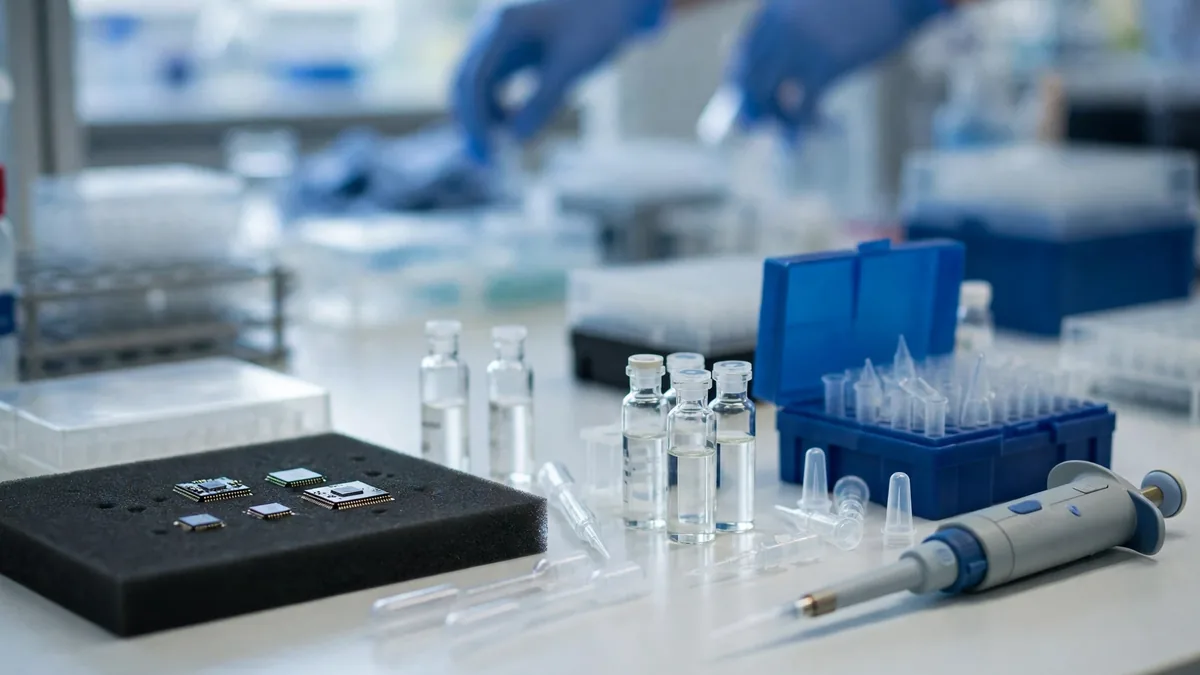
The write step is done using an application-specific chip design and a DNA synthesis platform built by AtlasBase. The company works with imec, an advanced research centre in Belgium, to build production-scale permanent DNA-based storage on 300mm silicon, with a dense array of nano-scale electrochemical cells on top of a control CMOS chip designed by AtlasBase. In plain terms, the chip is a silicon wafer covered in millions of tiny sites, each able to build DNA, controlled by the electronics underneath.
That parallelism is the whole idea. A single synthesis site working alone would take far too long, but millions of sites working together can scale DNA synthesis by orders of magnitude, creating hundreds of gigabytes per synthesis cycle. The device is matched with an enzyme fluid system that runs the synthesis operations, and the company says it can write 250 gigabytes per chipset in 24 hours. Multiple chips running in parallel could increase that rate further.
From a chip to a steel can
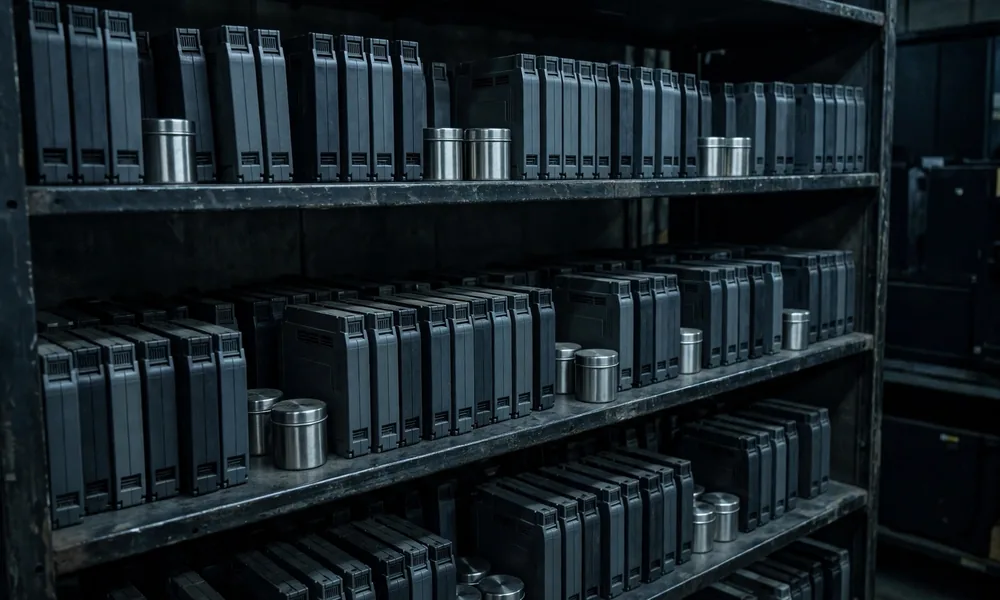
Once the DNA is synthesised, it is harvested from the device, dried, and hermetically sealed in small stainless steel cans filled with helium. The can is the archive: no power, no cooling, no moving parts, just dried DNA in an inert atmosphere. One hundred cans can be assembled in a small shelf that inserts into a shell the size of an LTO tape cartridge, the standard format used in tape libraries. The company says one cubic inch of DNA can store a petabyte, so a shelf of that size could hold several petabytes.
One caution: an investor page describes an Atlas Eon 100 product packing 60 petabytes into 60 cubic inches, while a separate industry account noted a capsule photograph supplied by the company showed 10 terabytes. That gap is unconfirmed, and the headline densities remain company claims, not a specification sheet for a shipping product.
Reading the data back, and why tape still wins on speed
To read the data, the dried DNA must be put back into solution and run through conventional DNA reading, decoding the base pairs to reconstruct the stored data. That is a laboratory process, slower than reading from tape, which is itself slower than reading from a disk. Coughlin is direct about this: the technology is intriguing for long-term retention, but writing and reading speeds are still considerably slower than conventional magnetic tape.
There is also a security angle that Coughlin highlights: a growing need for long-term retention that is not directly connected to existing networks and therefore cannot be easily manipulated, encrypted or destroyed. A steel can of dried DNA on a shelf is air-gapped in the most literal sense, and no ransomware can reach it. That offline quality is part of why archives, governments and companies with sensitive records are interested, even before the economics are settled. The same concern drives work on keeping data private while it is processed — see what confidential computing is.
Why DNA lasts, and what “indefinitely” really means
There is a second, quieter problem that the durability claim does not solve. Even if the DNA itself survives for centuries, the knowledge of how to read it must also survive — a long-term security problem in its own right, much like how to migrate to quantum-safe encryption. A future archivist would need the sequencing technology, the decoding software and the address scheme that maps DNA fragments back to files.
Where AtlasBase came from
AtlasBase began as Atlas Data Storage, spun out of Twist Bioscience in 2025, and launched in May 2025 with a 155 million dollar seed round, according to Twist Bioscience’s own announcement, with Twist keeping a minority stake. Backers include ARCH, Deerfield, Bezos Expeditions, In-Q-Tel and Earth Foundry. In March 2026, the company renamed itself AtlasBase and installed Jeff Treuhaft as chief executive, while founder Bill Banyai stayed on as chief technology officer.
What it means for archives, and what to watch
The open questions are the ones that will decide whether DNA storage stays a laboratory achievement or becomes an industry. The first is cost: DNA storage would need to become vastly cheaper to compete with tape for ordinary archiving, and no public price has been given. The second is throughput: 250 gigabytes per chipset per day is a real number, but an archive that generates petabytes a year would need many chips running in parallel, and the cost of that fleet is unknown. Future computing shifts will also change what archives must protect against — see whether quantum computing is nearly ready for business. The third is reading: the process works, but it must be proven at scale, with error rates low enough that a file written today can be trusted to come back intact in fifty years.
Checklist: how to judge a DNA storage claim
- Ask for the write speed in gigabytes per day, and whether it was measured on a production chip or a laboratory device.
- Ask for the read process: how long it takes to get a file back, and what the error rate is.
- Separate density in principle from density in a shipping product, and ask what a single can or cartridge actually holds.
- Ask who the customers are: named early-access users matter more than investors.
- Ask about the reader: how will the data be decoded in 50 years if the format changes?
- Treat “centuries” and “indefinitely” as claims to be tested, not measured results.
Frequently asked questions
What is DNA data storage?
It stores digital files in synthetic DNA. Binary data is translated into the four DNA letters, A, C, G and T, machines build DNA strands that spell out the file, and a DNA reader sequences those strands later to rebuild it.
Who is behind AtlasBase?
AtlasBase was spun out of Twist Bioscience in 2025 as Atlas Data Storage and renamed in March 2026. Its chief executive is Jeff Treuhaft and its founder and chief technology officer is Bill Banyai. It raised 155 million dollars in seed financing.
How much data can AtlasBase store?
The company says one chipset can write 250 gigabytes in 24 hours and that DNA can potentially hold hundreds of petabytes per gram, with one petabyte per cubic inch. These are company claims; the capacity of a shipping product has not been publicly confirmed.
How long does DNA storage last?
AtlasBase says its dried DNA can last indefinitely in helium-filled steel cans, compared with magnetic tape replaced every 7 to 10 years. That is a company claim based on the stability of dried DNA; no synthetic DNA archive has been tested over centuries.
Why not just use tape or hard drives?
Tape and disks are faster and cheaper today, but tape must be recopied every decade and disks need power and fail within years. DNA needs no power or cooling to retain data and is far denser, which suits archives that write data once and rarely read it.
When will DNA storage be available to ordinary users?
There is no public timeline for consumer use, and none should be assumed. AtlasBase works with early-access customers, and the technology is aimed at archives and institutions. Cost is still the main barrier to wider use.
Bottom line
AtlasBase has built something that deserves to be taken seriously: a working system that writes data into synthetic DNA on a silicon chip, seals it in steel, and offers archives a way to keep information for centuries without power or recopying. The Forbes visit shows a real laboratory, a real chip and a real physical format, backed by a team with semiconductor and DNA experience.
The honest way to read the story is as a beginning, not a finish. DNA storage in late 2026 is past the lab bench and short of the data centre, with a tiny customer list, slow read and write speeds, and unanswered questions about cost and long-term reading. If AtlasBase can prove its chip at scale and name its customers, it will have earned its place in the archive. Until then, it is a promising answer to a real problem.