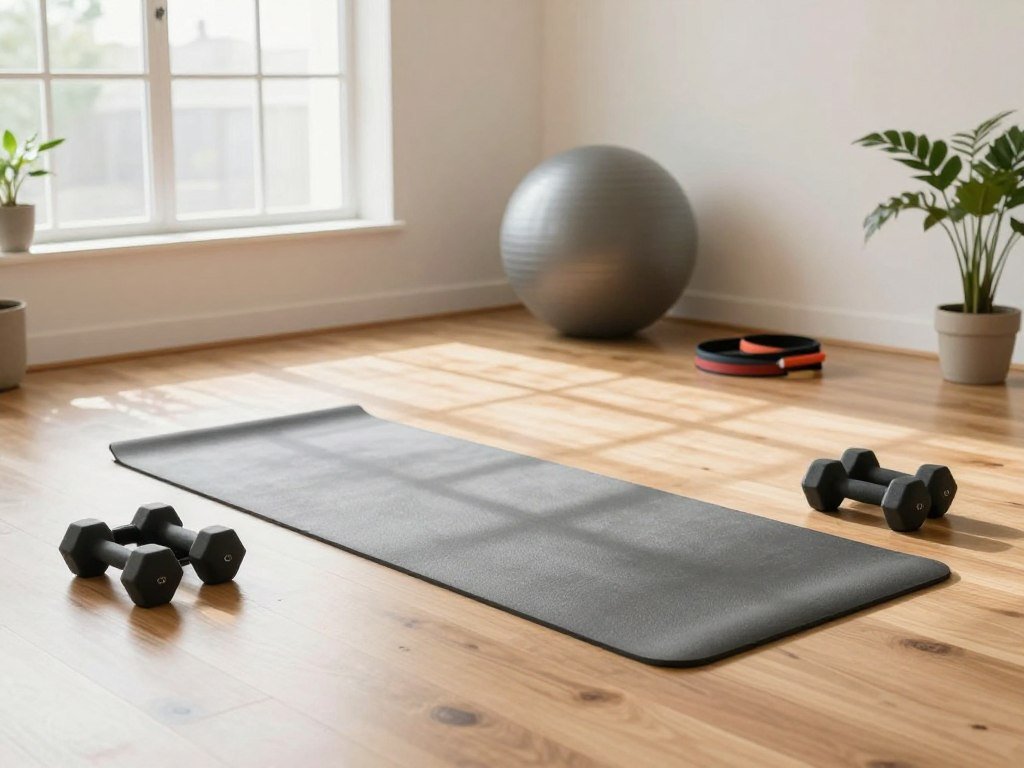
You can build a challenging home workout in a small clear space, even if you do not own weights. A few square feet of floor can be enough, and you can start without buying equipment. The best exercises for strength at home can fit your available time, space, and ability. You can also adjust each movement as your control improves.
This practical full-body approach starts with a short list of useful movements. You will see how to choose a version that suits you, then combine your choices into a routine. You can use body weight alone or add simple resistance when you have it. The goal is a workout you can repeat with care, not a test of how much you can do in one day. Start with the version of each movement you can control comfortably.
Key Takeaways
- Body weight can provide resistance for strength training.
- A balanced routine covers legs, hips, pushing, pulling, and trunk control.
- Start with movements you can perform with steady form.
- Add challenge gradually when your current version feels manageable.
- Use a workout log to notice changes over time.
- Recovery days can help you return ready for your next session.
Can bodyweight exercise build strength and muscle at home?
Yes, bodyweight training can build strength and muscle when the movement is demanding enough to challenge you. Your body supplies resistance, so strength training does not require machines or free weights. Progressive overload means gradually increasing the challenge of training so muscles have a reason to adapt.
Resistance training means working muscles against an external load or your body weight. A controlled movement through a comfortable, full range can help you train without gym equipment. Harvard Health describes body-weight exercise as adjustable and able to support muscle growth without external loads.
An eight-week press-up study with 18 male participants found gains in muscle and strength comparable to bench-press training at a load near 40% of one-repetition maximum, or 1RM. That result offers one example, not a promise for every person or exercise.
Choose a variation that challenges the working muscles while letting you keep control through the movement.
The 2026 ACSM Position Stand reviewed 137 systematic reviews representing more than 30,000 participants. Resistance training improved strength, muscle size, power, endurance, contraction speed, gait speed, balance, and other physical functions compared with no exercise.
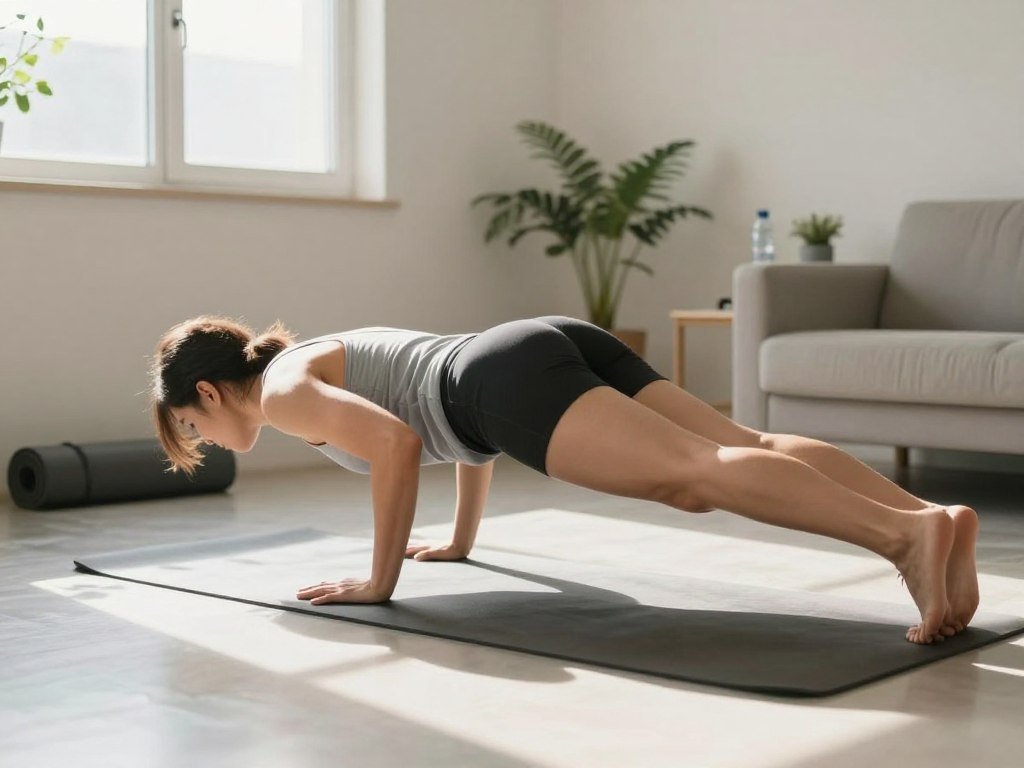
Those findings cover resistance training broadly, not a guarantee that one home routine will produce every outcome. Start with a version that suits your current ability, then pay attention to how well you can control it. Choose a variation that lets you move through a comfortable, controlled range.
Which Are the Best Exercises for Strength at Home?
A balanced home routine starts with movements that cover the legs, hips, pushing, pulling, and trunk. Seven core choices can give you a practical starting menu without making your workout hard to plan. The best exercises for strength at home without equipment include bodyweight options, though a few patterns work better with added resistance.
This core selection works for men and women; individual ability and goals matter more than gender. These strength training exercises at home can also suit beginners when you choose an appropriate variation. The best exercises for strength at home for men are not a separate set of movements, and the best exercises for strength at home with no equipment share the same basic movement patterns.
- Squat: a knee-bend pattern that trains the thighs and glutes.
- Split squat or reverse lunge: a one-leg pattern that challenges the legs, hips, and balance.
- Glute bridge: a hip-extension movement that works the glutes and back of the thighs.
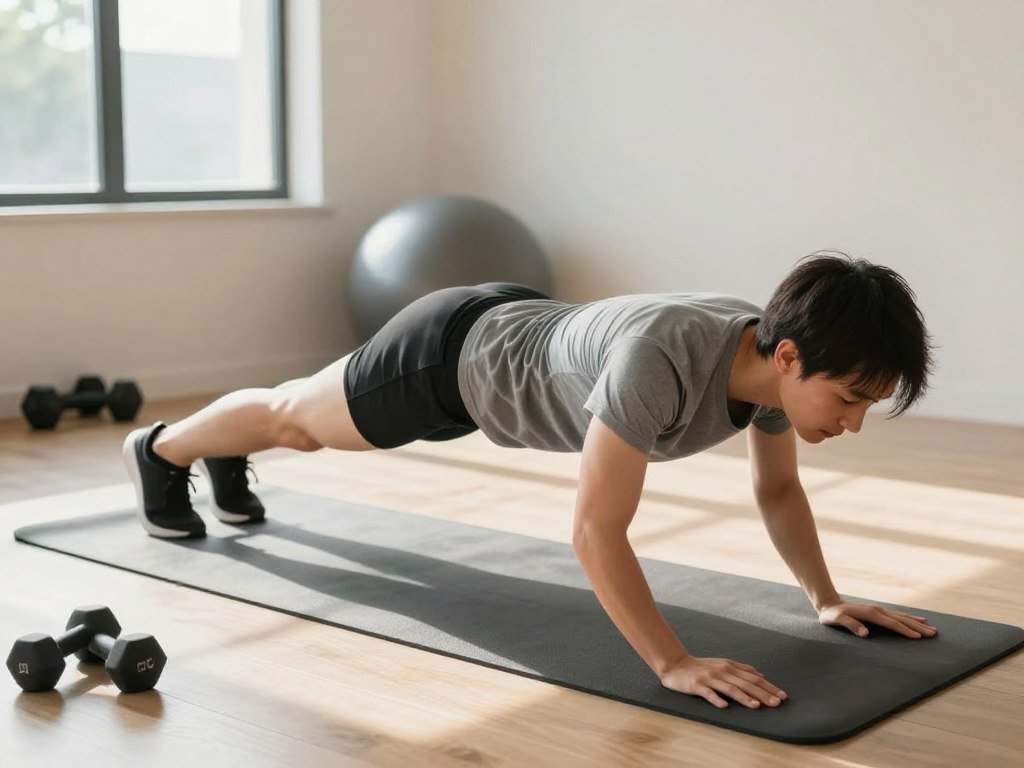
- Push-up: an upper-body push that trains the chest, shoulders, and triceps.
- Row: an upper-body pull that works the back and arms.
- Overhead press: a vertical push that trains the shoulders and arms.
- Plank: a trunk-stability exercise that challenges the core muscles.
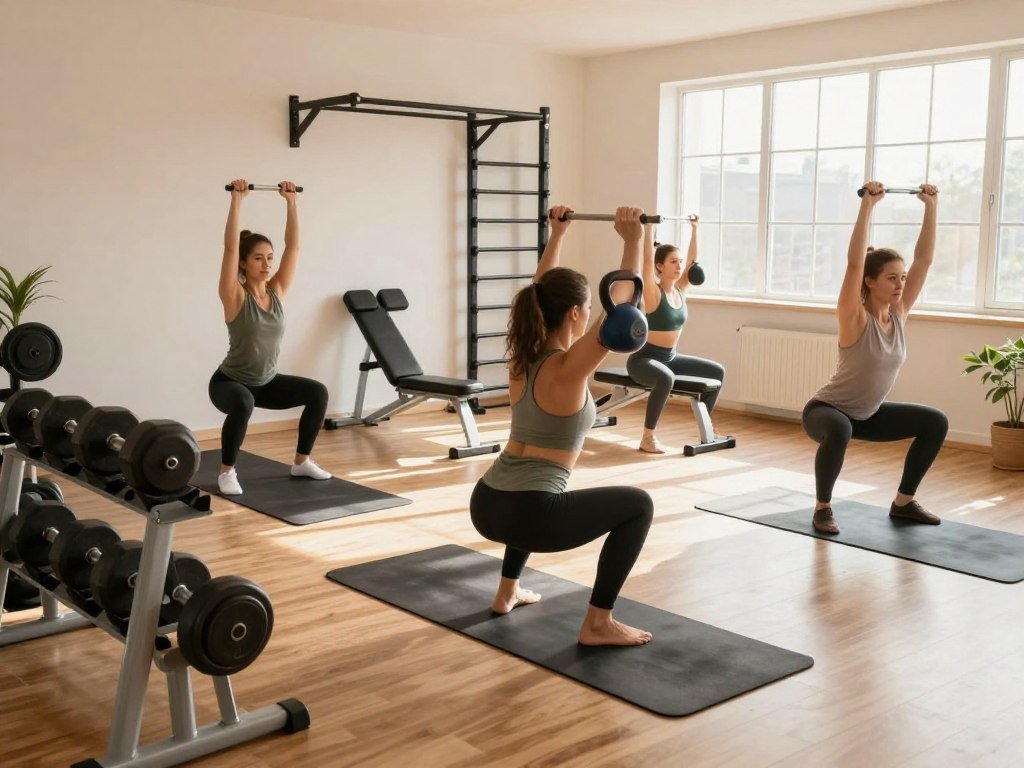
Rows and overhead presses need a band or dumbbells for a substantial challenge. Body weight alone does not provide much pulling resistance in a typical home setup. A ten-movement home menu can add arm circles, leg raises, and pull-ups to these seven choices, though those extras are not essential picks.
These strength training exercises address the main patterns without asking you to learn many complex skills at once. They can form a workout for a person with no equipment, while added resistance can make pulling and pressing more demanding. Keep the seven core choices simple enough to repeat with consistent form.
What equipment do you need for strength training at home?
You can begin with body weight alone, then add a band or weights when an exercise no longer feels challenging. A clear floor area is the main need for many basic movements. Resistance training can use body weight, free weights, machines, bands, or water, with muscles acting through different types of movement.
Pulling movements are harder to load well with no equipment. If you add a band or household weight, check that it stays secure during the exercise. Avoid using unstable furniture as an anchor.
Training with no equipment
Bodyweight variations let you begin without buying anything. A floor and enough room to move your arms and legs may be all you need. You can adjust the movement itself to make an exercise easier or harder, rather than adding a load right away.
Resistance can come from body weight or an object, and muscle actions can be isometric, isotonic, or isokinetic. In plain terms, muscles can hold a position, move under load, or work at a steady speed with specialized equipment.
Adding bands, dumbbells, or household weights
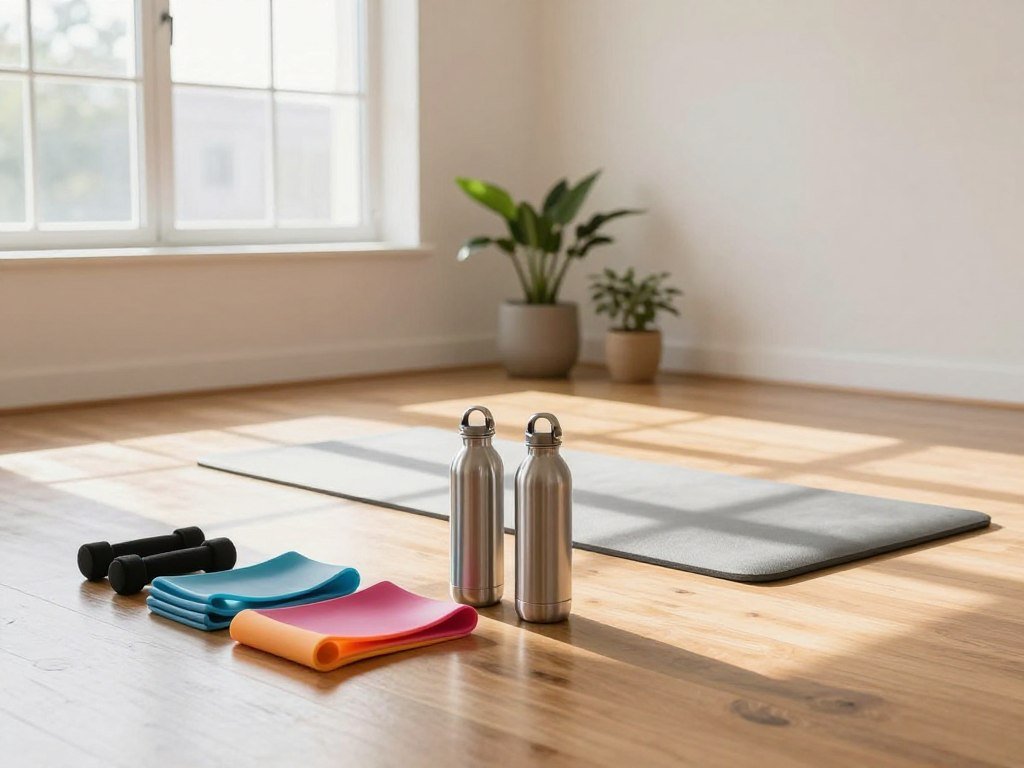
A resistance band takes little storage space and can add tension to rows or presses. Dumbbells offer a firm, easy-to-grip load. Water bottles work as light household weights, though their shape may feel less secure.
| Equipment option | What it adds | Space or setup | Useful for |
|---|---|---|---|
| No equipment | Bodyweight resistance | Clear floor area | Squats and planks |
| Resistance band | Adjustable pulling tension | Small storage space | Rows and presses |
| Dumbbells | Firm external load | Floor or shelf storage | Rows and overhead presses |
| Household objects such as water bottles | Light added weight | Use a secure grip | Light presses and rows |
Use only a chair, table, or other household support that is stable and will not shift under load.
How should beginners start strength training at home?
Your first session should feel like a practice session, not a test of how much you can do. Begin with control and choose a version that lets your body move smoothly. The NHS suggests repeating each strength exercise 8-15 times as a general target, but a beginner can use an easier variation or smaller range while learning.
Stop a set when you can no longer keep the movement steady. A slower pace gives you time to notice your position and how the exercise feels. You do not need to add resistance during your first practice.
Set up a comfortable starting point
Clear the floor of loose objects, and wear clothing that lets your arms and legs move freely. A brief warm-up can include easy marching or gentle arm movements. Keep the space simple so you can focus on the exercise instead of stepping around clutter.
Learn the movement before adding load
Practice at a controlled pace and use an easier version if the full movement feels awkward. Reduce the range of motion while you learn, then widen it as your control improves. If your form breaks down, pause or end the set rather than forcing more repetitions.
- Clear the floor before you begin.
- Test the movement without added load.
- Breathe continuously during each repetition.
- Use a range that feels comfortable.
- Rest when you need it.
These checks help you set up a manageable first session without turning it into a performance test. Record which variations felt steady and which ones need more practice. Move on to resistance only when you can repeat the movement without losing control.
How often should you train at home?
For most beginners, plan two or three strength sessions each week and leave a recovery day between full-body sessions. Two sessions is a useful starting point if you are building a new habit. The 2026 ACSM Position Stand found strength benefits from training at least two sessions per week.
Strength sessions do not need to fill every day of your week. The NHS recommends strength-based exercise at least twice a week alongside 150 minutes of moderate-intensity aerobic activity. Walking or similar aerobic activity can support endurance, but it does not replace strength work.
| Weekly setup | Example spacing | Recovery note |
|---|---|---|
| 2 full-body sessions | Monday and Thursday | At least a full day between sessions |
| 3 full-body sessions | Monday, Wednesday, and Saturday | Leave recovery days between sessions |
| Strength sessions plus aerobic activity | Strength Monday and Thursday, walks on other days | Keep aerobic days distinct from hard strength work |
That spacing gives you a clear example, not a rule that every day needs a workout. The NHS advises leaving at least a full day of recovery between strength sessions. A walk can fit on a separate day or at an easy pace when it suits your week.
Your schedule can shift when work, family plans, or sleep change. Keep the recovery gap between full-body strength sessions rather than squeezing them together to meet a calendar target. If soreness or fatigue is changing your form, give the worked muscles more recovery time before training them hard again.
How do you progress when home exercises get easy?
If you can finish every set easily with steady form, increase one part of the challenge instead of changing everything at once. Gradual change gives your muscles time to adjust. Progressive overload can come from adding resistance, repetitions or sets, range of motion, or better movement control.
Make a change when the current version feels controlled, not rushed. For example, a bodyweight squat can move from 3 sets of 10 repetitions to 3 sets of 12 when the original sets feel easy. You could also add one repetition each week or increase weight every two to three weeks.
Add repetitions or resistance gradually
Use a small step rather than a sudden jump in load. If you can complete each set with control, try a few more repetitions or a modest increase in resistance. Hold steady if the new version makes you rush or shorten the movement.
Change one training variable at a time
Changing one variable helps you see what made an exercise harder. Use the table to choose a small adjustment, then keep the rest of the movement familiar.
| Variable | How to progress it | Example | When to hold steady |
|---|---|---|---|
| Resistance | Add a small load | Use a heavier dumbbell | Grip or form becomes shaky |
| Repetitions or sets | Add a small amount | Squat for 3 sets of 12 | Later repetitions lose control |
| Range of motion | Move a little farther | Lower into a deeper squat | Balance or comfort declines |
| Movement control | Use a slower, smoother action | Lower with less momentum | You cannot keep the pace steady |
Reassess a strength-training plan every 4-6 weeks. A change should match your current control and goal, rather than a desire to make every workout harder. Reassess the plan after 4-6 weeks and keep the changes that remain manageable.
How do you arrange a full-body home workout?
A well-rounded session pairs lower-body work with upper-body pushing and pulling, then adds a trunk exercise. A simple sequence can cover the main movement patterns without turning the session into a complicated circuit. You can adjust the sets and rests to match your current level.
Choose one movement for each main area before adding extra exercises. This keeps the workout focused and helps you use your time well. Start with movements that need the most attention, then finish with a stable trunk exercise.
Choose movements for different muscle groups
Use these components to shape a balanced workout:
- Lower-body movement, such as a squat or lunge.
- Hip movement, such as a bridge.
- Upper-body push, such as a push-up.
- Upper-body pull, such as a row.
- Trunk exercise, such as a plank.
Put the exercises in a practical order
An illustrative full-body sequence could be a squat, a bridge, a push-up, a row, then a plank. Do one movement at a time, and rest as needed between sets. You can use fewer repetitions or longer rests while learning the sequence.
A 20-minute CrossFit bodyweight AMRAP used 5 pull-ups, 10 push-ups, and 15 squats. Its comparison reported a greater training stimulus than treadmill running at 85% of maximum heart rate for the same duration. That example shows that a bodyweight circuit can feel demanding, but it is not a required format for strength training.
For a steadier strength session, complete each exercise at a pace that lets you maintain clean repetitions. You can change the number of sets and rest time without racing through the movements. Pick a format you can repeat without sacrificing clean repetitions for speed.
How can you train your chest, shoulders, and back at home?
Push-ups give you a practical home option for the chest, shoulders, and triceps, while a row or pull-up trains a different pattern. Pushing and pulling both matter for a balanced upper-body workout. Push-ups can be adjusted to match your current strength and control.
Push movements do not replace pulling work. A bodyweight setup can make back training harder because it offers fewer ways to create pulling resistance. Bands or a purpose-built pull-up option can help fill that gap.
Push movements for the chest and shoulders
A wall or elevated push-up can reduce the challenge, while a floor push-up asks for more work from your arms and chest. An overhead press can train the shoulders with a suitable resistance band or dumbbells. Pick a load that lets you move smoothly without leaning or twisting.
A muscle-activation study compared eight quadrupedal movement exercises with a push-up, bodyweight squat, and forearm plank in 20 healthy volunteers. Push-ups produced higher triceps and pectoralis activation than the quadrupedal movements, while squats produced lower biceps femoris activation than those movements. Muscle activation alone does not prove better real-world results.
Pull movements for the back
Band rows offer a home pulling option when the band stays secure. A pull-up can also work if you have a secure, purpose-built bar or another setup designed to hold your load. These movements train the back and arms through a pattern that push-ups cannot provide.
Check the setup before loading it, and do not improvise with a weak fixture. Do not use a table edge or door fixture for rows unless it is designed to hold your full load.
How do you strengthen your legs and glutes at home?
Squats and lunges train the legs from different positions, while bridges emphasize hip extension. Bodyweight resistance can challenge the lower body without weights, especially when you use a controlled range. A stable foot position helps you return to standing with balance.
Keep your feet planted and choose a depth you can control. Squats, split squats, and lunges all use body weight as resistance. They can feel different because your stance and balance demands change.
Squat and lunge patterns
A chair-assisted squat gives you support as you practice sitting back and standing again. A split squat keeps one foot forward and one behind, while a reverse lunge steps one foot backward before you lower. Choose the version that lets you keep balance without forcing a deep position.
Stand with your feet in a steady position and let your knees bend in a way that feels comfortable. Lower only as far as you can keep your balance and control. Return to standing smoothly instead of pushing off the floor or rocking forward.
Hinge and bridge patterns
A glute bridge trains hip extension while you lie on the floor with your feet planted. Press through your feet and lift your hips only as high as you can without arching your back. When that version feels controlled, a single-leg bridge can increase the challenge.
Keep the movement smooth on the way up and down. If your feet slide or your balance shifts, shorten the range and reset your position. Use a range of motion that lets your feet stay planted and your balance remain steady.
Which core and balance exercises belong in a home routine?
A plank challenges trunk stability, while a balance drill asks you to control your position as your base of support changes. Both skills can fit into home training, but they serve different purposes. A modified plank can be easier to manage than a full floor version.
Balance practice is a separate skill from adding load to a strength exercise. You might practice standing on one foot near a wall, then use a plank to train trunk control. Keep the focus on a steady position rather than speed.
The 2026 ACSM Position Stand found resistance training can improve physical function, including gait speed and balance. That finding supports including strength work, while a balance drill still gives you a direct way to practice body control.
A wall or sturdy chair can offer support when you need it. Keep one nearby for a balance position, especially when you are learning how the exercise feels. You can make the drill easier by using a wider stance or lightly touching the support.
Use a clear floor area and keep your feet close enough to a stable support to reach it safely. Small balance challenges can be useful practice without adding weight to a lift. Keep a stable support within reach when practicing a balance position.
What types of strength can you train at home?
Strength is not one single quality, so the best exercise emphasis depends on whether you want force, repeated effort, or speed. Different goals call for different work. Maximal strength is the greatest force a muscle or muscle group can create in one effort, while relative strength compares strength with body weight.
Strength endurance is the ability to keep repeating muscle contractions over time. Speed strength means exerting force quickly during fast movement. Explosive strength means producing a high amount of force in a short time.
Strength for force and repeated effort
Home workouts can focus on controlled force, repeated effort, or a mix of both. The right emphasis depends on what you want your training to improve, not on one exercise being best for every goal.
| Strength quality | Plain-language meaning | Home-training emphasis |
|---|---|---|
| Maximal | Highest force in one effort | Use a challenging, controlled load |
| Relative | Strength compared with body weight | Practice bodyweight movements |
| Endurance | Repeated contractions over time | Use steady repeated efforts |
| Speed | Force during fast movement | Move quickly while staying in control |
| Explosive | High force in a short time | Use brief, powerful actions |
Maximal strength focuses on force, while endurance work asks your muscles to repeat effort. Relative strength considers how much force you can create compared with your body weight. These qualities can overlap in a home exercise.
Strength for speed and explosive movement
The 2026 ACSM Position Stand found power benefits with moderate loads of 30%-70% of 1RM, low-to-moderate volume of no more than 24 repetitions⋅sets, and a fast concentric phase. The concentric phase is the part where the working muscles shorten, such as rising from a squat.
Fast movement should not mean losing control on the way down. If you practice a quicker rising action, use a load and range that let you land or finish steadily. Beginners can build their base with slower, controlled strength work first.
Strength for quick starts and direction changes
Starting strength is the ability to create force at the beginning of a movement. A controlled example is pushing up from a chair with a smooth first effort, rather than rocking forward.
Agile strength means changing direction quickly and efficiently while keeping control and balance. A low-risk example is stepping sideways between two floor marks at a careful pace, then returning without rushing. Build a base of controlled strength before adding fast or explosive movements.
How should older adults adapt strength exercises at home?
Older adults can start with familiar bodyweight movements and add resistance only when the movement feels comfortable. Support can make practice easier, especially when a new movement feels uncertain. The National Institute on Aging lists arm circles, leg raises, pushups, pullups, planks, squats, and lunges as strength exercise examples.
Start without weights or resistance bands until the movements feel comfortable. Use a range and pace that let you stay steady. A health professional can help if a movement feels unsafe or causes concern.
Start with supported, comfortable movements
Choose familiar movements and use a sturdy chair or wall for support when needed. You can begin with bodyweight work, then add a band or weight once the movement feels comfortable. Keep the effort at a level that allows you to move with control.
Add strength and balance across the week
The National Institute on Aging recommends muscle-strengthening activity at least two days per week. One set of 8-12 repetitions of each strengthening exercise can be effective, and two or three sets may work better. Use at least a moderate effort that makes another repetition difficult.
Avoid working the same muscle group on consecutive days. Balance practice is recommended about three times each week, with a sturdy chair, person, or wall close by.
- Stand on one foot near a support.
- Walk heel to toe along a clear path.
- Walk backward or sideways with a steady pace.
- Practice standing up from a chair.
Choose a clear path for walking drills and stay close to your support. Stop if you feel unsteady, then reset before trying again. Use a sturdy support within reach for balance practice, and ask a health professional about a movement that feels unsafe.
What common mistakes can slow strength gains at home?
A home workout can stall when every set feels easy or when the movement is rushed to get it over with. Small habits matter because they shape how well you can repeat the work. A useful routine challenges you without making every session a race.
Fatigue alone does not prove that a workout worked better. The 2026 ACSM Position Stand found that several training methods did not consistently change outcomes for healthy adults. No single approach, including training to momentary muscle fatigue, is essential for results.
- Choosing a version that is too easy: move to a harder option when you can control the current one.
- Rushing repetitions: slow down enough to keep the movement steady.
- Skipping pulling work: include a safe row or pull-up option alongside pushing exercises.
- Changing too many variables at once: adjust one part of the workout, then see how it feels.
- Treating fatigue as proof of a better workout: judge progress by control and performance, not exhaustion alone.
The ACSM findings do not support treating equipment type, exercise complexity, set structure, time under tension, blood-flow restriction, or periodization as required for every person. Training to momentary fatigue also did not consistently affect outcomes. Choose a routine you can sustain, then make a clear change when your current version stops challenging you.
A hard workout is not automatically a better workout. Keep control and progress without making exhaustion the goal.
Keep the routine challenging enough to progress, but simple enough to repeat consistently.
What is 5-4-3-2-1 strength training?
The 5-4-3-2-1 method uses five consecutive sets, with repetitions falling from five to one as the weight rises. Each set gets shorter, and the load increases as the repetition count drops. This is a pyramid-style sequence used in strength training.
You need a load and exercise you can control across all five sets. The method is not required to build strength. Regular sets can be a simpler choice while you learn an exercise and build consistency.
For example, the sequence is five repetitions, then four, then three, then two, then one. The weight rises as the repetitions decrease. The exact load should still let you move with control throughout the sequence.
A beginner may find it easier to use the same load for regular sets before trying a pyramid. That approach leaves fewer changes to track while you learn how the exercise feels. If the final single requires a strained effort, the load is too heavy for that set.
Keep each repetition smooth, and stop rather than forcing a poor movement. Choose a load that keeps every repetition controlled rather than forcing the final single.
How can you tell whether your home plan is working?
A simple workout log can show progress that is hard to notice from one session to the next. Write down what you did, then compare similar workouts over time. Useful measures include exercise variation, sets, repetitions, and resistance or range of motion.
Compare the same movement under similar conditions. More controlled repetitions, a harder variation, greater resistance, or a wider movement range can all show progress. Appearance can be one measure, but it does not tell the whole story.
Record the exercise variation as well as your sets and repetitions. Note the weight or band you used, or how far you moved through the range. A brief note about how the movement felt can help explain why one session differed.
Compare a floor push-up with another floor push-up, not with a wall version from weeks earlier. Keep similar rest and setup when you can, so the comparison stays fair. Day-to-day energy can change, so look for a pattern across sessions instead of judging one workout.
Progress can mean better control or a harder variation, even when the number on a scale stays the same.
Appearance may change slowly and can reflect factors beyond training. Your log gives you a direct record of the work itself, such as a larger range or steadier repetitions. Keep the measures that matter to your goal and update the log after each workout.
Conclusion
A strong home routine is built by choosing movements you can perform well and repeating them consistently. Body weight or simple resistance can challenge your muscles, and you can adjust the work over time. A useful workout does not need to take over your living space.
Choose three or four familiar movements for your first session. Record the versions you try and how each one feels, so you have a clear place to start next time. Set aside space for your first session, choose your starting variations, and record how they feel.