What good is a perfect playlist if your earbuds slide out halfway through a set of burpees? Anyone who has fished a loose bud out of a gym mat knows the frustration. The search for the best headphones for working out is not really about sound quality alone. It is about gear that stays put, shrugs off sweat, and keeps going when the rest of you wants to quit. (Headphones)
This guide cuts through the marketing noise. It covers the numbers that matter (IP ratings, battery figures), the fit designs that hold up in real training, and the mistakes that quietly kill earbuds months before their time. No hype, no brand cheerleading, just the practical stuff.
Start With the IP Rating, Not the Word “Sweatproof”
Here is the first thing most buyers get wrong: they trust the adjective. “Sweatproof,” “waterproof,” “sport-ready” are marketing words with no regulated definition in consumer audio. Two brands can print the same phrase on a box and mean completely different things.
The real signal is the IP code, a two-digit rating system defined by the IEC 60529 standard. The first digit covers solids like dust; the second covers liquids. For workout headphones, the second digit is the one to watch. The plain-language explanation of IP code digits is worth five minutes of your time before you buy anything.
| IP rating | What it means in practice | Typical workout use |
|---|---|---|
| IPX2 | Dripping water, light tilt | Casual walks, light gym use |
| IPX4 | Splashing water from any direction | Most sweat-heavy training, rain-resistant |
| IPX5 | Water jets at low pressure | Heavy sweaters, outdoor training |
| IPX7 | Brief immersion up to 1 meter | Swimming-adjacent use, extreme sweat |
A few honest caveats. These ratings are self-declared by manufacturers, not independently certified, so a brand with a shaky reputation can still print IPX5 on the box. Also, IPX4 is genuinely fine for most people. You do not need a diving-grade rating to survive a spin class. What you need is a number, not a slogan.
Fit and Stability: The Real Differentiator
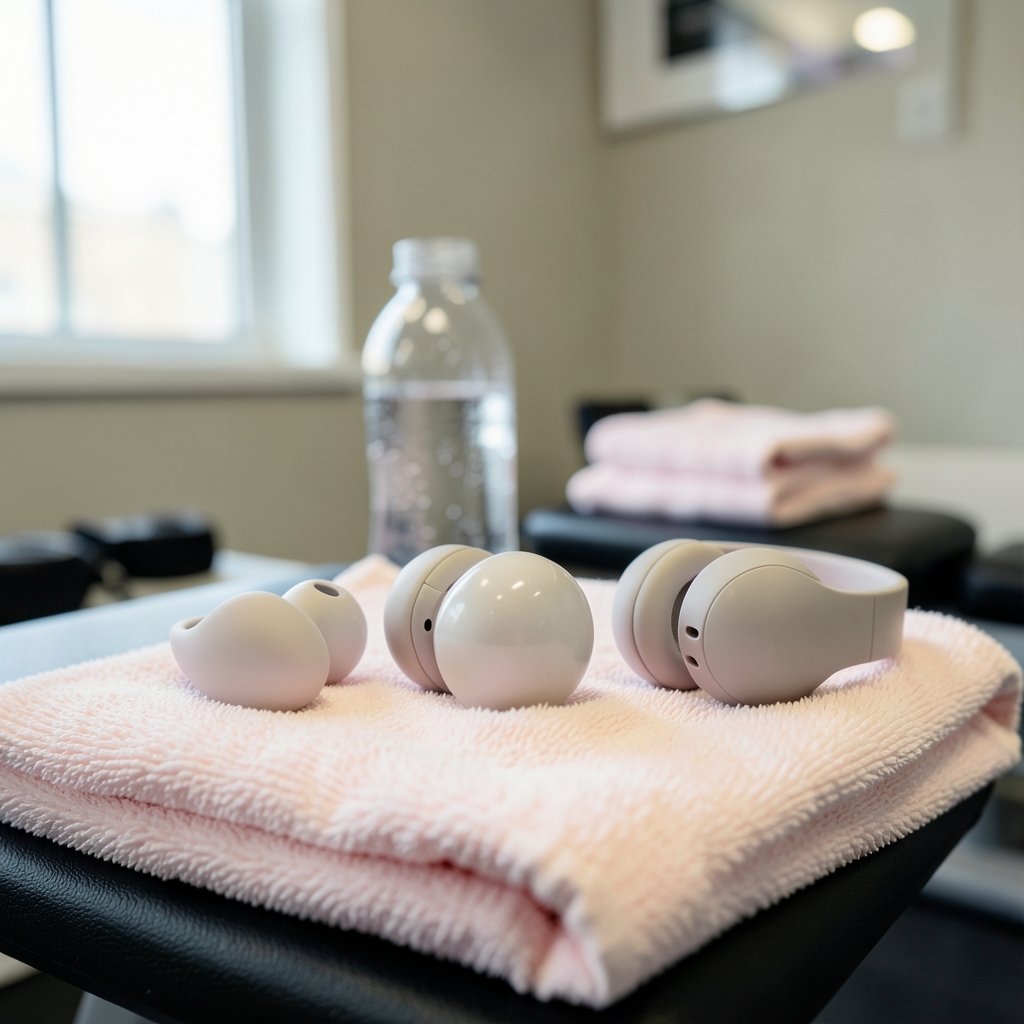
Ask ten regular gym-goers what made them keep a pair of earbuds and most will talk about fit, not frequency response. A headphone that sounds incredible but needs re-seating every 90 seconds is useless during a workout.
Three designs dominate:
Wing-tip or fin earbuds. A soft silicone fin tucks into the ridge of your ear. These suit most people and work well for lifting and indoor cardio.
Ear-hook designs. A rigid hook loops over the ear and holds the bud in place. They are bulkier but nearly impossible to shake loose, which makes them a favorite for running and HIIT.
Open-ear and bone-conduction models. These sit outside the ear canal entirely. Bone conduction sends vibration through the cheekbone to the inner ear, and the mechanics are explained well in this overview of bone conduction audio. The appeal is ambient awareness: you hear traffic and gym announcements while still hearing your music.
One practical tip that saves a lot of returns: try earbuds with the smallest tip first, then work up. Many people default to the medium tip in the box and wonder why the seal keeps breaking. A proper seal is also what makes bass sound right, so fit and sound quality are the same conversation.
Noise Cancellation vs. Transparency: Pick Your Battlefield
Active noise cancellation (ANC) uses microphones and anti-noise signals to cancel steady background sound. It is a gift in a gym with thumping music, clanging dumbbells, and a treadmill chorus. The mechanics of active noise control are genuinely clever, and the practical effect is that you can listen at lower volume.
Transparency or ambient mode does the opposite: it pipes outside sound in through the microphones. Outdoors, this matters. Runners and cyclists who need to hear approaching cars should favor transparency mode or an open-ear design.
Most current sport earbuds offer both, and the honest advice is to use them as intended. ANC indoors, transparency outdoors. Treat the safety benefit of open-ear designs as a sensible design rationale rather than a proven crash-prevention feature, because the evidence on that is limited and mostly indirect.
Battery Claims and What They Hide
Battery figures on the box are almost always music-playback numbers at moderate volume, often with ANC off. Real workout use, with higher volume and noise cancellation running, typically shortens runtime noticeably. Plan for less than the sticker says.
A workable rule: if the claimed figure is under six hours per charge, assume it will feel tight on long training days. If you train in short sessions, anything above four hours is workable, especially with a charging case. Case capacity matters more than people expect, since a quick top-up between sets is often all you need.
Bluetooth, Codecs, and Multipoint
Bluetooth is the connection standard behind nearly all wireless workout headphones, and the details affect daily life more than spec sheets suggest. Two features are worth checking:
Codec support. SBC is universal, AAC is common on phones, and the aptX family appears on some Android-friendly models. Codec support varies by model and by phone operating system, so check compatibility rather than assuming.
Multipoint. This lets one headset stay connected to two devices at once, say your phone and a laptop. If you switch between devices during the day, multipoint prevents the small daily annoyance of repairing. The background on Bluetooth profiles and codecs explains why the same earbuds can behave differently across phones.
Open-Ear vs. Sealed: A Quick Comparison
| Factor | Sealed in-ear | Open-ear / bone conduction |
|---|---|---|
| Bass and isolation | Strong | Weaker, by design |
| Ambient awareness | Low unless transparency is on | High |
| Fit security during running | Good with the right tips | Very good, hooks over the ear |
| Comfort over long sessions | Can cause pressure fatigue | Generally easier on the canal |
| Best for | Gym, lifting, indoor cardio | Running, cycling, outdoor training |
Neither wins outright. Many regular trainers end up owning one of each, using sealed buds for the gym floor and open-ear gear for the road.
Mistakes That Kill Workout Headphones Early
Plenty of earbuds fail not because they were bad, but because of how they were treated. The most common errors:
- Storing them damp. Sweaty earbuds tossed into a closed case create a humid little chamber. Wipe them down and let them air dry before sealing the case.
- Skipping the cleaning routine. Ear tips and mesh screens collect earwax, sweat residue, and bacteria. A quick wipe after each session and a deeper clean weekly keeps both hygiene and sound quality in check.
- Charging in a hot car or gym bag. Heat is the quiet killer of small batteries.
- Ignoring the warranty language. Many manufacturers exclude liquid damage from standard warranties, which is exactly why a higher IP rating functions as a warranty-risk hedge. Read the terms before you need them.
- Cranking the volume to drown out gym noise. This is the one that affects your body, not the product.
Hearing Safety Deserves a Paragraph
Loud music plus loud gym equals a real risk over time. Public-health guidance recommends limiting both volume and duration, and the widely repeated 60/60 rule of thumb (no more than 60 percent volume for no more than 60 minutes at a stretch) is a reasonable default even though it is a rule of thumb rather than a formal standard. The WHO Make Listening Safe initiative lays out the broader case for protecting hearing during recreational listening.
In practice, ANC helps here. If the headphones cancel the treadmill drone, you do not need to push volume as high to hear your podcast. It is one of the few cases where a premium feature has a genuine health angle.
Practical Buying Advice That Saves Money
A few habits separate happy buyers from frustrated ones:
Buy for your main activity, not every activity. A lifter and a marathon runner need different things. Trying to cover both with one pair usually means compromising on the one you do most.
Check the return window. Fit is personal and hard to predict from reviews. A generous return policy is worth more than a small discount.
Do not overpay for features you will not use. If you never take calls mid-workout, microphone quality is irrelevant. If you train indoors only, transparency mode is a nice-to-have.
Consider budget options seriously. The gap between budget and premium earbuds has narrowed a lot, and a sensible starting point is a curated look at the best budget headphones before assuming you need to spend big. If you are new to the category, this practical guide to Bluetooth headphones worth buying for beginners covers the basics without the upsell.
Troubleshoot before you replace. Connection drops, one bud failing, or pairing problems are often fixable. A rundown of the most common Bluetooth headphone problems covers the usual suspects, and if you suspect a network issue rather than the headphones, this guide on how to test if your VPN is working with IP, DNS and kill switch checks is a useful diagnostic detour.
Matching Headphones to Your Training Style
Different workouts punish headphones in different ways, and matching the gear to the session prevents most disappointment.
Strength training. Rest periods are long, movement is minimal, and the gym is loud. Sealed earbuds with ANC and a secure wing tip are the natural fit. Battery life matters less here because sessions rarely run past 90 minutes.
Running and cycling. Motion and traffic are the two variables. Ear hooks or open-ear designs keep the bud in place, and transparency or open-ear audio keeps you aware. Sweat volume is high, so IPX4 is the floor and IPX5 is a sensible buffer.
HIIT and classes. These combine jumping, sweating, and rapid direction changes. Ear hooks win. Anything that relies on a friction seal alone will eventually lose.
Swimming. Standard Bluetooth does not transmit through water, so pool use needs specific waterproof designs with onboard memory. Do not assume a high IP rating means swim-ready.
Conclusion
The best headphones for working out are not the ones with the biggest marketing budget. They are the pair that fits your ears, matches your main activity, and carries an IP rating you can actually verify. Start with the IP number instead of the word “sweatproof,” prioritize fit over spec-sheet bragging, and treat battery claims with mild skepticism. Add a cleaning habit and a sensible volume ceiling, and a good pair will last years rather than months. Buy for the workout you actually do, and the rest falls into place.
Frequently Asked Questions
What IP rating do I need for workout headphones?
For most people, IPX4 is enough. It handles splashing water from any direction, which covers typical sweat and light rain. Heavy sweaters and outdoor runners may prefer IPX5 or higher. The key point is to look for the number itself, since “sweatproof” has no regulated definition.
Are bone-conduction headphones good for the gym?
They are better outdoors than indoors. Bone conduction and open-ear designs leave the ear canal open, so ambient noise competes with your music in a loud gym. For running and cycling, that awareness is an advantage. For heavy lifting in a noisy room, sealed earbuds with noise cancellation usually work better. (Preventing noise-induced hearing loss)
How long should workout headphone batteries last?
Look for at least six hours of claimed playback per charge, and expect real-world runtime to be shorter with high volume and noise cancellation on. A charging case with two or three extra full charges makes short sessions easy to manage.
Can sweat damage headphones even if they are water-resistant?
Yes. Ratings are self-declared and degrade over time as seals wear. Storing damp earbuds in a closed case, skipping cleaning, and charging in hot environments all shorten lifespan. Many warranties exclude liquid damage, so a higher IP rating works as a hedge against that risk.
Should I use noise cancellation while running outside?
Generally no. Noise cancellation blocks the traffic sounds you need to hear. Use transparency mode or an open-ear design outdoors, and save full ANC for the gym or indoor training where blocking background noise helps you listen at a lower, safer volume.
How often should I clean my earbuds?
Wipe the tips and mesh after every sweaty session, and do a deeper clean weekly with a dry soft brush. Ear tips collect sweat residue, earwax, and bacteria, which affects both hygiene and sound quality. Replace worn tips when the seal stops holding.