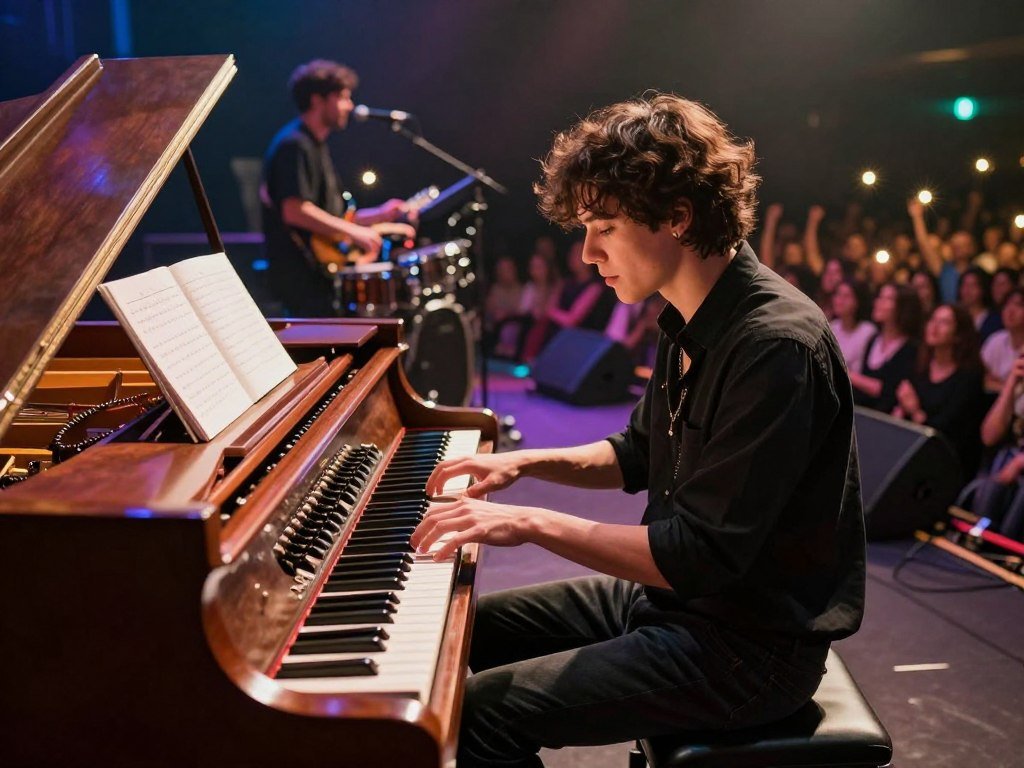
A keyboard line can become as recognizable as a singer’s voice or a guitarist’s riff. For people exploring rock, the right player can change how a whole band sounds. Piano, organ, and synthesizer each bring a different voice to music.
This rock-centered selection looks at ten influential artists, not every great player in every style. A piano makes a clear, struck sound, while an organ can hold notes beneath a band. A synthesizer creates and shapes electronic tones. A Hammond organ is an electric tonewheel organ that produces a sustained sound shaped by drawbars and became a distinctive instrument in rock and jazz.
Key Takeaways
- Keith Emerson leads this rock-focused editorial ranking.
- Keyboardists can shape melody, harmony, rhythm, and atmosphere.
- Polls and editorial rankings use different ways to select artists.
- Piano, Hammond organ, and synthesizer create distinct sounds.
- Listening closely to one part can reveal its role in a song.
The order offers a starting point, not a final verdict on musical skill. Listen for the sound and musical role that make each player distinctive.
Who Is the Best Keyboardist?
Keith Emerson is the clearest answer if the question is about a rock-focused best keyboardist ranking. Within this ranking, he is the strongest pick for best keyboardist of all time and best keyboardist in the world.
That answer applies to this editorial selection, not every genre or set of judging rules. A famous keyboard player can earn notice through an individual sound as well as a high list placement.

A list of 100 greatest rock keyboardists and pianists places Emerson first. Rick Wakeman follows at No. 2, with Jon Lord at No. 3, Ray Manzarek at No. 4, and Richard Wright at No. 5.
| Rank | Artist | Associated act |
|---|---|---|
| 1 | Keith Emerson | Emerson, Lake & Palmer |
| 2 | Rick Wakeman | Yes |
| 3 | Jon Lord | Deep Purple |
| 4 | Ray Manzarek | The Doors |
| 5 | Richard Wright | Pink Floyd |
The next five keyboard players in the same ranking are:
- No. 6, Tony Banks of Genesis.
- No. 7, Billy Preston, known for solo work and collaborations.
- No. 8, Rod Argent of the Zombies.
- No. 9, Steve Winwood of Traffic.
- No. 10, Al Kooper, a session musician and bandleader.
The ranking names 100 rock keyboardists and pianists, but other lists may judge different skills. Some favor public votes, while others focus on influence or a particular instrument.
Treat the order as a useful starting point for listening, not a measurement of every style of playing.
Keith Emerson’s Classical-Rock Ambition
Emerson’s importance comes from making the keyboard feel like a lead instrument in progressive rock. His playing joined classical training with an interest in jazz and a taste for forceful rock arrangements.
His work offers three different places to hear that ambition: the Nice, Emerson, Lake & Palmer, and his solo recordings. BBC Music Magazine named him No. 1 on its list of 11 greatest keyboard players.
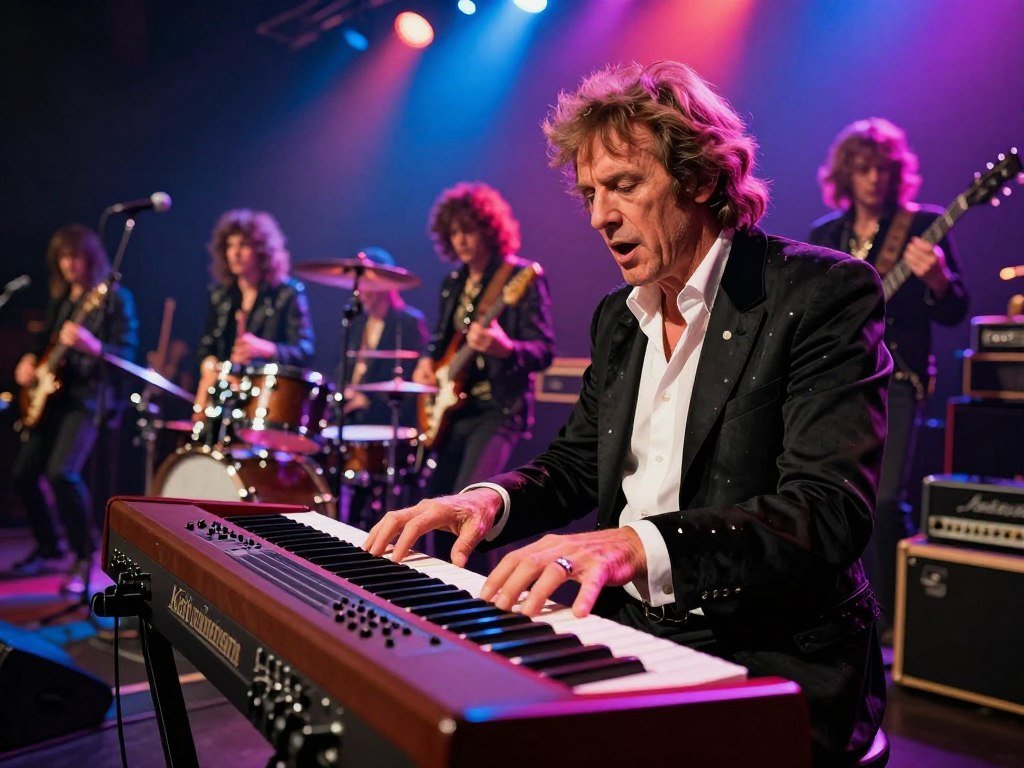
Emerson founded the Nice in 1967. He brought classical material into the group’s rock setting, then developed a larger sound with Emerson, Lake & Palmer, often called ELP.
His musical path also included six solo studio albums. The recordings let him work beyond the demands of a band, though his solo career remained one part of a career spanning over five decades.
These studio recordings mark three useful chapters:
- The Nice: three studio albums.
- Emerson, Lake & Palmer: nine studio albums.
- Solo career: six studio albums.
Emerson’s playing could be aggressive and experimental, not just a display of speed or skill. He treated the keyboard as a source of drama, attack, and unusual sounds.
His range makes him a strong first listen for readers curious about classical ideas pushed into rock.
Rick Wakeman’s Expansive Progressive-Rock Sound
Rick Wakeman is a strong choice for listeners drawn to fast, elaborate progressive-rock arrangements. His work with Yes shows how a keyboardist can add scale without losing a clear melody.
Wakeman’s layered parts can move between a lead line and a much larger band arrangement. On the Yes album Fragile, keyboards help create shifts in pace and mood.

Wakeman’s sound often features quick runs, bright melodic phrases, and carefully arranged layers. These details give a song room to expand, then bring its focus back to the band.
His career also reached beyond Yes. He performed session work with David Bowie, bringing his keyboard skills to another artist’s recording and a different musical setting.
That range matters because a session part has to serve the song in front of the player. A flourish may catch the ear, but the arrangement still needs a strong shape.
On Fragile, listeners can hear keyboard parts add movement while helping the band sound broad and connected. The arrangement gives each line space without making every moment feel crowded.
Listen for how the keyboard lines shift between melody, flourish, and the larger arrangement.
Jon Lord Put the Hammond Organ at the Center of Hard Rock
Jon Lord made the Hammond organ sound like a hard-rock lead voice. His playing gave Deep Purple a thick, classical-influenced edge beside its electric guitars.
The organ could sustain chords, answer a guitar, or reinforce its weight instead of merely filling empty space. Lord’s touch made that sound a core part of the band.

Lord was a Hammond organ master, but his impact came from more than instrument choice. He shaped the organ’s tone to stand up in a loud rock setting.
His biography describes how he used a Marshall amplifier to give the Hammond organ presence alongside electric guitar. The Jon Lord biography also covers his work with Deep Purple and as a solo composer.
That sound could meet a guitar in a musical exchange, then hold a chord while the rest of the band moved around it. The result felt both heavy and carefully arranged.
The organ’s weight and sustained presence alongside the guitar make Lord’s contribution easy to hear.
Ray Manzarek Made the Doors’ Keys Part of the Rhythm
Ray Manzarek’s role in the Doors shows how keyboard parts can help hold a band’s whole arrangement together. His electric piano and other keyboard parts gave the group a steady harmonic base.
A keyboardist can carry a song’s groove without taking a long solo. Manzarek’s playing could add chord movement while helping fill the low end.

The Doors did not have a bass player in their usual live lineup, so Manzarek often covered more than one musical job. His parts helped the band sound full while leaving room for the vocal and guitar.
That balance is different from a keyboard part built mainly around a solo. Manzarek could keep the song moving through repeated patterns and changing chords.
His approach also shows how a keyboard can shape rhythm through timing and emphasis. A part does not need to play many notes to guide a song’s feel.
Listeners can follow the keyboard line beneath the vocal as well as during instrumental passages.
Richard Wright’s Subtle, Atmospheric Touch
Richard Wright’s contribution is a reminder that a memorable keyboard part does not need to dominate the mix. His work with Pink Floyd often brought a quiet sense of space and mood.
Keyboard textures can support a band by creating atmosphere and continuity. Piano, organ, and other sounds helped Wright shape the space around guitars and vocals.
On Pink Floyd’s The Dark Side of the Moon, the keyboards help the music feel connected across changing moods. Wright’s contribution is not limited to a single solo or instrument.
A sustained sound can give a song room to breathe. A chord change can also link one phrase to the next without drawing attention away from the singer.
That restraint takes judgment. A keyboardist must know when a part needs to grow and when a few notes can do enough.
Notice the sustained textures and harmonic atmosphere around the vocal and guitar.
Tony Banks Built Genesis Around Layered Keyboard Parts
Tony Banks stands out for how his keyboard writing helps give Genesis songs their structure. As a band member and composer, he used layered parts to shape musical sections.
Arrangement and songwriting matter alongside instrumental technique. Banks could support long progressive passages and later, more direct pop-rock songs.
The Genesis albums Duke and Genesis offer useful examples of his range. His playing serves each song’s shape, rather than drawing attention to itself at every turn.
Longer arrangements can build through several keyboard layers. A more concise song may use a smaller set of parts and reach its main idea sooner.
That shift calls for choices about sound, space, and timing. The keyboardist must decide which lines need to stay in front and which should sit behind the vocal.
The contrast between dense progressive arrangements and concise pop-rock writing is a useful way to hear his range.
Billy Preston Brought Gospel Energy Into Rock
Billy Preston brought a bright, propulsive keyboard sound to the music he played with others. His gospel roots gave his parts lift and rhythmic punch.
Feel and timing can matter as much as a technically elaborate solo. Preston could make a recording move with a lively chord pattern or a short reply to the singer.
Preston performed with the Beatles, including on the song “Get Back.” His electric piano added a clear, lively edge to the recording.
He also built a solo career, distinct from his work as a collaborator and session keyboardist. Those roles called for different choices, from shaping another artist’s song to leading his own recording.
His gospel background helped him bring energy without crowding the arrangement. A well-timed chord or response can give a song a fresh push.
Encyclopedia.com’s Billy Preston biography covers his gospel beginnings and recordings with the Beatles.
His feel and timing can matter as much to a performance as a technically elaborate solo.
Rod Argent’s Organ and Piano Work With the Zombies
Rod Argent’s career connects the Zombies’ keyboard sound with wider British rock. He brought songwriting and keyboard playing together in work that reached beyond one band.
A strong band keyboardist can contribute as a writer and collaborator as well as a player. Argent’s career includes both group work and sessions for other artists.
Argent was a member of the Zombies, where piano and organ helped shape the band’s sound. His parts could add color and melody while supporting the song’s structure.
His reach beyond the group included playing piano on the Who’s “Who Are You?” That contribution offers one example of how a keyboard player can enter a different band’s musical world.
Argent also performed on the Zombies’ “Hold Your Head Up.” One track cannot sum up a career, but it shows how his playing and writing could serve a song in distinct ways.
He remains a clear example of a musician whose work spans band arrangements and collaboration.
A strong band keyboardist can contribute as a writer and collaborator as well as a player.
Steve Winwood Moved Easily Between Rock Styles
Steve Winwood’s career makes him a useful example of a keyboardist who can move between rock styles. His work with Traffic drew on blues-rooted sounds and a wider range of popular music.
His appeal comes from musicianship across roles, not keyboard technique alone. Winwood has combined keyboard playing with singing and songwriting.
Traffic gave Winwood a setting for music that could shift in feel and arrangement. The band’s songs show how keyboard playing can sit within a larger mix of styles.
A musician who sings and writes can shape a song before the keyboard part begins. That broader view can help a player choose when to lead and when to support.
Winwood’s career also shows why one signature sound does not need to define every project. The same player can fit different bands and musical settings.
His work with Traffic offers a useful starting point for hearing that range.
Al Kooper Made the Session Keyboardist a Creative Force
Al Kooper shows that a keyboardist can leave a mark on a record without owning the spotlight. His work as a session musician gave him a creative role in shaping songs.
A brief part can become central when it gives an arrangement its character. Kooper worked with Bob Dylan and Blood, Sweat & Tears during a career that also included solo recordings.
Kooper gained attention for his involvement in the “Like a Rolling Stone” session. The song offers a familiar example of a session musician adding a part that listeners remember.
A session player must respond to the song and the people making it. The goal is not always to play the most notes; it may be to find one sound that changes the whole feel.
Kooper’s collaborative work differs from his solo career, where he could shape the music around his own ideas. Both sides show how a musician can contribute from different positions.
That creative range makes him a notable rock keyboardist beyond his work with famous artists.
How Do Different Keyboardist Rankings Compare?
Two lists can name different winners because one may reflect a public poll while another uses editorial ranking. The method matters when readers compare keyboard players across styles.
A poll and a ranking answer different questions, even when both name great musicians. Rock bands with keyboard players span progressive rock, hard rock, art rock, and pop.
What a Piano Poll Puts in the Spotlight
A rock piano players poll features 150 artists and songs associated with them. Elton John and Jerry Lee Lewis sit at the top, so readers can connect each name with music.
The poll has over 150,000 viewers, but its format differs from an editorial list. A vote-based selection reflects its voting method, while an ordered editorial selection reflects the criteria behind its ranking.
The songs matter because they give a listener a direct way to hear each artist. The list can also include piano players whose work does not fit the same band or style.
What a Ranked List Can Show
A separate list covers 100 rock keyboardists and pianists, while BBC Music Magazine’s list includes 11 keyboard players and names Keith Emerson first.
| Selection | Size | Featured top name or names |
|---|---|---|
| Rock piano poll | 150 artists | Elton John and Jerry Lee Lewis |
| Rock keyboardists and pianists list | 100 | Keith Emerson |
| BBC Music Magazine list | 11 | Keith Emerson |
The 150-artist piano poll names Elton John and Jerry Lee Lewis at the top. Its scope and format help explain why it may differ from a ranking built around broader keyboard work.
Compare lists by checking four points:
- Who selects or votes.
- Which musicians qualify for inclusion.
- Whether the list names songs.
- Whether it focuses on a particular genre.
Across rock, keyboards may carry lead lines, harmony, texture, or rhythmic drive. Check what a list counts and how it selects its entries before treating its order as a verdict.
Which African Pianists Should You Hear First?
For South African jazz, start with Nduduzo Makhathini; for classical repertoire from Africa and its diaspora, start with William Chapman Nyaho. The musical tradition is the clearest way to choose.
Makhathini is the featured choice for South African jazz, while Nyaho fits classical piano repertoire. Their work offers two distinct routes into music by African and African Diaspora artists.
William Chapman Nyaho’s African and Diaspora Anthology
William Chapman Nyaho is a Ghanaian-American pianist who champions music by lesser-known composers from Africa and the African Diaspora. His work helps bring this repertoire to piano students and listeners.
His five-volume piano anthology is aimed at intermediate to advanced students. It features music from Africa and the African Diaspora, giving players a range of works beyond the most familiar classical repertoire.
The five-volume piano anthology is a strong fit for people who want to learn or explore these composers. Its level makes it most suitable for pianists with some experience.
Nduduzo Makhathini’s South African Jazz
South African pianist Nduduzo Makhathini offers a different path through jazz. His Blue Note debut, Modes of Communication: Letters from the Underworlds, was named one of The New York Times’ “Best Jazz Albums of 2020.”
His 2017 album Ikhambi won Best Jazz Album at the South African Music Awards in 2018. He has released eight albums of his own since founding Gundu Entertainment in 2014.
Choose between the two by musical tradition first, then explore the artist’s recordings or repertoire.
What Do Piano, Hammond Organ, and Synthesizer Add?
Piano, organ, and synthesizer can all be played from a keyboard, but they produce very different sounds. The way each tone begins helps explain its role in a band.
A piano strikes strings, an organ sustains tones, and a synthesizer generates and shapes electronic sounds. Those differences affect both the sound and the way a player uses the instrument.
Piano and Electric Piano
A piano makes sound when hammers strike strings. That action gives each note a clear attack, then the sound fades unless the player holds the keys or uses the sustain pedal.
An electric piano creates sound through a different design, then sends it through amplification. Its tone can feel softer or more rounded than an acoustic piano.
Organ and Synthesizer
A Hammond organ uses electric tonewheels and can sustain a tone while the player holds a key. Its controls shape the sound, making it useful for long chords and moving lines.
A synthesizer generates and shapes electronic tones. Its timbre can change widely, from a sound close to a bright keyboard tone to one that feels less like a traditional instrument.
| Instrument | How the sound is made | Typical sound behavior | Rock example |
|---|---|---|---|
| Piano | Hammers strike strings | Clear, percussive attack | Elton John |
| Hammond organ | Electric tonewheel organ | Sustained tone shaped by controls | Jon Lord |
| Synthesizer | Electronic tone generation | Adjustable timbre | Keith Emerson |
These instruments can serve four common band roles:
- Lead melody.
- Harmonic support.
- Rhythmic drive.
- Atmosphere.
Identify the instrument’s sound before deciding what musical job it is doing.
Which Performances Make a Good Listening Starting Point?
A useful first listen follows one keyboard part through a full song rather than waiting only for a solo. Small details can reveal as much as a featured passage.
Track the sound’s attack, sustain, register, and place beside the vocal or rhythm section. These cues help explain how a keyboard part works in a band.
Hear the Keyboard in the Arrangement
Attack means how sharply a note begins; sustain describes how long it holds. Register tells whether the part sits high or low in the song.
Listen for how the keyboard responds to the vocal, guitar, bass, and drums. A part may lead the melody, mark the beat, or add a sound behind the main action.
Listeners setting up a live rig can also compare keyboard stands for stage performance by fit and stability. The right setup helps a player focus on the music.
Compare Five Distinct Performances
These five songs offer different ways to hear a keyboard part at work.
| Player | Act | Song | Listening focus |
|---|---|---|---|
| Keith Emerson | Emerson, Lake & Palmer | “Karn Evil 9: 1st Impression, Part 2” | Organ performance |
| Rick Wakeman | Yes | “Roundabout” | Keyboard performance |
| Ray Manzarek | The Doors | “Riders on the Storm” | Fender Rhodes |
| Tony Banks | Genesis | “Firth of Fifth” | Keyboard performance |
| Billy Preston | Solo | “Will It Go Round in Circles” | Keyboard performance |
A simple checklist can keep a first listen focused:
- Follow the melody.
- Notice the rhythmic pattern.
- Listen for held notes.
- Hear how the part interacts with the rest of the band.
Replay one track while focusing on a different listening cue each time.
Conclusion
The best place to start is the player whose sound makes you want to hear another song. The strongest pick depends on the musical tradition and tone that appeal to each listener.
Keyboardists shape songs through more than solos. Their parts can guide a melody, support harmony, drive a rhythm, or create atmosphere around a band.
Pick one artist from the list, play a full track, and listen once for the keyboard part alone.
FAQ
Are rankings of the best rock keyboardists objective?
No, rankings of rock keyboardists are not objective measures shared by every listener. A poll reflects votes, while an editorial ranking follows its own selection criteria. Some lists focus on piano, and others include organ or synthesizer work. Treat the order as a guide to artists and recordings, not as proof that one player outranks every musician in every style.
What is the difference between a keyboardist and a pianist?
A pianist focuses on piano, while a keyboardist may also play organ or synthesizer. The roles can overlap because one musician may play piano on one song and organ on another. The terms describe a player’s focus, not strict groups that never mix. In rock, a keyboardist may switch instruments to fit a song’s sound or arrangement.
Which rock bands made keyboards central to their sound?
Emerson, Lake & Palmer, Yes, Deep Purple, the Doors, and Genesis all made keyboards important to their sound. Emerson, Lake & Palmer and Yes are known for progressive-rock arrangements, while Deep Purple joined organ with hard rock. The Doors used keyboards as part of the group’s groove, and Genesis built songs with layered parts and changing forms.
How do keyboardists contribute to a rock song besides playing solos?
Keyboardists can carry a lead melody, add harmony, drive a rhythm, support the bass range, or create atmosphere. A sustained chord can fill space without taking attention from a singer. A repeated pattern can help a band hold its groove. These parts may shape a song from its opening through its final section, even when the player never takes a solo.
What should a beginner listen for in a keyboard performance?
A beginner can listen for how each note starts, how long it rings, and whether the sound changes. Then follow the keyboard part beside the vocal or rhythm section. Notice whether it leads the melody, marks the beat, or sits behind another instrument. Listening for one detail at a time can make a busy arrangement easier to follow.
Does a synthesizer count as a keyboard instrument?
Yes, a synthesizer counts as a keyboard instrument when played through a keyboard interface. The synthesizer is the sound-generating instrument, while keyboard often describes the set of keys used to play it. Some synthesizers can also be controlled in other ways. In a rock band, the player can shape electronic tones to add sounds not made by piano or organ.