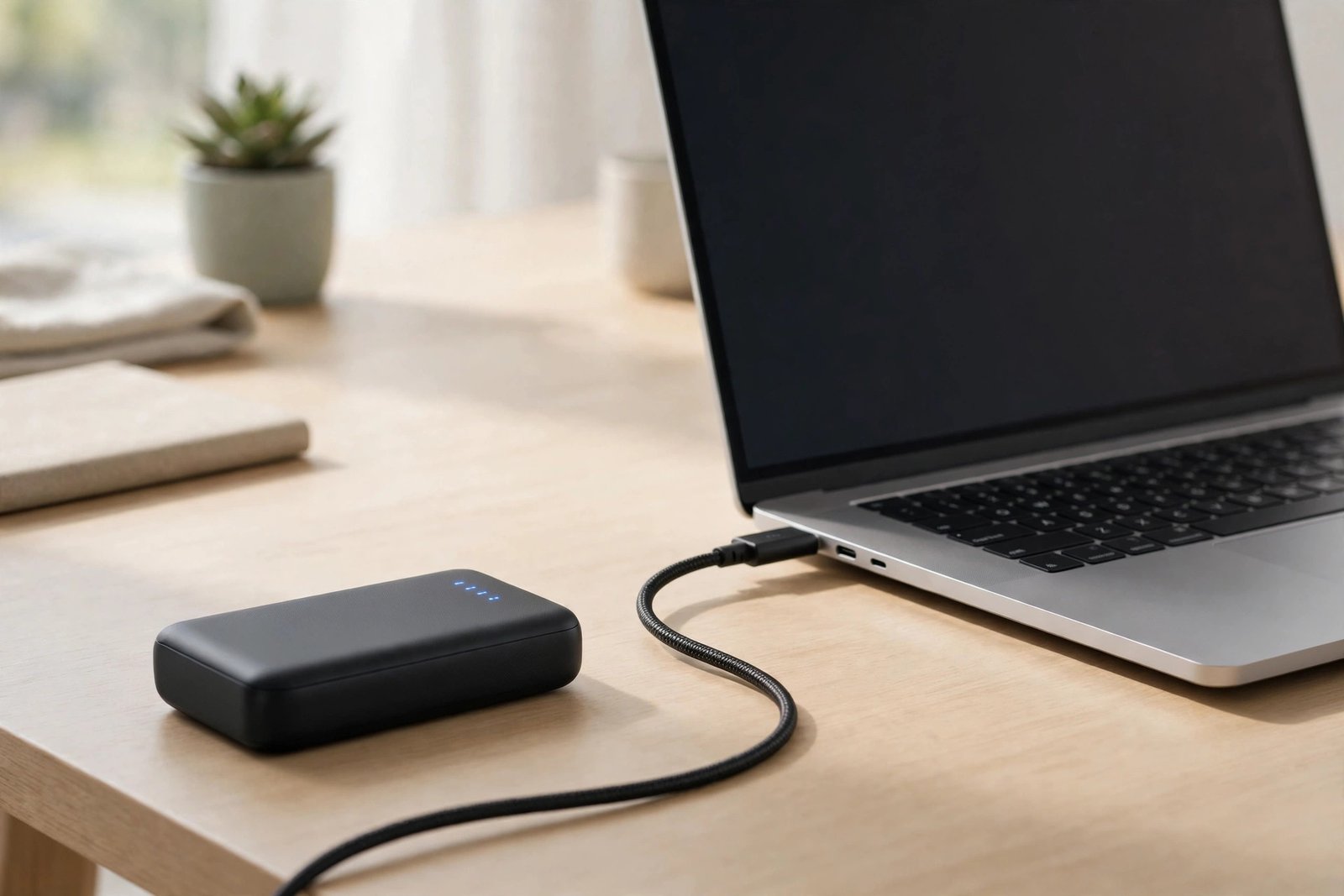
The best portable chargers for laptops in 2027 are not the phone power banks you already own: they are larger, heavier and far more powerful, because a laptop asks much more of a battery than a phone does. A portable charger needs USB-C Power Delivery output of 45W or more to charge most laptops at all, and 65W to 100W to charge one properly while you work. Buy a bank that is too weak and your laptop will drain slowly even while plugged in.
The short answer is that a 65W bank suits most ultrabooks and MacBook Airs, a 100W bank suits most 14-inch and 16-inch laptops, and a 140W bank suits the most demanding machines. Capacity has a hard ceiling, too: the limit for carrying a lithium battery on a plane without airline approval is 100Wh, so the biggest travel-friendly banks sit just under it. We state no prices and make no claims about laboratory test results.
Key takeaways
- A laptop power bank needs USB-C PD output of 45W or more; 65W to 100W is the sweet spot for most laptops.
- Capacity is capped at 100Wh for air travel without airline approval, so the best travel banks sit just under it.
- A 20,000mAh bank holds roughly 74Wh, about one full charge for most ultrabooks, not two.
- A 100W bank suits most 14-inch laptops; a 16-inch laptop under heavy load may need 140W.
- Fast recharging matters: a bank that refills in about an hour beats one that takes all night.
- Check your laptop’s charger wattage first, then buy a bank that matches it.
How to choose a portable charger for your laptop
Start with your laptop’s charger. A MacBook Air ships with a 30W or 35W charger, most 13-inch and 14-inch ultrabooks with 45W or 65W, and larger 15-inch and 16-inch laptops with 65W, 100W or more. Your power bank needs to match that number to keep up while you work. A weaker bank will still add charge when the laptop is asleep, but it will lose ground while you edit video or run a video call.
Next, understand capacity, where most buyers are misled. Capacity is usually printed in milliamp-hours (mAh), but the number that matters for laptops is watt-hours (Wh). A typical 20,000mAh bank holds about 74Wh, and a 27,000mAh bank holds about 100Wh. A modern ultrabook battery holds roughly 50Wh to 70Wh, so a 20,000mAh bank gives you about one full charge, once you allow for energy lost as heat. Claims that it charges a laptop twice are not realistic.
Aviation rules cap lithium batteries in cabin baggage at 100Wh without airline approval, and most airlines allow two spares up to that limit. Banks above 100Wh need approval and may be refused, so the best travel banks are built just under the line, typically at 99Wh or 99.5Wh. If you fly often, do not buy a bank over 100Wh unless you have checked your airline’s rules.
Recharge speed is easy to overlook: a large bank refilled through a slow charger can take most of a day, while the better banks accept 65W or 100W input and refill in around an hour to ninety minutes. Our guide to the best GaN chargers explains how to pick a compact adapter that can refill a power bank quickly.
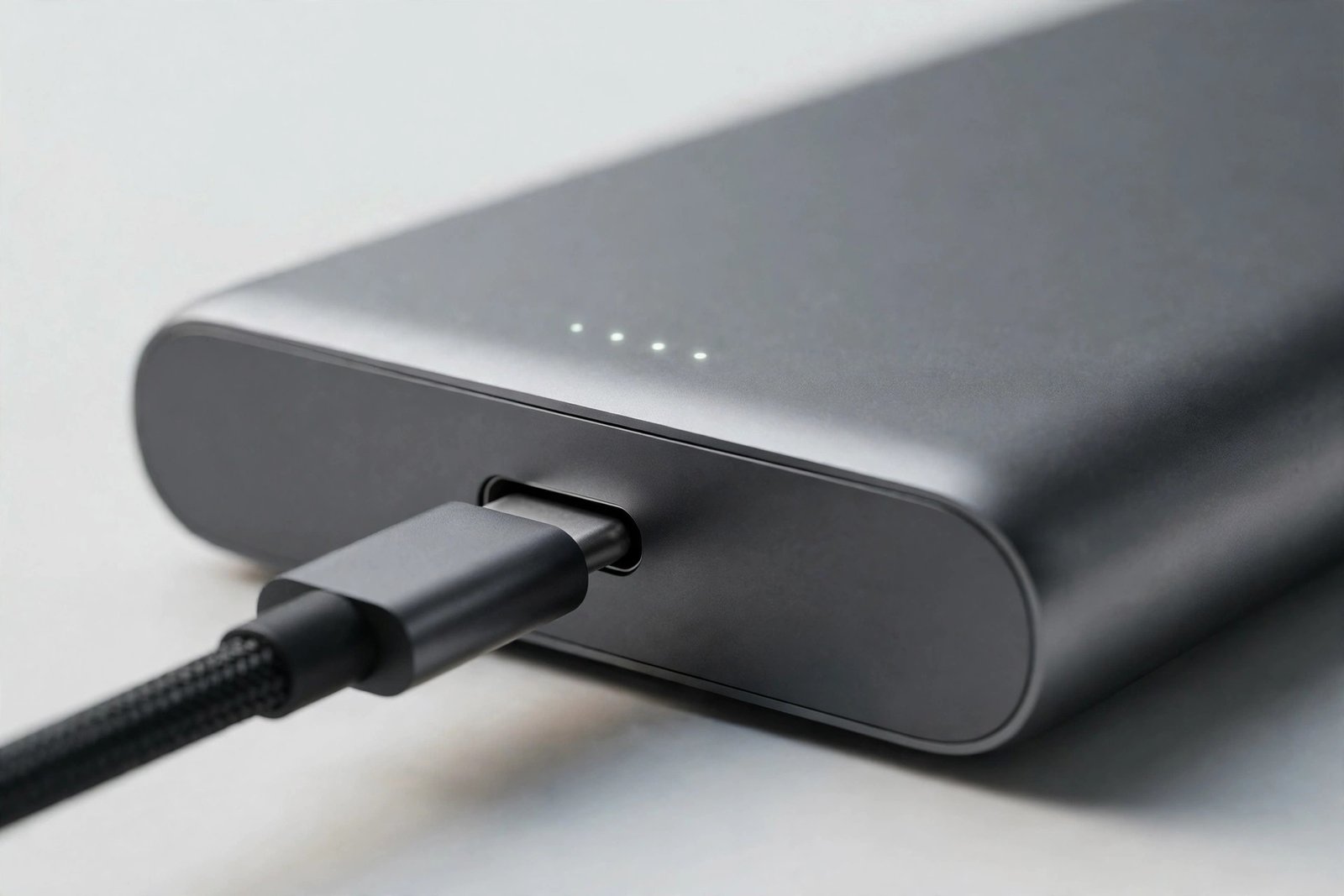
The best portable chargers for laptops in 2027 at a glance
Anker Prime 27,650mAh — the best portable charger for laptops overall
Best for: travellers and power users who want maximum capacity and the fastest charging.
Anker’s Prime 27,650mAh bank is the most capable laptop charger here, and the one to buy if you want a single bank that handles almost any laptop. It holds just under the 100Wh flight limit, delivers up to 100W or more from its main USB-C port depending on the version, and has enough ports to charge a laptop, a phone and a tablet at once.
The trade-offs are size, weight and price: at around 600g to 700g it is a serious object in a bag, and it costs more than the smaller banks below. It is also overkill for a MacBook Air or a light ultrabook. But if you carry a 14-inch or 16-inch laptop and travel often, this is the most complete option available. Check current price before buying.
Anker 737 PowerCore 24K — the best 140W portable charger for laptops
Best for: owners of demanding 16-inch laptops and anyone who wants the fastest laptop charging a power bank can offer.
The Anker 737, also sold as the PowerCore 24K, is built for laptops that need more than 100W. It delivers up to 140W from its main USB-C port, covering larger laptops under heavy load. Capacity is around 86Wh, comfortably under the flight limit, with two USB-C ports plus a USB-A port.
The display shows input and output wattage in real time. The downside is the same as the Prime: large, heavy and expensive, and most ultrabooks will never use the extra 40W. Buy it when your laptop’s charger is rated above 100W; otherwise, a 100W bank gives the same practical result for less money and weight.
UGREEN Nexode 12,000mAh 100W — the best compact 100W portable charger
Best for: commuters and travellers who want 100W output in a bank that fits a jacket pocket.
UGREEN’s Nexode 12,000mAh bank is the most portable way to get a genuine 100W output. Roughly the size of a phone and much lighter than the 100Wh banks above, its main USB-C port still delivers 100W, enough for most 14-inch laptops. That makes it the best everyday-carry option here.
The compromise is capacity. At 12,000mAh, roughly 44Wh, it holds about two-thirds of a typical ultrabook charge, so it will top a laptop up or rescue a low battery, but not fully charge a large laptop from empty. Think of it as a safety net rather than a second battery.
Baseus 20,000mAh 65W — the best budget portable charger for laptops
Best for: ultrabook owners who want laptop charging at the lowest sensible price.
Baseus’s 20,000mAh 65W bank is the cheapest way to charge a laptop properly, and for many ultrabooks it is all you need. Its 65W USB-C PD output matches the charger that ships with most 13-inch and 14-inch ultrabooks, so it keeps up while you work rather than merely slowing the drain. Capacity is around 74Wh, close to a full charge for most ultrabooks.
The compromises are modest: it recharges more slowly than the premium banks, it has no display, and its build is functional rather than premium. Just check your laptop’s charger wattage: if it is rated above 65W, this bank will charge more slowly than its own adapter, and a 100W bank is the better buy.
If you also want a compact bank for your phone alone, our guide to the best 20,000mAh power banks with USB-C PD compares lighter, cheaper phone-focused options.
Best portable chargers for laptops in 2027: comparison table
| Power bank | Capacity | Max USB-C PD output | Ports | Best for |
|---|---|---|---|---|
| Anker Prime 27,650mAh | ~99Wh | 100W+ | 2x USB-C, 1x USB-A | Best overall for travel |
| Anker 737 PowerCore 24K | ~86Wh | 140W | 2x USB-C, 1x USB-A | Demanding 16-inch laptops |
| UGREEN Nexode 12,000mAh | ~44Wh | 100W | 1x USB-C, 1x USB-A | Compact everyday carry |
| Baseus 20,000mAh 65W | ~74Wh | 65W | 1x USB-C, 1x USB-A | Budget ultrabook charging |
Table: the best laptop portable chargers in 2027 compared on capacity, output, ports and best use.
Use this table to match the bank to your laptop. Start with output: it must match or beat your laptop’s charger wattage. Then check capacity against the 100Wh flight limit. A bank that cannot keep up with your laptop is the wrong bank, however good its other features look.
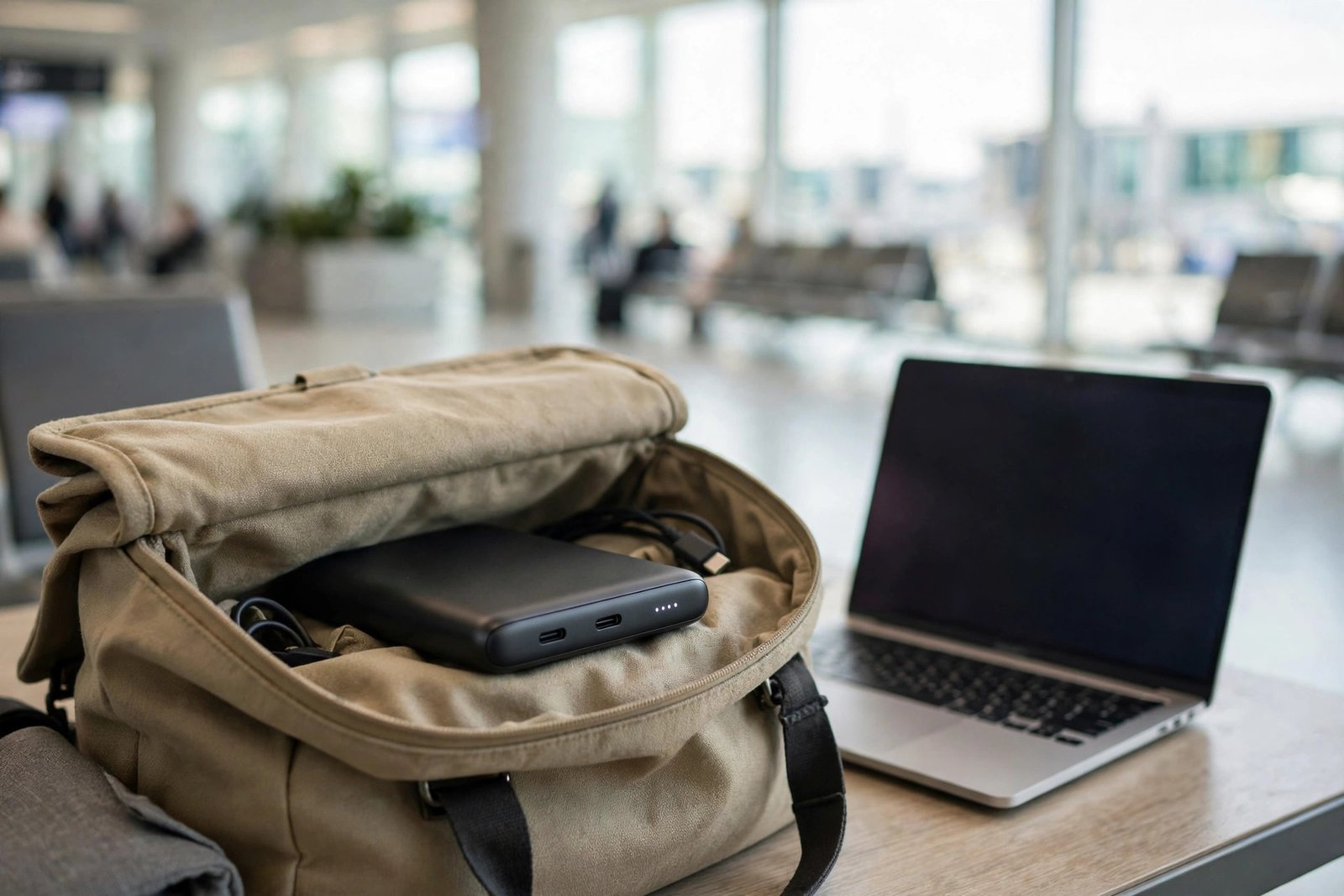
A checklist before you buy a portable charger for your laptop
- Check your laptop’s charger wattage: buy a bank whose USB-C PD output matches or beats it. 45W is the minimum for most laptops, 65W suits most ultrabooks, 100W suits most 14- and 16-inch machines.
- Check capacity in watt-hours: a 20,000mAh bank holds about 74Wh, roughly one full charge for an ultrabook.
- Stay under 100Wh for flights: banks above it need airline approval. The best travel banks sit just under the limit.
- Count the ports: two USB-C ports plus a USB-A port cover a laptop, a phone and earbuds. Check total output when several ports are in use.
- Check recharge speed: a bank that accepts 65W or 100W input refills in about an hour to ninety minutes.
- Check the cable: a laptop bank needs a USB-C cable rated for the wattage you plan to use. A cheap 60W cable will limit a 100W bank.
Frequently asked questions
Can any power bank charge a laptop?
No. A laptop needs a bank with USB-C Power Delivery output of at least 45W, and most need 65W or more to charge while in use. A standard phone power bank, typically 10W to 20W, will not charge a laptop. Check the USB-C PD output before you buy.
How many times will a 20,000mAh power bank charge a laptop?
About once, for most ultrabooks. A 20,000mAh bank holds roughly 74Wh, and a typical ultrabook battery holds 50Wh to 70Wh, so after conversion losses you get close to one full charge. A larger laptop may get only a partial charge.
Can I take a laptop power bank on a plane?
Yes, in cabin baggage, provided it is 100Wh or under, which covers almost all the banks in this guide. Spare lithium batteries must go in cabin baggage, never in checked luggage. Banks above 100Wh need airline approval.
What wattage do I need to charge a MacBook?
A MacBook Air charges well from a 45W or 65W bank, a 14-inch MacBook Pro is best served by a 100W bank, and a 16-inch MacBook Pro benefits from 140W. The laptop only draws what it needs, so a higher-wattage bank is safe.
Why does my laptop drain even when plugged into a power bank?
The bank’s output is lower than the power your laptop is using: if the laptop draws 65W while the bank supplies 45W, the battery drains slowly despite being plugged in. The fix is a bank whose output matches or beats your laptop’s charger wattage.
The bottom line
The best portable charger for a laptop is the one whose output matches your laptop and whose capacity fits your travel. For most ultrabooks, that is a 65W bank; for most 14-inch and 16-inch laptops, a 100W bank; and for the most demanding machines, a 140W bank. Capacity follows the same logic: a 20,000mAh bank gives you about one full charge, and a bank just under 100Wh gives you the most energy you can fly with.
Start by reading the wattage on your laptop’s charger, then pick the bank in this guide that matches it. If you fly often, stay under 100Wh. If you carry the bank daily, favour the lighter options. Buy once, with the right numbers, and the bank quietly saves a working day. If you also charge a phone magnetically, our guide to the best MagSafe chargers covers the best magnetic options.
A short safety note: keep lithium power banks away from heat and direct sun, never carry them in checked luggage, and never use one if the case is swollen, cracked or very hot. Charge on a hard surface with airflow, use a cable rated for the wattage involved, and replace a bank that shows any sign of damage. If a bank ever becomes very hot, swells or smells odd, stop using it.