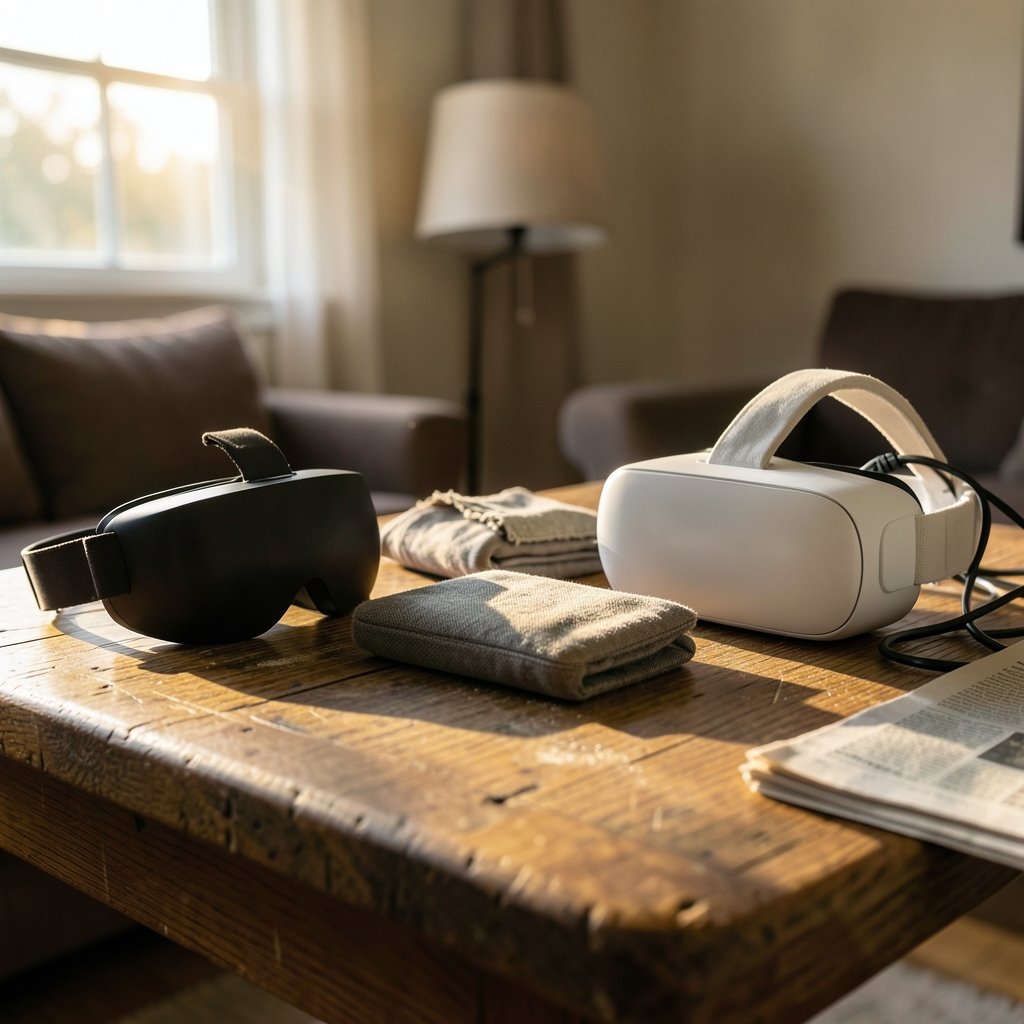
What if the biggest change in VR isn’t sharper screens or faster chips, but the simple fact that the headset stops feeling like a brick strapped to your face? That is the story of 2027. After years of bulky goggles, the market is splitting into two camps: tiny glasses that push the computing into your pocket, and heavier machines built for people who want maximum immersion. Picking the best VR headset for 2027 means deciding which camp you belong to before you spend a four-figure sum.
Here is how the field actually looks, based on what has been announced and reported heading into the year.
The 2027 lineup at a glance
Four devices dominate the conversation. Each one targets a different buyer, and the price gaps are wide.
| Headset | Price | Release timing | Weight on face | Best for |
|---|---|---|---|---|
| Meta VR Glasses | $1,299 | Spring 2027 | About 100 g glasses plus a puck | Comfort, mixed reality, long sessions |
| Valve Steam Frame | From $1,059 (256GB) / $1,299 (1TB) | Out since late 2026, limited stock | About 185–190 g core, 435–440 g total | PC VR gaming, Steam library |
| PlayStation VR2 | Around €434 | Already available | About 560 g | PS5 owners who want OLED |
| Pimax Crystal Pro | $1,399 / $1,899 with wireless kit | Available | Heavier, tethered-style build | Sim fans chasing raw resolution |
A fifth name, the Xreal Aura, sits closer to spatial computing glasses than a classic VR headset, and it arrives before the end of 2026. It matters because it competes directly with Meta’s new device for the same “big screen in the air” use case.
Meta VR Glasses: the comfort play

Meta skipped a Quest 4 and went in a different direction. The Meta VR Glasses are not a Quest with a new name. They are a lightweight pair of glasses wired to a separate computing puck that you carry in a pocket or clip on. The result is roughly 100 grams on your face instead of the 515 grams of a Quest 3.
That number is the whole pitch. Meta’s device is reportedly 83% lighter and 60% smaller than the Apple Vision Pro, which weighs in around 600 to 650 grams. If you have ever ended a VR session with red marks across your cheeks, you understand why this matters more than a spec sheet suggests.
The trade-offs are real, though. The field of view is about 70 degrees, well below the 110 degrees you get from a Quest 3 or PS VR2. The open-sided design keeps your peripheral vision clear, which helps with awareness but can break immersion in dark games. And the glasses do not ship with controllers, relying instead on hand and eye tracking.
Key specs at a glance:
- Micro-OLED displays at 2,412 x 2,288 pixels per eye
- 37 pixels per degree, sharper than the Quest 3’s 25
- Four eye-tracking cameras and full hand tracking
- Colour passthrough with autofocus and depth sensing at 26 PPD
- About three hours of runtime from the puck battery
- Touch Plus controller compatibility, sold separately
The positioning is telling. Meta is aiming these at adults who want a premium screen for films, sport and work, not at teenagers playing shooters. Streaming and sports partnerships are part of the launch story. If your idea of VR is watching a match on a virtual cinema screen, this is the most comfortable way to do it.
Valve Steam Frame: the gamer’s machine
Valve’s Steam Frame takes the opposite approach. It is a self-contained headset at roughly 435 to 440 grams, with the processor and battery built in. Pre-orders opened on September 14, 2026, at $1,059 for the 256GB model and $1,299 for 1TB. Stock has been hard to find since launch.
The Frame is unapologetically for PC players. It leans on the Steam library, ships with ringless controllers included, and runs on AA batteries rated for around 40 hours. It has two eye-tracking cameras and no hand tracking, which tells you exactly who Valve expects to buy it: people holding controllers.
Battery life is the weak spot. There is no official runtime figure, and early reviewers have flagged limitations. That is worth knowing before you plan a long session.
If you are weighing this against Meta’s glasses, the decision comes down to content. Steam Frame wins on games. Meta wins on comfort and mixed reality. For a wider look at how AI-driven interfaces are reshaping the software around these devices, the roundup of the 10 best AI chatbots, including GPT-5 and Claude, under the hood in 2027 shows how much of the assistant layer now runs on the same kind of spatial hardware.
PlayStation VR2: still the value pick for console owners
Sony’s headset has not been replaced, and it remains the easiest recommendation for anyone who already owns a PS5. The PS VR2 brings OLED HDR panels at 2,000 x 2,040 pixels per eye, deeper blacks than the LCDs in a Quest, eye tracking with foveated rendering, headset haptics and Sense controllers with adaptive triggers. It connects with a single USB-C cable.
Since August 2024, a €59.99 PC adapter has let the PS VR2 work with SteamVR. That sounds like a bonus, but the fine print matters. On PC you lose HDR, eye tracking, headset haptics and adaptive triggers, and you need a DisplayPort 1.4 cable that is not included. The lenses are Fresnel, and the camera view is black and white, so there is no real mixed reality.
At around €434, it is by far the cheapest way into high-quality VR. Just go in knowing it is a console-first device with a PC mode that strips out its best tricks.
Pimax Crystal Pro: for the spec chasers
The Pimax Crystal Pro sits at $1,399, or $1,899 with the wireless kit. It exists for flight sim and racing sim players who want maximum clarity and do not mind the bulk. One detail has raised eyebrows in the community: it uses a 2020-era chip inside a headset at that price. Whether that matters depends entirely on what you run. For seated sims, the compute matters less than the panels.
For most buyers, this is a specialist tool, not a daily driver.
Xreal Aura and the smart glasses wave
The Xreal Aura arrives before the end of 2026 and runs on Android XR with Gemini built in. It shares the Snapdragon Reality Elite chip and a 70-degree field of view with Meta’s glasses, and both offer roughly three hours of battery. Xreal’s edge is connectivity to other devices and Google’s software and services. Meta’s edge is MicroOLED displays, eye tracking and hand tracking.
A broader wave of smart glasses from Xreal, Samsung and Meta is also arriving. If you mainly want notifications and a floating screen rather than full immersion, these are worth a look before you commit to a headset.
How to choose without wasting money
The most common mistake is buying on specs alone. A headset with a 110-degree field of view is useless if it hurts after 20 minutes. Here is a practical order of operations.
- Decide what you will actually do. Games, films, fitness, work monitors and sims all push you toward different devices.
- Weigh comfort over resolution. A 100-gram pair of glasses you wear for two hours beats a 560-gram headset you wear for 20 minutes.
- Check the content library. Steam Frame lives on Steam. PS VR2 lives on the PlayStation Store. Meta’s glasses lean on streaming and sports partnerships.
- Budget for accessories. Meta’s glasses do not include controllers. The PS VR2’s PC adapter does not include the cable you need. These add up.
- Try before you buy if you can. Field of view and fit are personal, and no table captures either.
If you are also planning a big purchase elsewhere in 2027, the same logic applies: the Toyota Tacoma 2027 that buyers can realistically expect is a good reminder that announced specs and delivered reality are not always the same thing. (Best ai tools writers 2027 15 apps compared head head)
What the community is actually saying
The mood around the 2027 lineup is a mix of excitement and impatience. Steam Frame owners are happy with the hardware but frustrated by availability. Meta’s glasses have drawn praise for the weight and skepticism about the narrow field of view and the missing controllers. Pico cancelled its Space Pro launch the day before it was due, which has made some buyers cautious about committing early to any new platform.
Prices also climbed in 2026 because of memory shortages, and that pressure has not fully eased. Meta raised Quest prices in April 2026, with the Quest 3S starting at $349.99 and the Quest 3 at $599.99 in the US. Those older headsets remain the budget option if $1,299 is too steep.
So which one is the best VR headset for 2027?
There is no single winner, and anyone who tells you otherwise is selling something. The honest answer depends on your priorities.
- For comfort and mixed reality: Meta VR Glasses. Nothing else comes close on weight, and the eye and hand tracking are genuinely useful.
- For PC gaming: Valve Steam Frame. The Steam library and included controllers make it the gamer’s pick, if you can find one.
- For value: PlayStation VR2. Around €434 for OLED and eye tracking is a good price, provided you own a PS5.
- For sims and resolution: Pimax Crystal Pro. A specialist purchase with a specialist price.
- For spatial computing on Android: Xreal Aura. A strong alternative if you use Google’s apps and services.
The broader trend is clear. VR is shrinking from headsets toward glasses, and 2027 is the year that shift becomes a real buying decision rather than a demo. The device that wins your money should be the one you forget you are wearing.
Frequently asked questions
What is the best VR headset to buy in 2027?
For most people who want comfort and mixed reality, the Meta VR Glasses at $1,299 are the strongest all-round pick. For PC gaming, the Valve Steam Frame is the better fit. For budget buyers with a PS5, the PlayStation VR2 at around €434 offers the best value.
How much do the new 2027 VR headsets cost?
The Meta VR Glasses cost $1,299 and launch in spring 2027. The Steam Frame starts at $1,059 for 256GB or $1,299 for 1TB. The Pimax Crystal Pro is $1,399, or $1,899 with the wireless kit. The PS VR2 sits around €434.
Is the Meta VR Glasses better than the Steam Frame?
They serve different buyers. Meta’s glasses weigh about 100 grams on the face and include eye and hand tracking, making them better for comfort and mixed reality. The Steam Frame is a heavier, self-contained headset built around the Steam library with controllers included, which suits PC gamers better.
Do the Meta VR Glasses come with controllers?
No. The glasses rely on hand and eye tracking out of the box, and Touch Plus controllers are compatible but sold separately. That is a cost many buyers forget to add when comparing prices.
Can I use the PlayStation VR2 with a PC?
Yes, through a €59.99 adapter that has been available since August 2024. However, you lose HDR, eye tracking, headset haptics and adaptive triggers on PC, and you need a DisplayPort 1.4 cable that is not included.
Should I wait for 2027 or buy a Quest now?
If budget matters, the Quest 3S at $349.99 and Quest 3 at $599.99 remain solid entry points. If comfort is your main complaint with current headsets, waiting for the lighter Meta VR Glasses in spring 2027 makes sense. Check official pages closer to launch, since availability and final pricing can shift.
Conclusion
The best VR headset for 2027 is not the one with the biggest number on a spec sheet. It is the one that fits the way you actually use it. Meta has bet that comfort wins, and the 100-gram VR Glasses make a persuasive case. Valve has bet that PC gamers want a self-contained machine with their Steam library ready to go. Sony quietly keeps offering the best value for console owners, and Pimax serves the sim crowd who want every pixel.
Before you spend, be honest about three things: how long you will wear the thing, what you will run on it, and whether the accessories you need are in the box. Get those right and the choice becomes much simpler. Get them wrong and even a $1,299 headset ends up in a drawer.