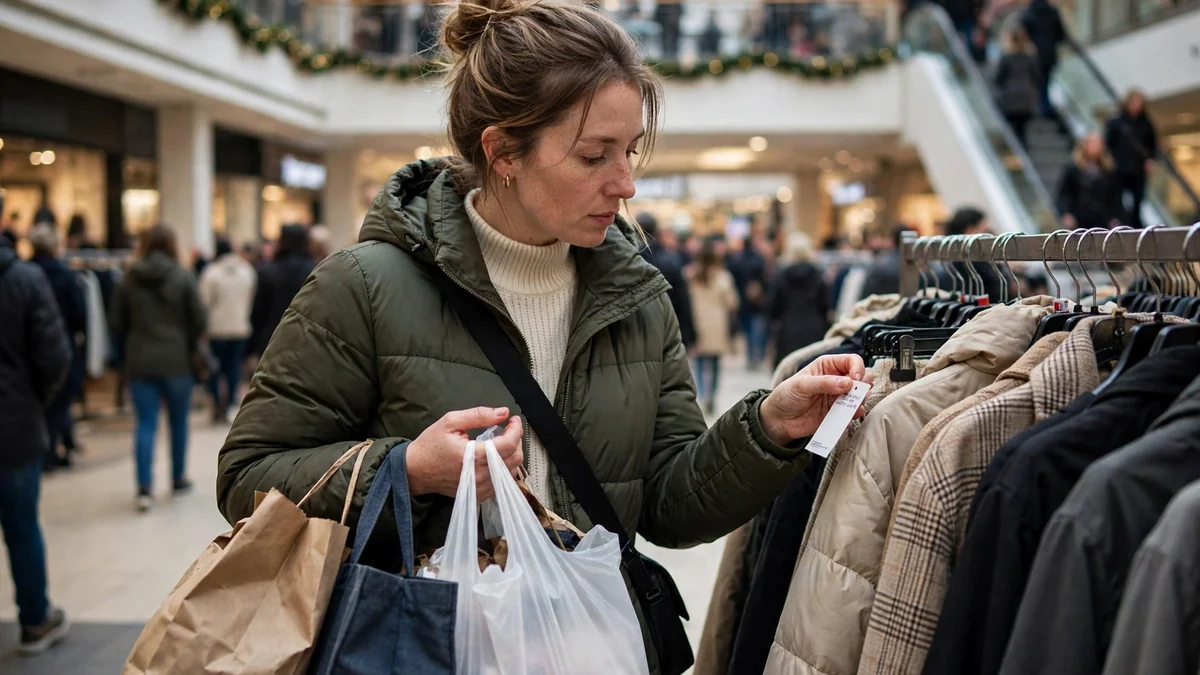
Black Friday 2026 arrived with quieter malls, shorter gift lists and shoppers openly counting every dollar. At a luxury mall in downtown Manhattan, security guards outnumbered shoppers, parking spots were easy to find at malls in the New York suburbs, and a shopper at a Walmart in Chicago said her holiday budget had been cut in half. Bloomberg’s reporting from the day, published on 29 November 2026, described a Black Friday that got off to a slow start as shoppers knocked people off their gift lists, pared back on big purchases and traded down to cheaper items.
The slow start does not mean shoppers stayed home entirely. Total holiday spending is still expected to climb by 5.4% this year compared with 2025, or 2.8% once inflation is stripped out, according to PwC, and Americans are expected to spend almost $13 billion in online transactions on Black Friday alone, according to Adobe Analytics. The tension between those two facts is the story of this season: people are spending, but higher prices mean the money buys less.
What shoppers say they are doing is strikingly practical. They are buying what people need rather than what they want, swapping new electronics for accessories, hunting second-hand deals, and choosing gifts that keep people away from screens, such as puzzles, knitting supplies and shared experiences. For households watching every price tag, Black Friday 2026 is less a splurge and more a careful restock at a discount.
Key takeaways
- Black Friday 2026 started slowly, with quiet malls and shoppers trimming gift lists and trading down to cheaper items, according to Bloomberg’s reporting from the day.
- Total holiday spending is still forecast to rise 5.4% this year, or 2.8% excluding inflation, according to PwC, while Adobe Analytics expects almost $13 billion in online spending on Black Friday alone.
- An NRF survey found 82% of consumers are taking steps to manage holiday costs, such as buying less expensive gifts, and 40% are looking for more resale and vintage deals, according to PwC.
- Middle- and lower-income shoppers are more likely than wealthier ones to spend less, having traded down for months, according to a Kearney survey reported by Reuters.
- Higher starting prices mean many discounts look smaller than they seem, so the real test of a deal is the final price, not the size of the percentage cut.
What Black Friday actually looked like on the ground
The scenes Bloomberg’s reporters described were muted rather than chaotic. At the Mall at Short Hills in Millburn, New Jersey, 22-year-old Rose Lora said her family was still buying gifts but being more careful. “We’re still gonna buy gifts for people, but we’re definitely gonna be just a little bit more cautious with money,” she said. At a Costco in Springfield, Virginia, 46-year-old Laura Forbes summed up the shift in one line: “Before it was well, ‘what do you want?’ Now it’s ‘what do you need?'”
Carla Baeza, shopping at a Walmart in Chicago, put numbers on it. She was stocking up on a 15-pair pack of socks for $5 and said she has cut her overall budget from $2,000 to $1,000. Tarsha Rice, 51, said she is not planning to buy new electronics this year and has cut her spending by 30% to 40%. “We’ll accessorize. Ordinarily we might upgrade,” she said. Kayla Pinto, 28, drove about 45 minutes from home to the Kittery Premium Outlets in Kittery, Maine, and said consumers were looking for “deals on top of deals.” Even brands such as Alo, Levi’s, LoveShackFancy and Adidas struggled to lure shoppers into some of their stores.
The mood fits a wider cooling in consumer spending. As our report on US consumers tempering spending as the global economy cools explains, October spending was little changed and households entered the holidays with less momentum than they had a year ago. Black Friday did not reverse that picture; it confirmed it, with shoppers spending more selectively and only where the discount felt real.
The trade-down in the cart

Trading down is the clearest pattern of the season. Instead of a new television or a new phone, shoppers are buying accessories, smaller gifts and cheaper versions of the things they would normally choose. Gifts that keep people away from screens are a priority this year: puzzles, knitting supplies and experiences such as concerts, travel and spa days that can be shared with loved ones. Second-hand shopping is also on the rise, with 40% of consumers looking for more resale and vintage deals, up five points from last year, according to the PwC data.
Why budgets are shrinking
Inflation and high fuel costs are the pressures shoppers name most often, and neither is expected to stop Americans from spending altogether. Holiday spending, which unofficially begins on Black Friday, is seen topping last year’s strong figures by 4% to 6% across several economic forecasts, according to Reuters. The National Retail Federation sees November-December holiday retail sales rising 4.2% year over year, to just above $1 trillion. The spending is happening; it is simply being spread thinner, across fewer people and cheaper items.
Two extra pressures landed just before the weekend. Widespread tech issues affecting flight systems, communications servers and banks sent some consumers into prepper mode, with Walmart, Costco and Tractor Supply seeing panicked buying of generators and bottled water. A stock market correction after the midterms could also dampen the wealth effect that has seen affluent shoppers splurge on gadgets, UBS analysts said.
What it means for retailers
Retailers saw the belt-tightening coming and said so on recent earnings calls. Target, Dollar Tree and Kohl’s have all pointed to shoppers watching their spending, and the discount end of the market is drawing even higher-income bargain hunters. Kohl’s and Dollar Tree have expanded $3 to $20 gift sections, and Dollar Tree chief executive Michael C. Creedon Jr. said shoppers are “cherishing value and buying closer to need.”
Online spending remains the bright spot. Consumers spent about $7.1 billion online on Thanksgiving Day, up 10.4% over last year according to Adobe, and Black Friday online spending is expected to jump 9.2% to $12.9 billion, driven by buy now, pay later and discounts on televisions, toys and furniture. The contrast with last year is sharp: as our report on Black Friday spending jumping as electronics led the way in 2026 shows, big-ticket gadgets drove the story a year ago, while this year the growth is in cheaper items and essentials.
How to shop a tight budget this season
The second step is to compare the final price, not the discount percentage. With starting prices higher than last year, a 30% discount can still leave an item more expensive than it was twelve months ago, so check the price at two or three retailers before buying.
The third step is to use the trade-down deliberately. If a new device is out of reach, an accessory or a shared experience can carry the same thought for a fraction of the price, and resale is worth a look early, since 40% of consumers are hunting second-hand deals. Buy now, pay later can spread the cost, but only if the instalments are already in the budget. A budgeting app can help enforce the limit, and our roundup of the top AI tools for finance in 2027 is a good place to start.
The caveats that matter
Most of the figures in this article are forecasts or survey results, not final sales data, and they will be revised as the season unfolds. PwC’s 5.4% holiday forecast and Adobe’s $12.9 billion Black Friday estimate are projections made before the weekend’s sales were counted, and the shopper stories Bloomberg reported are snapshots from a handful of stores, not a national sample.
| Detail | What is known | Bloomberg reported on 29 November 2026 that shoppers trimmed budgets and traded down |
|---|---|
| Holiday spending forecast | Up 5.4% this year, or 2.8% excluding inflation, according to PwC | Almost $13 billion expected (Adobe); Thanksgiving Day online spending was $7.1 billion, up 10.4% |
| Managing costs | 82% of consumers are taking steps to manage holiday costs, NRF November survey |
| Resale and vintage | 40% of consumers are looking for more resale and vintage deals, up five points from last year, PwC |
| Holiday retail sales | NRF sees November-December sales rising 4.2% to just above $1 trillion |
| Toy prices | Up 13.2% since the start of the year; Mattel cut its annual forecast as shoppers balked |
| Who is cutting most | Middle- and lower-income shoppers, who have traded down for months, Kearney survey |
A tight-budget Black Friday checklist
- Set a fixed total budget before shopping, write it down, and treat it as a hard limit rather than a rough guide.
- Make a gift list with one named recipient per item, and cut the list before cutting the quality of every gift.
- Compare final prices across at least two retailers instead of trusting the discount percentage on the tag.
- Check resale and vintage options early, since the best second-hand finds go first and 40% of shoppers are looking there.
- Choose useful gifts and shared experiences over big-ticket electronics when the budget is tight.
- Use buy now, pay later only for purchases already inside the budget, and check current pricing and payment terms before committing.
Frequently asked questions
Are shoppers spending less this Black Friday?
Not exactly. Total holiday spending is forecast to rise 5.4% and online Black Friday spending should reach almost $13 billion, but many shoppers are spending less per gift, trimming lists and choosing cheaper items, so higher prices are doing much of the work behind the higher total.
What does trading down mean for holiday shopping?
Trading down means choosing a cheaper version of something, a smaller gift, an accessory instead of a new device, or a second-hand item instead of a new one. It is the main pattern of Black Friday 2026, reported across income levels but most common among middle- and lower-income shoppers.
Why are malls quieter this Black Friday?
Bloomberg’s reporters found quiet malls, easy parking and thin crowds at several locations, while online spending jumped. Shoppers are still buying, but more of the buying has moved online, and in-store visits are shorter and more targeted, with list in hand rather than a day of browsing.
Are Black Friday discounts smaller this year?
The percentage discounts may look similar, but they start from higher original prices, so the saving in cash terms can be smaller. Neil Saunders of GlobalData made the point directly: discounts are there, but they are starting from a higher original price point in a lot of cases.
Is second-hand shopping really growing?
Yes, according to PwC’s holiday data. Some 40% of consumers are looking for more resale and vintage deals this year, up five points from last year, and the trend covers gifts as well as everyday items.
Will spending recover before Christmas?
That is not yet known. The NRF expects holiday retail sales to rise 4.2% to just above $1 trillion, and Cyber Monday and December discounts could still lift the season. The early read is cautious rather than gloomy: shoppers are careful, not absent.
Bottom line
Black Friday 2026 belongs to the careful shopper. Budgets are smaller, gift lists are shorter, and the trade-down, from new devices to accessories, from new gifts to vintage finds, from wants to needs, is visible in almost every cart Bloomberg’s reporters looked into. The retailers winning the season are the ones selling value plainly: clear prices, real discounts and useful goods, not the ones shouting the biggest percentage off.
For households, the lesson is simple and worth keeping past the holidays. Decide the budget first, compare final prices rather than discount claims, and let the list, not the store, decide what comes home. Spending is still expected to rise this season, but the shoppers who come out ahead will be the ones who spent deliberately, not the ones who spent the most.