

In 2021, a man paralyzed from the neck down used an implanted brain sensor to type roughly 90 characters per minute, just by imagining his hand moving. That is faster than many people text on a phone. It sounds like science fiction, but brain-computer interfaces, or BCIs, are already moving from labs into real clinical trials. This guide breaks the technology down in plain language: what it is, how it works, who it helps, and where it still falls short.
Quick Answer: What is brain computer interfaces and how does it work in simple terms?
A brain-computer interface is a system that reads electrical signals from your brain, translates them with software, and uses the result to control a computer or device without moving a muscle. Most systems today are non-invasive and use scalp sensors called EEG, while a smaller number are implanted directly on or inside the brain for sharper signals. (Brain–computer interface)
The main difference between approaches is signal quality versus safety. Scalp sensors are safe and cheap but noisy, while implants capture clearer signals but require surgery and carry durability risks. Clinics and research labs are the places where these systems are actually used right now, mostly to help people with paralysis communicate or control equipment.
Before trusting any BCI claim, check the signal method, the peer-reviewed evidence behind it, the surgical risk, how long the hardware lasts, who regulates it, and what it actually costs.
A Quick Tour of the Technology
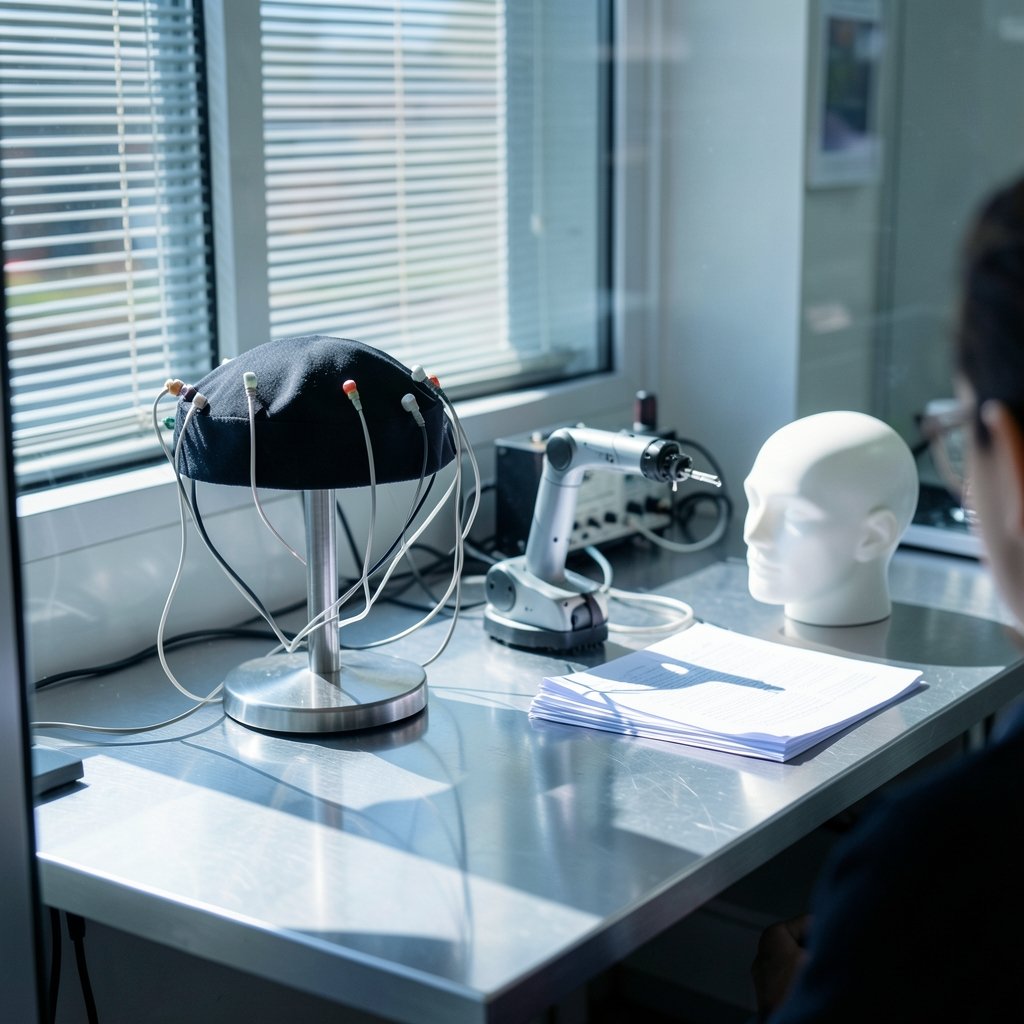
Think of a BCI as a three-part relay team. First, a sensor picks up brain activity. Second, software cleans that raw signal and matches patterns to intentions. Third, the decoded intention drives an output, like a cursor, a robotic arm, or a speech synthesizer.
The brain runs on electricity. When groups of neurons fire together, they create tiny voltage changes that sensors can detect. A BCI does not read minds in any mystical sense. It recognizes patterns that consistently accompany a thought like “move my right hand” or “pick the letter A.” The machine learns those patterns through calibration, and the user learns to produce them reliably. It is a two-way training process, and that surprises most newcomers.
The idea goes back decades. Work on using brain signals to control external devices began long ago, and early demonstrations in the 1990s and 2000s showed that monkeys and then humans could move cursors with thought alone. What changed recently is computing power, better electrodes, and machine learning models that can interpret noisy neural data much faster than older methods.
How a BCI Works, Step by Step
Here is the pipeline in plain terms:
- Record. Electrodes capture electrical activity, either on the scalp, on the brain surface, or inside the cortex.
- Filter. Software strips out noise from muscle movement, electrical interference, and the body itself.
- Extract features. The system isolates specific patterns, such as frequency rhythms or the firing of particular neuron groups.
- Interpret. A trained model maps those patterns to intentions, like “move cursor left” or “select this word.”
- Output. The command goes to a device: a screen, a wheelchair, a robotic limb, or a speech synthesizer.
- Feedback. The user sees the result and adjusts, which gradually improves accuracy on both sides.
That last step matters more than people expect. In practice, most early frustration comes from users expecting instant mind-reading. Real BCIs need minutes to hours of calibration, and performance drifts when users are tired, distracted, or tense. Clinicians often report that relaxed focus works better than intense concentration, which is counterintuitive for first-timers.
Invasive vs. Non-Invasive: The Core Trade-Off
The biggest fork in the road is whether the sensor goes inside the skull. Each path has real costs and benefits.
| Feature | Non-invasive (EEG) | Invasive (implanted arrays) |
|---|---|---|
| Sensor location | Scalp surface | On or inside the cortex |
| Signal quality | Lower, blurred by skull | High, single-neuron detail |
| Surgery required | No | Yes |
| Typical risk | Skin irritation, gel mess | Infection, bleeding, hardware failure |
| Setup time | Minutes, but noisy | Long surgical recovery |
| Best current use | Research, simple control, neurofeedback | Communication and prosthetics for severe paralysis |
| Cost and access | Relatively low, widely available | High, limited to trial sites |
A middle path exists too. Some systems place electrodes on the brain surface (electrocorticography) or deliver them through blood vessels, which lowers surgical burden while improving signal quality compared with scalp recordings. These approaches are still experimental but represent a genuine compromise rather than a marketing claim.
For readers curious about how software turns raw data into usable output, the same pattern-recognition logic shows up in consumer tools. Understanding how AI image generation works is a useful parallel: both rely on models trained on large datasets to convert messy input into a clean result.
What BCIs Can Actually Do Today
The clearest wins are in restoring function for people with severe paralysis. Participants with ALS or spinal cord injuries have used implanted BCIs to type, send messages, control a cursor, and in some studies produce synthesized speech at conversational speeds. One widely reported 2023 result described speech decoding at roughly 62 words per minute in a participant with ALS, which is far faster than earlier spell-on-a-screen methods.
Other active areas include:
- Robotic arm control for reaching and grasping tasks.
- Wheelchair navigation using decoded movement intentions.
- Communication spellers that let users select letters with focused attention.
- Neurofeedback for attention and relaxation training, mostly in non-clinical settings.
Consumer headsets exist, and they are genuinely fun to experiment with. But be skeptical of bold claims. Most affordable EEG devices detect broad states like focus or relaxation, not specific thoughts. If a product promises to read your intentions from a headband, ask for peer-reviewed data. Also be careful with the software you install alongside these tools, since sketchy downloads are a real risk. Knowing what a computer virus actually is helps you spot bundled malware disguised as a driver update.
The Human Side: What Practice Actually Reveals
Textbook diagrams make BCIs look cleaner than they are. In real sessions, a few practical truths stand out.
Calibration is everything. Users who skip or rush the setup phase get poor control and blame the hardware. A patient 20-minute calibration usually beats an impatient 5-minute one.
Fatigue degrades performance fast. Neural signals shift when you are tired, and sessions longer than about an hour often show declining accuracy. Good trial protocols build in breaks.
Simple beats clever. Systems that give clear, immediate feedback outperform fancy interfaces with laggy responses. Latency kills the sense of control.
Electrode contact is fragile. With scalp systems, dry skin, thick hair, and sweat all degrade signal. Technicians spend real time prepping the scalp, and that unglamorous work determines results.
Expectation management is half the job. Families often arrive expecting telepathy. Honest clinicians set expectations early: this is a slow, effortful skill, closer to learning an instrument than flipping a switch.
There is also a practical hygiene angle for anyone running BCI software on a lab or home computer. Install updates, avoid unknown downloads, and follow basic steps to prevent computer viruses, because research machines hold sensitive participant data. (Brain-computer interfaces: communication and restoration of function)
Where the Field Is Headed
Several trends are worth watching. Electrode counts are rising while device sizes shrink. Wireless transmission is replacing cables, which matters enormously for user dignity and infection risk. Machine learning is squeezing more meaning out of fewer neurons, and speech decoding is improving quickly.
Regulatory attention is growing too. Regulators have published draft guidance on implanted BCIs, signaling that approval pathways are being formalized. That is good news for safety, though it also means timelines will stretch. Company announcements should be read alongside peer-reviewed publications, and the gap between the two is often wide. A flashy demo video is not the same as a controlled study with published outcomes.
Ethics deserve real space here. Neural data is uniquely personal, and questions about consent, data ownership, and cognitive privacy are unresolved. Researchers increasingly argue that BCIs need privacy rules stricter than those for ordinary health data, because a decoded signal could reveal intentions or emotional states a user never meant to share. Anyone evaluating the field should weigh those concerns as seriously as the technical milestones.
How to Evaluate a BCI Claim
Whether you are a patient, a caregiver, a student, or a curious investor, a short checklist helps separate substance from hype:
- Is the work published in a peer-reviewed journal, or only announced in a press release?
- How many participants, and over what time period?
- What is the signal method, and what are its known failure modes?
- Who regulates or oversees the trial?
- What happens when the hardware degrades or the company folds?
- What does the user actually gain in daily life, measured in hours of independent function?
That last question is the one that matters most. A system that types 90 characters per minute in a lab but requires a technician and a stable power supply may deliver far less real-world freedom than a simpler tool. Practical independence, not benchmark numbers, is the honest metric.
Conclusion
Brain-computer interfaces are neither magic nor vaporware. They are a maturing engineering discipline built on a simple loop: record brain activity, interpret the pattern, act on it, and learn from the result. Non-invasive systems are easy to access but noisy; implanted systems are capable but carry surgical and durability costs. The most convincing progress so far sits with people who have lost movement or speech, and for whom even slow, effortful control makes a real difference.
For everyone else, the sensible stance is informed curiosity. Follow the peer-reviewed literature, treat company announcements with healthy skepticism, and remember that the field’s hardest problems are as much about privacy, access, and long-term reliability as about electrode counts. The technology will keep improving. The judgment about when and how to use it belongs to people, not to the machines.
Frequently Asked Questions
Do brain-computer interfaces require surgery?
Only invasive types do. Scalp-based EEG systems need no surgery at all; they use electrodes in a cap or headset. Implanted systems require a surgical procedure to place arrays on or inside the cortex, which brings infection and hardware-failure risks. A third category delivers electrodes through blood vessels, reducing surgical burden but still counting as an implant.
Can a BCI read your thoughts?
Not in the mind-reading sense. A BCI detects patterns of electrical activity linked to specific intentions or states, and only after training on that individual. It cannot access memories or inner monologue. Most systems can distinguish a handful of intended actions at best, and accuracy drops when users are tired or distracted.
How long does it take to learn to use one?
It varies widely. Simple cursor control with scalp EEG can take a few sessions, while implanted systems for communication often require weeks of practice to reach peak speed. Calibration is continuous, and performance depends heavily on rest, focus, and consistent electrode contact. Think of it as learning an instrument rather than flipping a switch.
Are consumer BCI headsets worth buying?
For curiosity and basic neurofeedback, they can be enjoyable and educational. They detect broad states like attention or relaxation, not specific thoughts. Be cautious with bundled software, since unknown downloads are a common infection route. If you experiment, learn how to choose the best antivirus for your computer first, and keep your device firmware updated.
What are the biggest risks of implanted BCIs?
Surgical complications such as bleeding and infection lead the list. Over time, electrodes can degrade or scar tissue can build up, weakening signals. Data privacy is another concern, since neural recordings are intensely personal. Long-term reliability data is still limited, which is why most implants remain investigational rather than routine care.
Will BCIs ever replace keyboards or phones for ordinary users?
Unlikely in the near term. Keyboards and touchscreens are fast, cheap, and reliable, and BCIs cannot match them for general tasks. The realistic path is assistive use first, where the benefit is enormous for people with paralysis or speech loss, followed by narrow niche applications. Mainstream adoption would require major gains in comfort, cost, and safety.



