Ever opened a hardware news site, seen ten headlines about chip yields, data centers, and CPU throttling, and wondered whether any of it changes what you should buy? You are not alone. Most computer hardware news is written for people who already know the jargon. This guide translates the big stories into plain English, shows which ones touch your wallet, and explains how to read the noise without getting fooled. (Router hardware offloading explained your cpu not doing)
Why Computer Hardware News Feels So Loud Right Now
Three forces are pushing hardware coverage into overdrive. First, AI infrastructure spending has pulled manufacturing capacity toward servers and accelerators, which ripples into consumer prices and supply. Second, chip manufacturing yields have become front-page material, because a single fabrication problem can delay an entire product line. Third, memory supply has tightened enough that even Apple quietly pulled high-capacity Mac Studio and Mac mini configurations from its store, a detail reported by Tom’s Hardware amid what it described as a memory crunch affecting consumer products. (Tesla website robotaxi semi roadster three hardware bets 2026)
The result is a news cycle where a factory in one country changes the price of a laptop in another. That is genuinely new for a hobby that used to revolve around launch dates and benchmark charts.
The Intel Story: Ambition, Yields, and Nova Lake
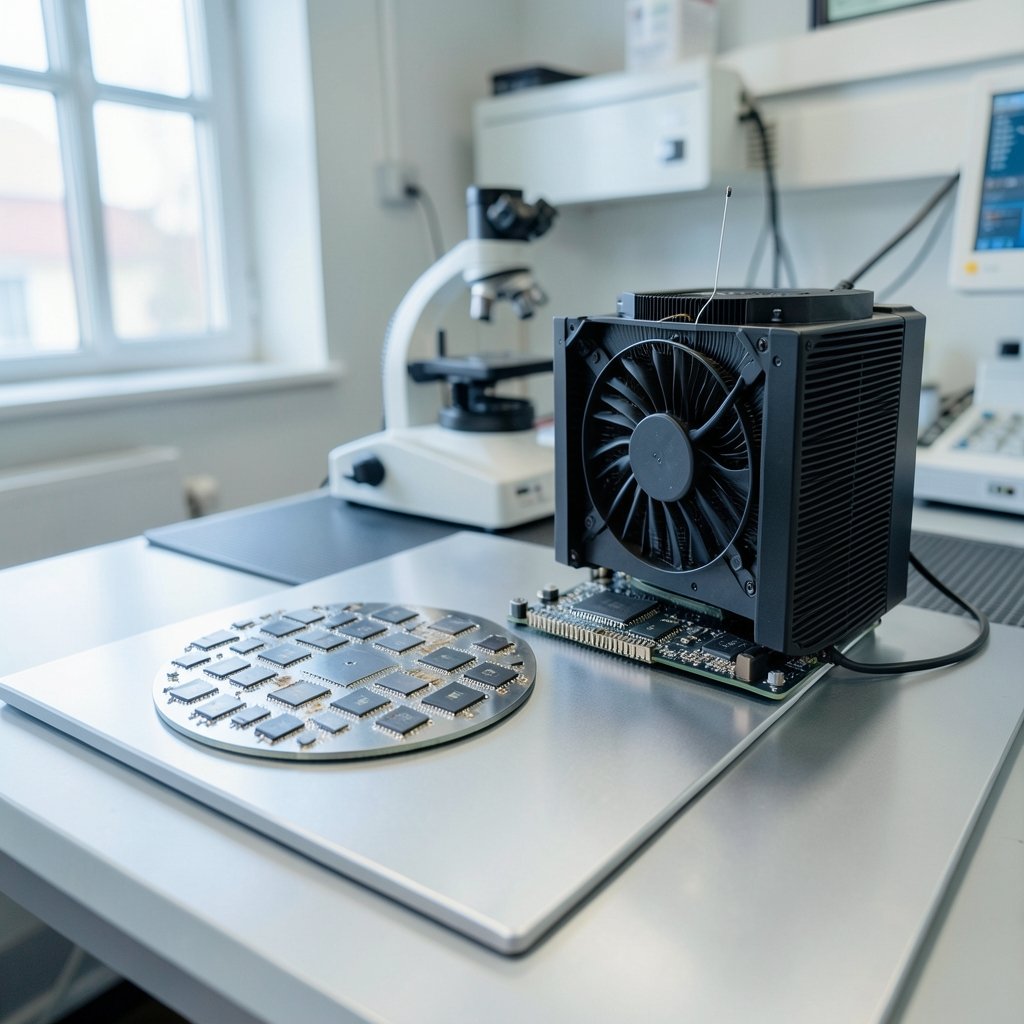
Intel dominates hardware headlines for reasons that have little to do with a single product. The company’s 18A process was meant to mark a major technological and strategic comeback. Instead, reports point to yield problems and internal adjustments that have slowed the flagship. That matters to buyers because process delays cascade: fewer chips per wafer means higher costs, tighter supply, and sometimes a refresh that arrives late or in limited volume.
On the desktop side, the picture is more concrete. Intel has said its Nova Lake chip will fill the high-end desktop CPU gap, positioning it against AMD’s X3D processors. A separate leak suggests Nova Lake CPUs throttle boost clocks once they hit 90°C, which would make them more temperature-sensitive than Intel’s Core 200 and Core 300 generations and AMD’s Ryzen 9000 series. Treat that as a leak, not a review. Leaks about thermal behavior are frequently accurate in direction and wrong in magnitude, and the only number that matters is the one measured on a retail chip in a real case.
What to do with this information
If you are building now, do not wait for a chip that has not shipped. If you are building in the next few months and you care about sustained performance, budget for a better cooler than you think you need. Thermal sensitivity is one of the few leak categories where the practical fix is cheap and the downside of ignoring it is real: a $60 cooler is cheaper than a rebuild.
AMD’s Two Faces: Data Center First, Desktop Second
AMD’s messaging has become unusually blunt. Days after US voters approved dozens of data center moratoriums, CEO Lisa Su said she wants AMD to be the best partner to the largest users of compute in the world, describing the company as data center first. Read that plainly: the highest-margin customer gets priority attention.
For desktop buyers, the practical translation is that consumer GPUs and CPUs are no longer the center of the strategy. That does not mean abandonment. It means consumer launches will be timed around manufacturing availability rather than enthusiast demand. Expect fewer dramatic price cuts and more careful inventory management.
On the server side, AMD’s Instinct MI350P brings the CDNA 4 generation to a classic PCIe add-in card rather than only a large OAM platform. The pitch is telling: the message is not the fastest product in the series, but the model that fits into real racks without requiring half the data center to be redesigned. That is a mature engineering argument, and it is the kind of detail that rarely makes consumer headlines but shapes which accelerators enterprises actually deploy.
GPUs: Supply, Margins, and the Quiet Disappearance
GPU news has split into two genres. The first is availability. Nvidia quietly removed the RTX 5080 from its online store, a small move that generated outsized speculation. The second is board-partner economics. Reports suggest ASUS may be reconsidering which models are still worthwhile to produce, with memory chips, margin, and inventory planning driving the decision more than architecture.
That is the unglamorous truth of the GPU market: a generation says less about shaders than about memory supply and whether a board partner can make money on a given SKU. If you are shopping, watch for models disappearing from retail listings. A card vanishing from a first-party store is a supply signal, not a performance signal.
There is also a genuinely interesting wildcard. Chinese manufacturer Xiang Dixian presented its Fuxi A0 graphics chip at the ICCAD trade fair in Chengdu, based on the DXD GPU architecture. Whether it reaches Western markets is a separate question, but new entrants are worth tracking because competition at the low end is what eventually moves prices.
Memory and Storage: The Quiet Squeeze
The memory crunch is the story most likely to affect your next purchase without making a dramatic headline. Apple’s removal of 128GB Mac Studio and Mac mini configurations is the visible tip. Behind it sits a broader allocation problem: memory capacity that would have gone into consumer devices is being pulled toward AI servers.
Storage is moving in the opposite direction, toward cheaper high-speed networking and denser controllers. Realtek has outlined an SSD controller roadmap aimed at high-end consumer drives, and it has previewed a platform for sub-$100 5GbE network switches. That last item is quietly significant. Faster networking at lower cost changes what a home lab or small office can do, and it is the sort of incremental progress that rarely trends but improves daily life.
Servers, Cooling, and the Physical Side of Computing
Some of the most consequential hardware news is about plumbing. Celestica debuted a liquid-cooled co-packaged optics switch, the DS6005, targeting AI network efficiency through Broadcom switch silicon. NTT deployed an Nvidia GPU test cluster at its Munich 2 data center so customers can test AI applications on Blackwell hardware. D-Wave delivered its Advantage2 quantum computer to Italy, funded by SQT to support regional quantum computing ambitions.
Cooling is spreading to the desktop too. DeepCool added a vapor chamber to an air cooler, aiming for liquid-cooler-like performance with air-cooler reliability. That is a genuinely useful trend for anyone who dislikes pump noise or the risk of a leak.
The sobering counterpoint: hardware news also covers industrial reality. Two workers were killed and a third injured in an explosion at Intel’s Kiryat Gat fab in Israel, with the company cooperating with authorities. Coverage of supply chains should never lose sight of the people inside them.
How to Read Hardware News Without Getting Fooled
Most bad purchasing decisions come from misreading a headline, not from bad products. A few habits fix that.
- Separate leaks from launches. A report citing “consistent reports” is a signal, not a specification. Wait for retail units and independent thermal testing.
- Check the date and the category. Aggregated news pages mix months of stories. A page of latest news can contain items from several weeks apart, and context changes fast.
- Ask who the story is for. Data center first is a strategy statement aimed at investors and hyperscalers. It tells you about priorities, not about the chip on your shortlist.
- Watch listings, not just articles. Products disappearing from a manufacturer store, or a board partner going quiet on a model, often signals supply trouble before any article explains it.
- Distrust single-number claims. Boost clocks, TDP figures, and yield percentages are all context-dependent. A 90°C throttle point means nothing without a cooler, a case, and an ambient temperature.
If your interests lean toward software and security rather than silicon, the same discipline applies. Understanding what is a computer virus and how it spreads is as important as knowing which CPU to buy, and choosing antivirus software deserves the same skepticism you would apply to a benchmark chart. Physical security has its own hardware news cycle too, and a hardware security key backup strategy is worth planning before you need it, not after you are locked out.
Desktop, Laptop, and the Build-It-Yourself Renaissance
The desktop market is healthier than the headline narrative suggests. Mini-ITX cases now house flagship graphics cards, and compact towers blur the line between NAS appliance and small-form-factor PC. Morefine’s N1, for example, pairs a Ryzen 7 Pro 8845HS with support for up to 96GB of DDR5-5600 ECC memory and dual 10GbE ports, targeting virtualization and multi-service home labs rather than light file serving.
At the other extreme, one Chinese TechTuber built a tower PC large enough for a human to work and play inside, complete with air conditioning. It is absurd, and it is also a useful reminder that the enthusiast community experiments far ahead of what vendors ship.
Laptops are where the memory crunch bites hardest, because soldered RAM cannot be upgraded later. If you are buying a laptop this season, buy more memory than you need today.
Where to Follow the News Without Drowning
Pick two or three sources with different incentives and read them consistently rather than skimming everything. Technical outlets publish teardowns and thermal measurements; business outlets explain allocation and margin; regional outlets surface products that never get Western coverage.
The computer vision news cycle is a good example of why breadth matters, since advances in vision workloads drive demand for the same accelerators and memory that consumer products compete for. Likewise, Tesla’s hardware bets across robotaxi, semi, and roadster show how one company’s silicon decisions can absorb enormous manufacturing capacity. And if you want to understand why your home network feels slow despite a fast plan, the explanation often sits in router hardware offloading rather than in your ISP.
Conclusion
Computer hardware news rewards readers who ask two questions: who is this story really about, and does it change what I can buy this month? Intel’s yield struggles and Nova Lake leaks matter mostly as a cooling warning and a timing signal. AMD’s data center first stance explains why consumer launches feel slower. GPU listings vanishing from storefronts tell you more about supply than any spec sheet. And the memory crunch, visible in pulled Mac configurations and rising laptop prices, is the story most likely to cost you money if you ignore it.
Buy for the workload you have, leave headroom where you cannot upgrade later, and treat every leak as a rumor until a retail unit proves otherwise. That approach will serve you better than any single headline, no matter how dramatic it looks on a Monday morning.
Frequently Asked Questions
What counts as computer hardware news?
It covers processors, graphics cards, memory, storage, motherboards, cooling, servers, and networking gear, plus the business behind them: manufacturing yields, supply allocation, pricing, and corporate strategy. The most useful stories connect a technical detail to something a buyer or administrator can act on.
Are CPU leak reports about throttling reliable?
Sometimes, but never completely. Leaks about thermal behavior often get the direction right and the specifics wrong, because final firmware and retail cooling change the outcome. Wait for independent testing on shipping hardware before you change a purchase plan based on a reported temperature limit.
Why is AMD focusing on data centers instead of gamers?
Data center customers buy in enormous volumes at higher margins, so prioritizing them is a rational business decision. The company has said publicly it wants to be the best partner to the largest users of compute. For consumers, that usually means launches timed around manufacturing availability rather than enthusiast demand.
Does the memory shortage affect laptops or desktops more?
Laptops are hit harder in practice, because most soldered memory cannot be upgraded after purchase. Desktops with socketed DIMMs give you an escape route: buy less now, add more later. If you are choosing a laptop, over-specify memory rather than under-specify it.
Should I wait for the next generation of CPUs or GPUs?
Only if you can name a specific feature you need and a credible launch window. Waiting is expensive when your current machine is failing, and leaks rarely survive contact with retail products. If you need a working system now, buy for today’s workload and accept that something faster will always be announced next quarter.
How can I tell a supply problem from a performance problem?
Watch retail listings and first-party stores. When a specific model quietly disappears while sibling models remain available, that is usually allocation or margin, not a defect. Performance problems show up in independent benchmarks and user reports, not in the absence of a product page.