MIT Technology Review reported on 24 November 2026 that data centres are getting their own natural gas power plants, and the scale is startling. As of October 2026, US developers had announced plans for more than 100 behind-the-meter gas power plants at data centre sites, with a combined planned capacity of over 115 gigawatts, more than double the peak power demand of California. The vast majority of the announcements have come since the beginning of 2025.
The reason is not that gas is cheap or clean. Connecting a large data centre to the electricity grid can take as long as a decade, and the companies building AI infrastructure are not willing to wait. Instead of joining the queue, they are building power plants of their own, feeding their own buildings directly, turning the data centre from a customer of the electricity system into a power producer in its own right.
That change carries consequences well beyond the technology industry. If the announced plants are built, they will shape greenhouse-gas emissions and household energy bills for decades. The numbers in this story are plans, not finished plants, and the gap between the two is one of the most important details in it.
Key takeaways
- More than 100 behind-the-meter natural gas plants have been announced for US data centres as of October 2026, totalling over 115 gigawatts of planned capacity, according to Cleanview data cited by MIT Technology Review.
- The main driver is speed: grid connection approval can take up to a decade, and on-site gas lets developers open years earlier.
- Only a small fraction of the announced capacity exists today, with 4.9 gigawatts operating and 15.8 gigawatts under construction.
- Most planned projects would use cheaper single-cycle turbines rather than more efficient combined-cycle plants, meaning higher emissions per unit of electricity.
- If every announced American plant were built, BloombergNEF estimates the fleet could emit 345 million metric tons of CO2 equivalent a year by 2035.
What is actually happening at data centre sites
These facilities are called behind-the-meter plants because they sit on the customer’s side of the utility meter, supplying the building directly rather than through a grid hookup. A developer installs gas turbines beside the server halls and generates the electricity its computers consume. Some plants are designed to run permanently; others are a temporary bridge, with the site eventually connecting to the grid and keeping its own plant only as backup.
The trend has a high-profile precedent: the campus built by xAI in Memphis has used dozens of natural gas turbines since 2024, some without permits, and the site remains entangled in legal disputes. What was once an unusual workaround has become a common strategy, and the Cleanview figures show how quickly it has spread: more than 100 plants announced, over 115 gigawatts, almost all of it since the start of 2025.
One concrete example comes from Texas. In a quarterly filing dated 12 November 2026, Net Power said it was developing a natural-gas power project to serve a data centre located alongside it, operating without connecting to the ERCOT grid that serves most of Texas. Rather than waiting for grid access, the developer pairs generation and computing on the same site and cuts the utility out entirely. Our report on the AI data centre boom and who is paying for all this compute covers the financing side of the same buildout, while this article focuses on where the electricity itself will come from.
Why speed beats price for AI developers
Building a power plant is generally more expensive than hooking up to the grid, but the AI rush has made developers willing to pay a significant premium to get online faster. “The biggest motivator for on-site power right now from data centers is speed,” Musfika Mishi, an associate at the energy consultancy BloombergNEF, told MIT Technology Review. For a company racing to train larger models, a site that opens in two years instead of seven is worth far more than the extra cost of its own turbines.
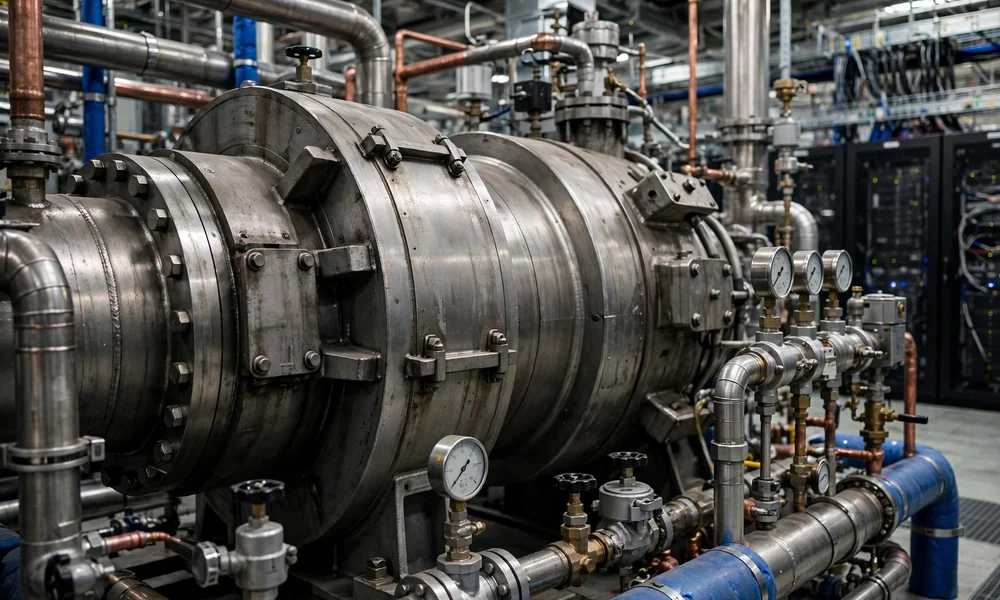
The scale of demand explains the urgency. MIT Technology Review has reported that the smallest data centres attractive for AI training draw around 300 megawatts, while the ideal facilities are closer to 6,000 megawatts, roughly the power draw of Chicago. Sites that large are usually built in rural areas with almost no grid infrastructure, which means bringing your own power is a precondition, not a luxury.
That urgency is visible in equipment orders too. Anthropic has reportedly agreed to pay 3.4 billion dollars for gas turbines, described as the largest power generation purchase by an AI company. The figure is unconfirmed, but it fits the pattern: the companies building the largest models are now among the largest buyers of power generation equipment in the world. The record funding flowing into AI startups, covered in our report on AI startups raising record funding in 2026, is part of what makes that spending possible.
The background: a grid that was not built for this
The electricity grid was designed for steady, predictable demand growth, and the AI buildout has broken that assumption. A single AI training facility can demand as much power as a small city, and dozens of such facilities are planned at once. Utilities must study each connection request, plan new transmission lines, and secure approvals that can take years, and the queue for those studies has grown faster than the capacity to process them.
Brendan Pierpont, director of electricity at the think tank Energy Innovation, described on-site gas as an expensive way to bridge the gap. “It’s really just a very expensive way to bridge that maybe five-to-seven-year timeline gap until these data centers can get a grid connection,” he told MIT Technology Review. On that reading, many of these plants are a costly workaround for a connection process that moves far more slowly than the AI industry does.
The workaround carries risk for developers too. Mishi warned that operators risk locking in fossil fuel reliance once they invest capital in generation infrastructure: a gas plant built as a five-year bridge has a way of becoming a twenty-year asset. The decision shapes a company’s energy mix long after the grid connection finally arrives.
The caveats that matter
The most important caveat is that the headline numbers describe announcements, not operating plants. MIT Technology Review was explicit that not all of the announced facilities will be built, and Cleanview’s data shows the gap clearly: 4.9 gigawatts of behind-the-meter gas projects tied to data centres are operating, while 15.8 gigawatts are under construction. The remaining roughly 95 gigawatts of announced capacity exists on paper, in filings and press releases, and some of it will never be built.
| Detail | What is known |
|---|---|
| Reported by | MIT Technology Review, 24 November 2026 |
| Plants announced | More than 100 behind-the-meter gas plants in the US, as of October 2026 |
| Planned capacity | Over 115 gigawatts, more than double California’s peak power demand |
| Data source | Cleanview, a market intelligence company |
| Operating today | 4.9 gigawatts, with 15.8 gigawatts under construction |
| Global total | BloombergNEF tracks 181 gigawatts announced worldwide, 90% of it in the US |
| Emissions projection | 345 million metric tons of CO2 equivalent a year by 2035 if all US plants are built |
| What is NOT confirmed | How many announced plants will actually be built, and on what timetable |
The emissions figures deserve the same care. BloombergNEF estimates that if every planned American behind-the-meter plant goes forward, the fleet could emit 345 million metric tons of carbon dioxide equivalent annually by 2035, exceeding grid-connected emissions by 152 million metric tons. That is a modelled projection conditional on full buildout, not a measurement of current emissions.
Technology choice matters. Large gas plants typically use combined-cycle turbines that capture waste heat to boost efficiency, but very few planned behind-the-meter projects will use them, according to Mishi. Instead, developers rely on cheaper single-cycle turbines, which emit more per unit of electricity: rational for a developer optimising for speed, costly for the climate.
There is also a cost question for everyone else. Energy Innovation’s global policy research director Matthias Fripp told MIT Technology Review that increased data centre demand for natural gas could push fuel prices higher, raising rates for the roughly 60% of American households that use gas for cooking and heating, while potentially lifting wholesale electricity prices too. Going off-grid does not shield other consumers from the costs, because the gas market is shared even when the electricity is not. The xAI Memphis campus illustrates a different risk: turbines installed without permits have drawn legal challenges, as detailed in our report on what the xAI build logs revealed about Grok.
Checklist: judging the on-site gas boom honestly
- Separate announced capacity from operating capacity: most of the 115 gigawatts is a plan.
- Ask who pays: on-site generation costs developers more than a grid hookup, and gas demand can raise prices for households too.
- Check the turbine type: single-cycle plants emit more per unit of electricity than combined-cycle plants.
- Remember the bridge argument: some plants are temporary, but capital investment makes temporary infrastructure sticky.
- Distinguish a projection from a measurement: the 345 million ton figure assumes every announced plant is built.
- Watch the permits: the Memphis example shows that speed can come with legal exposure.
Frequently asked questions
What is a behind-the-meter gas power plant?
It is a power plant built on the customer’s side of the utility meter, supplying a building directly rather than through a grid connection: gas turbines beside the server halls generating the electricity the computers consume.
Why are data centres building their own power plants?
Speed. Grid connection approval for a large data centre can take as long as a decade, and developers pay a premium for on-site generation to open years earlier. BloombergNEF’s Musfika Mishi called speed the biggest motivator for on-site power right now.
How much gas power is planned?
As of October 2026, more than 100 behind-the-meter gas plants had been announced for US data centres, totalling over 115 gigawatts, according to Cleanview data cited by MIT Technology Review. BloombergNEF tracks 181 gigawatts announced globally, with 90% of it designated for the US.
How much of that capacity actually exists?
Very little so far: 4.9 gigawatts operating and 15.8 gigawatts under construction, which means the overwhelming majority of the announced capacity is still on paper.
What does this mean for emissions?
If every announced American plant were built, BloombergNEF estimates the fleet could emit 345 million metric tons of CO2 equivalent a year by 2035. Most planned projects would also use cheaper single-cycle turbines rather than more efficient combined-cycle technology.
Will households pay higher energy bills because of this?
Possibly. Energy Innovation’s Matthias Fripp warned that greater data centre demand for gas could push fuel prices higher, raising rates for the roughly 60% of American households that use gas for cooking and heating, and potentially lifting wholesale electricity prices.
The bottom line
Data centres are building their own gas power plants because the grid cannot move at the speed the AI industry demands, and the numbers are enormous: more than 100 plants announced, over 115 gigawatts planned, and a global pipeline of 181 gigawatts tracked by BloombergNEF. A developer that waits a decade for a grid connection loses the race; one that builds its own turbines opens years earlier and pays the premium gladly.
The open question is how much of the announced pipeline becomes real infrastructure. Only a small fraction is operating or under construction today, and the emissions projections assume a full buildout that may never happen. But the consequences are durable: turbines bought for a five-year bridge tend to keep running, and gas demand pushes prices for households. Watch the construction figures, not the announcements, to know how fast this is really happening.