
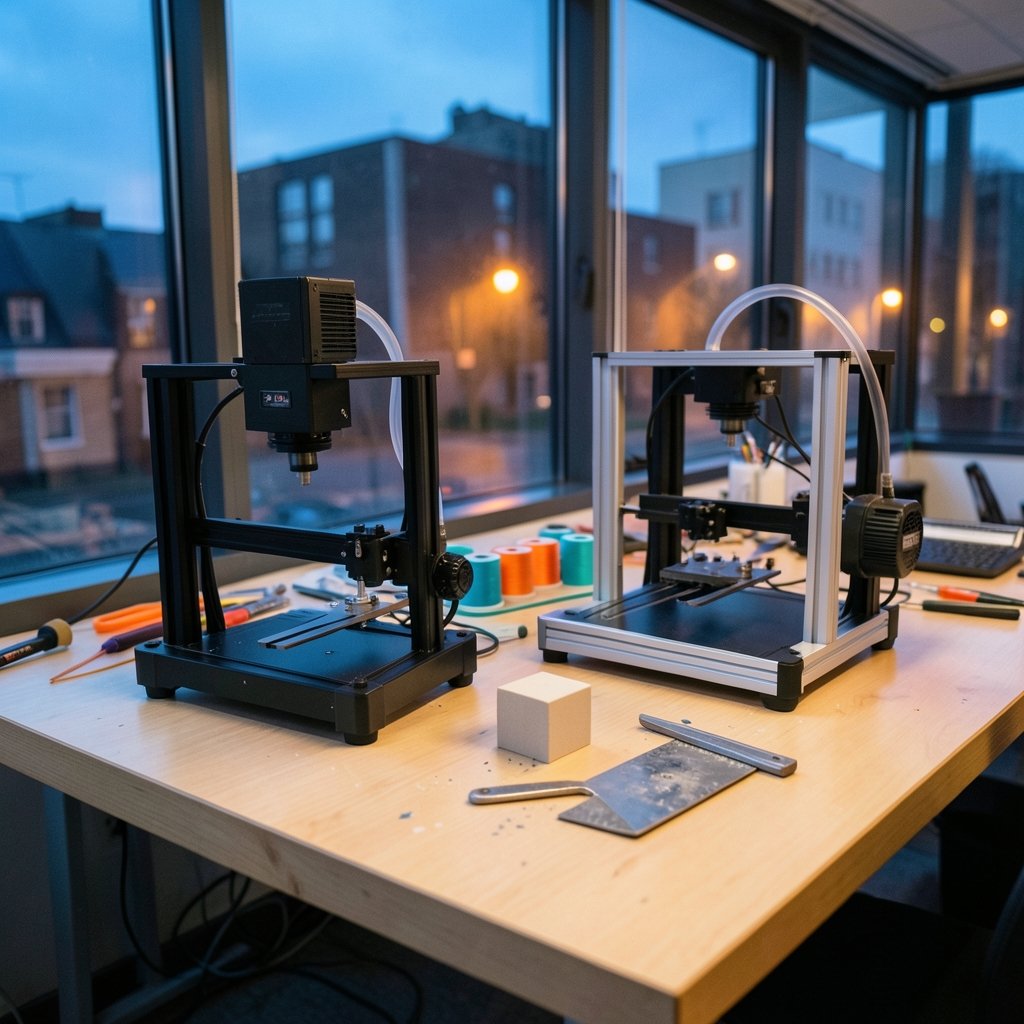
Ever watched a print fail because a flexible filament coiled up inside a PTFE tube like a snake refusing to cooperate? That single moment explains why the direct drive vs Bowden debate still rages in workshops and forums a decade after both designs went mainstream. The extruder is the part of a 3D printer that grabs filament, melts it, and pushes it out. Where that motor sits changes almost everything about how the machine behaves. (Fused filament fabrication)
This guide breaks down the real trade-offs, the mistakes people make when choosing, and which setup suits which kind of user.
What Actually Separates Direct Drive From Bowden?
The difference is mechanical and simple. In a direct drive system, the extruder motor rides on the moving print head, right above the hotend. The filament path from gear to nozzle is short, often just a few centimeters.
In a Bowden system, the motor stays bolted to the frame. Filament travels through a flexible PTFE tube to a lightweight hotend on the carriage. That tube is the defining feature, and it is also the source of most Bowden quirks. (Bowden extruder)
Neither design is newer or inherently better. Both have shipped on successful commercial machines for years, and both appear in the RepRap family of open-source printer designs documented on the RepRap wiki.
The Moving Mass Trade-Off Nobody Escapes

Physics runs this show. Every gram on the carriage has to accelerate, decelerate, and reverse direction thousands of times per print. A direct drive motor adds roughly 150 to 300 grams depending on the model. That mass amplifies ringing and ghosting, the wavy surface artifacts that appear after sharp corners.
Bowden setups keep the carriage light, which is why budget Cartesian printers and fast delta machines embraced them. Lighter heads can hit higher accelerations without the frame shaking itself apart.
But here is where the old rule gets fuzzy. Modern printers with rigid frames, linear rails, and input shaping firmware handle heavy direct drive heads at speeds that would have seemed absurd a few years ago. Motion dynamics research on vibration compensation in FDM printing, such as work indexed through Google Scholar, shows that tuning matters as much as mass. A well-tuned heavy carriage can beat a poorly tuned light one.
Practical takeaway: if someone claims direct drive is always slow, they are repeating a half-truth from 2016.
Retraction, Stringing, and the Tube Factor
Retraction pulls filament back to relieve nozzle pressure and stop oozing during travel moves. Bowden systems need longer retractions because the PTFE tube acts like a spring. The filament compresses and rebounds inside the tube, so the extruder has to pull back further to get the same pressure relief at the nozzle.
Direct drive retractions are short, crisp, and predictable. That makes stringing easier to tame, especially on detailed parts with lots of small travels.
| Factor | Direct Drive | Bowden |
|---|---|---|
| Typical retraction distance | Short | Longer |
| Stringing control | Easier to tune | Needs more testing |
| Flexible filament (TPU) | Handles well | Prone to buckling |
| Moving mass | Higher | Lower |
| Max speed potential | Good with rigid frames | Good on light frames |
| Hotend access | More crowded | Cleaner, easier swaps |
| Common failure mode | Carriage wobble if frame is flexy | Tube wear, coupler slip |
The tube is also a wear item. Over hundreds of hours, PTFE liners degrade, couplers loosen, and the filament path develops slop. That shows up as inconsistent extrusion that no amount of slicer tuning fixes. Direct drive eliminates that failure mode entirely, though it introduces its own: a heavier head stresses the gantry and belts.
Flexible Filaments: Where Direct Drive Usually Wins
TPU and other flexibles are the clearest dividing line. Soft filament buckles under compression. In a Bowden tube, the gap between extruder and hotend gives it room to fold, jam, or spiral. Direct drive constrains the filament over a short distance, so it cannot escape sideways.
Bowden can run stiffer flexibles like some 95A TPU with slow speeds and modified feeders, but it is fighting the design. Anyone whose work involves phone cases, gaskets, or wearables should treat direct drive as the default.
This matters for beginners picking a first machine too. If a starter printer ships with direct drive, flexible experiments become a weekend project instead of a troubleshooting saga. Guides on choosing a best 3d printer for beginners often flag extruder type for exactly this reason, and a best budget 3d printer pick with direct drive can save months of frustration.
Speed, Precision, and What Modern Printers Changed
The classic split said Bowden equals speed and direct drive equals precision. That framing is outdated but not dead.
Bowden still shines on lightweight frames where every gram counts. Delta printers and fast bed-slingers benefit from a stripped-down carriage. The trade-off is that tube compliance limits retraction precision and makes pressure advance tuning fussier.
Direct drive favors accuracy, material range, and repeatability. The cost is that the frame and motion system must be stiff enough to carry the extra mass without artifacts. On a flimsy acrylic frame, a heavy direct drive head can make prints worse, not better.
A mistake people make: buying a direct drive upgrade kit for a budget printer with a wobbly gantry, then blaming the extruder when corners ring. The extruder was fine. The frame was not ready.
Modern high-speed consumer machines have muddied the water further. Lightweight direct drive motors, remote drive systems, and hybrid designs now blur the categories. The honest answer is that extruder type is one variable among several, alongside frame rigidity, belt tension, and firmware tuning.
Maintenance and Daily Life With Each Design
Direct drive puts more hardware in a small space. Hotend swaps take longer, and the carriage needs occasional bolt checks because vibration loosens things. On the plus side, the filament path is short and visible, so jams are easier to diagnose.
Bowden keeps the carriage clean and light. Hotend maintenance is simpler, and the motor sits safely on the frame away from heat. But tube-related gremlins, like a liner that creeps forward or a coupler that slips mid-print, can waste hours before the cause becomes obvious.
For anyone running a print farm or a busy classroom, downtime matters more than spec sheets. A design that is easy to service often beats one with marginally better numbers. The same logic applies when choosing storage for all those sliced files and timelapses; a comparison like idrive vs backblaze 2026 follows the same principle of matching the tool to the workload.
How to Choose Without Regret
Start with materials, not marketing. That single question resolves most of the debate.
- List the filaments you actually plan to print. Include at least one flexible if there is any chance you will try it.
- Check the printer’s frame. Rigid frames with linear rails tolerate direct drive mass. Flexy acrylic frames do not.
- Decide whether speed or surface finish matters more for your parts.
- Look at service access. Can you reach the hotend without dismantling the carriage?
- Read the retraction guidance for the specific machine, not generic forum posts.
If flexible filament, small detailed parts, or material variety dominate your work, direct drive is the safer bet. If you print rigid materials at high speed on a lightweight machine and rarely touch TPU, Bowden remains a sensible, proven choice.
Kids and shared workshop machines deserve a mention too. Fewer tube-related jams means fewer stalled prints, which keeps attention spans intact. A best 3d printer for kids pick with a simple, robust extruder path tends to survive enthusiastic use better than a fussy Bowden setup.
Upgrades, Mods, and the Honest Cost
Converting a Bowden printer to direct drive is popular, and kits are widely available. The results range from transformative to disappointing. Success depends on whether the frame can handle the added mass and whether the firmware is retuned afterward.
People often forget the second part. Replacing hardware without recalibrating acceleration, jerk, and retraction settings produces prints that look worse than before. Set aside time for tuning as well as installation.
There is also a middle path: lightweight direct drive motors and geared extruders that cut mass while keeping the short filament path. These designs have narrowed the gap considerably. For a broader look at hardware choices that pair well with extruder upgrades, including storage and backup workflows for large project files, resources like best external hard drives for backup are worth a glance before a big modding session.
Conclusion
The direct drive vs Bowden question has no universal winner, and anyone who insists otherwise is selling something. Bowden keeps carriages light and machines fast, at the cost of tube quirks and weaker flexible filament handling. Direct drive trades some mass for precision, material range, and simpler filament paths. The right answer depends on what you print, how often you service the machine, and whether the frame can carry the weight. Choose based on materials and workflow, tune carefully afterward, and either design will serve you well for years.
Frequently Asked Questions
Is direct drive better than Bowden for beginners?
Not automatically, but it is often more forgiving. Short retractions and a simple filament path mean fewer mysterious jams, especially with flexible materials. Beginners who want to experiment with TPU or detailed parts usually have an easier time with direct drive, provided the printer’s frame is reasonably rigid.
Can a Bowden printer handle TPU at all?
Yes, within limits. Stiffer flexibles around 95A can print on Bowden setups with slow speeds, reduced retraction, and sometimes a modified feeder. Soft flexibles below that hardness tend to buckle in the tube. Results vary by machine, so test small before committing to a long print.
Why does my Bowden printer need such long retraction settings?
The PTFE tube adds compliance. Filament compresses and rebounds inside it, so the extruder must pull back further to relieve nozzle pressure. Tube length, liner condition, and coupler tightness all affect the ideal value, which is why copied settings from another printer rarely work perfectly.
Does direct drive really slow a printer down?
It can, but the effect is often overstated today. Added carriage mass raises the risk of ringing at high acceleration, especially on flexible frames. Modern rigid printers with input shaping compensate well. A well-tuned direct drive machine can match or beat a sloppy Bowden one.
Is it worth converting a Bowden printer to direct drive?
It depends on the frame and your materials. If you print flexibles or want tighter retraction control and the gantry is stiff, a conversion can be a genuine upgrade. On a wobbly budget frame, the added mass may cause more artifacts than it solves. Plan for firmware retuning either way.
What are the most common failure points on each design?
Bowden setups suffer from worn PTFE liners, slipping couplers, and inconsistent extrusion over time. Direct drive setups face carriage wobble on weak frames, loosened bolts from vibration, and cramped hotend access during maintenance. Knowing the likely failure mode helps you inspect the right parts first.
Does direct drive handle abrasive filaments better? Not inherently. Hardened nozzles and wear-resistant feeders matter more than extruder type. However, the shorter filament path on direct drive reduces the chance of abrasive material grinding inside a tube and causing partial clogs. Either design works with abrasives once the hotend is upgraded.
Which design produces better print quality? Neither wins outright. A well-tuned Bowden machine on a rigid frame can match direct drive for most rigid materials. Direct drive has an edge in retraction consistency and flexibles. Print quality depends more on calibration, belt tension, and frame stiffness than on extruder layout alone.



