
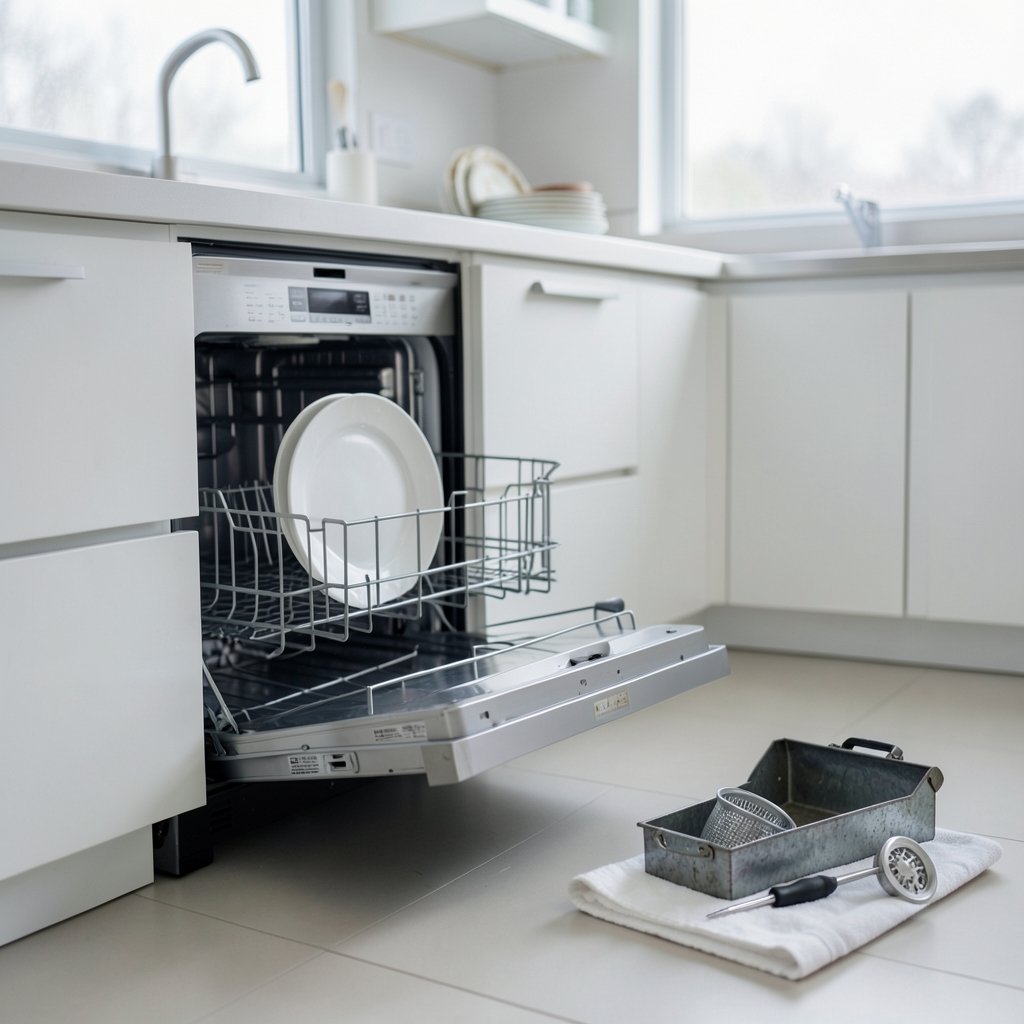
What do you actually mean when you type “dishwasher nearby” into a search box at 7 p.m. with a sink full of dirty plates? That question matters more than it sounds, because the phrase splits into two very different missions. One person needs a technician standing in their kitchen tomorrow morning. Another wants to see a dishwasher in a showroom, hear the door close, and drive it home this weekend. Search engines cannot tell the difference, so they hand you a jumble of repair shops, big-box store listings, and marketplace ads for used units. This guide sorts that jumble out. It covers how local search actually behaves, how to vet a repair tech before they touch your machine, when repair stops making financial sense, what to check before buying new or used, and the mistakes that cost people the most money.
Two Different Searches Hiding Behind One Phrase
The first step is deciding which job you are hiring the internet to do.
Scenario A: something is broken. Your dishwasher leaks, won’t drain, flashes an error code, or leaves grit on every glass. You need a local repair technician, possibly a spare part, and a realistic idea of what the fix should cost.
Scenario B: nothing is broken, but you want something different. Maybe the old unit is loud, tiny, or simply ancient. You need local stock — a store, an appliance dealer, or a warehouse with units on the floor and delivery trucks in the area.
A third, smaller scenario exists too: you need a part or accessory (a cutlery basket, an inlet hose, a door latch) and want it today rather than shipped in a week. Local appliance-parts shops still exist in many towns, and they are gold when you are mid-repair.
Once you know your scenario, the search itself gets easier. Add the word “repair” or “store” to your query. Add your town or postcode. Vague queries return vague results.
Why “Nearby” Results Look Different on Every Device

Search engines and map apps estimate your location from your device’s GPS, your IP address, or your account settings. That estimate is not always accurate. A phone on Wi-Fi can appear to be in a nearby city. A laptop behind a work VPN can appear to be in another country entirely.
The practical fix is simple: turn on location services for your browser or maps app, or type your town, suburb, or postcode directly into the search box. This one habit removes most of the frustration people feel when local results seem to point at the wrong side of town.
It also helps to search at the right level. “Dishwasher repair” plus a suburb name will surface smaller independent technicians that a bare “nearby” query buries under national chains and paid ads. If you are also hunting for dinner while the kitchen is out of action, the same logic applies to food searches — the guide to takeout food near me find good food fast shows how location signals shape those results, and the principle is identical for appliance services. (Best empanada de ataon near me)
How to Vet a Local Dishwasher Repair Technician
Anyone can buy a van and print a logo. A short checklist separates the professionals from the gamblers.
- Ask for the brand experience first. Dishwashers from different manufacturers use different control boards, pumps, and diagnostic routines. A technician who works on your brand weekly will diagnose faster and stock more of the right parts.
- Confirm the call-out fee and diagnostic charge in writing. A fair structure is a fixed diagnostic fee that is either waived or credited against the repair. Vague “we’ll see when we get there” pricing is a warning sign.
- Ask about warranty terms on the work. Reputable shops warranty both the part and the labour for a defined period, often 90 days to a year.
- Check the warranty on your appliance before booking anyone. Some manufacturers require authorised service to keep certain warranties valid. Using an unauthorised repairer can void coverage on some brands, so read the terms or call the manufacturer’s line first.
- Verify insurance. A technician working inside your home should carry liability insurance. Ask. The good ones answer without hesitation.
- Read recent reviews for the specific location. A chain’s city-centre branch and its suburban branch can be run by completely different teams.
One more practical tip from the field: describe the symptom precisely when you book. “It doesn’t clean” gets you a general visit. “The bottom of the tub fills with standing water after the cycle ends, and the error code reads E24” gets you a technician who arrives with the right drain pump on the van. Model number, age of the machine, and the exact error code are the three details that save the most time.
Repair or Replace? A Rule of Thumb and Its Limits
The most repeated guideline in appliance repair is this: replace rather than repair when the repair cost exceeds about half the price of a new unit, or when the machine is roughly 8 to 10 years old. It is worth saying plainly that this is a rule of thumb, not an industry standard. It appears in consumer advice everywhere and it is useful as a starting frame, nothing more.
Here is how to apply it sensibly.
| Situation | Sensible default | Why |
|---|---|---|
| Under 5 years old, single failed part | Repair | Long remaining life; parts widely available |
| 5 to 8 years, repair under half of new price | Repair | Still economical, especially on a quality unit |
| 8 to 10 years, repair near half of new price | Weigh carefully | Efficiency gains and remaining lifespan both matter |
| Over 10 years, major failure (pump, board, motor) | Usually replace | Parts get scarce and expensive; new units use less water and power |
| Any age, cheap fix (door latch, hose, filter) | Repair | Small cost, big payoff |
Two factors push the decision toward replacement even when the maths says repair. The first is energy and water use. Modern full-size dishwashers typically use roughly 9 to 13 litres per cycle, with efficient eco programmes often landing around 9 to 10 litres. An old machine may use considerably more, so the running-cost gap narrows the price difference over a few years. The second is noise and features — if the machine is in an open-plan kitchen, a quieter model has real daily value.
Two factors push toward repair. If the machine is a high-end brand with years of life left, a mid-priced repair is usually the smarter call. And if the failure is a single inexpensive component, replacing an otherwise healthy appliance is pure waste.
The Parts Question: Why Some Repairs Take Weeks
Here is where local service gets complicated, and where a little knowledge helps you ask better questions.
In the European Union, ecodesign rules for household dishwashers have, since 2021, required manufacturers to make certain spare parts available to professional repairers for a set number of years. The exact durations and the list of covered parts are set out in the regulation itself, and they vary by component. The practical effect is that a competent local technician in the EU can often still source parts for a machine that is several years old.
In the United States, the picture is patchier. Right-to-repair laws have spread across several states since 2023, but coverage and effective dates vary widely by jurisdiction, and appliance rules are not uniform. The practical effect is that some US technicians can obtain parts and service information that others cannot. When you call around, ask directly: “Can you get parts for this model, and how long do they usually take?” A technician who answers with specifics is worth keeping.
If you are waiting on a part and eating out in the meantime, local search skills pay off in the kitchen too — the same approach behind best thai food near me works for finding a repair shop that actually stocks what you need.
Buying a Dishwasher Locally: What to Check Before You Pay
If you have decided to replace, buying locally has real advantages: you can see the unit, confirm the size, and get a delivery date you can plan around. It also has traps.
Measure the cavity, not the old machine. Width, height, and depth of the opening, plus the position of the water inlet, drain, and power point. Standard full-size units are typically 60 cm wide in Europe and 24 inches in the US, but “standard” has exceptions, especially in older kitchens.
Check the energy label version. Since 1 March 2021, dishwashers sold in the EU carry a rescaled energy label running A to G, with the old A+/A++ classes retired and new test methods applied. If you are comparing a showroom model against a spec sheet from an older listing, you are comparing two different scales. In the US, look for the ENERGY STAR mark and check that the unit meets the current specification version, since those criteria are revised periodically.
Ask about the delivery and installation package. Local dealers often include removal of the old unit and connection, which big-box stores sometimes charge extra for. Get it in writing.
Confirm the model number on the box matches the one on the showroom floor. Display models and end-of-line stock can differ in small but meaningful ways.
Buying Used: The Checks Most People Skip
A used dishwasher can be a genuine bargain or a leaking headache. Three checks separate the two.
First, check for safety recalls. Before buying or repairing any used appliance, look up the model in the official recall databases for your region. In the US that means the Consumer Product Safety Commission’s recall listings; in the EU it means the Safety Gate alert system. Both are free, searchable, and take two minutes.
Second, ask to see it run. A seller who won’t run a cycle is telling you something. Listen for grinding from the pump, watch for leaks at the door seal, and feel whether the tub heats up.
Third, factor in the age and the parts situation. A ten-year-old machine from a brand with strong parts availability is a safer bet than a five-year-old machine from a brand nobody local will service.
Common Mistakes That Cost Real Money
A few patterns show up again and again.
- Booking the first paid ad. Ads are bought, not earned. Cross-check two or three local shops before committing.
- Skipping the diagnostic fee question. Surprise charges at the door are the most common complaint in appliance repair.
- Ignoring the error code. Photograph the display before the technician arrives. It may clear when the machine is reset.
- Assuming the drain is blocked when the filter is. Many “won’t drain” calls end with a five-minute filter clean. Check the filter and the drain hose kink before you book anyone.
- Buying without measuring. A dishwasher that doesn’t fit the cavity is a very expensive cupboard.
- Forgetting the old unit. Removal and disposal are often a separate line item. Ask.
None of these are exotic. They are simply the things people skip when they are stressed and the sink is full.
Conclusion
The phrase “dishwasher nearby” is really a fork in the road. If something is broken, your job is to find a vetted local technician, describe the fault precisely, and know the repair-versus-replace maths before the quote arrives. If you are buying, your job is to measure the cavity, check which energy label scale you are reading, confirm the current efficiency criteria, and verify the model has not been recalled. Turn on location services, add your town to the query, ask about parts availability up front, and treat every rule of thumb as a starting point rather than a verdict. Do those things and the search stops being a gamble. It becomes a short, boring, successful errand — which is exactly what you want when the dishes are piling up.
FAQ
What should I search to find a dishwasher repair technician near me?
Add the word “repair” and your town or postcode to the query, and make sure location services are enabled on your device. A bare “dishwasher nearby” search mixes repair shops with retail listings, so the extra word does most of the work.
How much should a dishwasher repair cost before I should just replace it?
There is no fixed threshold, but a widely used rule of thumb is to replace rather than repair once the repair cost passes roughly half the price of a new unit, or once the machine is around 8 to 10 years old. Treat that as guidance, not a standard, and weigh energy use and remaining lifespan alongside the quote.
Can a local technician void my manufacturer warranty?
It can, depending on the brand’s terms. Some manufacturers require authorised service to keep certain warranty coverage valid, so check your warranty documents or call the manufacturer before booking an independent repairer.
Why do my “nearby” results show shops in the wrong town?
Location estimates come from GPS, IP address, or account settings, and any of those can be wrong, especially on Wi-Fi or a work VPN. Enabling precise location or typing your town directly into the search box usually fixes it.
What is the difference between the old and new EU energy labels on dishwashers?
Since 1 March 2021, dishwashers sold in the EU carry a rescaled label running from A to G, with the old A+/A++ classes removed and new test methods applied. That means a rating from an older listing is not directly comparable to a current one.
Should I check for recalls before buying a used dishwasher?
Yes, and it takes only a couple of minutes. Search the model number in the official recall database for your region — the CPSC in the United States or the Safety Gate system in the EU — before you hand over any money or book a repair.



