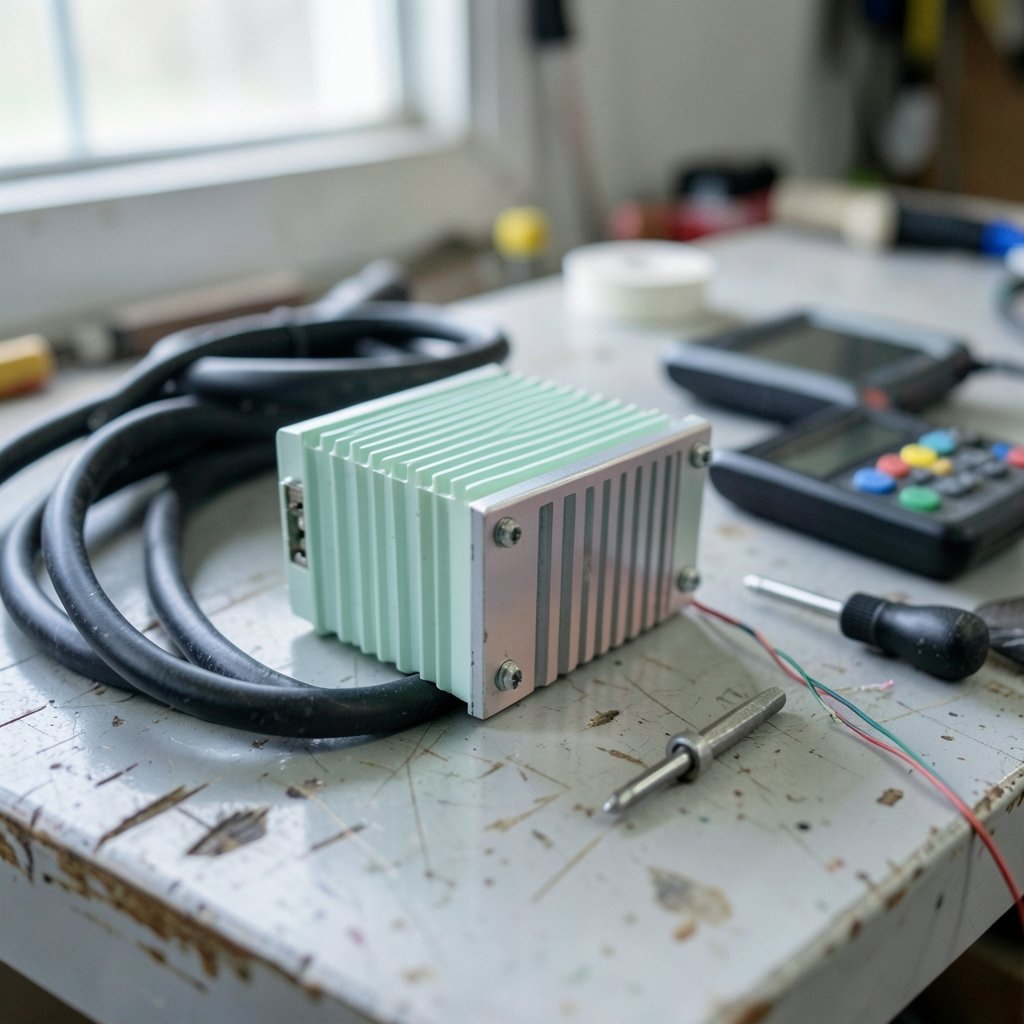
What if the most important change in computing hardware this year is not a faster chip, but the box that feeds it power? That question sounds odd until you look at the numbers coming out of power electronics labs. Efficiency figures that once seemed impossible for compact adapters are now routine announcements. The high efficiency power supply news cycle has shifted from small annual gains to genuine leaps, and those leaps change what buyers, builders, and IT teams should expect from the hardware they purchase.
This article walks through what the recent announcements actually say, why gallium nitride (GaN) keeps appearing in them, and how to read efficiency claims without getting fooled by marketing math.
Why efficiency suddenly matters more than it used to
For years, power supply efficiency was a background concern. A decent unit hit 80 Plus Gold, nobody asked questions, and the conversation moved on. That has changed for three reasons.
First, power demands have climbed. AI accelerators, dense data center racks, and high-wattage laptops all pull more current than their predecessors. Every wasted watt becomes heat that has to be removed, and cooling budgets are finite.
Second, regulators and buyers now treat efficiency as a purchasing criterion rather than a nice-to-have. Wasted power at the wall is wasted money at scale.
Third, the components got better. Wide-bandgap semiconductors, especially GaN, let designers switch at higher frequencies with lower losses. That single change drove most of the recent headline numbers.
The announcements driving the current news cycle

Recent product news shows how far the technology has moved in a short window.
XP Power’s UCH750 series is a fanless, convection-cooled 750W AC-DC supply that reaches up to 96% efficiency. It fits the same 8 x 5 inch footprint as the company’s earlier 600W UCH600, carries 2xMOPP isolation, and specifies 100 µA patient leakage current. That last detail matters: this is a medical-grade unit, and squeezing 150 extra watts into an unchanged footprint without a fan is a meaningful engineering result.
Recom’s RACM3000-M series pushes 3 kW AC-DC conversion at up to 94% efficiency, with 24 V, 26 V, and 48 V outputs, CAN Bus support, and medical approvals. It can run up to four units in parallel, which is how larger systems scale without redesigning the whole power stage.
Advanced Energy introduced three high-density M-CRPS supplies, two at 3200 W and one at 3600 W, aimed at AI, data center, networking, and telecom architectures. The wattage tells the story: these are built for racks that did not exist as a design target a few years ago.
Enedo Power’s HDP1200 uses GaN transistors to fit 1,200 W of AC-DC conversion into a 900 cm³ volume, running from 85 to 305 Vac and delivering 24 V or 48 V plus a 5 V standby output. Efficiency reaches 95.5%, and the unit is de-rated to 1 kW below 137 Vac.
TDK-Lambda added the EDC series of programmable DC-DC supplies at 1.5 kW and 3 kW, plus the CUS1600M and CUS2000M AC-DC medical series. The DC-grid framing is notable, because renewable energy and battery storage systems increasingly want native DC distribution rather than repeated AC conversion.
GaN is the thread running through most of these designs
Look closely at the list above and a pattern appears. The compact, high-efficiency designs lean on GaN power devices, while the highest-density AI and data center parts lean on integration.
A 140W USB-C Power Delivery reference design from Eggtronic, built on Renesas high-voltage GaN transistors, claims peak efficiency approaching 96%. The design pairs Eggtronic’s EPIC combo controller with a 700 V, 150 mΩ GaN FET and uses a regenerative architecture instead of the usual LLC, asymmetrical half-bridge, or active-clamp flyback converters.
Rompower took a different route to a similar destination. Its 140W AC-DC adapter design uses a single-switch “Ideal Flyback” topology with a passive clamp, and the company reports best-in-class efficiency across the universal input range while staying compliant with USB PD 3.0 and 3.1.
MPS released the NovoOne MPXG2100 switching family and the MPG44100 PFC regulator, both integrating GaN devices. For a 140W universal PD design, the company reports efficiency above 93% at 90 Vac and above 95% at 230 Vac, with standby power under 20 mW for the single-stage solution and under 50 mW with power factor correction added.
At the component level, GlobalFoundries and onsemi signed an agreement to develop and manufacture 650V GaN power devices on a 200mm eMode GaN-on-silicon process, targeting AI data centers, electric vehicles, renewable energy, and industrial systems. That kind of foundry commitment signals that GaN is moving from premium niche to mainstream supply.
For anyone building or buying around these parts, the practical lesson is straightforward: efficiency claims now depend heavily on the switching technology inside; the wattage on the label is only one factor.
What the efficiency numbers actually mean for buyers
A 96% efficiency rating sounds impressive, and it is. But the number alone does not tell you whether a supply suits your situation. A few habits separate informed buyers from people who overpay for a spec they never use.
Check the load point. Efficiency peaks in a specific band, often around 50% load. A unit rated 96% at half load may be far less efficient at 10% load, which is exactly where a desktop idles most of the day. Light-load behavior is where cheap designs quietly give up ground.
Ask about cooling. Fanless designs like the UCH750 trade noise for careful thermal engineering. If a build needs silence, that trade is worth paying for. If it lives in a rack, a fan may cost less and cool better. Buyers routinely get this backwards, assuming fanless always means better.
Read the isolation and leakage specs if the application is medical. The 2xMOPP and 100 µA figures on the XP Power unit are not decoration. They determine whether a device can legally touch a patient.
Match the form factor to the upgrade path. The UCH750 fitting the same footprint as the UCH600 means an existing design can gain 150 W without a chassis redesign. That is often worth more than a marginal efficiency gain.
Do not confuse peak efficiency with average efficiency. Real systems spend most of their time at partial load. A supply with excellent full-load numbers and mediocre light-load numbers will waste more energy over a year than its datasheet suggests.
If you are weighing a purchase and want a plain-language walkthrough of what matters, this guide to a power supply unit worth buying for beginners covers the practical buying decisions in more depth.
Common mistakes people make with high-efficiency supplies
Even careful buyers stumble on the same handful of issues.
- Assuming a higher efficiency rating means lower total cost. A 96% unit that costs twice as much as a 92% unit may never repay the difference in a low-usage desktop. Run the math on your actual hours and electricity rate before paying a premium.
- Ignoring standby power. A supply that draws a few watts at idle, multiplied across a fleet of machines and thousands of hours, adds up quietly.
- Buying for peak wattage instead of sustained load. Transient spikes matter, but so does the efficiency curve where the system actually operates.
- Skipping the derating table. The Enedo HDP1200 de-rates to 1 kW below 137 Vac. In regions with weak mains voltage, that is not a footnote, it is the real capacity.
- Overlooking connector and cable losses. A superb supply feeding thin cables still loses energy. The supply is one link in a chain.
- Treating parallel capability as free headroom. Running four Recom units in parallel works, but load sharing and failure behavior need planning, not improvisation.
When things do go wrong, the symptoms often look like something else entirely. Random shutdowns, coil whine, or a machine that will not wake from sleep can all trace back to the power stage. A troubleshooting walkthrough of common power supply unit problems and how to fix them helps separate a dying unit from a software fault before you replace hardware unnecessarily.
Where the data center and AI segment is heading
The 3200 W and 3600 W M-CRPS units from Advanced Energy point at a clear trend: power density per rack is climbing, and the supply has to keep up without melting.
Empower Semiconductor’s Crescendo platform, recognized in EDN Japan’s 2025 Product of the Year coverage, takes a different angle. It uses a vertical power delivery architecture that places the regulator directly beneath the processor, claims multi-megahertz bandwidth, roughly five times higher power density, more than 20% lower delivery losses, and up to 15% lower processor power consumption. The company frames the benefit in gigawatt-hours saved annually across AI data centers.
Ferric’s Fe1766, a 160A DC-DC buck converter in a 1mm-thick, 35mm² package, follows the same logic: put more conversion closer to the load, switch faster, and shrink the losses.
For anyone tracking server refresh cycles, this matters. A rack designed around older power delivery may not accommodate the newer, denser supplies without changes. Planning for power density, alongside total wattage, is now part of infrastructure work.
How to separate real efficiency gains from marketing noise
Announcements arrive constantly, and not every claim deserves equal weight. A few filters help.
| What to check | Why it matters | Red flag |
|---|---|---|
| Test conditions | Efficiency varies by load and input voltage | A single peak number with no conditions listed |
| Cooling method | Fanless affects noise, cost, and thermal limits | No thermal data at all |
| Certification level | Independent standards give a baseline | Vague “high efficiency” wording only |
| Derating curve | Real capacity depends on input voltage | Capacity quoted only at ideal input |
| Standby draw | Idle losses accumulate over time | No standby figure published |
Beyond the datasheet, the honest signal is third-party testing and standards compliance. A unit that clears a recognized efficiency standard and publishes its full curve is easier to trust than one that leads with a bold percentage and nothing else.
The other useful habit is watching the component supply chain rather than only finished products. When foundries commit to 200mm GaN production, prices fall and designs that were premium become ordinary. That shift is already visible in the 140W USB-C adapter space, where multiple companies now report efficiency near 96% using different topologies. Competition at that level tends to push reliability up and cost down.
If your interest runs toward how power efficiency interacts with broader hardware choices, a comparison of the RTX 4090 vs RTX 5080 power efficiency is a useful reality check on how graphics card power draw shapes the supply you actually need.
Conclusion
The high efficiency power supply news of the past year tells a consistent story. GaN switching, tighter integration, and smarter topologies have pushed compact supplies past 95% efficiency while packing more watts into smaller footprints. Medical-grade units now combine fanless cooling with serious isolation specs. Data center supplies have crossed 3 kW. USB-C adapters approach 96%.
For buyers, the takeaway is not to chase the biggest number on a datasheet. It is to match the efficiency curve to real usage, check the derating and standby figures, and treat cooling and certification as part of the specification rather than an afterthought. The technology has genuinely improved. The judgment about which improvement matters for a given system still rests with the person holding the spec sheet.
FAQ
What does high efficiency mean for a power supply?
It describes how much of the electricity drawn from the wall reaches the device instead of being lost as heat. A 96% efficient supply converts 96% of input power to output, wasting 4%. Higher efficiency means less heat, lower running costs, and often quieter operation because less cooling is needed.
Why is GaN showing up in so many new power supplies?
GaN transistors switch faster and with lower losses than traditional silicon parts. That lets designers shrink the converter, cut heat, and reach efficiency levels that were hard to hit in compact sizes. Recent 140W USB-C reference designs and compact 1,200 W units both rely on it.
Is a fanless power supply always better?
No. Fanless designs are quieter and avoid fan failure, which suits medical, office, and home environments. But they depend on careful thermal design and may cost more. In a rack or a case with strong airflow, a fan-cooled unit can be cheaper and equally reliable.
How much does efficiency actually save on an electricity bill?
It depends on load, hours of use, and local rates. The savings from a few percentage points are modest for a single desktop but significant across a fleet or a data center running continuously. Calculate using your real average load, not the peak rating.
What is derating, and why should I care?
Derating means a supply delivers less than its rated power under certain conditions, such as low input voltage. The Enedo HDP1200, for example, drops to 1 kW below 137 Vac. Ignoring the derating curve can leave a system underpowered in exactly the conditions where it needs headroom.
Should I replace a working power supply just to gain efficiency?
Usually not. A functioning unit with a reasonable rating rarely justifies replacement on efficiency alone. Replace when you need more capacity, quieter operation, a different form factor, or when the existing unit shows signs of failure such as instability or unusual noise.