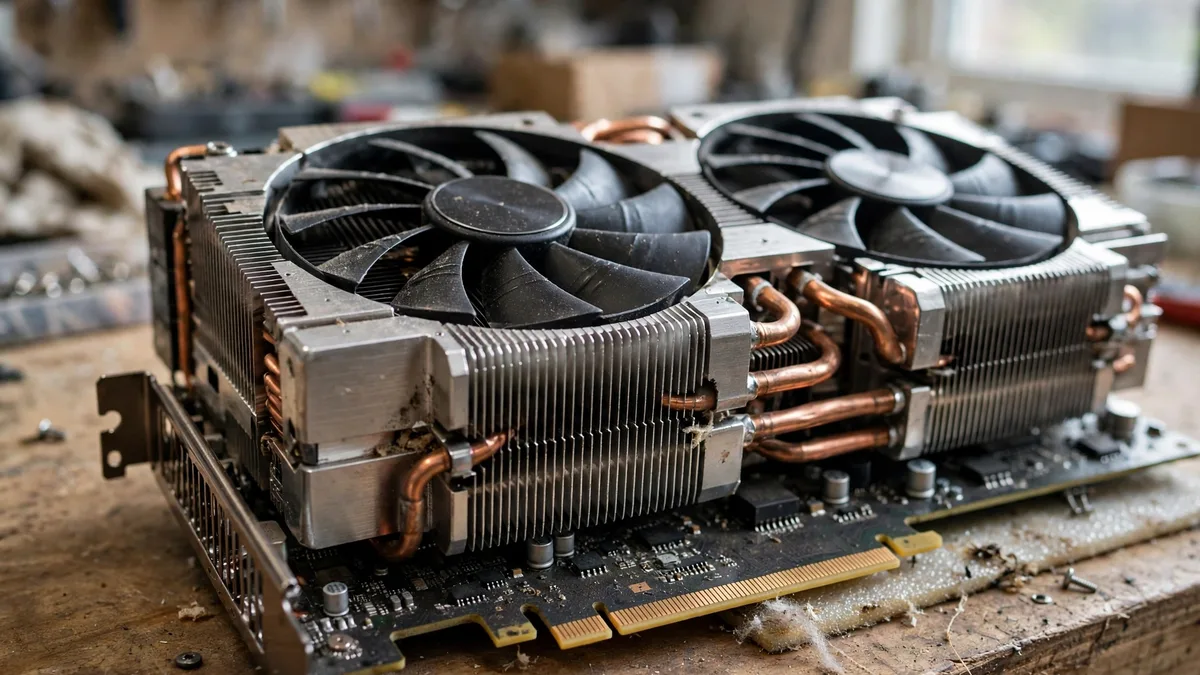
Intel’s Gaudi2 is four years old, it lost the AI chip race when it launched, and Intel has since abandoned the Gaudi line altogether. Yet in one specific AI inference test, reported this week, the old chip beat Nvidia’s H100. According to TweakTown, performance software company Standard Kernel reports that a single optimised Gaudi2 delivered 60 per cent higher decode throughput than a single Nvidia H100 80 GB PCIe card, along with 8 per cent higher prefill throughput, after software tuning alone.
The result is real, narrow and instructive all at once. It came from one workload, a Qwen3.5-27B-FP8 model running 16 concurrent requests with very long inputs and a 95 per cent shared prefix, and the comparison was against the PCIe version of the H100, not the faster SXM version. It does not make Gaudi2 a better chip than the H100 in general, and it arrives too late to change Intel’s AI accelerator plans. What it does show is how much performance can be hiding in software, and how misleading a single benchmark can be when it is read as a verdict.
This article sets out the test as Standard Kernel reported it, what the tuning changed, and the limits that keep the result in proportion. Every comparison figure is attributed to Standard Kernel’s testing as reported by TweakTown and corroborated by Wccftech and Dataconomy.
Key takeaways
- Standard Kernel reports that one optimised Intel Gaudi2 delivered 60 per cent higher decode throughput and 8 per cent higher prefill throughput than one Nvidia H100 80 GB PCIe card.
- The test ran the Qwen3.5-27B-FP8 model with 16 concurrent requests, 70,000-token inputs and a 95 per cent shared prefix.
- Software tuning alone lifted Gaudi2’s cached-prefill throughput by 3.21 times and its decode throughput by 2.84 times against its own unoptimised baseline.
- At quoted rental prices, Gaudi2 cost $0.60 an hour against $3.50 for the H100, producing 9.4 times more tokens per dollar in the test.
- The result covers one workload only, and Intel has abandoned the Gaudi roadmap.
What Standard Kernel actually tested
The test compared one Intel Gaudi2 accelerator with one Nvidia H100 80 GB PCIe accelerator, running the same model: Qwen3.5-27B-FP8, a 27-billion-parameter model in FP8 precision. Each run used 16 concurrent requests, every request had an input of 70,000 tokens, and 95 per cent of that input was shared between requests. Long inputs with a heavily shared prefix describe workloads like long documents or large codebases, and the test was designed around exactly that shape.
AI inference has two stages, and the test measured both. Prefill is the stage where the model reads and processes the input prompt; decode is the stage where it generates output tokens one at a time. Standard Kernel reports that the tuned Gaudi2 delivered 60 per cent higher decode throughput and 8 per cent higher cached-prefill throughput than the H100. Decode is where the headline gap sits, and it dominates cost in serving workloads.
The tuning gains against Gaudi2’s own starting point were larger still. Standard Kernel says its software work alone lifted cached-prefill throughput by 3.21 times and decode throughput by 2.84 times on the same chip, with no hardware change at all. The chip did not change; the software around it did. The same software-versus-hardware question plays out in miniature in phones and laptops, as our explainer on what an NPU is covers.
How software made an old chip faster
Standard Kernel’s optimisations were aimed at removing wasted work, and they touched both stages of inference. On the prefill side, the team used finer 128-token buckets instead of larger padded blocks, which cuts the computation wasted on padding and lets more requests fit within the scheduling budget without splitting them. It also separated cached prefixes from causal suffixes during attention processing, and used batched matrix operations with larger cache-aligned key-value tiles.
One of the more involved changes concerned the model’s gated delta network, or GDN, layers. The team replaced expensive 128 by 128 matrix inversions with smaller blocked inversions, accelerated by a custom kernel for Gaudi2’s tensor processing cores, and reused cached tensors to eliminate redundant forward passes. It also used FP16 precision for intermediate tensors while keeping sensitive operations in FP32. None of this changes what the model computes, only how efficiently the hardware is told to compute it.
The decode-stage changes followed the same logic of doing shared work once instead of sixteen times. Shared key-value prefix data is now gathered once instead of separately for each request, recurrent state is kept in dense buffers across decode steps instead of being repeatedly read and written back to the cache, and convolution, activation, query-key-value extraction and normalisation were fused into a single custom kernel. The result is a chip doing the same arithmetic with far less administrative work around it.
| Detail | What was reported |
|---|---|
| Tester | Standard Kernel, on its own benchmark |
| Chips compared | One Intel Gaudi2 against one Nvidia H100 80 GB PCIe |
| Workload | Qwen3.5-27B-FP8, 16 concurrent requests, 70,000-token inputs, 95 per cent shared prefix |
| Decode throughput | Gaudi2 60 per cent higher than the H100 |
| Prefill throughput | Gaudi2 8 per cent higher than the H100 (cached prefill) |
| Tuning gain on Gaudi2 | 3.21 times cached prefill and 2.84 times decode, software only |
| Memory bandwidth | Gaudi2 2.45 TB/s against about 3.35 TB/s for the H100, a 37 per cent H100 advantage |
| Rental cost | Gaudi2 $0.60 an hour against H100 $3.50 an hour; 9.4 times more tokens per dollar |
Why the result is narrower than the headline
The first limit is the workload itself. A 95 per cent shared prefix and 70,000-token inputs describe a specific serving pattern, and Standard Kernel’s optimisations were designed for exactly that pattern: long context, heavily shared prefixes, and many concurrent requests. Change the shape of the work and there is no evidence the advantage persists. TweakTown’s own framing makes the point in its headline: Gaudi2 won in one AI inference test, not in AI inference generally.
The second limit is the comparison hardware. The H100 in the test was the 80 GB PCIe version, the slower, lower-power form of the chip, rather than the SXM version used in most large AI clusters. The H100 still holds a clear bandwidth advantage, about 3.35 TB/s against Gaudi2’s 2.45 TB/s, and Gaudi2’s larger memory, 96 GB against 80 GB, only partly offsets that. The test says nothing about how Gaudi2 would fare against the H100’s faster SXM configuration.
The third limit is the one the coverage itself flags: it is not known how well tuned the H100 setup was. Standard Kernel’s numbers describe its own optimised Gaudi2 stack against an H100 running some baseline configuration, and the reporting does not say how much tuning effort went into the Nvidia side. Readers should treat the 60 per cent figure as the result of that particular pairing. A single benchmark does not change where chips are made or who buys them, as our report on India’s chip manufacturing boom shows.
What the cost figures do and do not prove
The cost numbers are striking. Standard Kernel found Gaudi2 available to rent at $0.60 an hour, against $3.50 for the H100, about 17 per cent of the Nvidia card’s hourly price. At those prices, the optimised Gaudi2 produced 9.4 times more tokens per dollar in the benchmark, and $0.35 per million decoded tokens against $3.28 for the H100.
But rental prices are a snapshot, not a specification. They reflect supply, demand and the second-hand market for older accelerators as much as they reflect performance, and Gaudi2’s low price is itself a consequence of its weak market position. That cheapness is what makes the tokens-per-dollar figure so large, and the figure is tied to the same single workload, so it inherits all of the same limits.
There is a broader lesson here about how AI hardware is judged. Until another party runs the same workload on both chips, the honest summary is that one vendor’s optimised software made one older chip look very good on one test. Intel’s own market position tells a similar story of caution, as our comparison of Broadcom versus Intel as chip stocks for 2027 shows.
Checklist: reading an AI chip benchmark honestly
Use these checks before taking any single benchmark at face value.
- Identify who ran the test and whether they sell software or hardware for one of the chips involved.
- Read the workload: model, precision, concurrent requests, input length and how much context is shared.
- Check which exact versions of each chip were compared, including PCIe against SXM and memory size.
- Ask how tuned each side was, and treat an untuned baseline as a measure of the software gap, not the hardware gap.
- Separate throughput from cost, and check whether rental prices are current, local and like for like.
- Look for independent replication on other workloads before treating one result as a general verdict.
Frequently asked questions
Did Intel’s Gaudi2 really beat Nvidia’s H100?
In one test, yes, according to Standard Kernel’s reporting as covered by TweakTown. A single optimised Gaudi2 delivered 60 per cent higher decode throughput and 8 per cent higher prefill throughput than a single H100 80 GB PCIe card on a Qwen3.5-27B-FP8 workload. It is not a general verdict on either chip.
What made the Gaudi2 faster?
Software, not hardware. Standard Kernel’s tuning lifted Gaudi2’s cached-prefill throughput by 3.21 times and its decode throughput by 2.84 times against its own unoptimised baseline, through finer token bucketing, shared-prefix reuse and fused decode kernels.
Why did the test favour the Gaudi2?
The workload used 70,000-token inputs with a 95 per cent shared prefix, a shape that rewards exactly the optimisations Standard Kernel built. It also used the PCIe version of the H100 rather than the faster SXM version, and the H100’s tuning level was not specified.
Is the Gaudi2 now a good buy for AI inference?
The test does not answer that. It shows strong value on one workload at current rental prices, $0.60 an hour against $3.50 for the H100, but Intel has abandoned the Gaudi roadmap, so buyers would be investing in a line with no future hardware.
What is decode throughput, and why does it matter?
Decode is the stage of inference where the model generates output tokens one at a time, after the prefill stage has processed the input. It dominates serving cost, so a decode advantage translates directly into cheaper tokens.
Does this change Intel’s position in AI chips?
No, not on its own. Intel has abandoned Gaudi and its Falcon Shores line is in limbo, according to the coverage. The result is a demonstration of what software optimisation can unlock on existing hardware, not a revival of Intel’s accelerator business.
The bottom line
A four-year-old chip beating a flagship rival makes a good headline, and the numbers behind it are genuinely impressive: a 60 per cent decode lead, a near-tripling of the chip’s own speed through software alone, and 9.4 times more tokens per dollar at rental prices. But it belongs to one workload, one vendor’s benchmark and one configuration of the rival chip. Read as evidence that AI hardware is often limited by its software rather than its silicon, it is exactly right.
The useful question is how much performance is sitting unused in the accelerators already installed in data centres. Standard Kernel’s work suggests the answer is a lot. In AI infrastructure, the software stack is not the finishing touch on the hardware. Increasingly, it is the product.