What if the biggest mistake people make with a laser level isn’t buying the wrong brand, but buying the wrong type of beam entirely?
That question comes up constantly. A homeowner hangs shelves with a cheap cross-line unit and loves it. A contractor tries the same tool for grading a driveway and hates it. Neither person is wrong. They simply needed different tools, and the spec sheets rarely explain why. This comparison walks through what actually separates laser levels, where the numbers mislead, and how to match a device to the task in front of you.
The Two Families That Matter Most
Almost every laser level sold today falls into one of two groups: cross-line (and dot) lasers and rotary lasers. The distinction shapes everything else, including price, range, and how you read the beam.
Cross-line lasers project fixed horizontal and vertical lines onto a wall or floor. They shine indoors, they’re compact, and they’re built for layout work: tile, cabinets, framing, shelving, drop ceilings. A dot laser is the same idea with single points instead of lines, handy for aligning recessed lights or conduit runs.
Rotary lasers spin a single beam at high speed to create a 360-degree horizontal plane. They’re the choice for long-range and outdoor work: setting grades, leveling slabs, running drainage falls, checking elevations across a site. Most rotaries pair with a detector or receiver, a handheld sensor that picks up the beam in bright sunlight where the naked eye cannot see it.
| Feature | Cross-line laser | Rotary laser |
|---|---|---|
| Typical use | Indoor layout, fit-out, remodeling | Site grading, excavation, long spans |
| Beam | Fixed lines, often green or red | Spinning 360-degree plane |
| Working range | Room-scale without a detector | Site-scale, extended by a detector |
| Outdoor performance | Poor in daylight | Good with a detector |
| Price band | Lower | Higher |
| Mounting | Wall bracket, small tripod | Heavy tripod, often with a staff |
The practical lesson: if the job involves reading a line on a wall, buy a cross-line. If it involves moving dirt or checking a plane across 30 meters, buy a rotary. Buying a rotary for cabinet work wastes money. Buying a cross-line for a drainage project wastes a weekend.
Reading Accuracy Specs Without Getting Fooled
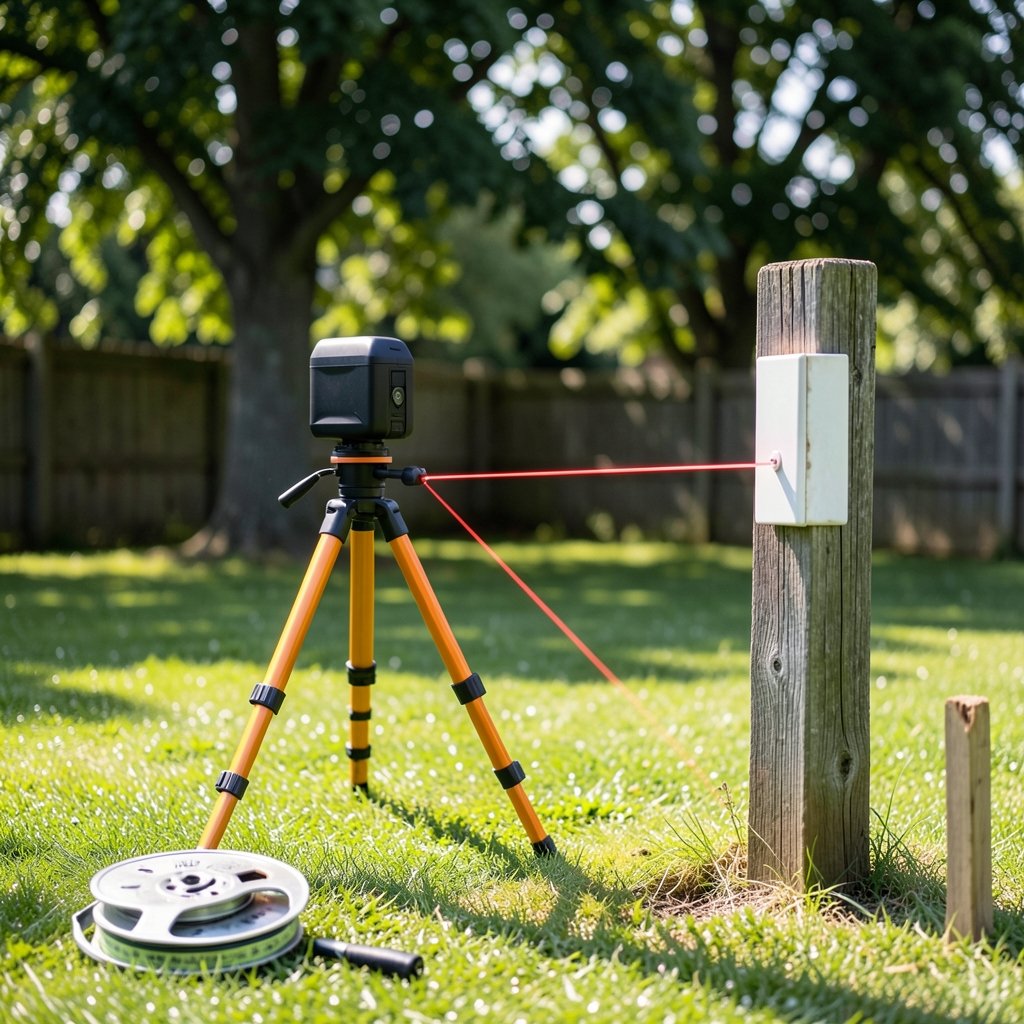
Every box advertises an accuracy figure, and almost every buyer misreads it. Manufacturers usually quote accuracy per distance, such as ±2 mm per 10 m or ±1/8 inch at 30 feet. Those two examples describe roughly the same error, just in different units.
The trap is assuming that number holds at any range. It doesn’t. Error grows with distance, so a laser rated ±2 mm at 10 m might be off by 6 mm at 30 m. That’s still fine for most framing, but it matters for anything with a tight tolerance.
There’s a second trap: accuracy claims are not standardized across brands. One maker measures at 10 m at room temperature. Another measures at 5 m after a warm-up period. Comparing headline numbers across brands is approximate at best. Compare them within a brand’s own lineup, and treat cross-brand figures as rough guides.
Then there’s the mount. A wobbly tripod, a sagging wall bracket, or a plastic clamp on a bowed stud can introduce more error than the laser itself. In practice, the mount is the weak link far more often than the optics. A mid-range laser on a solid tripod will beat a premium laser perched on a flimsy shelf bracket every time.
Self-Leveling, Pendulum, and What the Alarm Means
Most cross-line and rotary lasers are self-leveling. Inside the housing, a pendulum or electronic compensator swings the optics until they’re truly level. The tool only does this within a stated range, commonly ±3° to ±5°. Tilt it beyond that and it stops projecting, or sounds an alarm.
New users often think the alarm means the tool is broken. It doesn’t. It means the surface you set it on is too far off level, and the laser refuses to lie to you. Fix the setup, not the tool.
A few practical habits prevent most self-leveling headaches:
- Set the laser on a surface you’ve already checked with a spirit level, or on a tripod you’ve roughly leveled by eye first.
- Let the unit settle for a few seconds after you switch it on. Pendulum models need a moment to stop swinging.
- Lock the compensator before moving the tool. Many models have a transport lock, and skipping it is a common way to knock a pendulum out of calibration.
- Re-check the line against a known reference, like a door head or a marked height, before trusting it for a long run.
Green Beams, Red Beams, and the Visibility Question
Green beams have taken over the mid-market, and for good reason. A green diode (around 532 nm) reads brighter to the human eye than a red one (around 635 to 650 nm) under typical indoor lighting. That’s a perception effect, not an accuracy improvement. The green laser isn’t more precise; it’s just easier to see.
Easier visibility translates into real benefits: longer usable range indoors, faster setup, less squinting in a bright room. It also drains batteries faster, and green modules cost more. For dim interiors and short-range work, red is perfectly serviceable and cheaper. For sunny rooms, high ceilings, or long corridors, green earns its premium.
Outdoors in direct sun, neither color survives naked-eye viewing at distance. That’s the detector’s job, and it’s why rotary lasers dominate site work.
Safety: Classes, Labels, and Habits That Matter
Consumer laser levels are typically Class 2 (visible output at or below 1 mW) or Class 3R under IEC 60825-1, the international safety standard for laser products. The current edition is IEC 60825-1:2014, with later amendments. In the United States, the equivalent framework is the FDA/CDRH laser product performance standard under 21 CFR 1040.10 and 1040.11.
Two cautions follow. First, don’t assume every consumer laser is Class 2; labeling varies by model and region, so check the sticker. Second, never stare into the beam or point it at people, vehicles, or reflective surfaces like windows and mirrors. Class 3R units carry a higher risk, and the label on the housing tells you which class you’re holding.
Calibration, Drift, and the Maintenance Nobody Talks About
Many manufacturers recommend periodic recalibration, often annually for professional use. This is a manufacturer recommendation, not a regulatory requirement, and intervals vary by maker, so check your manual rather than assuming a universal rule.
In the field, drift shows up as a line that no longer agrees with itself. A quick self-check: set the laser up, mark the line at two points several meters apart, then rotate the unit 180 degrees and see whether the line still hits both marks. If it misses by a visible margin, it’s time for service. Dropped tools, temperature swings, and long storage in a hot van all nudge a laser out of true.
Matching the Tool to the Job
Here’s where the comparison becomes practical. Different buyers need genuinely different devices, and the workflow differences are large enough to justify separate purchases. The same logic applies across tool categories: a laser that suits a remodel rarely suits a site, just as the workflow gap between a diode and a CO2 laser changes which machine a beginner should buy first, as this breakdown of diode vs CO2 laser beginner workflow differences makes clear.
| Buyer | Best fit | Why |
|---|---|---|
| Homeowner hanging shelves, art, or a TV | Basic cross-line, red beam | Short range, indoor, budget-friendly |
| Remodeler doing tile and cabinets | Cross-line, green beam, tripod | Visibility in bright rooms, fine layout |
| Electrician or plumber | Dot or cross-line with a clamp mount | Point alignment in tight spaces |
| Landscaper setting grades | Rotary with detector and staff | Long range, outdoor, elevation work |
| General contractor running a site | Rotary plus a cross-line | Two jobs, two tools, no compromise |
Notice the last row. Many professionals carry both, because no single laser covers indoor layout and outdoor grading well. That’s not upselling; it’s the honest answer to “which one should I buy?”
Mounting and Setup: Where Accuracy Is Won or Lost
The spec sheet stops mattering the moment the tripod wobbles. A few setup habits separate clean results from frustrating ones.
Use a tripod with a firm head and lock the legs. For elevation work, a grade staff paired with a detector beats eyeballing a mark on a wall. For wall layout, a magnetic bracket on a steel stud is more stable than a clamp on drywall. And always verify the first line against a known reference before building anything on top of it.
One more habit worth adopting: mark your reference height on a wall or post at the start of a job, then re-check the laser against that mark after lunch. Temperature changes and accidental bumps happen, and a thirty-second check catches them before they cost you a rework.
How the Buying Decision Actually Shakes Out
Strip away the marketing and the decision tree is short.
If the work is indoors and within a room or two, a green cross-line laser on a decent tripod covers most of it. If the work involves dirt, distance, or daylight, a rotary with a detector is the only sensible choice. If you do both, buy both, and accept that the cross-line will be the one you reach for nine days out of ten.
Budget matters, but it matters less than the mount and the beam type. A careful buyer spending mid-range money on the right category will outperform someone spending top money on the wrong one. That pattern repeats across buying decisions in every tech category, whether it’s picking the right tier of a subscription plan, as this ChatGPT Go vs Plus vs Pro paid plan comparison shows, or choosing among AI models with wildly different strengths, as this AI model comparison of GPT 6.1 Sol vs Sonnet 5.5 vs Gemini 4 Argon lays out. The tool that fits the task wins, every time.
Conclusion
Laser levels aren’t complicated once you separate the two things buyers confuse: the type of beam and the quality of the build. Cross-line lasers own indoor layout. Rotary lasers own distance and daylight. Green beams help you see; they don’t make you more accurate. Accuracy specs are per distance and not standardized across brands, so treat them as guides rather than guarantees. And the mount, the setup, and a periodic self-check matter more than the number on the box.
Buy for the work you actually do, verify the line before you trust it, and check the class label on the housing. Do those three things and a mid-priced laser will serve you better than a premium one bought for the wrong job.
Frequently Asked Questions
Are green laser levels more accurate than red ones?
No. Beam color affects visibility, not precision. Green reads brighter to the eye under indoor lighting, which can extend usable range and speed up setup, but the accuracy spec comes from the optics and compensator, not the diode color.
What does the accuracy rating on a laser level actually mean?
It’s an error figure per distance, such as ±2 mm per 10 m. Error grows with distance, so the same tool is less precise at 30 m than at 5 m. Because brands measure under different conditions, cross-brand comparisons are approximate.
Why does my self-leveling laser keep beeping and shutting off?
It’s telling you the surface is tilted beyond its self-leveling range, usually ±3° to ±5°. The tool won’t project a line it can’t guarantee. Level the tripod or surface first, then switch it back on and let the pendulum settle.
Can I use a cross-line laser outdoors?
Only in shade or over short distances. In direct sunlight the beam washes out, and cross-line units generally lack the range for site work. For outdoor grading, a rotary laser with a detector is the practical choice.
How often should a laser level be recalibrated?
Many manufacturers recommend annual recalibration for professional use, but intervals vary by maker and it’s a recommendation rather than a regulation. Check your manual, and run a quick 180-degree self-check if the tool has been dropped or stored in extreme heat.
Do I need a detector to use a rotary laser?
Not indoors or in low light, where the beam is visible. Outdoors in daylight, a detector is what makes the tool usable at range, since it senses the beam the eye cannot see. Most rotary kits include one or offer it as an add-on.