
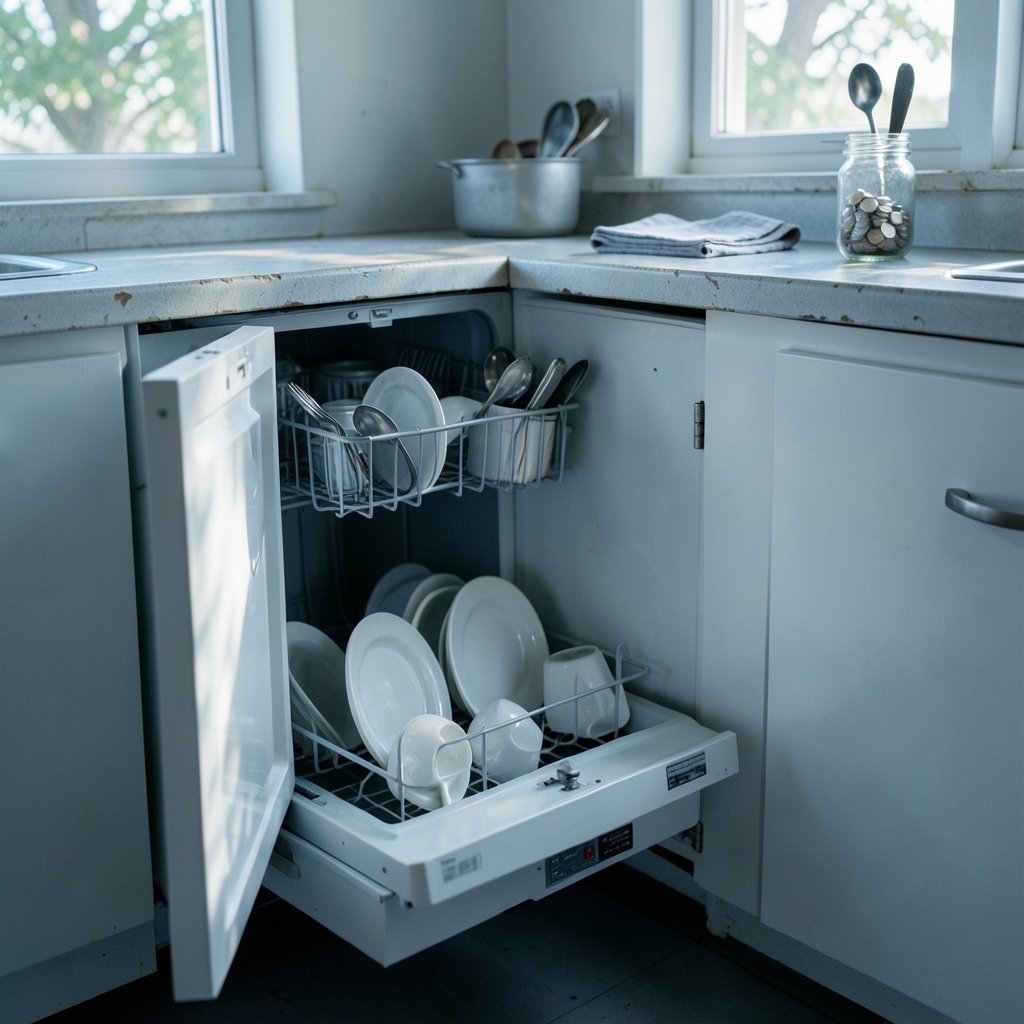
What if the cheapest dishwasher on the showroom floor turned out to be the most expensive one you could buy? That sounds like a sales gimmick, but it happens more often than most shoppers realize. The sticker price is only the first bill. The second bill arrives every month on your utility statement, quietly, for the next decade. That is why shopping for a budget dishwasher is less about finding the lowest number and more about finding the lowest total cost of ownership over the machine’s life.
This article walks through what actually matters when money is tight: energy and water consumption, the new labeling rules that changed how efficiency is measured, capacity definitions that trip people up, noise ratings, water hardness, and the installation types that quietly add to the bill. No hype, no invented model numbers, and no promises about prices that will be stale by next season. Just the durable facts that help a careful buyer spend wisely.
The Sticker Price Is Only Half the Story
A dishwasher is a rare appliance because it touches two utility bills at once, electricity and water, and it does so hundreds of times a year. Over a typical service life of roughly a decade, the running cost can rival or exceed the purchase price depending on local tariffs and how often the machine runs. That single fact reshapes the entire “budget” question.
A shopper comparing two machines should ask a different question than “which is cheaper?” The better question is “which is cheaper to own?” A slightly higher purchase price paired with lower energy and water use can flip the math within a few years. The catch is that you cannot eyeball this from the box. You need the energy label, and you need to understand what it is telling you.
The same reasoning applies to budget tech purchases. Anyone weighing a cheap laptop against a pricier one has to factor in battery life and replacement cycles alongside the checkout total. That is why guides on the best gaming laptops under 1000 actually fits budget spend so much time on long-term value. Appliances deserve the same scrutiny.
Why the Energy Label Changed and Why It Matters
On 1 March 2021, the European Union rescaled its energy labels. The old A+, A++, and A+++ classes disappeared, replaced by a simple A to G scale, and the measurement methods became stricter. For dishwashers, the label also carries a noise class and the water consumption per cycle.
Why does this matter to a budget buyer? Because older stock and secondhand listings still reference the retired classes. A machine labeled A+++ under the old system is not automatically the most efficient option today. The scales are not comparable, and mixing them up is one of the most common mistakes shoppers make. If a listing brags about A+++, treat it as a signal that the machine predates the rescaling, then go find the actual consumption figures.
The United States takes a different route. There, the ENERGY STAR program sets maximum annual energy use in kilowatt-hours and maximum water use per cycle for standard-size dishwashers, and qualifying models must meet those thresholds. The specific limits get revised periodically, so any figure quoted in an article, including this one, needs an “as of” date attached. The safe habit is to check the current specification before you buy rather than trusting a number you read last year.
Reading the Numbers That Actually Predict Your Bill
Labels and spec sheets are dense. Here is a practical way to cut through the clutter.
Annual energy use is the headline figure. It is expressed in kilowatt-hours per year and assumes a set number of cycles. Multiply it by your electricity rate to get a rough annual energy cost. This is the single most useful number on the sheet.
Water consumption per cycle matters more in places with high water rates or metered supply. Modern machines typically land somewhere in the broad range of roughly 9 to 13 litres per cycle in the EU and about 3 to 4 gallons per cycle in the US on eco or normal settings. Treat those as approximate ranges rather than precise guarantees, and always read the actual label for the model in front of you.
Place settings is the standard capacity unit in both regions, but the definitions differ between markets. A 12-place-setting machine in Europe and a 12-place-setting machine in the US are not measured identically. Capacity numbers are not directly comparable across regions, which matters if you are reading reviews from another country.
Noise in dB(A) deserves a mention because it affects daily life more than people expect. A difference of about 3 dB represents roughly a halving of sound energy, though the perceived loudness difference is smaller than that suggests. In an open-plan kitchen, paying attention to this number is worth more than most shoppers assume.
| What to Check | Why It Matters | Where to Find It |
|---|---|---|
| Annual energy use (kWh/yr) | Predicts your electricity bill | Energy label or spec sheet |
| Water per cycle | Predicts your water bill | Energy label or spec sheet |
| Place settings | Sizes the machine to your household | Spec sheet |
| Noise in dB(A) | Affects comfort in open-plan homes | Energy label or spec sheet |
| Energy class | Quick comparison within one scale | Energy label |
Eco Mode, Quick Cycles, and the Trap of Speed
Here is a counterintuitive fact that saves real money: the eco or normal program usually runs longer at lower temperatures and uses less energy than the intensive or quick cycles. Quick cycles often trade energy for time. They heat water faster and push through the load, and that speed has a cost.
Many budget shoppers default to the quick wash because it feels efficient. It usually is not. The eco cycle is the one the manufacturer tuned to hit the energy label figure. If you want the running cost you paid for, use it.
A second practical tip: scrape, don’t rinse. Pre-rinsing under a running tap can waste more hot water than the dishwasher itself uses for the whole load. Modern machines and modern detergents handle food residue well. Loading properly, with space between items and nothing blocking the spray arms, does more for cleaning performance than any pre-rinse.
Installation Type Quietly Changes the Price
The same internal hardware can carry very different price tags depending on how it fits into your kitchen.
Freestanding models are usually the cheapest and simplest to swap out. They need no cabinetry work.
Semi-integrated models hide most of the front panel but keep a visible control strip. They sit in the middle on price.
Fully integrated models disappear behind a cabinet door. They look the cleanest and often cost the most, partly because installation is fussier.
Slimline (45 cm) models fit narrow gaps but are frequently priced higher per place setting than full-width machines. If space is tight, that premium is the price of fitting at all.
The lesson for budget buyers is simple. If your kitchen already has a standard cavity, a freestanding or semi-integrated machine usually stretches your money furthest. Chasing a fully integrated look on a tight budget often means paying more for the same washing performance.
Hard Water, Salt, and the Cost You Don’t See
In hard-water areas, the dishwasher’s built-in water softener or separate salt compartment becomes a long-term cost factor. Machines without a softener can develop limescale, which degrades performance and shortens life. Machines with one need salt refills, which is a small recurring expense but a real one.
Budget shoppers sometimes skip the softener to save on the purchase price and regret it later. If your water is hard, factor in either a machine with a softener or a whole-home treatment option. Rinse aid matters too. It helps water sheet off and speeds drying, which matters more on machines without a heated drying element.
The same principle applies to budgeting in other rooms of the house. A cheap upgrade that ignores ongoing costs tends to cost more later. That is why budget-conscious planners reading up on small kitchen remodeling ideas budget smart upgrades that are encouraged to think about durability and running costs alongside the initial spend.
Repair Rights and Why They Favor Budget Buyers
Since 2021, EU ecodesign rules for dishwashers require manufacturers to make certain spare parts available for a minimum period and to provide access to repair information. The exact durations and part lists should be checked against the regulation text, but the direction is clear: repairability is now part of the product, not an afterthought.
For budget buyers, this is genuinely good news. A machine that can be repaired is a machine you can keep. Keeping an appliance longer spreads the purchase price over more years and is often the single biggest money-saver available. Before buying, check whether the brand has a service network in your area and whether common parts like baskets, spray arms, and door seals are obtainable. A bargain machine from a brand with no local support can become landfill the moment a cheap component fails.
A Practical Buying Sequence
When the budget is fixed and the options are many, a repeatable process beats impulse. Here is a sequence that works.
- Measure your cavity, including height clearance and door swing, before you look at anything.
- Decide the installation type based on what your kitchen already supports.
- Pull the energy label for every candidate and write down annual energy use and water per cycle.
- Estimate annual running cost using your own utility rates.
- Compare noise ratings if the kitchen is open to living space.
- Check water hardness and whether a softener is needed.
- Confirm spare parts availability and local service.
- Only then compare purchase prices.
Steps three and four are the ones most shoppers skip, and they are the ones that determine whether a “budget” dishwasher stays a budget purchase. The same discipline shows up in other budget decisions, like comparing subscription tiers before committing, as laid out in this breakdown of best ai chatbot your budget 2027 0 50 500 tiers compared. Cheap up front and cheap over time are two different questions.
Common Mistakes That Cost Real Money
The most frequent error is buying on sticker price alone. The second is trusting a retired energy class like A+++ as proof of modern efficiency. The third is defaulting to quick cycles and then wondering why the bills crept up.
Another common slip is overfilling. A packed machine cleans poorly, and rewashing by hand or running a second cycle erases any savings. Loading matters. So does using the right amount of detergent for your water hardness.
Finally, many buyers ignore the door swing and clearance, then discover the machine will not open fully under a counter edge. Measuring first is free. Returns are not.
Conclusion
The best budget dishwasher is not the cheapest one on the shelf. It is the one with the lowest total cost of ownership: modest purchase price, low annual energy and water use, a noise level you can live with, and a brand that can actually be repaired when something wears out. Read the label, ignore retired efficiency classes, use the eco cycle, and measure before you buy. Do those things and the machine that looked slightly more expensive up front often turns out to be the genuine bargain.
Frequently Asked Questions
What does “budget” actually mean for a dishwasher?
It means low total cost of ownership rather than a low sticker price. A machine with modest purchase cost and low annual energy and water use usually beats a cheaper machine that guzzles utilities for a decade. Running costs are a real part of the budget.
Is an old A+++ dishwasher more efficient than a new A-class one?
Not necessarily, and the two cannot be compared directly. The EU rescaled its labels on 1 March 2021, retiring A+, A++, and A+++, and tightened the measurement methods. An A+++ rating signals a machine that predates the rescaling. Compare actual consumption figures instead.
Does the eco cycle really save money if it takes longer?
Yes, in most cases. Eco and normal programs typically run longer at lower temperatures and use less energy than intensive or quick cycles. Quick cycles often trade energy for speed. The eco program is usually the one tuned to hit the energy label figure.
How many place settings do I need?
It depends on household size and how often you run the machine. Note that place-setting definitions differ between the EU and US, so capacity numbers are not directly comparable across regions. Match capacity to your real daily load rather than the biggest number available.
Is a quieter dishwasher worth paying more for?
It can be, especially in open-plan kitchens or homes where the machine runs in the evening. Noise is rated in dB(A), and a 3 dB difference represents roughly a halving of sound energy, though perceived loudness changes less than that suggests. Decide based on where the machine sits relative to living space.
Do I need a water softener in the dishwasher?
If your water is hard, a built-in softener or salt compartment protects performance and lifespan by limiting limescale. Machines without one may need extra maintenance. Factor salt refills into the running cost, and weigh the purchase premium against longer machine life.



