Robot-training video firms are suddenly spending a lot more time talking about privacy. A year ago, companies collecting or preparing first-person footage to train robots approached video-anonymization firm Pimloc roughly once a month. Now those calls arrive several times a week, according to Pimloc founder and chief executive Simon Randall, writing in Fortune on 25 November 2026.
The surge reflects how fast the market for robot-training video has grown, and how quickly its privacy problems have caught up with it. Developers need enormous volumes of real-life footage to teach machines physical tasks, recorded inside homes, workplaces, factories and vehicles, often capturing people who never agreed to appear in a training dataset.
Randall’s account puts a number on the change: inquiries up from about one a month to several a week within a single year, from companies working across autonomous vehicles, delivery robots, factories and drones. Their problem is no longer whether the footage exists. It is whether they are allowed to use it and sell it.
Key takeaways
- Companies selling robot-training video now approach privacy firm Pimloc several times a week, up from about once a month a year ago.
- India’s technology ministry probed home-services platforms in November 2026 over cleaners wearing head-mounted cameras inside customers’ homes.
- One startup told Fortune it collected more than a million hours of footage in its first month.
- Robotics and physical-AI firms had raised nearly $48 billion by early October 2026, per PitchBook.
- Buyers of training footage are now demanding proof of consent and protection for the people in it.
| Fact | Detail |
|---|---|
| Who reported the surge | Simon Randall, founder and CEO of Pimloc, a video-anonymization software firm |
| Where it appeared | A Fortune commentary published on 25 November 2026 |
| Inquiry pace a year ago | About once a month from companies collecting footage for physical AI training |
| Inquiry pace now | Several times a week, across vehicles, delivery robots, factories and drones |
| Regulatory trigger | India’s technology ministry inquiry into home-services platforms using head-mounted cameras |
| Scale of footage | More than a million hours collected by one startup in its first month |
| Funding in the sector | Nearly $48 billion raised by early October 2026, per PitchBook |
Why robots need video of real life
Chatbots learned to communicate by reading the internet. Robots cannot learn the same way. As Randall puts it, a robot has as much chance of learning to fold clothes by trawling search engines as he has of becoming a Michelin-starred chef by reading a cookbook. Physical skills need physical examples, recorded from real people doing real tasks.
That is why developers pay people to film their everyday work. Footage of preparing food, stocking shelves, repairing equipment and cleaning homes gives a robot the first-person view it needs to connect what a task looks like with how hands, tools and objects move. One startup told Fortune it collected more than a million hours of such footage in its first month.
From testing to selling, and why the rules changed
Many of the companies that first approached Pimloc were using open-source tools to redact footage, and the results were far from perfect. That was acceptable while the video stayed inside private development and testing, where nobody outside the company saw it or paid for it.

Two things have changed. First, many of those companies are now preparing to sell their footage to large AI developers with exacting standards. A buyer spending serious money on a dataset wants assurances about how it was collected, whether permissions cover its intended use, and whether the people in it are protected.
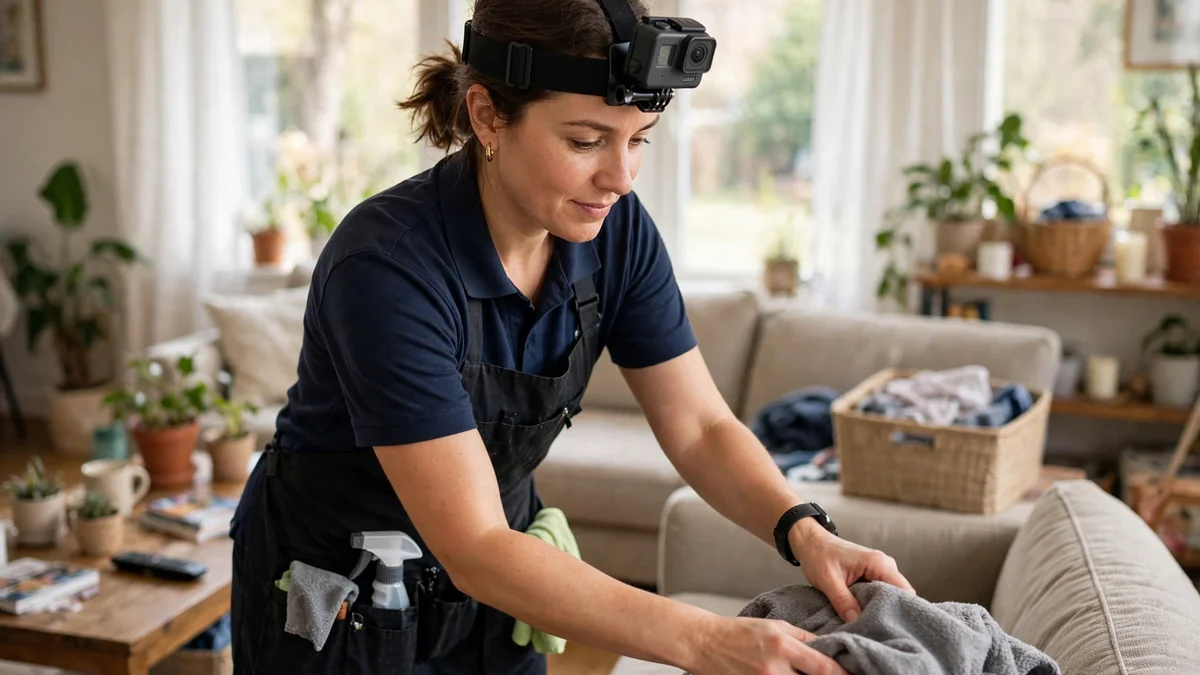
Second, governments are paying attention. Earlier in November 2026, India’s technology ministry probed home-services platforms about cleaners wearing head-mounted cameras inside customers’ homes, asking how the footage was collected, what consent was obtained, and whether it was going to AI developers overseas.
The India inquiry that put the issue on the map
The inquiry focused on a specific scene: a cleaner wearing a head-mounted camera while working inside a customer’s home. The footage was being collected to train robots, and officials asked how it was gathered, what consent had been obtained, and whether it was being sent to AI developers abroad.
The case matters because it combines every hard question in one place. The home is private. The worker wears the camera, but the customer owns the space. Other people may walk through the frame, and children, documents, screens and personal belongings can appear in the background. Consent from one person does not cover everyone else in the shot.
A wearable-camera veteran sees an old question return
Randall brings an unusual perspective to the debate. More than a decade ago, he helped build Autographer, one of the first wearable cameras. Back then, the central question was simple: how do I know if I am being filmed? The team designed privacy into the product from the start.
Today, he writes, the question has changed because cameras are everywhere. People are filmed all the time, so the question is no longer whether filming happened. It is where that footage goes, who has access to it, and what is being done with it. Much of Pimloc’s work involves police body-camera footage, which Randall says is remarkably similar to what robotics firms now collect. Wearable cameras keep moving from consumer gadgets into new roles, as seen in Warby Parker’s $395 smart glasses, tested in everyday use.
Two kinds of supplier, two very different problems
Randall divides the suppliers entering the market into two groups. Some companies were created specifically to collect training footage. They can build consent and anonymization into their processes from day one, designing forms, camera placement and redaction workflows around the dataset they plan to sell. That does not settle every concern, but it gives them a head start.
The second group is harder. These are established businesses that have recorded video for years for a different purpose and are only now discovering its new value. A home-services company or a factory may hold years of footage that suddenly looks like a valuable asset. But having captured the footage is not the same as having the right to sell it. Randall describes one such case: an established business that helps people with everyday tasks asked Pimloc about anonymizing years of customer footage for AI training. His team asked whether permissions could realistically be established, years later, for a use nobody had envisaged, and whether every identifying detail could be reliably found and protected. That discussion is still ongoing.
What buyers can do that regulators cannot
Randall’s advice to any business sitting on a digital archive is to start with two questions: did the people you meant to film agree to the footage being sold, and is everyone else in it protected? A company cannot assume the value of its archive without addressing those gaps first.
He also argues that buyers are best placed to make those checks standard. The large AI companies and labs developing physical AI products have little choice but to push the same questions down to the organizations selling them the footage they need. If the buyers paying for training data insisted on the same proof of permission and protection wherever it was recorded, every supplier would have to meet that bar. One company that approached Pimloc recently put it simply: we need to solve this problem, and redaction is important to us. The same pressure is visible across the wider AI industry, including the talks described in Amazon and Meta’s discussions about unblocking the Muse AI agent.
What it means
The surge in privacy calls is a sign that the robot-training video market is growing up. A year ago, footage was an experiment. Now it is a product, and products need provenance. The companies that built consent and anonymization into their collection from the start have an advantage. The ones sitting on old archives face a harder question: whether they can prove, years later, that the people in their footage agreed to this use.
For the robotics industry, the lesson is that data quality now includes privacy quality. A dataset with a million hours of footage is worth less if buyers cannot verify how it was collected. For workers and householders, the India inquiry shows that governments are starting to ask the questions Randall has been asking since the Autographer days: where is the footage, who has access, and what are you doing with it. The debate over trust in AI is already heated, as shown by a Siemens automation chief calling Silicon Valley’s AI jobs story toxic, and privacy is now part of that argument.
Checklist: what a robot-training video supplier should be able to prove
- Written consent from the people the cameras were meant to film, covering sale to AI developers.
- Protection for everyone else who appears in frame, including bystanders and children.
- A record of where each clip was collected and which country’s rules apply to it.
- Reliable redaction of faces, voices, documents, screens and other identifying details.
- Clear limits on overseas transfer of footage, agreed before the sale, not after it.
- A process for removing footage and handling complaints when consent is withdrawn.
Frequently asked questions
What is robot-training video?
It is first-person video of people doing everyday physical tasks, such as cleaning, cooking, stocking shelves or repairing equipment, recorded so that robots can learn those tasks. Developers use it because a robot cannot learn a physical skill by reading text on the internet.
Why are privacy calls to Pimloc rising?
Companies collecting footage for physical AI training approached Pimloc about once a month a year ago and now do so several times a week. The rise follows a shift from internal testing to selling footage to large AI developers, who demand proof of consent and protection.
What did India’s technology ministry ask about?
Earlier in November 2026, the ministry probed home-services platforms about cleaners wearing head-mounted cameras inside customers’ homes. Officials wanted to know how the footage was collected, what consent was obtained, and whether it was going to AI developers overseas.
How much footage are companies collecting?
One startup told Fortune it had collected more than a million hours of first-person footage in its first month, and Pimloc says it hears similar figures from others. Robotics and physical-AI companies had raised nearly $48 billion by early October 2026, according to PitchBook data.
Can old footage be sold for robot training?
Not automatically. A business that recorded video years ago for another purpose may not have permission to sell it for AI training. Pimloc asks whether permissions can realistically be established years later, and whether every identifying detail can be found and protected.
Who is Simon Randall?
He is the founder and chief executive of Pimloc, a company that sells software to anonymize sensitive video, much of it police body-camera footage. More than a decade ago, he helped build Autographer, one of the first wearable cameras, and he wrote the Fortune commentary on the surge in privacy inquiries.
The bottom line
The market for robot-training video has arrived faster than its rules. Inquiries to the firm that anonymizes that footage have jumped from monthly to several times a week, regulators in India have started asking how it is collected and where it goes, and buyers are making privacy proof a condition of sale.
What happens next depends on whether suppliers can prove consent and protection as reliably as they can collect hours of video. Companies built for this market from day one have a head start. Companies hoping to sell archives recorded for another purpose face the hardest test, and buyers may set the standard first. Randall is optimistic about what physical AI could do, but the footage teaching it captures far more than the task, and what a camera picks up by accident matters as much as what it is pointed at.