Siemens automation chief Ujjwal Kumar has called Silicon Valley’s AI jobs story “toxic and self-serving” in an interview with Fortune. Kumar, who leads Siemens’ automation business in the Americas, said the tech industry had done lasting damage by talking about artificial intelligence as though eliminating jobs were worth celebrating.
The Siemens AI jobs debate matters because it shapes how the public understands the technology now reshaping work. The loudest warnings about AI and employment have come from the companies building the systems, with mass white-collar job losses presented as inevitable and even exciting. Kumar argues that framing has left workers fearful and communities suspicious of the factories and data centers being built across the United States.
At the same time, Kumar says Siemens is living through a building boom unlike anything in his 27-year manufacturing career. He counts about 30,000 new industrial projects announced across the Americas in recent months. His message is that automation should be described as a way to move people into better work, not as a machine for removing them.
Key takeaways
- Ujjwal Kumar, president of Siemens’ automation business in the Americas, called Silicon Valley’s AI jobs story “pretty toxic and self-serving.”
- He cited Anthropic chief Dario Amodei’s May 2025 warning that AI could eliminate half of entry-level white-collar jobs within five years.
- He counts about 30,000 new industrial projects announced across the Americas, about a third in the US.
- Siemens USA pledged in December 2025 to train 200,000 electricians and manufacturing workers by 2030.
- Siemens has also announced cuts of more than 6,000 jobs worldwide, even as its headcount of roughly 300,000 stays broadly stable.
| Detail | What is known |
|---|---|
| Who spoke | Ujjwal Kumar, president of Siemens’ automation business in the Americas |
| Where | Interview with Fortune, published 28 November 2026 |
| Central quote | “The AI industry, especially the high-tech story coming out of Silicon Valley was pretty toxic and self-serving” |
| Warning cited | Anthropic’s Dario Amodei, May 2025: AI could eliminate half of entry-level white-collar jobs in five years |
| Building boom | About 30,000 new industrial projects announced across the Americas, about a third in the US |
| Training pledge | Siemens USA aims to train 200,000 electricians and manufacturing workers by 2030 |
Who is Ujjwal Kumar, and why his words carry weight
Ujjwal Kumar has spent 27 years remaking factories, starting at General Motors in Detroit, then ten years at GE and seven at Honeywell, before running the robot maker Teradyne Robotics. Today he leads Siemens’ automation business in the Americas, and he says he meets five or six chief executives a week because of the wave of new factory projects.
That background makes his criticism land differently. Kumar is himself an automation executive whose business depends on machines taking over tasks people used to do. He is not arguing against automation, but against how the technology industry talks about it. “My dad is a mechanical engineer. I’m a mechanical engineer,” Kumar told Fortune. His father, he said, “was thankful about the fact that he had a job.” The next generation, he said, will not accept the same bargain.
What exactly did Kumar call “toxic and self-serving”?
“The AI industry, especially the high-tech story coming out of Silicon Valley was pretty toxic and self-serving,” he said. “It was almost like gloating, saying, ‘Oh, it is a good thing that it is eliminating every job.'”
Kumar did not name anyone, but the best-known version of the warning came from Anthropic chief executive Dario Amodei, who told Axios in May 2025 that AI could eliminate half of all entry-level white-collar jobs within five years and push unemployment as high as 10% to 20%. “That is not how we in the industrial world talk,” Kumar said. “I have no idea why we would gloat about human beings losing their job, everybody going on UBI [universal basic income]. Like, that doesn’t excite people.”
The data center backlash that changed the conversation
Data centers became a political flashpoint in the midterm elections, with Democrats campaigning against big projects and voters pushing back over electricity costs, water use and a lack of local say. The opposition was not confined to one party, and what followed was described as a “blue tsunami” that saw Democrats win in states such as Mississippi and Texas, where they had not won in decades.
Kumar was at the SuperComputing2026 trade show in Chicago the week after the vote, and he said the results reshuffled what the industry talked about. He does not read the vote as a rejection of building. “They [the voters] said, ‘The way you are doing data centers, it is not helping me in my community,'” he said. He agreed communities should set the limits. He called the backlash a “boundary condition” and warned: “We don’t want to become the next tobacco industry.” The AI data centre boom raises the same question of who pays for the power, water and disruption new facilities bring.
A “greenfield” era: 30,000 projects and a different kind of factory
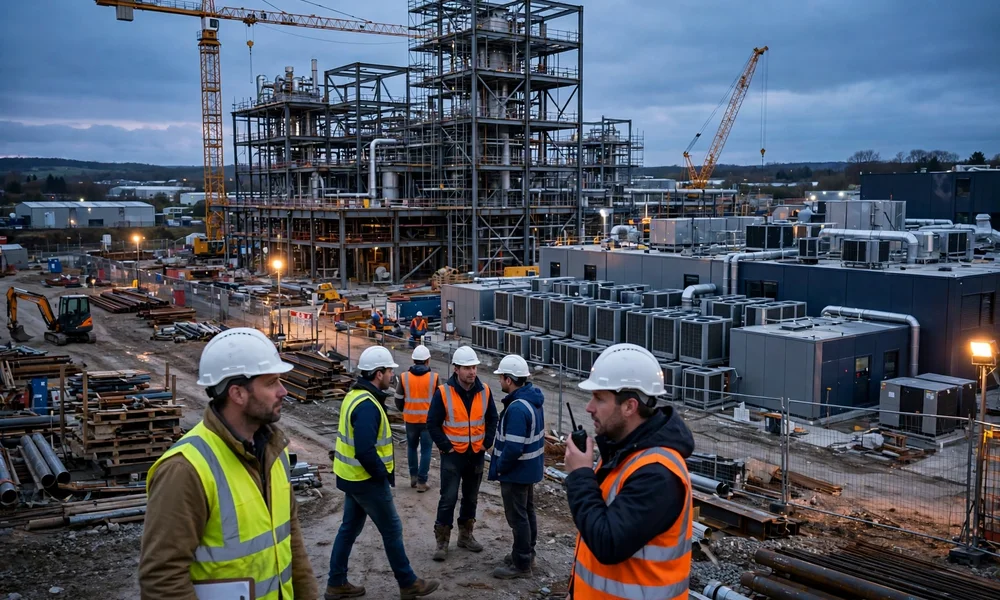
Despite the backlash, Kumar sees a building boom on a scale he has not witnessed before. By his count, about 30,000 new industrial projects have been announced across the Americas in recent months, to be awarded over the next three years, with about a third in the United States. Only about 3,000 are data centers and chip plants, while food and beverage plants are Siemens’ biggest category in the Americas. “We have never seen this level of greenfield work. We used to be more of a brownfield continent,” he said.
Kumar thinks most Americans, and plenty of executives, have not caught up to the difference. “It completely changes how you build your factories,” he said. “We will not build a factory today the way we used to build it 30 years back.” One reason is competition for workers: “In this generation, we in the manufacturing world, we interestingly are competing with Starbucks barista jobs,” he said. Automation, he argued, also wipes out the old case for offshoring: “whether I’m doing it in Shenzhen or doing it in Chicago, it doesn’t matter.” One caveat: spending on new manufacturing construction fell 22.4% in the first five months of 2026 from a year earlier, according to an analysis of Census Bureau data by the American Council of Engineering Companies.
Training 200,000 workers for the new factories
To staff the building boom, Siemens USA pledged in December 2025 to train 200,000 electricians and manufacturing workers by 2030. Kumar pointed to Siemens’ $190 million plant in Fort Worth, which opened in March 2025 to make electrical switchgear mostly for data centers. “We hired teachers, chefs, delivery drivers, and we trained them,” he said. Roughly a quarter of its approximately 800 workers had no prior manufacturing experience.
The training effort extends beyond Siemens’ own plants. The Siemens Foundation launched Careers Electric in February 2026 to train 25,000 new electricians in its first 10 years. Siemens is also a founding member of the Foundry School initiative, announced in September 2026 by the US State Department, to train the future workforce of the nation’s reindustrialization movement.
The awkward part: Siemens is cutting jobs too
Kumar’s argument has an awkward counterweight. Siemens has announced cuts at the same time as its training pledge, even as the company told Fortune that its overall headcount has remained “broadly stable” since 2025, at roughly 300,000 globally. In March, the company said it would cut more than 6,000 jobs worldwide, including about 5,600 by 2027 in factory automation.
His answer is that the work is being redefined rather than simply removed. “So there is a redefinition of the work going on throughout the economy and also in Siemens,” he said, adding that “we have used automation to move our human workers to more fulfilling jobs.” His pitch is an invitation: “You should come to one of our factories to see how net-net via automation and robotics is adding jobs, but different kinds of jobs.” The AI hype cycle has already distorted business decisions for smaller companies, and Kumar’s comments suggest the distortion reaches the labour market too.
What it means for workers, employers and the AI debate
For workers, Kumar’s message is mixed but more hopeful than the Silicon Valley version. The jobs of the future, in his telling, will be different rather than absent, and the skills that matter will be learned on the job. That is good news for career changers hired in Fort Worth, but cold comfort for anyone whose role is automated away first. None of this settles whether AI will eliminate half of all entry-level white-collar jobs, as Amodei warned. What Kumar has done is challenge the idea that either outcome should be celebrated.
Checklist: how to read the AI jobs debate
- Separate the prediction from the celebration: a forecast that AI will change jobs differs from treating job losses as a good thing.
- Ask who is speaking: an executive selling automation and one selling AI models have different interests.
- Check the numbers: project announcements are not the same as spending or hiring.
- Look at what companies do: training pledges test whether a firm believes workers are still needed.
- Watch the local politics: data center opposition is about electricity, water and community consent.
- Remember the worker’s view: people want fulfilling work.
Frequently asked questions
Who is Ujjwal Kumar?
Ujjwal Kumar is president of Siemens’ automation business in the Americas. He has spent 27 years in manufacturing, starting at General Motors, then ten years at GE and seven at Honeywell, before running the robot maker Teradyne Robotics.
What did Kumar say about Silicon Valley’s AI jobs story?
He told Fortune: “The AI industry, especially the high-tech story coming out of Silicon Valley was pretty toxic and self-serving. It was almost like gloating, saying, ‘Oh, it is a good thing that it is eliminating every job.'”
What warning was Kumar referring to?
He named no one, but the best-known version came from Anthropic chief Dario Amodei, who told Axios in May 2025 that AI could eliminate half of entry-level white-collar jobs within five years and push unemployment to 10% to 20%.
What is the “greenfield” building boom Kumar describes?
Greenfield means building a new plant from scratch on new land, as opposed to brownfield, upgrading an existing plant. Kumar counts about 30,000 new industrial projects announced across the Americas, about a third in the US. Only about 3,000 are data centers and chip plants.
How is Siemens training workers for the new factories?
Siemens USA pledged in December 2025 to train 200,000 electricians and manufacturing workers by 2030. Its $190 million Fort Worth plant, opened in March 2025, hired teachers, chefs and delivery drivers with no factory experience; roughly a quarter of its 800 workers had none.
Is Siemens cutting jobs while it talks about hiring?
Yes. Siemens said it would cut more than 6,000 jobs worldwide, including about 5,600 by 2027 in factory automation, even as its overall headcount stayed broadly stable since 2025 at roughly 300,000. Kumar says automation is redefining work, not simply removing it.
Bottom line
Ujjwal Kumar’s criticism of Silicon Valley’s AI jobs story is not an argument against artificial intelligence or automation. It is an argument about language, trust and who bears the cost of technological change. Coming from an executive whose own business sells automation, the charge that the tech industry sounded like it was gloating about eliminating jobs carries weight.
The test of Kumar’s alternative story will be written in hiring figures, training numbers and the factories themselves. If Siemens can staff its greenfield plants with career changers and keep its workforce broadly stable while automating, the industrial version of the AI story will have evidence behind it. The question of when to stop automating everything is now practical for every business.