
Warby Parker smart glasses are the eyewear company’s biggest bet since it helped invent the direct-to-consumer glasses business, and the first hands-on tests suggest the bet is both real and strangely familiar. Built with Google and Samsung and priced from $395, they put Gemini AI on your face, with a camera, speakers, and microphones tucked into frames that look like ordinary glasses. They film, translate, and answer questions without a phone in your hand, and testers agree: the technology is cool, and it is not very different from what Meta already sells.
That verdict, delivered bluntly by a Business Insider reviewer after a rainy Friday morning at Warby Parker’s New York pop-up, is the story of the launch in miniature. The reviewer spent hours with the glasses, tried the translation feature on a Spanish-speaking faux-retail worker, and came away with a two-word answer to what made them different from Meta’s glasses: not much. Fortune’s video test of 28 November 2026 reaches a warmer but compatible conclusion.
The launch matters because of who is making it. Warby Parker is one of the clear winners of the 2010s direct-to-consumer wave, with 360 stores and revenue up 10 percent to $245 million in its most recent quarter, yet it holds only about 1 percent of the United States eyewear market. Google is returning to consumer eyewear for the first time since the Google Glass era ended in embarrassment more than a decade ago. The $395 glasses are their joint attempt to make smart glasses something people actually want to wear, treating them as a fashion product first and a gadget second.
Key takeaways
- Warby Parker’s Intelligent Eyewear starts at $395, with presales from 12 November 2026 and sales from 10 December, in three frame styles.
- Built with Google and Samsung on Android XR, the glasses have Gemini AI, a 12-megapixel camera, about nine hours of battery, and weigh about 41 grams.
- There is no display in this $395 model: it is audio-first and screen-free, and all Gemini features are free, with no paid subscription required.
- Testers found the glasses comfortable and good-looking, but concluded they differ little from Meta’s Ray-Ban glasses.
- Warby Parker and Google say faces are redacted before Gemini analyses images, camera visuals are not used for AI training or advertising, and a recording light shows when the camera is active.
| Detail | What is known |
|---|---|
| Price | From $395; Gentle Monster’s version starts at $449 |
| Launch dates | Presales 12 November 2026; sales begin 10 December 2026 |
| Partners | Google: Android XR, Gemini; Samsung: hardware; Warby Parker: frames, lenses, sales |
| Camera | 12 megapixels, up to 3K video, recording light, anti-tampering protection |
| Battery and weight | Around nine hours per charge, with a charging case; about 41 grams |
| Display | None; audio-first and screen-free, prescription lenses available |
| Compatibility | Android and iPhone with feature parity; no paid Gemini subscription required |
What the glasses are
Warby Parker’s Intelligent Eyewear collection is the company’s entry into smart glasses, developed with Google and Samsung. Google owns the Android XR operating system and supplies the Gemini AI at the centre of the product. Samsung supplies most of the hardware: the cameras, microphones, and touch sensors.
The frames come in three styles, Alden, Reid, and Wren, in muted colours including green, brown, and black, starting at $395. Prescription lenses are available, including transition lenses that darken in sunlight, since these are meant to be worn all day as a person’s actual glasses. The cameras on the front of the frame could pass for screws, and wearers take a photograph or start filming by pressing a small button near the temple. Outward-facing lights illuminate while the user is recording.
The specifications are straightforward: 2GB of RAM and 64GB of storage, a 12-megapixel camera capable of up to 3K video, stereo speakers and far-field microphones, a touch sensor in the right arm, around nine hours per charge, and a weight of about 41 grams. One point of confusion deserves to be stated plainly: some earlier reporting described a high-resolution display tucked inside one lens, controlled with a wristband or watch. That display claim is unconfirmed and conflicts with later hands-on coverage, which describes the $395 model as screen-free. Until Google or Warby Parker clarifies the point, buyers should assume the glasses they can buy in December have no screen.
What Gemini does on your face
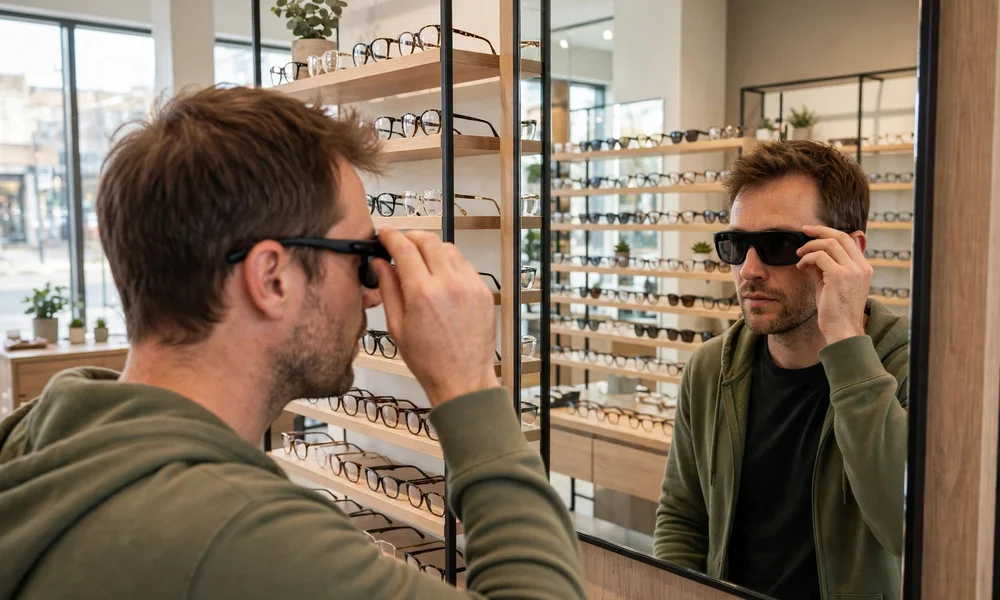
The centrepiece is Google’s Gemini AI, and using it is almost entirely verbal. Users ask the standard chatbot questions and get spoken answers: what is on the schedule, what should I text back, what is the horoscope. The glasses also have visual intelligence, letting them describe the room the wearer is looking at or give directions based on the street ahead. A reviewer picked up an invitation card and asked Gemini to add it to the calendar, with no phone and no manual entry.
Gemini stays on once activated, listening until a pause of about 15 seconds, so the wearer can keep asking questions without repeating a wake word. A short press on the button near the right temple takes a photo, a long press records video, and the touch sensor on the right arm controls volume, pauses audio, or dismisses Gemini. None of the features require a paid Gemini subscription. Everything is free, and the glasses work with Android and iPhone with feature parity.
Live translation is the feature reviewers single out. Press and hold two fingers on the temple and translation kicks in, automatically recognising the spoken language and rendering it in the wearer’s ear. The glasses recognise written text in over 70 languages, and in the stronger demonstrations, translation adapted to different speakers in a room. Independent verification in noisy environments is still pending. The weaker moments were consistent too. At the pop-up, the reviewer found it difficult to weave between conversations: after Gemini told him something, he would repeat it back to someone nearby, and Gemini took the repetition as a response and kept asking questions. Asked to translate Spanish into English, the glasses switched language slowly, inching through each word.
How they feel to wear
On comfort and style, the testers are unusually unanimous, and this is where Warby Parker’s contribution shows. The frames are not bulky or uncomfortable, and they look good. Google Glass failed in part because it looked like a gadget strapped to a face, and a device worn all day has to pass as ordinary eyewear. Co-founder Neil Blumenthal put it directly: this is a fashion product, and at its core, it is someone’s identity.
The comparison with Meta is unavoidable. Gilboa told the reviewer that the product may seem similar on the surface, but as soon as you put it on and demonstrate it head to head, the differences become clear. The reviewer, having done exactly that, disagreed. His answer was not much, and the feature list supports him: both products film, translate, and answer questions with AI, both expect the wearer to talk aloud, and both carry a recording light. Where Warby Parker hopes to win is on design, comfort, and trust, and on Gemini being the smarter assistant. His biggest takeaway was that the technology is cool.
Privacy, and the pervert glasses problem
The hardest question for the launch has nothing to do with specifications. Meta’s Ray-Ban glasses have run into serious trouble after men used them to film women without their knowledge, and the company has introduced updates to disable the filming abilities of users who tamper with the recording light. The controversy erupted in the middle of the Warby Parker glasses’ development. Blumenthal said everyone should be concerned about privacy, and Gilboa added that for someone to wear the glasses all day, they have to provide real utility and be a product that people around them are comfortable with. The glasses carry a recording light and anti-tampering features, so covering or disabling the light blocks capture. Google says it is not supporting direct livestreaming, and that it redacts faces before images are analysed by Gemini, with camera visuals not used for AI training or advertising.
Reviewers note the limits. The privacy commitment is Google’s stated policy, with no independent audit provided, and policy can change. A determined person might find a way around a recording light. Google’s answer is that the data protections matter more than the light: even if the light were defeated, the images would still be redacted and excluded from training and advertising. Whether that is enough to keep a $395 camera worn on the face out of the controversy cycle Meta faces is the question the next year of wear will answer.
What it means for the smart glasses market
The launch puts Google back in a category it helped create and then abandoned, through a partner that understands eyewear better than any technology company does. Google’s and Meta’s decisions to team up with established eyewear brands show that both companies understand that intelligent eyewear must be aesthetically pleasing and less science-fiction-like to achieve mass appeal. For buyers, the meaning is more practical. The glasses are a first-generation product in a category that is still small but gaining traction, and every strength reported so far comes with a condition attached. The AI is genuinely capable and free, but it depends on talking aloud and on Google keeping its privacy promises and its free tier intact. The translation shines in controlled demonstrations and crawls in at least one real-world test. Meta’s Ray-Ban Display glasses, with a screen and a neural wristband, have no direct Google rival yet.
Checklist: before you buy the $395 smart glasses
- Try them on in a store first, with your own prescription, and wear them for twenty minutes to check comfort.
- Test Gemini aloud in a noisy place, not just a quiet demo room, and try translation with a real conversation before deciding.
- Check the return policy and warranty, and ask who handles repairs.
- Read the privacy settings, including how long Gemini remembers conversations, and decide what you are comfortable with the camera capturing.
- Confirm the price includes the lenses you need, since prescription and transition options can change the total cost.
- Wait for early buyer reviews after the 10 December launch if you are unsure.
Frequently asked questions
How much do Warby Parker’s smart glasses cost?
The Intelligent Eyewear collection starts at $395. Gentle Monster’s version starts at $449, with identical specifications. Prescription lenses cost extra.
When can I buy them?
Presales opened on Thursday, 12 November 2026, and official sales begin on 10 December 2026. Warby Parker sells them through its stores, including its New York pop-up.
Do the glasses have a display?
No, not in the $395 model that goes on sale in December. The glasses are audio-first and screen-free. Some earlier reporting described a display inside one lens, but later hands-on coverage describes the shipping model as having no display, so buyers should assume there is no screen.
What can Gemini do on the glasses?
Gemini answers spoken questions, describes what the camera sees, gives directions, adds calendar events, and translates speech and written text in more than 70 languages. All features are free.
How long does the battery last?
Reviewers report around nine hours of use per charge, with a charging case for multiple recharges. The frames weigh about 41 grams.
What about privacy when the camera is recording?
A light on the frame shows when the camera is active, and covering or tampering with it blocks capture. Google says faces are redacted before Gemini analyses images, camera visuals are not used for AI training or advertising, and the glasses cannot livestream video. Reviewers note this is the company’s stated policy, with no independent audit.
The bottom line
Warby Parker’s $395 smart glasses are a good product with an honest problem. The frames are comfortable, the design is genuinely appealing, Gemini is the smartest assistant in the category, and the privacy protections are a real step beyond Meta’s. The translation feature can be remarkable, the camera is discreet, and the price, with no subscription attached, is fair.
The problem is that the glasses are, in the words of the reviewer who tested them most thoroughly, not much different from Meta’s. They film, translate, and answer questions with AI, they expect the wearer to talk aloud in public, and the translation that shines in a demonstration can crawl in a real conversation. The display that some early coverage promised is not in the model you can buy, and the privacy case, however strong on paper, will be tested on the street rather than in a showroom. Buy them for the design, the comfort, and Gemini, not because they reinvent the category. Compare them with other wearables in the best Black Friday smartwatch deals, and for the audio side, see Bose vs Sennheiser. The voice-recording angle is covered in the HiDock P1 AI voice recorder for Bluetooth calls.