What if the biggest decision in buying a projector had nothing to do with brightness or resolution, but with how far the machine has to sit from the wall? That is exactly the question that separates a short throw projector from an ultra short throw one. Both solve the same basic problem, which is that a normal projector needs a long, dark room and a ceiling mount to fill a big screen. But they solve it in very different ways, and picking the wrong one can cost you money, space, or a frustrating installation. (Projector)
This guide breaks down the real differences in throw ratio, placement, optics, screen choice, and price. It also covers the mistakes people make most often and what actually works in practice, so you can choose with confidence instead of guesswork.
What Throw Ratio Actually Means
Throw ratio is the number that defines everything here. It is the distance from the lens to the screen divided by the width of the image. A ratio of 1.5 means that for every 1 unit of image width, you need 1.5 units of distance. A 100-inch-wide image (about a 115-inch diagonal) at that ratio needs roughly 12.5 feet of throw.
From there, the industry sorts projectors into rough buckets:
| Category | Typical throw ratio | Distance for a 100-inch image | Common placement |
|---|---|---|---|
| Standard throw | 1.5 and up | 12 feet or more | Ceiling mount, back of room |
| Short throw | About 0.4 to 1.0 | Roughly 3 to 8 feet | Shelf or wall mount near screen |
| Ultra short throw | Below about 0.4 | Roughly 1 to 2 feet | On a stand or cabinet at the wall |
These cutoffs are conventions, not formal standards. Manufacturers disagree at the boundaries, and a few label a 0.5 ratio “ultra short.” Always check the spec sheet for the actual throw ratio and the published distance for the screen size you want, rather than trusting the marketing label.
How Short Throw Projectors Work
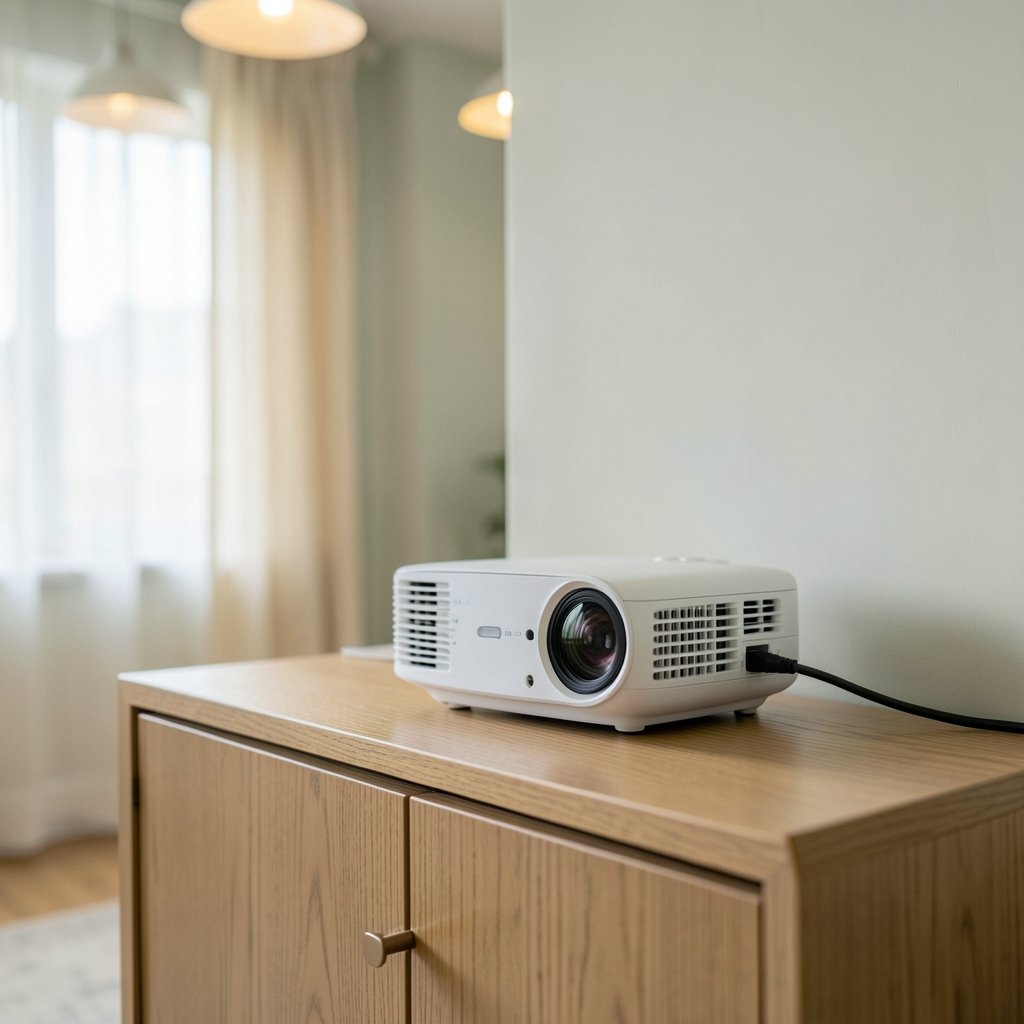
A short throw projector uses a lens with a wider field of view than a standard model, so it can sit much closer to the screen while still producing a large image. A typical short throw unit can fill a 100-inch screen from about 3 to 8 feet away, depending on the exact ratio.
The practical benefit is flexibility. You can place it on a shelf, a low cabinet, or a wall mount in front of the audience instead of hanging it from the ceiling. That means no ladder, no long cable run to the ceiling, and no drilling into a rental apartment ceiling. It also reduces the chance that someone walks between the lens and the screen and blocks the image, which is the classic “presenter shadow” problem in classrooms and meeting rooms.
Optically, short throw designs are a moderate step up in complexity. They usually add a few lens elements and some correction, but they remain close enough to standard optics that cost and image quality stay reasonable. Focus uniformity across the frame tends to be good, and setup is forgiving.
How Ultra Short Throw Projectors Work
An ultra short throw (UST) projector takes the same idea to an extreme. With a throw ratio often between 0.2 and 0.3, it can project a 100-inch image from just 1 to 2 feet away, sitting almost against the wall or screen.
That changes the room entirely. The projector can live on a media console under the screen, so there is no ceiling mount, no visible cabling, and no beam crossing the room. The presenter stands beside the screen rather than in front of the lens, so shadowing almost disappears. For a living room, a small conference room, or a classroom where the teacher writes on a board next to the image, this is a genuine advantage.
The trade-off is optical complexity. UST projectors rely on large aspheric or freeform lens elements to bend light through such a wide angle. That raises manufacturing cost and introduces challenges: corner focus can soften, geometric distortion needs digital correction, and the alignment between projector and screen becomes fussy. Get the angle slightly wrong and the image will not sit square on the screen.
Placement and Installation Compared
Placement is where the two categories diverge most in daily use.
A short throw projector still needs a few feet of standoff. In a small room, that can be awkward, because the ideal position may be in the middle of the floor or right where people walk. A shelf or wall bracket usually solves it, but you need to plan for it.
A UST projector needs almost no standoff, but it demands precision. The unit must sit level, at the correct height, and at the correct distance, and the screen must be perfectly flat. Many UST models include motorized focus and digital alignment tools, but these are corrections, not magic. A crooked cabinet or a bowed wall will show up in the image.
When planning a dedicated media room, budget for the entire room rather than only the projector. If the project overlaps with a build-out, apply the same planning used for home renovation costs: the screen, mounting, cabling, and furniture often cost more than the projector itself.
Image Quality: Brightness, Focus, and Uniformity
On paper, both categories can hit similar brightness and resolution. In practice, the differences show up at the edges.
Short throw models tend to have more even focus across the frame because the lens is doing less extreme work. Ultra short throw models can be razor sharp in the center and slightly softer in the corners, especially on cheaper units. Higher-end UST projectors use better lens assemblies and cost noticeably more.
Brightness matters more for UST because the projector usually sits in a room with ambient light. A UST paired with an ambient light rejecting (ALR) screen can look surprisingly good with the lights on, which is why the combination has become popular in living rooms. A short throw projector can also use an ALR screen, but the geometry is less demanding.
Screen Choice and Room Conditions
The screen is not an accessory here. It is part of the optical system.
| Factor | Short throw | Ultra short throw |
|---|---|---|
| Screen flatness required | Moderate | Very high |
| Wall texture sensitivity | Low to moderate | High |
| ALR screen benefit | Helpful | Major |
| Best screen type | Standard or ALR | Rigid ALR, tab-tensioned |
| Setup tolerance | Forgiving | Strict |
A UST projector aimed at a bare painted wall will work, but any ripple, texture, or unevenness becomes visible. A rigid ALR screen designed for UST geometry solves most of this and rejects light coming from above, which is exactly where room lighting tends to be. Short throw setups are more forgiving and can get away with a pull-down screen in a darker room.
Cost, Value, and What You Actually Pay For
For equivalent brightness and resolution, ultra short throw projectors generally cost more. The lens assembly is the reason. You are paying for complex optics, tighter tolerances, and the engineering that makes a 1-foot throw possible.
Short throw models sit in the middle. They cost more than standard throw but less than UST, and they deliver most of the placement convenience for a fraction of the optical complexity.
The total cost picture matters too. A UST setup often needs a rigid ALR screen and a stable cabinet, which adds to the bill. A short throw setup may need a wall mount and a longer cable run. Neither is cheap, but the UST path tends to have a higher floor.
Common Mistakes People Make
A few errors come up again and again when people buy their first short throw or UST projector.
- Ignoring the throw ratio math. Buyers assume “short throw” means “no distance needed.” It does not. Measure the room and check the published distance for your target screen size before ordering.
- Skipping the screen. A UST projector on a textured wall looks worse than a cheap standard projector on a proper screen. The screen is half the system.
- Placing the UST on an unstable surface. A wobbly cabinet means a wobbly image. The projector and screen must be rigid relative to each other.
- Forgetting cable management. UST units sit near the wall, so cables run along the floor or inside the cabinet. Plan for it.
- Buying for brightness alone. A very bright projector in a room with poor light control will still look washed out. Light control and screen choice matter as much as lumens.
Which One Should You Choose?
The decision usually comes down to the room, not the spec sheet.
Choose a short throw projector if you have a medium-sized room, want a flexible setup, plan to move the projector occasionally, or want good performance without paying the UST premium. It suits gaming, portable setups, and rooms where a shelf or wall mount is easy to add.
Choose an ultra short throw projector if the projector must live against the wall, if you want a clean living-room look with no ceiling mount, if the presenter needs to stand near the screen, or if you are building a fixed media wall with a rigid ALR screen. Classrooms, small meeting rooms, and digital signage are natural fits.
A simple rule of thumb: if the room has space for a few feet of standoff and you want to spend less, go short throw. If space is tight, the look matters, or shadowing is a real problem, go ultra short throw and budget for a proper screen.
Practical Setup Tips That Actually Work
A few habits separate a clean install from a frustrating one.
- Measure the exact distance from lens to screen for your target image size using the manufacturer’s calculator, then add a margin for adjustment.
- Mount the screen first, then position the projector. Doing it in reverse wastes time.
- For UST, use a spirit level on both the projector and the screen, and check the image corners after every adjustment.
- Test the setup with the room lights on and off before finalizing cable runs.
- Keep the lens clean. UST lenses sit low and collect dust, and a smudge is far more visible on a wide-angle lens.
If you are also equipping a workspace around the projector, pairing it with solid collaboration tools pays off as much as the hardware. A good project management software for teams keeps meetings short and focused, which is the real point of a good display. And if you are comparing display options more broadly, it is worth reading up on the best projectors for home theater before committing to a category. (Best projectors)
Conclusion
Short throw and ultra short throw projectors solve the same problem from different angles. Short throw gives you most of the placement convenience at a reasonable price and with forgiving setup. Ultra short throw gives you a nearly invisible installation, almost no shadowing, and a clean living-room look, but it demands a flat screen, careful alignment, and a bigger budget.
Neither is universally better. The right answer depends on how much space you have, how much control you have over light, whether the projector will be fixed or moved, and how much you are willing to spend on the screen and installation. Measure your room, check the real throw ratio, and budget for the screen. Do that, and the choice becomes obvious.
Frequently Asked Questions
What is the main difference between short throw and ultra short throw projectors?
The main difference is throw ratio, which is the distance needed for a given image width. Short throw projectors typically need about 3 to 8 feet for a 100-inch image, while ultra short throw models need only about 1 to 2 feet and sit almost against the wall.
Do I need a special screen for an ultra short throw projector?
It is strongly recommended. UST projectors perform best on a rigid, flat screen, ideally an ambient light rejecting screen designed for UST geometry. A textured or uneven wall will show ripples and soft corners that a proper screen eliminates.
Can I use a short throw projector on the ceiling?
Yes. Short throw projectors can be ceiling mounted, though many people choose a shelf or wall mount because the shorter distance makes ceiling installation less necessary. Either way, check the published throw distance for your screen size before mounting.
Is ultra short throw better for a bright room?
It can be, but only with the right screen. An ultra short throw projector paired with an ambient light rejecting screen handles room light better than most standard setups. Without an ALR screen, a bright room will still wash out the image.
Are ultra short throw projectors more expensive?
Generally yes, for equivalent brightness and resolution. The complex lens assembly needed to bend light through such a wide angle raises the cost. Budget also for a rigid ALR screen, which is often required to get the best result.
Can I move a short throw or ultra short throw projector between rooms?
A short throw projector is easier to move because setup is more forgiving. An ultra short throw projector is harder to relocate because it must be precisely aligned with a flat screen every time. For portable use, short throw or standard throw is the better choice.