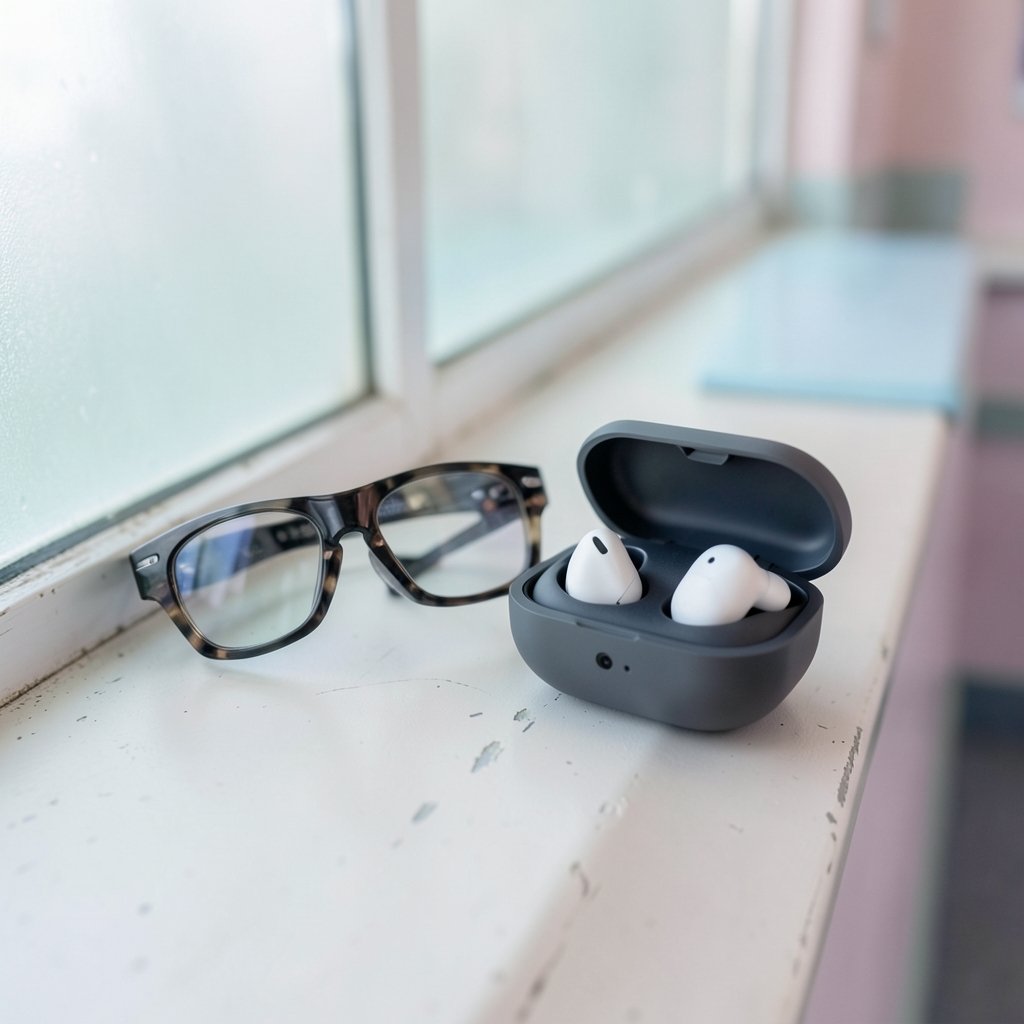
What if the most useful AI gadget of the next few years isn’t a screen at all, but something you already wear on your face or in your ears? That’s the fork in the road now facing anyone shopping for everyday assistance. Meta’s camera-equipped frames and the wireless earbuds already in millions of pockets both promise hands-free help. They get there in very different ways.
The honest picture is messier than either camp admits. Smart glasses win on awareness and seeing what you see. Earbuds win on audio quality, noise control, battery life, and plain social comfort. Picking wrong is easy, and it’s usually a quiet, daily annoyance rather than a dramatic failure.
The comparison at a glance
| Criterion | Meta Ray-Ban smart glasses | Wireless earbuds (with a phone) |
|---|---|---|
| Hands-free AI | Yes, wake word and camera input | Yes, voice assistant via phone |
| Audio isolation | None (open-ear) | Strong, with ANC on sealed models |
| Music quality | Modest | Rich, sealed-canal sound |
| Battery for calls | Roughly 3–6 hours | 6+ hours per bud, 30+ with case |
| Camera input | Built in, 12MP on Meta frames | Needs a separate camera system |
| Social comfort | Visible, sometimes questioned | Invisible to most people |
| Price starting point | From $299, lenses extra | Often far less |
| Best for | Awareness, capture, translation | Focus, calls, long listening |
That table is the whole argument in miniature. Everything below explains why each row matters in real use.
Why this comparison is the right one now

For years, smart glasses were measured against AR headsets and sci-fi promises. That was the wrong yardstick. The device most people actually replace with glasses is their daily audio wearable, which is exactly what the earbuds comparison in one detailed 2026 buyer’s breakdown argues. Meta now produces its frames in the millions annually, so this is no longer a novelty question. It’s a “what goes in my bag every morning” question.
The category has also split. As one 2026 wearable review put it, “AI wearable” now means three separate product lines, glasses, earbuds and watches, each with different maturity and a different buyer. The pin form factor is effectively dead, and the most useful devices solve one specific job well instead of promising to replace your phone. That framing should guide your choice more than any spec sheet.
Where smart glasses genuinely win
Situational awareness you can’t fake
Open-ear audio is the glasses’ secret weapon. You hear traffic, your kids, the barista calling your name. For cyclists, parents, and anyone moving through a busy street, that’s not a compromise, it’s the point. Sealed earbuds with noise cancellation literally cannot do this, because blocking ambient noise is their entire job.
Seeing what you see
The 12-megapixel camera on Meta’s frames is the feature no earbud matches yet. You can ask the assistant about what’s in front of you and get an answer spoken back. That’s useful for reading a menu in another language, identifying a plant, or checking a label. One hands-on comparison describes recording an entire trip hands-free with Meta glasses, which is a workflow earbuds simply can’t offer.
Capture without breaking the moment
Photos and video from eye level, triggered by voice, feel less intrusive than raising a phone. If you document life casually, this alone can justify the purchase.
The display tier exists, for a price
Higher-end models push further. The Ray-Ban Meta Display, at $799, adds a full-color 600×600 display in the right lens using waveguide technology, invisible from outside, with up to 5,000 nits at 90Hz. It ships with a neural wristband that reads muscle signals for gesture control, weighs 69 grams, and sold out in 48 hours. That’s a real glimpse of where everyday assistance is heading, though it’s a premium tier rather than a mass-market default.
Where earbuds quietly dominate
Noise control and music fidelity
If you commute on a train or work in an open-plan office, you need silence, and open-ear audio can’t give it to you. Sealed-canal listening is also fundamentally richer. Audiophiles aren’t switching to open-ear frames, and that’s fine.
Battery you don’t think about
Most glasses ship with roughly 3–6 hours of talk time. Earbuds typically manage 6+ hours per bud and 30+ with the charging case. For long calls or all-day listening, the math isn’t close.
Social invisibility
Earbuds are unremarkable. Glasses with a camera still trigger questions, and privacy pushback is a real, documented headwind for the category. If you dislike explaining your gadgets, earbuds win by default.
The camera-in-your-ear surprise
Here’s the twist: earbuds may close the “seeing” gap. Researchers at the University of Washington built a prototype called VueBuds, which uses tiny built-in cameras in wireless earbuds to capture images and let you talk with an AI about what’s in front of you. In a demonstration, a user looking at a food package in Korean asked for a translation and got English audio back in about a second. If that ships, the glasses’ biggest advantage narrows considerably.
The real-world friction nobody warns you about
Practical experience with both formats surfaces a few recurring mistakes.
First, people buy glasses expecting headphones and are disappointed by bass and isolation. Buy them for awareness and capture, and keep earbuds for focused listening.
Second, people underestimate battery. Three to six hours of talk time sounds fine until a workday of calls. A charging case is a genuine advantage, not a spec-sheet nicety.
Third, prescription wearers forget lens costs. Meta frames start at $299, and prescription lenses add a fee on top. Budget for that before comparing prices.
Fourth, translation is oversold. Getting a sentence translated is not the same as holding a conversation. AirPods-style approaches split the work between phone and buds, running translation on the handset, and the gap between “it translated” and “we understood each other” is where disappointment lives. Test translation in a real conversation before you rely on it.
Fifth, comfort over hours matters more than any feature list. A 69-gram frame feels different at hour six than at minute six.
If your broader setup is still undecided, it helps to read up on how the smart glasses future evidence actually shows before committing to a form factor.
Translation and assistance: the feature both camps claim
Real-time translation is the headline use case for both. The demand is clear and the demo is intuitive, but it’s also the easiest place to mistake a successful sentence for a completed conversation. Earbuds have an edge in delivering clean audio into your ear, which matters in noisy places. Glasses have an edge in showing context and keeping your hands free. Neither is a universal translator yet, and anyone selling it as one is overselling.
For a broader look at which everyday devices actually earn their place, the AI wearables category breakdown is worth reading before you spend.
Choose X if, choose Y if
Choose Meta Ray-Ban smart glasses if:
- You want hands-free AI that can see what you see.
- You value hearing your surroundings over blocking them.
- You capture photos or video casually and want it frictionless.
- You’re comfortable being visibly early to a category.
- You’ll use translation or object identification regularly.
Choose wireless earbuds if:
- You need noise cancellation for commuting or focused work.
- Music quality matters to you.
- You take long calls and can’t babysit a battery.
- You want the assistant without any social friction.
- You’d rather spend less and upgrade later.
Honestly, many people will end up with both. Glasses for awareness and capture, earbuds for focus and audio. That’s not indecision. It’s matching tools to moments, which is exactly what the smarter 2026 comparisons conclude.
How this plays out through 2027
Expect the lines to blur. Camera-equipped earbuds are in active research, glasses are adding displays and gesture control, and the “AI” label is doing less work than it did a year ago. The winning devices will be the ones that solve one job so well you stop thinking about them. If you’re building a wider setup, it’s worth seeing how form-factor choices play out in gaming and general use, from the Legion Go S vs Steam Deck everyday gaming comparison to the PC gaming vs console everyday experience. The same principle applies: pick the tool that fits your actual day, not the one with the longest feature list.
Conclusion
Smart glasses and AI earbuds are not really rivals fighting for one slot. They’re two answers to the same question, asked in different rooms. Glasses answer “help me while I’m looking at the world.” Earbuds answer “help me while I’m listening to it.” If you can only buy one, be honest about which sentence describes most of your day. If you can buy both, you’ll use each for exactly what it’s good at, and you’ll stop noticing either one, which is the highest compliment a wearable can earn.
Frequently asked questions
Are smart glasses better than earbuds for everyday AI help?
It depends on the task. Glasses win when you need awareness, camera input, or hands-free capture. Earbuds win on noise control, audio quality, battery life, and social comfort. For most people, the right answer is the one that matches their most common daily moment, not the one with more features.
Can earbuds really see what I’m looking at?
Not in mainstream products yet, but the research is real. A University of Washington prototype called VueBuds uses tiny cameras in wireless earbuds to capture images and answer questions about them, including near-instant translation of a foreign-language label. Treat it as a promising direction rather than something you can buy today.
How long do smart glasses batteries actually last?
Most glasses ship with roughly 3–6 hours of talk time, which is far less than earbuds, which typically manage 6+ hours per bud and 30+ with a case. If you take long calls, plan around charging or keep earbuds as your call device.
Do I need a prescription to use Meta Ray-Ban glasses?
No, but prescription lenses cost extra on top of the $299 starting price. Factor that into your budget before comparing against earbuds, which need no lens work at all.
Is the AI translation on these devices good enough for real conversations?
Sometimes, but not reliably. Translating a sentence successfully is not the same as completing a conversation. Test it in a real, noisy, multi-turn exchange before you depend on it for travel or work.
Will camera earbuds make smart glasses pointless?
Unlikely to make them pointless, but likely to narrow the gap. Glasses still offer open-ear awareness, eye-level capture, and optional displays. Earbuds will keep winning on audio and discretion. The two formats will probably keep splitting the job rather than replacing each other.
The practical takeaway for 2027 is to buy for the job you do most, then let the second device fill the gaps when budget allows. Prices will move, features will migrate between formats, and today’s premium display tier will look ordinary within a couple of product cycles. What won’t change quickly is the underlying trade-off: awareness versus immersion, capture versus discretion, hands-free convenience versus battery anxiety. Judge each device against your own routine—commute, desk, street, kitchen table—and the choice becomes obvious. Whichever you pick, the goal is the same: assistance that disappears into the moment instead of interrupting it.