
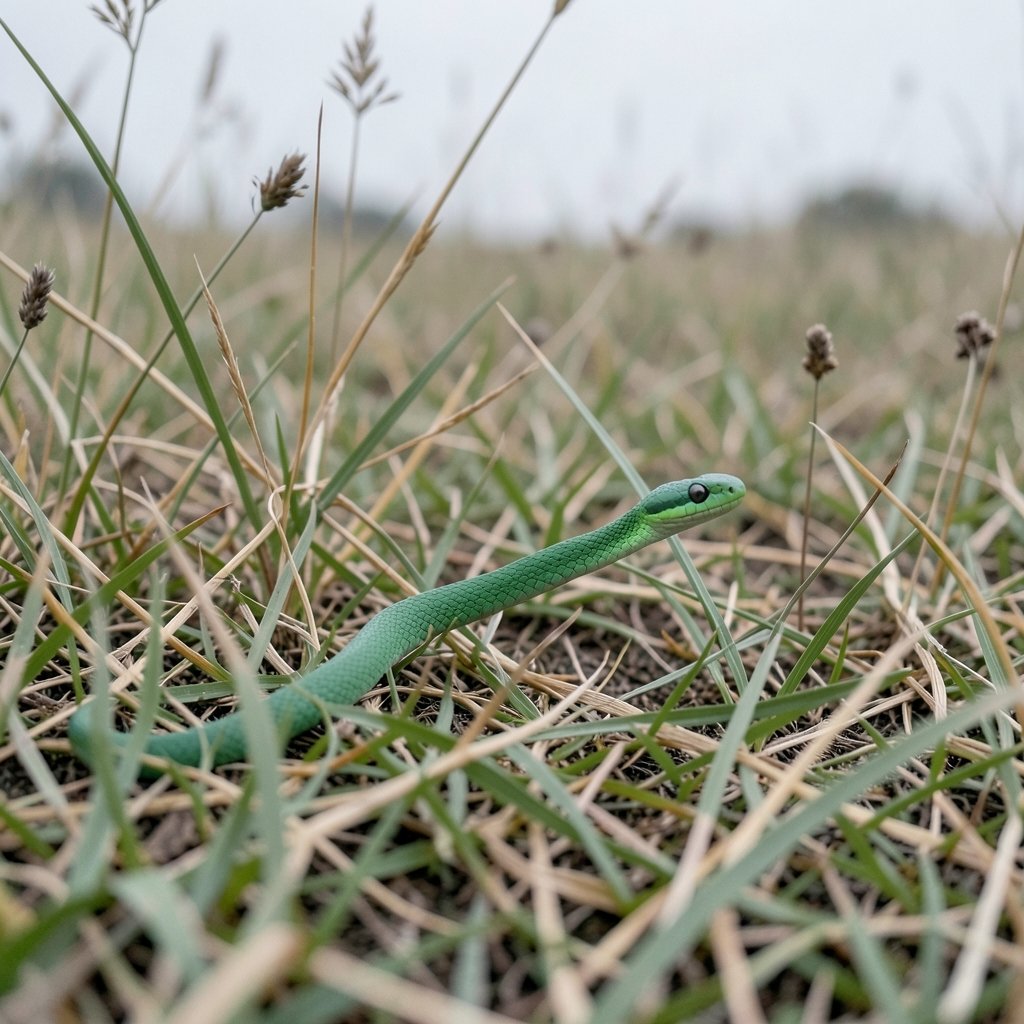
What small, bright green snake slips through tall grass, eats insects instead of mice, and almost never bites? If that question brings to mind a thin ribbon of green disappearing into a meadow, you are probably thinking of the smooth green snake. It is one of the most misunderstood reptiles in North America: quiet, tiny, and easy to confuse with its rougher relative. This guide walks through what the snake actually is, how to tell it apart from lookalikes, where it lives, what threatens it, and what to do if you stumble onto one in your garden.
What Is a Smooth Green Snake, Exactly?
The name “smooth green snake” is a common label, not a single universal species. In North America, it usually refers to Opheodrys vernalis, also written as the smooth greensnake. Field guides treat it as the smooth-scaled cousin of the rough green snake (Opheodrys aestivus), which lives farther south and has keeled, textured scales.
That naming detail matters more than it sounds. Search for “green snake” and you will get results from three continents. Southern Africa has Philothamnus bush snakes, Asia has green pit vipers and green colubrids, and North America has its own pair of gentle green insect-eaters. The facts in this article apply to the North American smooth green snake unless stated otherwise.
The snake is small. Adults typically fall somewhere in the range of 30 to 50 centimeters in total length, which puts them in the “pencil with a face” category. They are slender, fast, and built for slipping through grass rather than overpowering prey.
Smooth vs. Rough: Telling the Two Green Snakes Apart

The single most reliable difference is the scales. Run a finger gently along the back of a smooth green snake and it feels like glass. The rough green snake feels like it has a subtle ridge down each scale. That ridge is called a keel, and it is the standard distinguishing feature in field guides.
| Feature | Smooth green snake | Rough green snake |
|---|---|---|
| Scale texture | Smooth, glossy | Keeled, textured |
| Typical range | Northern U.S. and southern Canada, with scattered southern populations | Southeastern and south-central U.S. |
| Body shape | Slimmer, slightly shorter | Longer, more slender overall |
| Preferred cover | Moist meadows, marsh edges, grassy fields | Shrubs, vines, trees near water |
| Climbing habit | Mostly ground level | Frequently climbs vegetation |
One practical warning: both snakes look almost neon in good light, and both can appear blue-green or gray-green after death or in shed. Do not rely on color alone. Scale texture plus location is the honest identification method.
Why the Smooth Green Snake Is So Hard to Spot
This snake is a master of disappearing. It does not bask on open rocks the way garter snakes do. It does not rattle, hood, or bluff. It simply stops moving, and the grass wins.
Three habits explain the invisibility:
- It freezes instead of fleeing. When threatened, the snake often stays still and relies on camouflage. Most people walk past within a meter without noticing.
- It prefers dense ground cover. Moist meadows, marsh margins, grassy roadsides, and old fields are prime habitat. Mowed lawns offer little.
- It is active in conditions people avoid. Overcast, humid, mild days bring it out. Hot midday sun sends it under cover.
There is also a sadder reason sightings are rare in some areas. Populations are scattered and sometimes isolated, so even good habitat may hold few snakes.
What Does the Smooth Green Snake Eat?
Here is where this species separates itself from most backyard snakes. It is a dedicated invertebrate specialist. Its diet is built around soft-bodied insects and similar small prey:
- Caterpillars and grubs
- Spiders
- Slugs and snails
- Crickets, grasshoppers, and other insects
- Small worms and larvae
Notice what is missing: mice, frogs, birds, and eggs. The smooth green snake is not interested in rodent control, which is exactly why it poses no threat to pets or poultry. It hunts by sight and by movement, grabbing prey and swallowing it whole. Captive care is notoriously difficult for this reason; the snake often refuses substitute food and does poorly in captivity. Wild snakes should stay wild.
If you keep a garden and want to encourage insect-eating reptiles, the practical move is habitat, not handling. Leave a rough grassy strip, skip the broad-spectrum insecticides, and provide cover such as flat boards or brush piles at the meadow edge. Chemical sprays remove the food supply and can harm the snake directly.
Habitat: Where Smooth Green Snakes Actually Live
The species is associated with moist grassy places. Think meadow, marsh edge, wet prairie, roadside ditch with tall vegetation, and grassy openings near water. In some regions, crayfish burrows and other ground cavities serve as retreats, especially where winters are cold.
Range is where things get complicated. The smooth green snake occurs in scattered populations across the northern United States and southern Canada, with isolated populations farther south, including Appalachian and Rocky Mountain outliers. Range maps differ between sources, so treat any single map as a rough guide rather than a boundary line.
This patchy distribution is a key point for anyone building a management plan. A field that looks perfect may hold no snakes if it sits outside a known population. Conversely, a small, unremarkable meadow inside a known range can matter a great deal.
Is the Smooth Green Snake Dangerous?
No. The smooth green snake is harmless to humans. It has no venom, small teeth, and a strong preference for escape over confrontation. Bites are essentially unheard of, and even a defensive nip from a snake this size would barely register.
That said, a few sensible rules apply to any wild reptile:
- Do not pick it up. Handling stresses the snake and can injure it.
- Keep pets away. Cats and dogs kill far more snakes than snakes harm.
- Never kill a green snake out of fear. It is not a threat, and in many places it is legally protected.
- If one is inside a building, use a soft broom and a container to move it outside rather than grabbing it.
Confusion with venomous species is the main reason these snakes get hurt. In North America, no common venomous snake is small, uniform bright green, and smooth-scaled. In other parts of the world, green coloration is common among vipers, so regional knowledge matters. If you are unsure, photograph from a distance and ask a local expert.
Conservation Status: Secure Globally, Fragile Locally
At a broad scale, the smooth green snake is generally considered secure across its global range. The picture changes at state and provincial level, where some populations are listed as species of concern. Status varies by jurisdiction, so the only reliable answer for your area comes from your local wildlife agency.
The pressures are familiar and mostly human-made:
| Threat | How it affects the snake |
|---|---|
| Habitat loss | Meadow and marsh conversion removes both cover and food |
| Pesticides | Reduce insect prey and can cause direct poisoning |
| Mowing and brush clearing | Kills snakes directly and strips cover |
| Roads | Small, slow-moving snakes are vulnerable to traffic |
| Collection | Wild-caught individuals rarely survive captivity |
The mowing issue deserves emphasis because it is fixable. Mowing tall grass in late spring or midsummer hits the season when snakes are most active near the surface. Delaying cutting, mowing at higher blade settings, or leaving unmowed strips at field edges all reduce mortality without much cost. If you manage land, that single change may be the highest-value action available.
Common Mistakes People Make With Green Snakes
Experience with landowners and gardeners turns up the same errors again and again. Avoiding them is straightforward.
Mistake one: assuming bright green means venomous. In North America, it usually means the opposite. The smooth green snake is one of the least threatening reptiles around.
Mistake two: catching it to keep as a pet. This species is an insect specialist with demanding needs. Most wild-caught individuals do not thrive, and taking one removes a breeding animal from an already scattered population.
Mistake three: spraying the whole yard. Broad insecticide use removes the food base. Targeted treatment and tolerance for a little untidiness work better.
Mistake four: identifying from a photo alone. Color shifts with light, shed cycle, and camera white balance. Location and scale texture are better evidence.
Mistake five: tidying every corner. A completely clean, close-cropped landscape has no cover. A brush pile and a rough grass margin cost nothing and help considerably.
For readers who enjoy practical, step-by-step troubleshooting in other areas of home and tech life, the same principle applies: diagnose before you act. That is why guides like this step-by-step laptop green screen diagnostic plan start with observation rather than guesswork, and why a CPU and GPU bottleneck fix guide insists on measuring before upgrading. Good diagnosis saves money, and in wildlife terms, it saves lives.
Green in Nature, Green in Culture
Green carries a strange double meaning. In nature, it signals calm and camouflage. In culture, it signals money, luck, and sometimes something unripe or inexperienced. That split shows up everywhere, from the money money green green rap lyric that turned into everyday cash slang to the vivid color of a matcha powder behind a green latte. Even the shade itself has a story worth knowing.
The smooth green snake sits on the natural side of that divide. Its color is not decoration; it is working camouflage. On a background of grass stems and leaf litter, a bright green body with a pale belly breaks up into visual noise. That is the whole survival strategy: look like the place you are standing.
How to Look for One Without Disturbing It
If you want to see a smooth green snake, patience beats searching. A few field-tested tips:
- Pick a warm, humid, overcast day in late spring or early summer.
- Walk slowly along a meadow edge or marsh margin, scanning the ground a few meters ahead.
- Look for movement, not shape. The snake’s first reaction to your footsteps is often a small shift in the grass.
- Watch the transition zones, where tall grass meets shorter vegetation or water.
- Keep your distance and use binoculars or a zoom lens. A photograph identifies the snake; a capture does not improve the sighting.
If you find one, note the date, location, weather, and habitat, then report it to a local reptile recording scheme if one exists. Casual observations from the public fill real gaps in range maps for scattered species like this one.
Conclusion
The smooth green snake is a small, glossy, insect-eating reptile that asks very little of the world: some tall grass, a few caterpillars, and a break from the mower. It is harmless, hard to find, and quietly declining in places where meadows disappear. The most useful thing anyone can do is simple. Learn to recognize it, resist the urge to catch it, and leave a little wildness at the edge of the lawn. Do that, and the next flash of emerald in the grass may be a snake that has been there all along.
Frequently Asked Questions
Is a smooth green snake venomous?
No. The smooth green snake has no venom and is harmless to humans and pets. It eats insects and small invertebrates, not rodents or birds, and its first response to danger is to freeze or flee rather than bite.
How do you tell a smooth green snake from a rough green snake?
The scales are the giveaway. A smooth green snake has glossy, unkeeled scales that feel glassy to the touch. A rough green snake has a raised ridge, or keel, on each scale, giving it a textured look. Range helps too, since the rough green snake is mainly a southeastern and south-central species.
What do smooth green snakes eat?
They specialize in soft-bodied invertebrates: caterpillars, grubs, spiders, slugs, snails, crickets, grasshoppers, and small worms. This narrow diet is one reason they do poorly in captivity, where they often refuse substitute food.
Where do smooth green snakes live?
They favor moist grassy places such as meadows, marsh edges, wet prairies, and tall roadside vegetation. Their range is patchy, with scattered populations across the northern United States and southern Canada and isolated groups farther south, including Appalachian and Rocky Mountain outliers.
Are smooth green snakes endangered?
Globally the species is generally considered secure, but many state and provincial populations are of concern. Status varies by jurisdiction, so check with your local wildlife agency for the rules and listing that apply where you live.
What should I do if I find one in my yard?
Leave it alone and enjoy the sighting. Do not handle or relocate it unless it is inside a building, in which case a soft broom and a container work well. Avoid broad-spectrum insecticides, delay mowing tall grass where possible, and keep cats indoors. Those three steps protect both the snake and its food supply.



