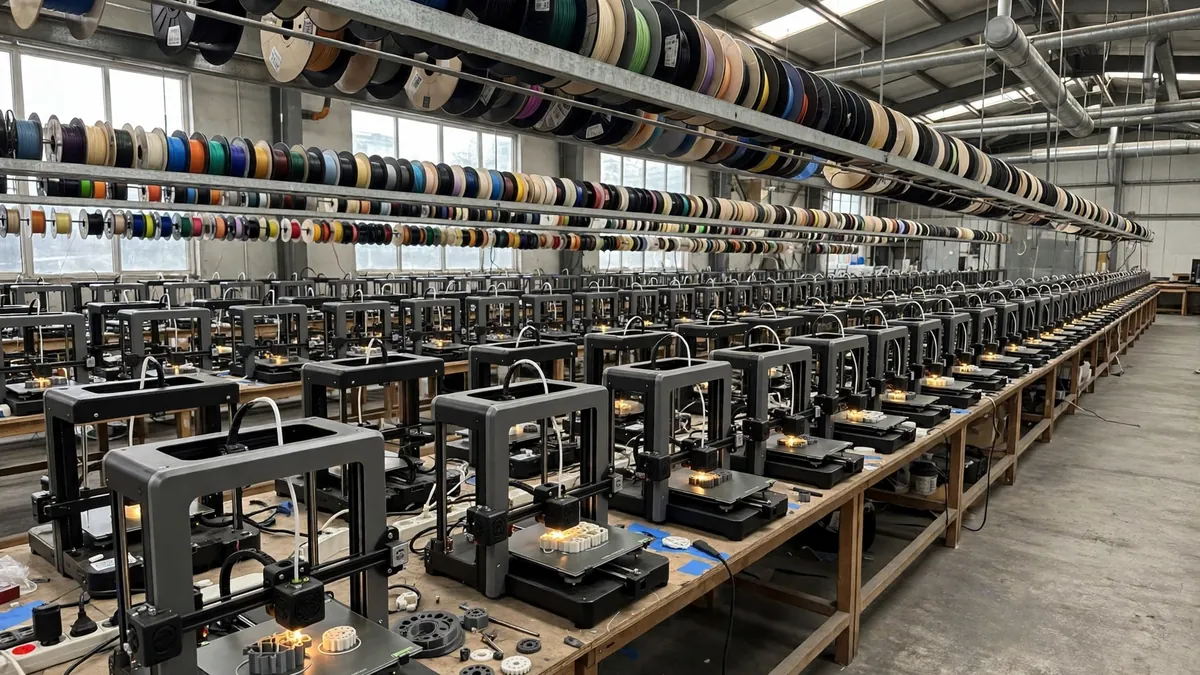
Three years ago, Mike Satterlee spent about 500 dollars of his own savings on a single 3D printer. He was 15, a high-school student in Clifton Park, New York, and the machine sat in his bedroom. Today he is 19, and the printer has become a warehouse full of them: roughly 160 desktop machines running at once, turning out can coolers by the hundred every day.
The business is called CruiseCup, and it sells hard-shell insulated can coolers, including a two-can design that can be loaded from the top or the bottom. It booked 808,000 dollars in gross revenue in 2025, according to CNBC, and had already generated about 601,000 dollars through September 2026.
Fortune picked up the story in November 2026 with a headline that framed the stakes plainly: a teenager’s 160-printer warehouse shows how 3D printing outgrew the hobby shop, and an expert says manufacturers should be nervous. It is about what happens when manufacturing gets cheap enough for one person to run a production line from a rented warehouse.
Key takeaways
- Mike Satterlee, 19, of Clifton Park, New York, runs about 160 desktop 3D printers in a rented warehouse, most of them Bambu Lab A1s listed at 299 dollars.
- His company, CruiseCup, sells hard-shell insulated can coolers and booked 808,000 dollars in gross revenue in 2025, with about 601,000 dollars through September 2026.
- The warehouse costs 3,600 dollars a month, the operation has one full-time employee, and Satterlee works 80 to 85 hours a week while paying himself 500 to 1,500 dollars a month.
- In 2026 he began moving part of production to stainless steel and injection moulding sourced from a manufacturer in China, while keeping plastic printing in-house.
| Detail | Figure |
|---|---|
| Founder | Mike Satterlee, 19, Clifton Park, New York |
| Printers | About 160 desktop printers, mostly Bambu Lab A1s at 299 dollars each |
| 2025 gross revenue | 808,000 dollars, via CruiseCup’s own website and TikTok Shop |
| 2026 revenue to September | About 601,000 dollars |
| Warehouse rent | 3,600 dollars a month, doubling as office and storage |
| Team | One full-time employee; Satterlee works 80 to 85 hours a week |
From one printer in a bedroom to a warehouse floor
Satterlee first learned to use a 3D printer as a high-school freshman, in a design and production class. In September 2022, at 15, he spent roughly 500 dollars of his savings on his own machine, an Ender printer.
Nine months later, in June 2023, he launched his first business from his parents’ basement. Solefully made shoe charms and accessories for Crocs, and it generated about 250,000 dollars in sales in 2024. That money did not go into his pocket. It went back into printers, filament, and warehouse space, and it paid for the move out of the basement into a rented unit in Clifton Park.
The CruiseCup idea arrived in 2025, and it arrived the way most of his products did, through social media. He had been experimenting with drink accessories and car cupholder adapters when a video of the two-can cooler reloading a drink went viral, and orders followed immediately. He started CruiseCup in May 2025, just before graduating from high school, and gave himself one year to work on the business full time. If it succeeded, he would keep going. If it failed, he would go to college.
The economics of 160 printers

The most useful way to read the 160-printer figure is as an accounting entry, not a boast. A traditional factory is a single large bet: a mould, a production line, a lease, a workforce, all committed before the first sale. A desktop printer breaks that bet into roughly 300-dollar pieces. Satterlee’s fleet is mostly Bambu Lab A1s, a model the company’s United States store lists at 299 dollars, which puts the hardware cost of the whole farm in the region of 48,000 dollars.
The small unit size changes how risk works. If a product stops selling, the printers can be pointed at the next one. If demand doubles, the answer is more machines, not a new building. If one machine breaks, the farm loses a fraction of a percent of its capacity, not its only line. The budget 3D printers that make this model possible have quietly become good enough, and cheap enough, to be treated as disposable capacity rather than precious equipment.
The revenue figures show the model working. CruiseCup booked 808,000 dollars in gross revenue in 2025. By September 2026 it had added about 601,000 dollars more. The costs that do not show up in the printer count are the ones that usually sink small manufacturers. Satterlee pays himself just 500 to 1,500 dollars a month, choosing to reinvest almost everything into more printers, advertising, and new products. He lives with his parents, so he pays no rent at home. His only full-time employee, Juan, handles shipping, cleaning prints, and fulfilment, while Satterlee handles the books, social media, and customer support himself, typically working 80 to 85 hours a week.
Why the product, not the printer, did the work
It would be easy to tell this story as a technology story, and that would miss the point. The printers are, by now, a commodity. What Satterlee sells is not printing but a small, well-judged object: a hard-shell insulated can cooler that holds two 12-ounce cans and loads from either the top or the bottom. The two-opening design is the kind of detail a large manufacturer might never think to try.
The viral video mattered more than any machine. A short clip of the cooler reloading a Dr Pepper spread quickly, produced immediate sales, and confirmed product-market fit in a way no focus group could. CruiseCup’s sales come through its own website and TikTok Shop, which means the business owns the customer relationship and keeps the margin that a retailer or distributor would otherwise take. The side hustles that actually pay in 2027 share this shape, a cheap tool, a direct channel, and a product people can understand in five seconds of video.
There is also a discipline in the story that the headline hides. Satterlee did not start with 160 printers. He started with one, then tried shoe charms, then cupholder adapters, then drink accessories, dropping products that did not sell and doubling down on the ones that did. The farm is the result of that winnowing, not the cause of it.
The move beyond the print farm
The most interesting turn in the story came in 2026, when Satterlee began moving part of production away from the printers. The stainless-steel versions of the cooler are now sourced from a manufacturer in China, and injection moulding is entering the picture for the products that sell in volume.
3D printing is fast to start and flexible to change, but it is slow per unit and expensive per unit compared with moulding at scale. Once a design is proven and demand is steady, the rational move is to make the high-volume version the cheap way and keep the printers for prototyping, custom work, and the products that are still finding their audience. This is the pattern that should worry established manufacturers, and it is the point Fortune’s headline gestures at. A founder can now test a product with a few hundred dollars of printing, prove demand on social media, and only then commit to tooling. The expert warning in Fortune’s report, that manufacturers should be nervous, is attributed in the headline, but the expert’s identity and exact wording are unconfirmed in the coverage available so far, so that part of the story should be read as Fortune’s framing rather than a quoted assessment.
What manufacturers should take from this
The first lesson is about the cost of trying. When a production run can start with one 300-dollar machine, the penalty for a failed product collapses. A large company that needs a business case, a budget meeting, and a tooling order to test an idea will always be slower than a founder who can print ten units overnight and film them the next morning.
The second lesson is about distribution. CruiseCup sells direct, through its own site and TikTok Shop, and that directness is inseparable from its economics. A manufacturer that depends on retailers and distributors cannot match the speed or the margin of a business that talks to its customers on a phone. The final lesson is the least comfortable one for incumbents. Satterlee’s path required no permission: no degree, no loan, no distributor, no trade show. He learned the machine in a school class, bought one with saved money, and let the orders decide what happened next. The beginner 3D printers now on the market are good enough that the next Satterlee does not even need the school class.
What a print-farm founder needs to get right
- Start with one machine: buy a single printer with saved money and prove a product sells before adding a second one.
- Let orders set the fleet size: add printers only when demand justifies them
- Sell direct: a website and a social shop keep the margin and the customer relationship that a distributor would take.
- Film everything: a short video of the product in use is the cheapest product test.
- Reinvest before paying yourself: a small founder salary
- Know when to leave the printer behind: move proven, high-volume designs to moulding or overseas production
Frequently asked questions
Who is the teenager behind the 160-printer warehouse?
Mike Satterlee, 19, from Clifton Park, New York. He started with a single 3D printer bought for about 500 dollars of his savings in September 2022, when he was 15, and now runs his company CruiseCup from a rented warehouse with about 160 printers.
What does CruiseCup sell?
CruiseCup sells hard-shell insulated can coolers, including a two-can design that holds two 12-ounce cans and can be loaded from the top or the bottom. The plastic double-can holder lists at 29.99 dollars, the single-can holder at 14.99 dollars on sale, and the stainless-steel double-can cooler at 39.99 dollars.
How much money has the business made?
According to CNBC, CruiseCup booked 808,000 dollars in gross revenue in 2025, and had generated about 601,000 dollars through September 2026.
How did a teenager afford 160 printers?
He did not buy them all at once. His first business, Solefully, which made shoe charms for Crocs, generated about 250,000 dollars in sales in 2024, and the proceeds went back into more printers.
How big is the operation?
The warehouse in Clifton Park costs 3,600 dollars a month and serves as production floor, storage, and office. There is one full-time employee, who handles shipping, cleaning prints, and fulfilment.
Is the business still all 3D printing?
No. In 2026 Satterlee began sourcing the stainless-steel models from a manufacturer in China and moving high-volume products toward injection moulding, while keeping plastic printing in-house for the traditional koozie and for new designs.
The bottom line
A warehouse with 160 printers looks like a factory, but it started as a bedroom with one machine and a teenager willing to let the market decide what to make next. The printers mattered because they were cheap, flexible, and easy to add one at a time. The business mattered because the product was good, the video was convincing, and the sales channel was direct. Together, those pieces turned 500 dollars of savings into a company doing hundreds of orders a day.
The warning for manufacturers is not that every teenager will build a print farm. It is that the cost of trying has collapsed, and the people who try fastest now get to decide what gets made. The companies that should be nervous are the ones still treating a new product as a capital project, when their newest competitor treats it as a weekend print.