When Tim Cook took over Apple in August 2011, the obituaries were already being drafted. Steve Jobs had resigned, the founder’s inspiration was said to be irreplaceable, and the new chief was an operations man — the person who made the supply chain run on time, not the one who imagined the next revolutionary product. Fifteen years later, the verdict looks very different: Apple is the world’s most valuable firm, thanks to Cook’s quiet, systematic way of running it.
Forbes, in a November 2026 piece by Steve Denning, frames Cook’s rise as stranger than a master plan: his unexpected ascent from operations chief to creator of the world’s most valuable firm was a series of ecosystem adaptations, not a pre-drawn blueprint. The strategy was never announced in a single keynote. It accumulated, decision by decision, into a system of devices and services customers find hard to leave — a helpful ecosystem, in Denning’s phrase.
This article traces how that ecosystem was built, what the numbers say, and what other businesses can learn. The focus is strategy, not biography: the supply chain, the services engine, the silicon, and the succession now handing the company to a new chief executive.
Key takeaways
- Forbes contributor Steve Denning argues Cook built Apple through ecosystem adaptations, not a pre-drawn blueprint.
- Apple’s market value grew from about $350 billion in 2011 to $4 trillion, then past $5 trillion in 2026.
- Apple’s installed base now exceeds 2.5 billion devices, according to Forbes, and services are worth more than $100 billion a year.
- On 30 October 2026 Apple retook the title of world’s most valuable firm at $5.03 trillion, ahead of Nvidia at $4.93 trillion.
- Denning’s full Forbes argument could not be read — the complete text was not openly accessible — so his claims are reported from the published summary and corroborating coverage.
From operations chief to ecosystem builder
Cook joined Apple in 1998 as senior vice president of worldwide operations, brought in by Jobs to fix a company drowning in operational dysfunction. He found roughly $400 million in unsold Mac inventory and no coherent supply-chain system. His response was structural: he cut component suppliers from about 100 to 24, shut 10 of Apple’s 19 warehouses, and compressed inventory turnover from 30 days to 6 days within seven months, freeing hundreds of millions in working capital without launching a product.
That episode contains the whole Cook method in miniature: problems are systems to be fixed at the root — the flow of materials, people and information through a complex operation. When he became chief executive in August 2011, after serving as interim CEO during Jobs’s medical leaves, he applied the same discipline to the whole company. The results followed: market capitalisation grew from $350 billion to $4 trillion, revenue nearly quadrupled from $108 billion in fiscal 2011 to over $416 billion in fiscal 2025, and the stock rose from about $13 to over $250.
The key move was a shift in what Apple sold: from a device seller with episodic revenue spikes to a device-plus-subscription business. The iPhone remained central — still around half of total sales in a given quarter — but around it grew iCloud, Apple Music, Apple TV, the App Store and Apple Fitness, a services business now worth more than $100 billion a year. Our comparison of the MacBook Air versus the MacBook Pro in 2027 shows how the hardware side still works: two laptops for different buyers, both pulling owners deeper into the same software and services.
The ecosystem logic is simple and hard to copy. Each device is a gateway into the services, and each service makes the next device easier to buy. An iPhone connects seamlessly with a Mac, iPad, Watch and AirPods, and the data, subscriptions and habits built up across them raise the cost of leaving. Once a customer buys a first product, they tend to stay — and keep paying long after the hardware sale is forgotten.
The three pillars of the helpful ecosystem
Denning’s word for Cook’s system is helpful, and it captures why it works. The ecosystem does not lock customers in with threats or penalties; it keeps them by being useful — devices that set each other up, services that remember preferences, software that arrives configured. That helpfulness is the moat: competitors can match a single product, but matching the whole web of interlocking products, services and habits is a different problem.
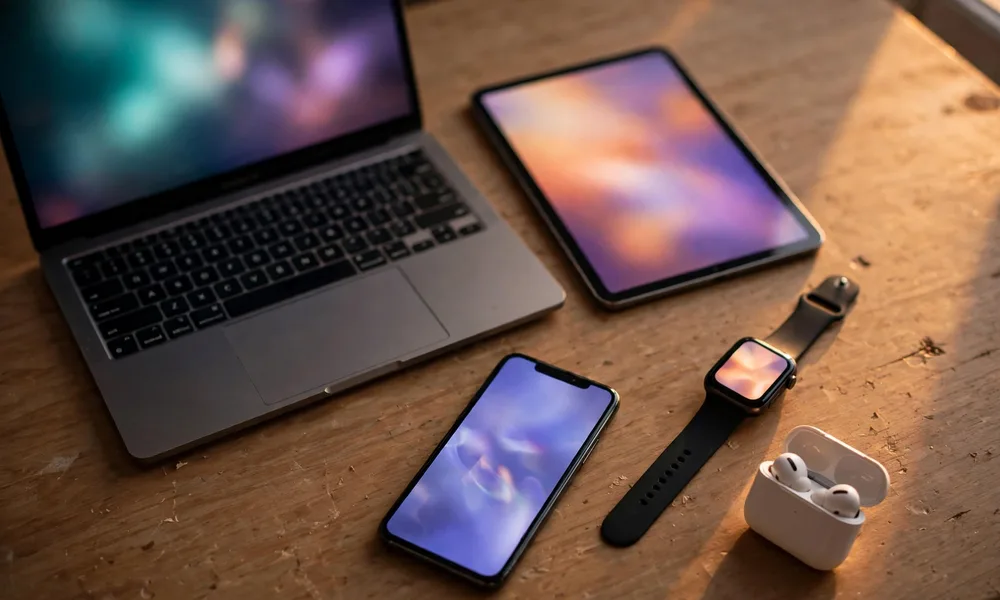
The first pillar is the hardware, and Cook’s record there is broader than his reputation suggests. The Apple Watch dominates wearables, AirPods reshaped wireless audio, and the iPad became the default tablet. Even the Vision Pro fits the pattern: not a revolution on day one, but another device feeding the same ecosystem. Our guide to the best wireless earbuds in 2027 shows how crowded that market is — and how much of it runs through Apple’s orbit.
The second pillar is services, the profit engine. Recurring subscription revenue is steadier and higher-margin than hardware sales, and it compounds: every new device adds a potential subscriber, and every subscriber is likelier to buy the next device. In the fiscal third quarter of 2026, revenue rose 16% year over year and iPhone sales were up 22% — the hardware engine still fires as services grow.
The third pillar is silicon. Under Cook, Apple moved its Macs from Intel processors to its own Apple Silicon in 2020, completing a vertical integration that began with iPhone chips. Owning the chip means Apple controls performance, battery life and product timing — and prepares the hardware for AI features that run on the device rather than in a distant data centre. That control is also why Apple expanded AI features without the heavy infrastructure spending its rivals took on.
The valuation, the succession, and what comes next
The market’s verdict has been emphatic, if not always smooth. Apple’s valuation first closed above $4 trillion in October 2025, passed $5 trillion in July 2026, and on 30 October 2026 the company retook the title of the world’s most valuable firm, closing at $5.03 trillion against Nvidia’s $4.93 trillion, as AppleInsider reported. The lead has swapped between the two for some time — iPhone and services demand against AI chip demand — and will probably keep flipping. What has not flipped is the machine underneath: a $5 trillion company still beating the market, its stock outperforming the S&P 500 by more than double in 2026.
The timing matters, because Cook’s tenure as chief executive is ending. Apple announced on 20 April 2026 that Cook will step aside as CEO and become executive chairman on 1 September 2026, with longtime hardware chief John Ternus taking over. The company called it the result of thoughtful, long-term succession planning — and Forbes’s Iconoclast list credits Cook with a master class in seamless succession, noting Apple’s 2.5 billion-device ecosystem ensures it will remain a gatekeeper in the AI revolution whoever runs it.
The caveats that matter
Two limits should be kept in mind. First, Denning’s full Forbes article was not openly accessible, so the argument reported here rests on the published summary — Cook’s rise as ecosystem adaptations rather than a pre-drawn blueprint — plus corroborating coverage from Fast Company, the Motley Fool and AppleInsider. The framing is Denning’s; the numbers are the corroborated record. Second, market values move daily: the $5.03 trillion figure is from 30 October 2026, the last verified date, and the ranking against Nvidia may already have changed.
| Detail | What is known |
|---|---|
| Chief executive | Tim Cook, CEO from August 2011; executive chairman from 1 September 2026 |
| Successor | John Ternus, longtime hardware chief, becomes CEO (announced 20 April 2026) |
| Market value at takeover | About $350 billion in August 2011 |
| Market value in 2026 | Past $4 trillion in October 2025; past $5 trillion in July 2026; $5.03 trillion on 30 October 2026 |
| Revenue | About $108 billion in fiscal 2011 to more than $416 billion in fiscal 2025 |
| Installed base | More than 2.5 billion active Apple devices (Forbes) |
| Services business | More than $100 billion a year, including iCloud, Apple Music, Apple TV and the App Store |
| Key strategic moves | Apple Silicon (2020), services expansion, asset-light supply chain, privacy-led differentiation |
Checklist: judging an ecosystem strategy
Use these checks when judging any ecosystem strategy — Apple’s or anyone else’s.
- Look for recurring revenue: does the business earn money every month, or only on each new sale?
- Count the switching costs: would leaving mean losing data, subscriptions or connected devices?
- Check the supply chain: can the company scale production without owning factories or tying up cash?
- Ask who owns the platform: does the company control its chips, software and store, or rent them?
- Watch the succession: is the strategy a system that can be inherited, or does it depend on one person?
- Test the helpfulness: does each new product make the existing ones more useful, or just add another sale?
Frequently asked questions
How did Tim Cook make Apple the world’s most valuable firm?
Not with a single breakthrough product, but by turning a device company into an ecosystem: recurring services revenue around the iPhone, every device integrated with the others, chip design in-house, and one of the world’s most efficient supply chains. Market value grew from about $350 billion in 2011 to more than $5 trillion in 2026.
What does Forbes mean by a helpful ecosystem?
Steve Denning’s phrase describes a system that keeps customers by being useful rather than locking them in. Devices set each other up, services remember preferences, software arrives configured — so each new product makes the ones a customer owns more valuable, and leaving means giving up convenience, not just a brand.
Is Apple still the world’s most valuable company?
As of 30 October 2026, yes: Apple closed at $5.03 trillion, ahead of Nvidia at $4.93 trillion, according to AppleInsider. The lead has swapped between the two before and may flip again, so check the latest market data rather than taking it as permanent.
Who is taking over from Tim Cook?
John Ternus, Apple’s longtime hardware chief, becomes chief executive on 1 September 2026, with Cook moving to executive chairman. Apple announced the transition on 20 April 2026 as the result of long-term succession planning.
What is Apple Silicon and why does it matter?
Apple Silicon is Apple’s own line of computer chips, which replaced Intel processors in Macs from 2020. Owning the chip gives Apple control over performance, battery life and product timing, and lets AI features run on the device — a key part of the ecosystem strategy and Apple’s privacy-led approach.
Can smaller businesses copy Apple’s ecosystem strategy?
The scale cannot be copied, but the pattern can: sell something that recurs, make each product more useful alongside the others, and own what matters most — the customer relationship and the data. The same logic applies when choosing tools, which is why our roundup of the best AI tools for small business in 2027 focuses on tools that connect with each other rather than working alone.
The bottom line
Cook’s legacy is not a product but a system. He inherited the most admired consumer brand in the world and a founder whose shadow covered a decade, and he answered the question everyone asked — whether Apple could survive without Jobs — by building something Jobs never built: an ecosystem of 2.5 billion devices, more than $100 billion a year in services, and customers who stay because everything works together. The market value is the receipt, not the strategy.
The lesson for other businesses is narrower than the headlines suggest. Ecosystems are not bought; they accumulate from unglamorous decisions about supply chains, recurring revenue, and making each product more useful alongside the others. Cook’s real skill was patience with that accumulation — and the next test, under John Ternus, is whether the system keeps adapting.