Quantum AI combines quantum computing with artificial intelligence to test whether quantum methods can help with selected machine-learning problems. Today, researchers are testing these methods in small experiments, often alongside ordinary computers. That work matters because some calculations may suit quantum hardware, while many familiar AI tasks may not.
For beginners, the key is separating research goals from proven results. Quantum tools do not replace the AI software people use every day, and a lab result does not prove a useful speed gain. You will get a clear picture of the basic ideas, the work happening now, and the limits that shape current research. Most work remains experimental, not a proven shortcut for everyday AI.
Key Takeaways
- Quantum methods are being tested in selected AI and machine-learning tasks.
- Classical computers still handle much of the work in many experiments.
- Noise and data-loading costs can limit performance.
- Current results need comparison with strong classical methods.
- A small software simulation can be a practical first step.
For now, think of it as an experimental extension to familiar computing, not a new AI system that makes every task faster.
What Is Quantum AI?
Quantum AI uses quantum computing techniques inside selected artificial-intelligence and machine-learning workflows. It is not a separate kind of artificial intelligence, but a way to test quantum methods on specific computing problems.
A classical bit holds 0 or 1. A qubit can hold a quantum state that combines possible values. Superposition is a quantum state that can combine multiple possible values until measurement produces a classical result. This gives researchers new ways to represent and process information.

Quantum methods matter only when they help solve a specific task better than classical computing.
The idea grew from quantum computing research. In the early 1980s, physicist Richard Feynman proposed quantum computers for simulating physical systems. That idea addressed a problem: classical computers can struggle to model quantum behavior.
In the 1990s, Shor’s factoring algorithm showed that a quantum algorithm could offer a major advantage for a certain math problem. It did not make quantum computers faster at every task, but it showed that new algorithms could change what a computer can do.
NASA, Google, and the Universities Space Research Association established the Quantum Artificial Intelligence Lab in the early 2000s. The lab helped bring quantum computing and AI research into closer contact.
The term can cover different experiments, from machine-learning models to tools that help researchers design algorithms. A useful primer on AI types and categories can help clarify how machine learning fits into artificial intelligence.
The practical question is not whether a quantum computer can replace a laptop, but whether a particular quantum method can help with a particular computation.
How Do Qubits Change Computing?
A classical bit stores either 0 or 1, while a qubit can be prepared in a quantum state that combines both possibilities. That difference gives quantum algorithms new tools, but it does not mean they read every answer at once.
Before measurement, a qubit’s state can combine possible values. When you measure it, you get a classical result, such as 0 or 1. The result depends on the state and the measurement, so a single readout does not reveal every possibility.
Superposition is a way to shape the odds of measured results, not a stack of answers you can read all at once. An algorithm must use quantum operations to make useful outcomes more likely. It may also need many runs to estimate those outcomes.

Entanglement is a shared quantum relationship between two or more systems. Measuring one part can relate to the other part’s result, even when the systems are apart. Entanglement does not let anyone send a message faster than light.
You can picture a qubit as a spinning coin before it lands, but the comparison has limits. A real qubit follows precise quantum rules, not the motion of a tiny coin. Measurement also changes what you can know about its state.
Classical computers remain better for many common tasks. Quantum computing can help only when an algorithm uses quantum states in a way that fits the problem and hardware.
A useful beginner’s rule is to treat superposition and entanglement as resources that algorithms must use carefully, not as automatic speed boosts.
How Does a Quantum-Classical AI Workflow Work?
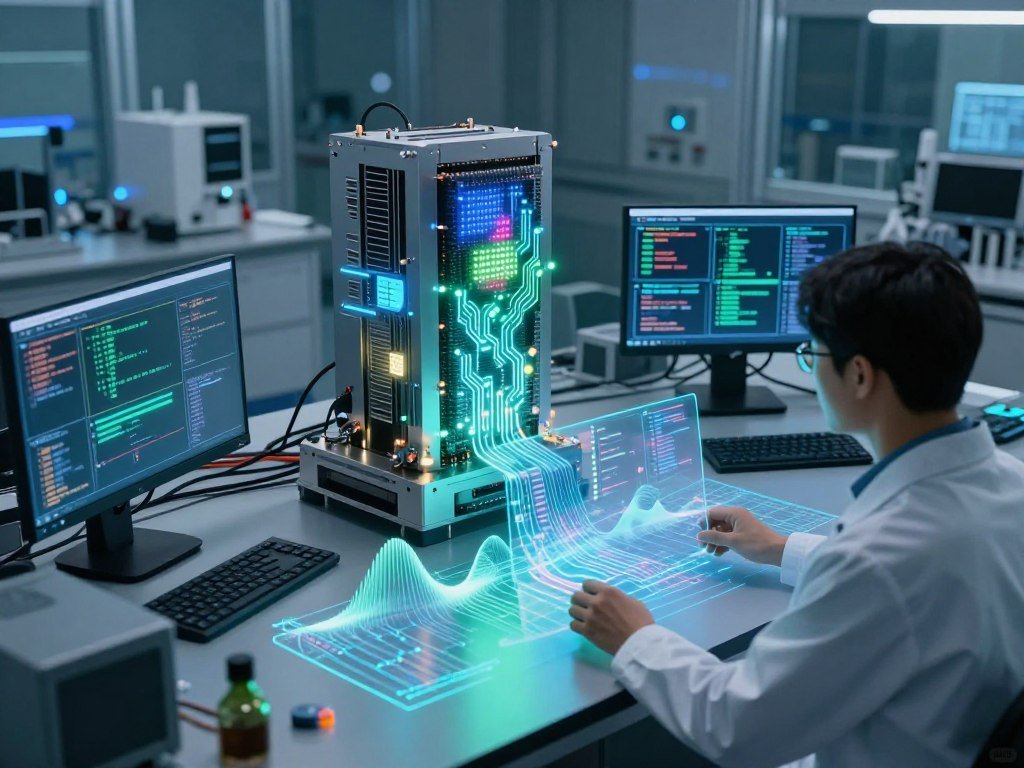
In a hybrid AI experiment, a classical computer does most of the coordination and sends a narrowly defined task to a quantum processor. The hybrid workflow shares work between familiar hardware and a quantum processing unit (QPU).
A CPU or GPU may prepare data, set model parameters, and run an optimizer. The QPU runs a chosen circuit or other small subroutine, then sends results back. Most control and data handling stays on the classical computer.
What classical computers handle
Classical computers prepare the input and manage the experiment. They can transform data into values a circuit can use, keep track of model settings, and decide how to change those settings after each run.
That division resembles other AI workflows, where software interprets information and connected tools handle set actions. A practical example is an AI-powered task workflow, which separates interpretation from predictable steps.
What happens on the quantum processor
The QPU runs a circuit designed for a narrow part of the calculation. It measures the circuit and returns classical numbers, often counts of different outcomes. The classical software then uses those results to adjust the next run.
A common experiment follows four steps:
- Prepare or encode the input data.
- Run a quantum circuit with chosen settings.
- Measure the circuit and collect its output.
- Update the settings on a classical computer.
Researchers use this setup because current quantum processors have noise and limited scale. They can test where a quantum step might help without asking the QPU to handle the whole model or workflow.
When you assess a result, include the time and effort needed to prepare data and retrieve measurements. A circuit can look fast in isolation while the full process takes longer.
Keep the quantum part targeted, since moving data into and out of a circuit can erase a hoped-for advantage.
Which Models and Algorithms Do Quantum AI Use?
Most quantum machine-learning experiments use a small set of circuit-based models rather than a quantum version of every familiar AI model. Researchers study trainable circuits, quantum kernels, and methods that pair quantum circuits with classical optimization.
A parameterized quantum circuit has adjustable settings that training can change. A quantum kernel uses a circuit to measure how similar two data points appear in a chosen quantum representation. These methods are research tools, not drop-in replacements for standard models.

Trainable circuits and quantum kernels
Quantum machine-learning methods often represent data with a circuit, then use its measured output to classify or compare examples. The circuit’s adjustable settings can affect its predictions.
Common approaches include:
- Parameterized quantum circuits with trainable settings.
- Quantum kernels that compare data points.
- Variational algorithms that pair circuits with classical optimization.
- QAOA, a quantum approach studied for optimization problems.
Software libraries help connect these models to ordinary machine-learning tools. PennyLane works with PyTorch, TensorFlow, and JAX. Qiskit Machine Learning supports quantum kernels and variational classifiers. Cirq with TensorFlow Quantum can support hybrid training.
The steps in model training also help explain why researchers divide data, train settings, and check results in stages.
Variational algorithms and the learning loop
A variational algorithm uses a quantum circuit whose settings a classical method tunes. Each training round encodes data, runs the circuit, measures results, and updates settings. Some experiments need thousands of rounds before they reach a useful result.
Researchers can test small circuits with simulators before using quantum hardware. Statevector simulators give exact results for small systems. Tensor-network simulators can approximate larger ones, though the work can still be demanding.
The U.S. Department of Energy describes work where AI can help design quantum algorithms and coordinate computing resources. Its quantum algorithms and AI research includes classical computing tools for preparing quantum workloads.
A simulator is useful for debugging a small circuit, but a simulation result alone does not establish a real-hardware advantage.
What Is Quantum AI Used For Today?
Today, quantum AI is used mainly to investigate optimization, classification, scientific modeling, and sampling problems. These applications are research directions, and early experiments do not guarantee better results than classical methods.
Researchers choose methods based on the shape of a problem. Optimization methods search for a good arrangement, while quantum kernels compare data points. Quantum simulation can help model physical systems linked to chemistry and materials.
Optimization, classification, and sampling
Quantum annealing and QAOA are studied for scheduling, routing, and resource allocation. For example, a researcher might test whether a method can assign workers to shifts or choose routes under set limits.
Quantum kernels are studied for classification, where a model sorts data into groups. Sampling-heavy research looks at ways to draw useful examples from complex probability patterns. Those methods may support generative modeling or uncertainty estimation.
| Problem area | Quantum method studied | Example task |
|---|---|---|
| Optimization | Quantum annealing or QAOA | Scheduling, routing, or resource allocation |
| Classification | Quantum kernels | Compare data-point similarities |
| Chemistry and materials | Quantum simulation with machine learning | Energy estimation or molecular-property prediction |
| Sampling-heavy machine learning | Quantum sampling | Generative modeling or uncertainty estimation |
Chemistry and materials research
Chemistry and materials research often asks how molecules behave or what energy a system may hold. Quantum computers are being studied for simulations of this kind, while machine learning may help predict properties from data.
These tasks remain difficult because quantum hardware is noisy and limited in scale. A method can perform well on a small test yet fail to help with a larger or more useful problem.
When you read about a possible use, check whether the test used a real task, a fair classical comparison, and the full cost of running the method. A result from one small benchmark cannot settle all three questions.
Treat a promising pilot as a testable hypothesis until it beats a well-chosen classical baseline on a useful task.
What Limits Quantum AI?
A quantum model can be mathematically promising and still perform poorly when noise, data-loading costs, or training instability dominate. The main challenge is making the full computing process useful, not just designing an elegant circuit.
Noise can change a qubit’s state or corrupt a measurement. Decoherence is the loss of a quantum state’s useful properties over time. Both can limit circuit depth, which is the number of operations a circuit can run before its results become unreliable.
Error mitigation can reduce some errors, but it is not the same as full error correction. Mitigation can improve estimates from noisy runs. Error correction aims to protect information by using groups of physical qubits to represent a more reliable logical qubit.
Noise, decoherence, and circuit depth
Ordinary data does not arrive as a quantum state. A workflow must encode it, and that step may need many gates or qubits. If encoding costs more than the quantum step saves, the full process loses its appeal.
Data loading and difficult training
Training can also stall. Barren plateaus are cases where circuit gradients become very small as circuit depth or parameter count grows. When gradients fade, a training method gets little signal about how to improve the model.
Practical constraints include:
- Noisy results that vary across runs.
- Data-loading overhead from encoding ordinary data.
- Unstable gradients that slow or stop training.
- Shared hardware queues and changing backend noise.
Hardware access can also vary by device. A shared queue may delay jobs, execution limits can cap experiments, and different backends can produce different noise patterns.
When a test uses a small data set, check whether its encoding and repeated runs would still fit the real task. A clean circuit diagram cannot answer that on its own.
Compare against a classical method using the same data and task before treating a small-scale result as a meaningful advantage.
What Is Google Quantum AI Working On?
Google Quantum AI is developing superconducting processors and software as part of its work toward error-corrected quantum computing. Its Willow processor and related experiments target more reliable quantum systems.
Google says Willow is a step toward a large-scale, error-corrected quantum computer. The company also says its Quantum Echoes algorithm on Willow showed what it calls the first verifiable quantum advantage. That claim reflects Google’s description of its result, not a broad verdict for every quantum task.
Willow and error correction
Error correction aims to protect information from faults that affect physical qubits. Google’s research combines processor design, control, and algorithms as it works toward systems that can handle longer computations.
Google says its quantum computers have more than 10,000 components. Microwave signals control and read the qubits, while cryostats cool superconducting processors to 10 millikelvin. That temperature is far colder than outer space.
Google’s official Quantum AI research page describes work on superconducting processors, algorithms, chemistry, materials, and optimization.
The Santa Barbara research campus
Google’s campus in Santa Barbara brings together a quantum data center, a processor-fabrication facility, and research teams. The shared site lets hardware and software groups work near the equipment they study.
Google Quantum AI’s official website gives current visitor details for its Santa Barbara campus. For the Google Quantum AI Santa Barbara address, use the company’s official site for current location and contact information rather than relying on an old listing.
Superconducting processors need cryogenic systems, complex control parts, and specialist teams, so a processor milestone reflects a large engineering effort.
A processor milestone is a step in hardware development, not proof that quantum AI already outperforms classical AI across everyday tasks.
Which Companies and Platforms Work on Quantum Computing?
Quantum-computing companies use several different hardware approaches, so “leading” depends on whether you mean a processor type, a cloud platform, or a research milestone. Five main qubit technologies are under development, each with different engineering needs.
Superconducting systems use tiny circuits, while trapped-ion systems control charged atoms. Photonic systems use light, neutral-atom systems use uncharged atoms, and topological systems explore a different way to protect quantum information.
Five main hardware approaches
| Qubit approach | Example companies | Beginner’s distinction |
|---|---|---|
| Superconducting | IBM, Google, Rigetti | Cooled circuits |
| Trapped-ion | IonQ, Quantinuum | Ions held and controlled as qubits |
| Photonic | PsiQuantum, Xanadu | Light-based qubits |
| Neutral-atom | QuEra, Atom Computing | Neutral atoms as qubits |
| Topological | Microsoft-associated research | Proposed approach based on topological states |
These are broad examples, not a ranking of performance. Company leadership depends on the measure you choose. One firm may lead in a type of hardware, while another may offer wider cloud access or report a major research result.
Cloud access and software platforms
Amazon Braket is a cloud access platform, not one type of quantum hardware. It gives users access to several hardware providers through a cloud service, so a beginner can explore more than one approach.
In 2025, PsiQuantum held over 18.2% of the photonic quantum-computing market, while the five leading photonic companies collectively held 60.8%. Those market figures describe commercial share, not which system performs best.
Before choosing a platform, check which devices you can access, what software it supports, and whether it fits your experiment. A platform label alone tells you little about how a specific circuit will run.
Choose a platform for the hardware access and software tools you need, not for a single headline metric.
What Skills and Tools Help Beginners Start?
A classical software engineer can begin exploring quantum software without first earning a physics PhD. Start with Python and computer-science basics, then use one quantum framework to build and test a small project.
For a first course or self-study plan, learn how to code, run a simulator, and read simple circuits. Next, build a small circuit or hybrid model, then compare it with a classical baseline. A portfolio project should show both the quantum result and the classical comparison.
Start with quantum software
Quantum software engineering usually calls for computer-science fundamentals, Python, and a compiled language such as C++ or Rust. Experience with Qiskit, Cirq, or PennyLane can help you build practical skills.
A realistic learning sequence is:
- Learn Python, algorithms, and basic computer science.
- Use a simulator and one quantum software framework.
- Build a small circuit or hybrid-model portfolio project.
- Compare its results with a classical baseline.
A self-study and portfolio transition may take 12-18 months, but that is an estimate, not a promise. Your starting skills, study time, and project depth affect the pace.
Hardware and applications careers
Hardware jobs often need much deeper formal study. Many roles call for a PhD or substantial postdoctoral work in physics, electrical engineering, or materials science. Daily work may involve cryogenics, optics, vacuum tools, or semiconductor fabrication.
| Path | Typical preparation | Example work |
|---|---|---|
| Quantum software engineer | Computer science, Python, C++ or Rust | Build circuits and software tools |
| Quantum hardware engineer | Advanced physics, electrical engineering, or materials science | Work with cryogenics, optics, or fabrication |
| Applications scientist | Quantum theory plus chemistry, finance, or materials knowledge | Map domain problems to quantum methods |
Applications scientists connect quantum theory with fields such as chemistry, finance, and materials science. They help decide whether a real research or business problem fits a quantum method.
For a first project, reproduce a small experiment in simulation and document where the classical baseline performs better.
What Should Investors Know About Quantum AI?
Quantum AI investment is a high-risk bet on a technology whose practical commercial benefits are still developing. A share in a large technology company is not automatically a bet on its quantum program.
Berkshire Hathaway’s Amazon and Alphabet holdings were valued at around $7.7 billion, but Berkshire did not buy those shares because of quantum-computing initiatives. The size of a diversified company can make its quantum work only a small part of the investment case.
Berkshire’s Amazon and Alphabet holdings show why a large stake in a technology firm does not prove a focused bet on quantum computing.
Analyst views can also shift. In 2026 coverage, a Benchmark analyst rated IonQ Buy with a $60 price target. That rating is one analyst’s opinion, not a forecast or a promise of returns.
Pure-play quantum firms face capital and timing risks. IonQ, Rigetti Computing, D-Wave Quantum, and Quantum Computing Inc. were described as losing money and using capital while pursuing commercial products.
A quantum stock is not a safe bet just because a processor reaches a new milestone.
Useful products may take years to become more cost-effective and efficient than classical computers. A diversified approach may limit exposure to one company, but it cannot remove market risk or guarantee gains.
The broader quantum industry attracted $4.9 billion in new private venture capital in 2025, up 192% from 2024. The QED-C 2026 industry report also counted $12.7 billion in new government funding commitments.
Treat any quantum-related stock as an investment decision based on your risk tolerance and the company’s broader finances, not on a processor headline.
Conclusion
Quantum AI is best understood today as an experimental way to combine quantum processors with familiar computing and machine-learning tools. Current work tests whether selected methods can help with specific tasks, and each result needs comparison with classical systems.
The field has real potential, but the hardware and software still face limits that can outweigh a theoretical gain. You do not need special equipment to begin learning. A simulator lets you try a small circuit and see how its output changes.
Start with one small simulated experiment and let its results, rather than the hype, guide what you learn next.
FAQ
What skills are needed for quantum computing?
Python and computer-science fundamentals are a good starting point for quantum software. You can then learn a framework and practice with a simulator. Hardware roles usually require advanced study in physics, electrical engineering, or materials science. Applications work also needs knowledge of a field such as chemistry or finance, plus enough quantum theory to map its problems to possible methods.
Which country is no. 1 in quantum computing?
The United States is a major commercial hub for quantum computing, but no single country ranks first on every measure. Research output, investment, hardware development, and access to trained workers can point to different leaders. These comparisons also change over time. A useful ranking needs to name its measure, rather than treating one company’s milestone as proof of national leadership.
Is Warren Buffett investing in quantum computing?
Berkshire Hathaway held around $7.7 billion in Amazon and Alphabet shares, but those holdings were not bought because of quantum-computing initiatives. Both companies have broad businesses, so owning their shares is not the same as making a focused bet on quantum technology. Berkshire’s stake alone does not show that Buffett expects quantum computing to drive their value.
What company is leading in quantum computing?
Google has reported a notable development with its Willow processor and Quantum Echoes algorithm, which it calls the first verifiable quantum advantage. That does not make Google the leader by every measure. Leadership can mean hardware performance, cloud access, error-correction progress, or useful applications. Companies work on different qubit technologies, so compare them by the specific result or tool you care about.
What are the best quantum stocks to buy in 2026?
There is no single best quantum stock for every investor, and this is not a stock recommendation. Pure-play firms may face years of development costs before their products compete with classical computers. Some companies are losing money while they pursue commercialization. Analyst ratings and price targets reflect opinions, not guarantees, so consider your risk tolerance and the company’s finances.
What is the best company to invest in quantum computing?
No single company suits every investor. A large technology firm may offer broad business exposure, while a pure-play quantum company gives more direct exposure and may carry higher risk. Look at the company’s finances, its share of quantum work, and how much risk you can accept. A company’s research milestone alone cannot show whether its stock fits your goals.
What are the 7 stocks for the coming quantum boom?
A list of seven stocks is not a reliable set of picks or investment advice. Some companies focus on quantum technology, while diversified firms earn most of their money from other products and services. Those two groups carry different risks and may respond differently to industry growth. Check what each company actually sells and how its broader finances look before making an investment choice.