Hilton Worldwide Holdings owns the Embassy Suites by Hilton brand, but it does not own every hotel carrying that name. A franchise is an agreement that lets an independent business operate under a hotel brand while following that brand’s requirements. This difference matters when you book a room or look into a hotel’s business ownership.
In the United States, a hotel’s sign may show a national brand, while a separate business owns the individual property. Hilton sets brand rules, but ownership of the building can sit elsewhere. That distinction is useful for business travel, especially when you need details about one location.
Key Takeaways
- Hilton Worldwide Holdings owns the brand.
- Independent businesses can own individual properties.
- A franchisee follows Hilton’s brand requirements.
- A management company may run hotel operations.
- Property details can identify its owner and operator.
The key distinction is that Hilton controls the brand while independent businesses can own individual properties.
Who Owns Embassy Suites in the United States?
Hilton owns Embassy Suites, but most U.S. Embassy Suites hotels are not owned by Hilton itself. The brand belongs to Hilton Worldwide Holdings, while many properties have independent owners.
About 92% of Embassy Suites properties in the United States are franchised. Hilton Worldwide Holdings trades on the NYSE as HLT. In 2026, Hilton reported 28 brands, more than 9,600 properties, and over 1.4 million rooms across 144 countries and territories.
A familiar name on the sign does not identify the deed holder.
Hilton owns the brand, not necessarily each building
Hilton Worldwide Holdings controls the brand identity, including its name and standards. Embassy Suites had 271 properties and about 62,000 rooms worldwide as of November 2025. Those properties are part of Hilton Worldwide, though that does not mean Hilton owns each building.
Franchisees and management companies run individual properties
Franchisees own most U.S. properties and run them under Hilton’s standards. A management company can handle daily hotel operations without owning the individual property. Embassy Suites is part of Hilton, not Marriott, so it is not a Marriott brand.
| What is controlled | Who controls it | Example | What that means |
|---|---|---|---|
| Brand identity | Hilton | Name and standards | Hilton sets brand requirements |
| Individual property ownership | Independent franchisees | Hotel building | Owner may be a separate business |
| Property operations | Management companies or franchisees | Daily hotel service | Operator may differ from owner |
For a specific hotel, check its property information to distinguish the owner from the company managing daily operations.
How Did Embassy Suites Become Part of Hilton?
Promus Hotel Corporation founded Embassy Suites in 1983, before Hilton became its parent. Hervey Feldman and Mike Rose are figures associated with the brand’s founding. Its path to Hilton took several years and began with a hotel in Kansas.
The brand’s early growth came before its Hilton name. These three milestones trace how Promus created it and how Hilton later took it on.
Promus founded the brand and opened its first hotel
- 1983-1984: Promus Hotel Corporation founded the brand in 1983. The first hotel opened in Overland Park, Kansas, in 1984.
- 1992: The first international property opened in Toronto.
- 1999-2015: Embassy Suites Hotels joined Hilton in 1999 through the merger of Hilton Hotels Corp. and Promus Hotel Corp. The brand adopted the name Embassy Suites by Hilton in 2015.
Feldman served as president and CEO until 1990, then executive chairman until 1992. His leadership overlapped with the brand’s early years, while Mike Rose is also linked to its founding.
Hilton gained the brand through the 1999 merger
Hilton gained Embassy Suites in 1999, when Hilton Hotels Corp. and Promus Hotel Corp. merged. A 2001 Hilton Hotels Corporation annual report lists Embassy Suites among Hilton’s hotel brands.
The 2015 name change made the Hilton connection visible in the brand name guests see today.
What Does the Hilton Brand Mean for a Stay?
Embassy Suites by Hilton is an upscale all-suite brand built around extra room to relax and two signature food-and-drink offerings. Its suites have separate living and sleeping areas, which gives you more space than a standard hotel room.
Guests receive free cooked-to-order breakfast and a complimentary nightly Evening Reception with drinks and light bites. The brand serves the United States, Canada, Latin America, the Caribbean, and the Middle East.
Most properties have an atrium-style layout, but the design is not a promise for every stay.
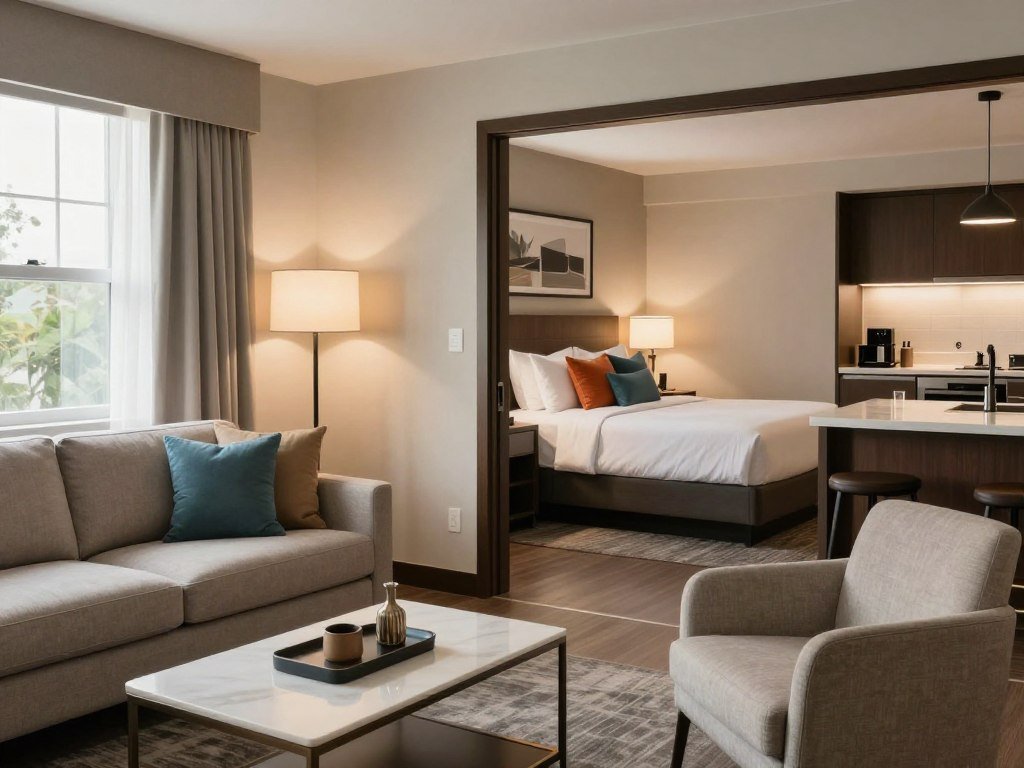
Hilton’s other brands include Hilton Hotels & Resorts, Hampton by Hilton, DoubleTree by Hilton, Homewood Suites by Hilton, and Home2 Suites by Hilton. An upscale brand position does not mean every individual property has the same design. Check the individual property’s amenities before booking, especially if an atrium-style layout matters to you.
Conclusion
Hilton owns the Embassy Suites name and brand, while the owner of a particular hotel may be a separate business. That distinction matters when you need to know who sets brand standards and who is responsible for one location.
An individual U.S. hotel may belong to an independent franchisee. The hotel’s brand affiliation alone does not tell you which business owns or manages that property.
Before booking or evaluating a specific location, review that hotel’s property details to confirm who operates it and which amenities it offers.
FAQ
Are Embassy Suites high end?
Yes, Hilton positions Embassy Suites by Hilton as an upscale brand. That label describes the brand’s place in Hilton’s lineup, not a promise that every property has the same style or features. Individual hotels can differ in design and amenities, so the upscale label does not mean each stay will look exactly alike.
Does every Embassy Suites property have an atrium?
No, not every Embassy Suites property has an atrium. Most have an atrium-style layout, but some do not. The design can shape how the lobby and guest areas feel, so check the specific hotel’s property details if an atrium matters to you. The brand name alone does not confirm that feature.
Which Hilton brands offer a different kind of suite stay from Embassy Suites?
Homewood Suites by Hilton offers a different style of suite stay. Its options include studio or one-bedroom suites with kitchens and free hot breakfast. Embassy Suites centers on two-room suites and cooked-to-order breakfast. Those differences can help you choose a Hilton hotel that better fits your plans and the way you like to eat or prepare meals.
Are Embassy Suites hotels located outside the United States?
Yes, the brand serves guests outside the United States. Embassy Suites has service regions in Canada, Latin America, the Caribbean, and the Middle East. The number of hotels can differ by region, so the brand’s presence does not mean every area has the same range of locations. Check the specific destination for nearby properties.
Can two Embassy Suites properties differ in design?
Yes, two Embassy Suites properties can have different designs. An atrium-style layout is common, but it is not universal, and other property features can vary too. The brand sets standards, while individual hotels may differ in their building style and amenities. Review the specific hotel’s details to see what its rooms and shared spaces offer.