
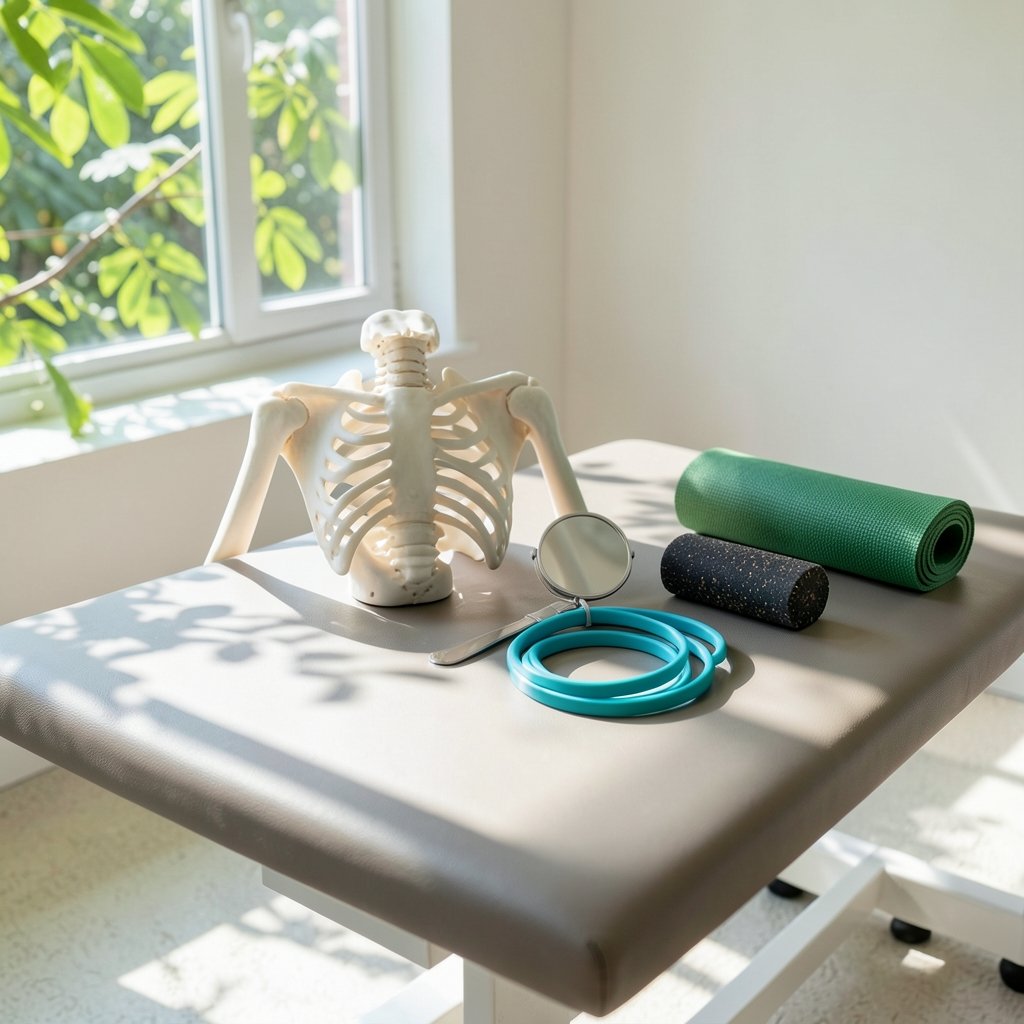
Have you ever pushed against a wall and noticed one shoulder blade jutting out like a small wing? That visible bump is what clinicians call a winged scapula, and it is one of the most misunderstood shoulder problems people bring to a physiotherapist. Some cases are mild and mostly cosmetic. Others signal a nerve injury that changes how the whole arm works. The tricky part is that the two look similar in a mirror but need very different plans.
This article walks through what physiotherapy can realistically do for a winged scapula, how assessment works, which exercises actually matter, and where the honest limits of conservative care sit. It is written for people who want to understand the condition without drowning in jargon.
What a winged scapula actually is
The scapula, or shoulder blade, normally glides flat against the rib cage. It stays there because muscles hold it in place, mainly the serratus anterior on the inner side and the trapezius on the outer side. When one of those muscles weakens or stops firing properly, the inner border of the blade lifts away from the ribs. That lifting is the wing.
There are two broad patterns, and the direction of the wing points to the likely cause:
| Pattern | Muscle involved | Typical nerve | Common triggers |
|---|---|---|---|
| Medial winging (inner border lifts) | Serratus anterior | Long thoracic nerve | Axillary surgery, trauma, repetitive overhead work |
| Lateral winging (outer border lifts) | Trapezius | Spinal accessory nerve | Neck surgery such as lymph node biopsy, neck trauma |
A third category exists too. Sometimes the winging is not a nerve problem at all but a mechanical or postural one, where muscle imbalance, pain inhibition, or poor scapular control changes how the blade moves. That distinction matters enormously, because a nerve injury and a control problem are not treated the same way.
Why the nerve matters so much

The long thoracic nerve is long, thin, and sits close to the surface as it travels down the side of the chest. That anatomy makes it vulnerable. It can be stretched during surgery, compressed by heavy loads, or irritated by repeated overhead activity. When it stops conducting signals, the serratus anterior goes quiet, and the scapula loses its main anchor against the ribs.
The spinal accessory nerve runs through the neck and supplies the trapezius. It is at risk during procedures in the posterior triangle of the neck. Damage there produces a different wing, one that appears more on the outer edge and often comes with drooping of the shoulder.
Nerve injuries are graded by severity. A mild stretch may recover on its own over weeks to months. A more serious injury takes longer, and some do not recover fully. This is why physiotherapy should never start with a generic exercise sheet. It should start with a clear picture of what is actually damaged.
How a physiotherapist assesses winging
Assessment is part observation, part hands-on testing, and sometimes part referral. A thorough session usually covers the following.
Observation and movement testing
The therapist watches the shoulders from behind while the person rests, then during forward arm raise and during a wall push-up. Winging often becomes most obvious when the arm is pushed forward against resistance, because that is when the serratus anterior should be working hardest. Comparing both sides in the same position gives a clear baseline.
Muscle testing
Manual testing grades the strength of the serratus anterior and trapezius. The therapist may also check for scapular dyskinesis, which is the broader term for altered shoulder blade movement, whether or not a true wing is present. Not every abnormal movement pattern is a nerve lesion, and not every nerve lesion shows dramatic winging at rest.
When imaging or nerve studies are needed
If a nerve injury is suspected, EMG and nerve conduction studies help localize the lesion and grade its severity. These tests are not routine for every shoulder complaint, but they change the picture when weakness is genuine rather than just poor control. The timing of testing matters, and a physiotherapist will typically coordinate with a doctor or neurologist rather than order it alone.
What physiotherapy can and cannot do
Here is the honest version, and it is worth stating plainly because a lot of online content oversells rehab.
Physiotherapy cannot make a damaged nerve regrow faster. What it can do is create the best possible environment for recovery, keep the shoulder joint from stiffening, maintain strength in the muscles that still work, and retrain movement patterns so the arm stays functional while the nerve recovers. For mechanical winging without nerve involvement, rehab is often the main treatment and can be very effective.
The evidence base is thinner than most people expect. Much of what is known about conservative management comes from case series and expert opinion rather than large controlled trials. There is no single consensus guideline that dictates a protocol. That does not mean rehab does not work. It means the plan should be individualized and reviewed regularly rather than followed blindly for months.
For severe cases that do not recover, surgical options exist, including nerve transfer, tendon transfer, and scapulopexy, which stabilizes the blade to the ribs. Physiotherapy still plays a role before and after those procedures.
Building a rehab plan that makes sense
A good plan follows a sequence. Skipping ahead to hard strengthening before the basics are in place is one of the most common mistakes people make, especially when they are following random videos online.
Step 1: Settle the irritated nerve
If the cause is compressive or repetitive, the first job is to reduce the load. That might mean changing how the arm is used overhead, adjusting sleeping position, or modifying work tasks. Rest alone is rarely the answer, but continuing to provoke the nerve is worse.
Step 2: Keep the shoulder moving
A stiff shoulder on top of a weak one is a much harder problem. Gentle range-of-motion work for the shoulder and upper back keeps the joint healthy without overloading the recovering nerve.
Step 3: Retrain scapular control
This is the heart of it. The goal is to teach the scapula to sit and move well against the rib cage. Early exercises are usually low-load and focused on awareness rather than strength. Wall slides, supported reach movements, and gentle protraction drills are common starting points.
Step 4: Strengthen progressively
As control improves, load increases. Serratus anterior work, lower trapezius work, and general upper back strengthening form the core. Progression should be based on how the shoulder behaves, not on a calendar.
Step 5: Return to real activity
The final stage is about the actual demands of life, whether that is lifting at work, swimming, or reaching overhead. Rehab that never touches real tasks tends to produce a shoulder that tests well and fails in practice.
Exercises that earn their place
Not every exercise is equally useful, and a few are genuinely overrated for this condition. The table below gives a practical view. (Other words money practical guide slang formal terms origins)
| Exercise | Main target | Why it helps | Common mistake |
|---|---|---|---|
| Wall push-up plus | Serratus anterior | Trains the exact muscle that anchors the blade | Rushing reps instead of feeling the blade move |
| Supported reach and lift | Scapular control | Builds awareness without heavy load | Letting the shoulder shrug toward the ear |
| Prone or seated row | Middle trapezius | Balances the pulling side of the shoulder | Using momentum rather than muscle |
| Lower trapezius raise | Lower trapezius | Supports the blade from below | Arching the low back to get range |
| Gentle overhead reach | Overall mobility | Maintains range as strength returns | Pushing into pain to force progress |
A few exercises people often try that tend to disappoint: heavy shrugs, aggressive resistance band work on day one, and any routine that ignores the upper back entirely. The shoulder blade does not work in isolation, and a plan that treats it that way usually stalls.
Practical tips and mistakes to avoid
People who do well with this condition tend to share a few habits. They get a proper assessment before starting, they keep sessions short and frequent rather than long and occasional, and they track changes in how the shoulder looks and feels over weeks rather than days.
The most common mistakes are worth naming directly:
- Self-diagnosing from a mirror. A visible bump is not automatically a nerve injury, and treating it as one can waste months.
- Chasing soreness. Muscle fatigue after exercise is normal. Sharp pain or new numbness is not, and it should prompt a review.
- Doing too much too soon. The recovering nerve does not benefit from heroic effort.
- Ignoring the neck and upper back. Scapular function depends on the whole region.
- Stopping the moment it looks better. Control often lags behind appearance, and a premature stop invites a relapse.
For readers interested in how tool choice shapes outcomes in other areas of health and performance, the same principle applies: the tool matters less than whether it fits the actual problem. That idea runs through discussions of Canva alternatives where other tools actually win, and it holds for exercise selection too. (One earbud quieter than other fix it)
How long recovery takes, realistically
This is the question everyone asks, and the honest answer is that it depends heavily on the cause. Mechanical winging driven by control problems can improve noticeably within weeks of consistent retraining. Nerve-related winging tends to move on a slower clock, often measured in months, and full recovery is not guaranteed in every case.
Rather than fixating on a date, it helps to track concrete markers: can the arm raise overhead without the blade lifting, can the person push against a wall with a stable shoulder, has strength on manual testing improved. Those markers tell a clearer story than a calendar. Progress is often uneven, with good weeks and flat weeks, and that pattern is normal rather than a sign of failure.
If nothing changes after a reasonable period of well-structured rehab, that is the point to revisit the diagnosis rather than simply add more exercises. Sometimes the answer is a different diagnosis. Sometimes it is a referral for nerve studies or a surgical opinion.
Conclusion
A winged scapula is a visible sign of something happening underneath, and physiotherapy is usually the first and most important response. The best outcomes come from a clear assessment, an honest understanding of whether a nerve is involved, and a staged plan that starts with control and builds toward strength and real activity. Rehab is not a magic fix, and the evidence behind specific protocols is modest, but a well-designed program gives the shoulder its best chance while protecting function along the way. Anyone noticing a new wing, especially after surgery or an injury, should get it looked at rather than wait and hope.
FAQ
What is the most common cause of a winged scapula?
The classic cause is weakness of the serratus anterior muscle from injury to the long thoracic nerve. That nerve can be stretched during axillary surgery, irritated by trauma, or affected by repeated overhead activity. Damage to the spinal accessory nerve, which supplies the trapezius, produces a different pattern of winging and is often linked to neck surgery. Not every case involves a nerve at all; some are mechanical.
Can physiotherapy fix a winged scapula without surgery?
In many cases, yes. Physiotherapy is first-line treatment for most cases, focusing on activity modification, scapular control, and progressive strengthening. Mechanical winging often responds well. Nerve-related winging can recover with time and structured rehab, though recovery is not guaranteed in every case and severe injuries may eventually need a surgical opinion.
How is a winged scapula diagnosed?
Diagnosis starts with observation and movement testing, including the wall push-up test, which makes winging more obvious. Manual muscle testing grades serratus anterior and trapezius strength. If a nerve lesion is suspected, EMG and nerve conduction studies help confirm and localize it. Imaging may be used to rule out other causes.
Which exercises are best for scapular winging?
Wall push-up plus movements, supported reach drills, rows, and lower trapezius raises form a sensible core. The key is sequence: start with control and awareness, then add load as the shoulder behaves well. Heavy shrugging and aggressive band work too early tend to disappoint. A physiotherapist should tailor the selection to the individual case.
How long does recovery usually take?
It varies widely. Control-based winging can improve within weeks of consistent training. Nerve-related winging typically moves more slowly, often over months, and outcomes depend on the severity of the injury. Tracking functional markers such as overhead reach and wall push-up stability gives a better picture than watching a calendar.
When should someone see a doctor instead of a physiotherapist?
New winging after surgery or trauma, especially with weakness, numbness, or shoulder droop, warrants prompt medical review. The same applies if rehab produces no change over a reasonable period. A doctor can arrange nerve studies and, where appropriate, refer for a surgical opinion. Physiotherapy remains valuable alongside that process.



