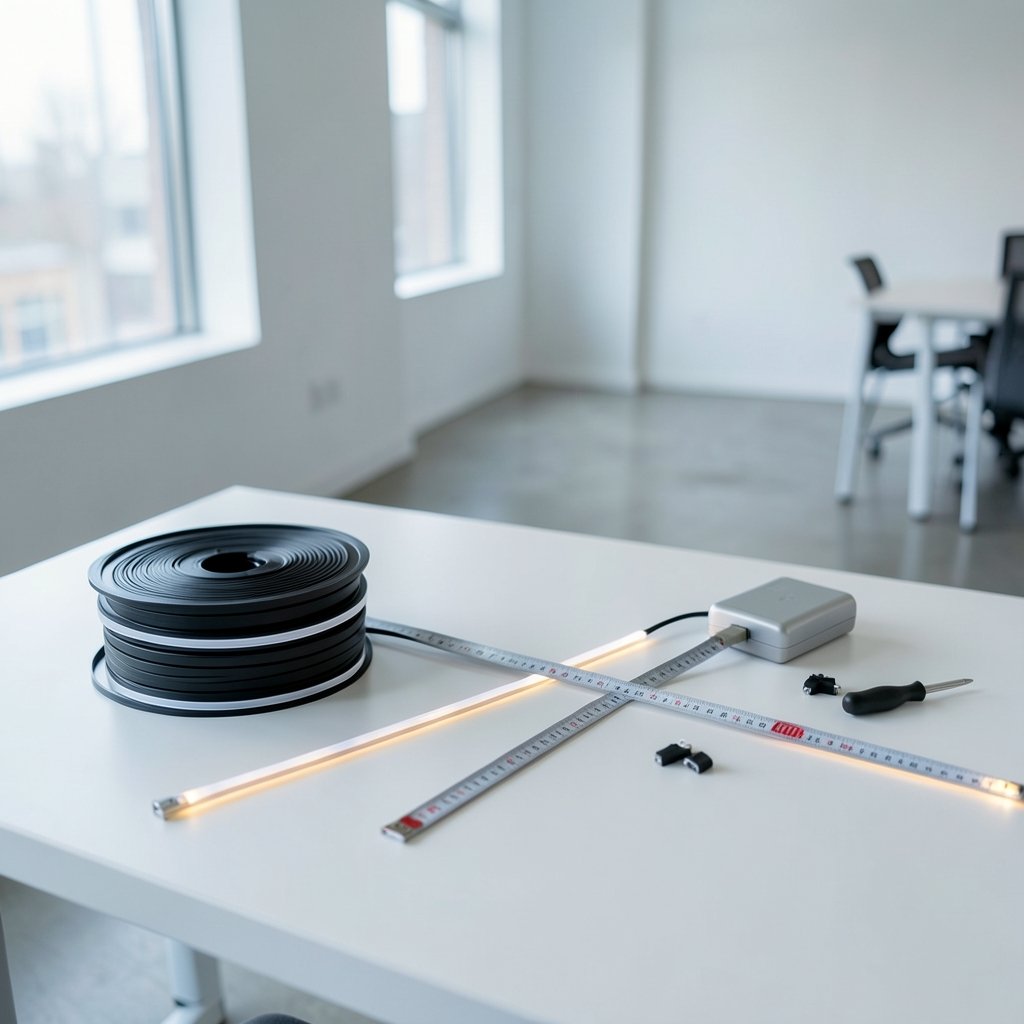
Picture this: you’ve measured the room, picked the color temperature, and ordered the LED strip. Then you notice the listing has two versions, 12V and 24V, and you have no idea which one you need. Choosing the wrong one won’t just dim your lights. It can destroy the strip entirely. (LED lamp)
The 12V versus 24V decision comes down to run length, power draw, and what you already have on hand. Get it right and the installation is simple. Get it wrong and you’ll be ordering replacements. Here’s how to decide, plus the mistakes that trip up even experienced DIYers.
The Basic Difference Between 12V and 24V Strips
Both types are low-voltage DC products. Neither connects directly to mains power. Each needs a driver (also called a power supply or transformer) that converts household AC current into 12V or 24V DC.
The strips themselves look nearly identical. The LEDs are the same size, the adhesive backing is the same, and the light output can be identical. The difference is how the LEDs are wired along the strip. On a 12V strip, LEDs are grouped in segments of three, and those groups sit in parallel. A 24V strip uses groups of six. That wiring change is the whole story, and it explains everything else you’ll read below.
Why Voltage Drop Decides Most Installations

Voltage drop is the silent killer of LED installations. As current travels along the copper traces inside a strip, some voltage is lost to resistance. The farther the current travels, the more it loses. The result is visible: the far end of the strip glows dimmer and shifts color compared with the end nearest the power supply.
Here’s the key relationship. For the same wattage, a 24V strip draws half the current of a 12V strip. Because resistive losses scale with the square of the current, a 24V system loses roughly a quarter as much energy per unit of length. In practice, that means a 24V strip can run much farther from its driver before dimming becomes noticeable.
As a rough rule of thumb, common 12V strips are often limited to about 5 meters per feed, while 24V strips commonly allow around 10 meters. Treat those numbers as starting points, not guarantees. A high-wattage strip with thin copper traces will fall short of them, and a low-wattage strip with heavy copper may beat them. Always check the manufacturer’s datasheet for the specific product.
Side-by-Side Comparison
| Factor | 12V Strip | 24V Strip |
|---|---|---|
| Current draw at equal wattage | Higher | Half of 12V |
| Typical max run per feed | Around 5 m | Around 10 m |
| Voltage drop over distance | More noticeable | Less noticeable |
| Driver cost | Usually lower | Slightly higher |
| Best for | Short runs, 12V systems | Long runs, high output |
| Cut points | Groups of three LEDs | Groups of six LEDs |
| Efficiency | Good | Marginally better |
When 12V Is the Smarter Choice
12V strips have a loyal following for good reasons. First, they’re the default in automotive, marine, and off-grid settings. If you’re wiring lights into a car, a camper van, or a boat, you already have a 12V battery system, and a 12V strip can run from it through a suitable regulator without an extra conversion step.
Second, 12V suits short runs. Under-cabinet kitchen lighting, a display case, a shelf accent, or a small cove rarely exceeds a couple of meters. Over that distance, voltage drop is negligible, and the lower-cost 12V driver makes sense.
Third, the 12V market is enormous. Selection is wider, prices are often keener, and replacement parts are easy to find. For small projects, that convenience matters.
The catch is that 12V strips draw more current, so you need thicker cable and a beefier driver for the same wattage. Long runs need power injection, where you feed power into the strip at multiple points. That’s extra wiring most people would rather avoid.
When 24V Wins
24V strips shine (literally) on longer runs and higher-output installations. Ceiling cove lighting, staircase accents, long kitchen runs, and commercial fit-outs all benefit from the lower current draw. Fewer power injection points mean a cleaner install and less cable to hide.
Higher wattage is the other advantage. If you want a bright, high-density strip, a 24V version handles the load with less stress on the copper traces and the driver. The system runs cooler and more efficiently overall, though the difference is usually modest and depends on the specific product.
One practical bonus: because 24V strips use groups of six LEDs, the cut points are spaced differently. If you’re trimming a strip to fit an exact length, check where the marked cut lines fall before you commit. A cut in the wrong place can leave a dead segment.
The Mistakes That Actually Cause Problems
Mixing voltages. This is the number one killer. A 24V strip connected to a 12V supply will glow dimly or not at all. A 12V strip connected to a 24V supply will be destroyed almost instantly. Label your drivers and strips clearly, especially if you keep spares in a drawer.
Sizing the driver too small. A driver must supply more than the strip’s total wattage. Add a safety margin of around 20 percent so it isn’t running at full capacity. A 10-meter strip drawing 100W needs a driver rated for at least 120W.
Ignoring voltage drop until it’s too late. Test-fit the strip before you stick it down. Power it up and look at the far end in a dark room. If it’s visibly dimmer, you need a shorter run, a higher voltage, or power injection.
Skipping the datasheet. Max run length varies enormously with wattage and copper weight. No universal number exists. The manufacturer’s spec sheet for your exact product is the only reliable guide.
Forgetting the cut points. Strips can only be cut at marked intervals. Measure twice, cut once, and cut only on the line.
Practical Tips That Save Time
- Plan the power location first. Put the driver near the middle of a long run if you can, so current travels half the distance in each direction.
- Use the right cable gauge. Higher current on 12V systems demands thicker wire. Undersized cable adds its own voltage drop before the strip even sees power.
- Buy a driver with headroom. A slightly oversized supply runs cooler and lasts longer.
- Keep spares of the same voltage. A mixed drawer of 12V and 24V strips is an accident waiting to happen.
- Check connector types. Some strips use proprietary connectors, so buy matching accessories at the same time.
If you’re planning lighting for a vehicle-based trip, the same voltage logic applies to your power setup, and it’s worth reading up on the best road trip routes in Europe while you plan the build.
Efficiency: What the Numbers Really Say
It’s tempting to claim 24V is dramatically more efficient. The honest answer is that the difference is usually small and product-specific. The LEDs themselves convert electricity to light at similar rates in both systems. The efficiency gain from 24V comes mostly from lower resistive losses in the strip traces and thinner, cheaper conductors, which matters most on long runs. For a two-meter under-cabinet light, you won’t notice the difference on your energy bill.
Safety and Standards
Both 12V and 24V are low-voltage systems, which makes them safer to handle than mains voltage. That doesn’t make them risk-free. The driver still connects to mains power, so it must be installed correctly, and the strip and driver should carry recognized safety certification for your region. Standards for LED modules and luminaires exist in most markets, but requirements vary by country, so check local electrical codes before installing anything permanent. If you’re unsure, a licensed electrician is worth the call. (Electrical)
A Simple Decision Framework
Still torn? Run through this quick sequence:
- Measure your longest run. Under 5 meters? 12V is probably fine. Over 5 meters? Lean toward 24V.
- Check your existing power. A 12V battery system points to 12V strips.
- Estimate total wattage. High-output installations favor 24V.
- Count your injection points. If you’d need several with 12V, 24V saves work.
- Confirm the datasheet. Match the max run length to your actual layout.
Conclusion
The 12V versus 24V question has a clean answer once you know your run length and power source. Choose 12V for short runs, automotive and marine systems, and small projects where cost and selection matter. Choose 24V for long runs, high-wattage installations, and any layout where you’d rather not run extra power cables. Whichever you pick, match the driver to the strip, respect the cut points, and test before you stick. Do that, and your strip will glow evenly from end to end for years.
Frequently Asked Questions
Can I run a 24V LED strip on a 12V power supply?
No, not usefully. The strip will be underdriven, so it will glow dimly or not at all. The reverse is far worse: a 12V strip connected to a 24V supply will be destroyed almost immediately. Always match the strip voltage to the driver voltage.
How far can I run a 12V LED strip without dimming?
There’s no universal number, but common 12V strips are often limited to roughly 5 meters per feed before voltage drop becomes visible. High-wattage strips may fall short of that, and low-wattage strips with heavy copper traces may exceed it. Check the manufacturer’s datasheet for your specific product.
Is 24V more energy efficient than 12V?
Marginally, in most cases. The LEDs themselves are similarly efficient in both systems. The gain from 24V comes from lower current and reduced resistive losses, which matters most on long runs. For short runs, the difference is negligible.
Why do 12V and 24V strips have different cut points?
The LEDs are wired in different group sizes. A 12V strip uses groups of three LEDs, while a 24V strip uses groups of six. You can only cut on the marked lines, so the spacing differs between the two versions even within the same product family.
Do I need a special driver for each voltage?
Yes. A 12V strip needs a 12V driver, and a 24V strip needs a 24V driver. Size the driver above the strip’s total wattage, ideally with around 20 percent headroom, so it doesn’t run at full capacity.
Which is better for a camper van or boat?
12V is usually the practical choice because most camper and marine electrical systems already run on 12V. You can power the strip from the existing battery system through a suitable regulator, avoiding an extra conversion step. Just confirm the regulator keeps output stable.
Can I mix 12V and 24V strips on one system? Only with separate drivers. A single supply cannot feed both voltages, and sharing one driver across mixed strips will damage the lower-voltage strip. If you need both, use two clearly labeled drivers and keep the wiring runs physically separate so nothing gets crossed later.
Do 24V strips cost more to buy? Slightly, in most cases. The strip itself is often priced similarly, but 24V drivers can cost a little more and the selection is narrower. For long runs, that small premium is usually offset by savings on cable and power injection hardware.
What about dimming and smart controls? Both voltages work with standard PWM dimmers and smart controllers, provided the controller is rated for the strip’s voltage and current. Check the controller’s rating before buying, since a 12V-only dimmer will not handle a 24V load.