
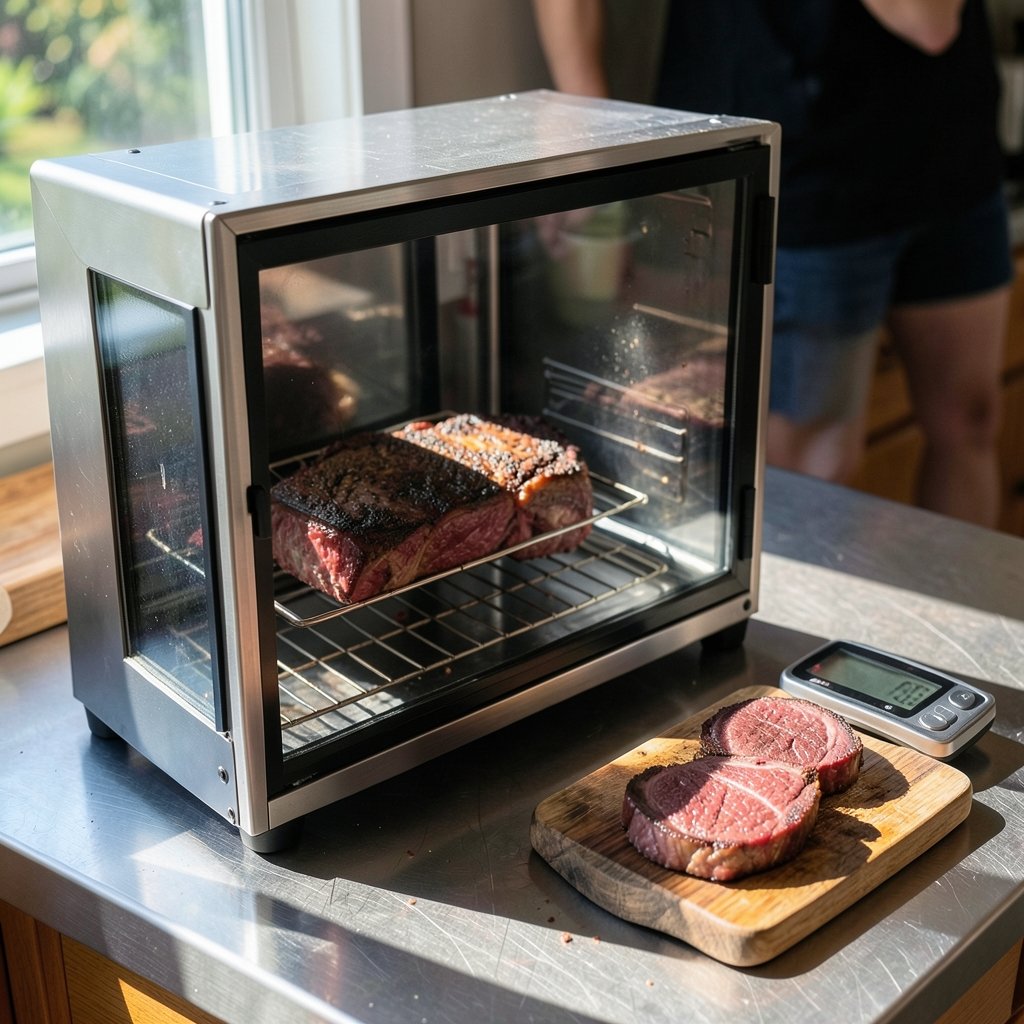
What if the most expensive steak on the menu owes its deep, nutty flavor not to a secret rub or a fancy grill, but to nothing more than time, cold air, and patience? That is the strange promise behind the dry ager — a term that gets tossed around for a machine, a walk-in room, and the person who tends it. Strip away the marketing and you find a surprisingly old idea: hold a big cut of beef in a cold, humid, moving-air environment for weeks, let moisture leave and enzymes go to work, then trim off the crust and cook what is left. The result can be extraordinary. It can also be a very expensive way to ruin a good piece of meat. This guide walks through what dry aging actually does, how the equipment works, what it costs in weight and money, and where the food-safety line sits.
What a dry ager actually is
The word covers three things, and mixing them up causes most of the confusion online.
First, a dry ager can be a person — a butcher or chef who practices the craft. Second, it refers to the cabinet or room where the process happens: a temperature- and humidity-controlled space with steady air movement. Third, it shows up as a verb-flavored label on consumer appliances and bags marketed for home use.
The underlying process, dry aging, means storing whole carcasses or large primal and subprimal cuts in a controlled environment for weeks to months. Typical conditions sit around 0 to 4 °C (32 to 39 °F) with roughly 75 to 85% relative humidity and constant airflow. Those figures are approximate and shift between sources — some butchers run drier, some wetter — but the principle is constant: cold enough to slow spoilage, humid enough that the meat does not turn to jerky, and breezy enough that moisture actually leaves the surface.
That last point trips people up. A dry ager is not a dehydrator. The goal is controlled evaporation, not desiccation.
What happens inside: moisture loss, enzymes, and crust
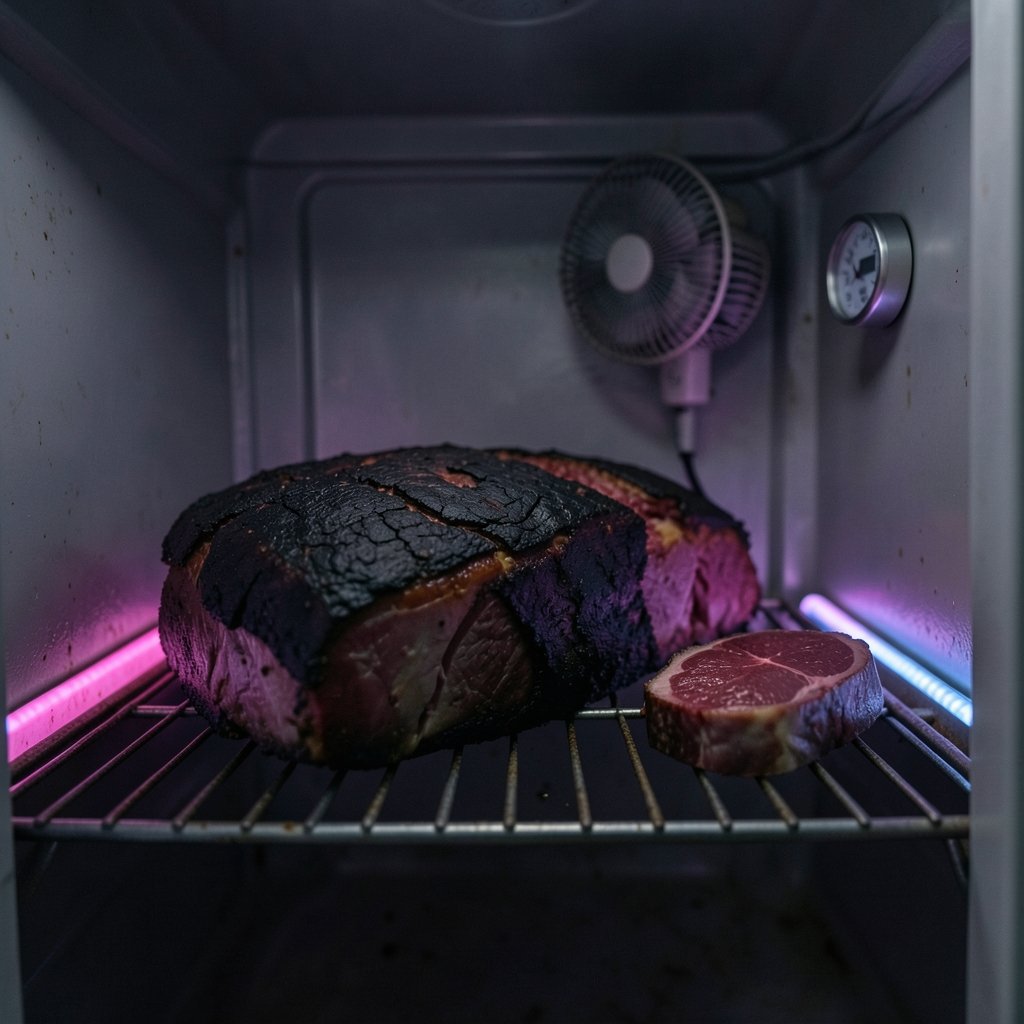
Two things drive the transformation, and the research community still debates how much each one matters.
Moisture loss is the easy part to measure. Water leaves the meat through evaporation, and the dried surface layer — the crust — is typically trimmed away before sale or cooking. Together, evaporation and trim commonly account for total losses on the order of 15 to 30%, depending on how long the beef ages and how the cabinet is run. A 10 kg primal can walk out of the chamber meaningfully lighter than it went in.
Enzymatic activity is the flavor story. Endogenous enzymes break down proteins and fats — proteolysis and lipolysis — and that slow chemistry is widely credited with the tender texture and deep savoriness that dry-aged beef is known for. Surface microbiota also play a role, and the relative contribution of enzymes versus microbes is genuinely unsettled in the literature. Anyone who tells you the science is fully pinned down is overselling.
What tasters actually report is more consistent than the mechanism: nutty, buttery, sometimes earthy or faintly blue-cheese-like notes. Those descriptors are usually tied to volatile compounds from lipid oxidation and microbial metabolism, though sensory panels differ from study to study.
Dry aging versus wet aging
Most beef sold commercially is wet aged — vacuum-sealed and held cold, which locks in moisture and avoids evaporation loss entirely. Dry aging is the niche, premium route.
| Factor | Dry aging | Wet aging |
|---|---|---|
| Environment | Open air, controlled humidity and airflow | Vacuum-sealed bag |
| Moisture loss | Significant (evaporation plus trim) | Minimal |
| Flavor profile | Nutty, savory, concentrated | Cleaner, beefier, milder |
| Yield | Lower | Higher |
| Cost | Higher per pound | Lower |
| Typical setting | Butcher shops, steakhouses, specialty cabinets | Mainstream supply chain |
Neither is “better.” They produce different products. Wet aging is efficient and predictable. Dry aging is a craft with a real failure rate, and the price reflects that.
The equipment: cabinets, rooms, and bags
A commercial dry-aging room is essentially a refrigerated walk-in with tight humidity control and serious airflow. At the other end of the spectrum sit countertop dry-aging cabinets built for home cooks, plus moisture-permeable bags that let vapor escape while blocking contaminants.
Here is the honest caveat: consumer appliances and bags are widely sold, but their food-safety performance has not been uniformly validated by independent research. Marketing claims run well ahead of published evidence. That does not mean the products are bad — it means the buyer is partly the test pilot.
If someone is setting up a home chamber, a few practical points matter more than brand:
- Confirm the unit holds a stable temperature in the low single digits Celsius, rather than only “cold.”
- Check that humidity can be monitored, ideally with a separate hygrometer rather than the built-in display alone.
- Verify real air movement — a fan that cycles, not a sealed box.
- Start with a single inexpensive primal before committing a costly one.
- Keep a written log of start weight, temperature, and humidity so results are repeatable.
That last habit separates hobbyists who improve from hobbyists who guess. Weighing before and after also tells you your true yield loss, which is the number that actually determines whether home aging saves money or costs it.
What it costs you in weight and money
The economics are unforgiving, and this is where many home projects go sideways.
Say a boneless primal starts at 6 kg. At a 20% total loss — a middle-of-the-road figure — roughly 1.2 kg disappears into water vapor and trimmed crust. The remaining 4.8 kg cost the same as the original 6 kg. That is a substantial effective price increase per usable pound, before accounting for the electricity and the risk of a spoiled batch.
Butchers price dry-aged beef accordingly, which is why it commands a premium. Home cooks often forget to run the same math and are startled when a “bargain” primal yields far less steak than expected.
The same yield logic shows up in plenty of everyday kitchen conversions — people routinely underestimate how much volume and weight shift between measurement systems. If you have ever wondered about the math behind liter and gallon conversions across US, UK, and dry measures, the principle is familiar: the number on the label is not the number on your scale. (Many ounces pint us uk dry measures explained)
Food safety: where the line actually sits
Dry aging is a controlled process, not a free-for-all, and the food-safety framework matters more than the flavor romance.
In the United States, inspection and labeling of meat fall under the U.S. Department of Agriculture’s Food Safety and Inspection Service, which has published guidance on dry aging that covers recommended temperature and humidity ranges and handling considerations. Rules vary by jurisdiction — the EU and UK operate under different hygiene regulations — so anyone selling dry-aged beef commercially needs to check local requirements rather than assuming a US guideline travels.
For home practitioners, the practical risk factors are few but serious:
- Temperature drift. A cabinet that swings warm for hours invites spoilage bacteria.
- Insufficient airflow. Still, damp air favors surface problems.
- Overly dry conditions. Too little humidity produces tough, wasted meat rather than aged beef.
- Poor sanitation. The chamber, racks, and hands all touch the product.
The reassuring part: dry aging is not a fragile biological gamble when conditions are held steady. The crust itself is a barrier of sorts, and trimming removes the surface layer before cooking. The failure mode is usually sloppiness, not bad luck.
Common mistakes that ruin a batch
Most disappointing dry-aging projects fail for predictable reasons.
Aging a small or thin cut. Dry aging suits large primals with enough mass to buffer moisture loss. Individual steaks will simply dry out.
Chasing extreme durations. Longer is not automatically better. Flavor intensity rises, but so does loss, and past a point the character turns funky rather than nutty.
Trusting the dial. Built-in hygrometers on budget cabinets are frequently off. A cheap separate meter catches problems early.
Skipping the trim. The crust is not meant to be eaten. Expect to cut it away and account for that in yield.
Ignoring the wet-aging alternative. For many home cooks, vacuum-sealing a primal in the fridge for a few weeks delivers tenderness gains with almost no loss. Dry aging is a choice with a cost, not a default upgrade.
There is a broader lesson here that applies well beyond meat: matching the tool to the job beats buying the most elaborate option. Anyone who has weighed a dryer versus a dry box for storing 3D printer filament has met the same trade-off — active drying equipment costs more and does more, while passive storage is cheaper and sufficient for many situations. The right answer depends entirely on what is being stored and for how long.
Does the flavor justify the effort?
For a steakhouse or a specialty butcher, almost certainly yes. Dry-aged beef is a signature product with a devoted following, and the premium pricing supports the yield loss.
For a home cook, the calculation is more personal. A well-run cabinet can produce genuinely impressive results, and the process itself has real appeal for people who enjoy projects. But the margin for error is thin, the equipment is not cheap, and the independent evidence on consumer appliances lags behind the sales copy.
A reasonable middle path: buy dry-aged beef from a trusted butcher first. Taste it, compare it to wet-aged beef side by side, and decide whether the flavor difference is worth pursuing at home. Many people discover they love it in a restaurant and find it too intense on their own plate — or the opposite. Either way, the tasting comes before the spending.
Conclusion
A dry ager is less a gadget than a set of conditions: cold, humid, moving air, and time. Get those right and beef develops a nutty depth that is hard to fake. Get them wrong and you lose a primal to dryness or spoilage. The process sheds 15 to 30% of the meat’s weight, the crust gets trimmed away, and the science of exactly why the flavor changes is still being argued over. What is not in dispute is that dry aging rewards discipline — steady temperature, monitored humidity, honest record-keeping, and realistic expectations about yield. Whether that trade is worth it depends on how much you value the result, and how carefully you plan to run the chamber.
Frequently asked questions
What is the difference between a dry ager and dry aging?
Dry aging is the process of holding large cuts of beef in a cold, humid, ventilated environment for weeks. A dry ager is either the person who does it or the cabinet or room where it happens. The terms are often used loosely, so context usually tells you which meaning is intended.
How much weight does beef lose during dry aging?
Total loss commonly falls in the range of 15 to 30%, combining water evaporation with the trimming away of the dried surface crust. The exact figure depends on how long the beef ages and how the chamber is run. Larger primals and longer durations push the loss higher.
Can you dry age beef at home safely?
Yes, with the right conditions: stable refrigeration near 0 to 4 °C, humidity around 75 to 85%, and genuine airflow. The main risks are temperature swings, stagnant air, and poor sanitation. Note that consumer cabinets and aging bags are widely sold but not uniformly validated by independent research, so results depend heavily on how carefully the equipment is run.
Is dry-aged beef better than wet-aged beef?
They are different products rather than better and worse. Dry aging produces nutty, savory, concentrated flavors and a tender texture at the cost of significant yield loss. Wet aging, done in vacuum-sealed bags, preserves moisture and yield and delivers a cleaner beef flavor. Most commercial beef is wet aged for exactly that reason.
How long should beef be dry aged?
Duration is a matter of taste within food-safety limits. Shorter periods give milder character with less loss; longer periods intensify flavor but increase trim waste and can push the profile from nutty toward funky. Many producers settle in a middle range rather than chasing maximum time, and home cooks are wise to start short.
What is the crust on dry-aged beef, and do you eat it?
The crust is the dried, darkened surface layer that forms as moisture evaporates during aging. It is typically trimmed away before the beef is sold or cooked, and that trim is part of why dry-aged beef costs more per usable pound. It is not a delicacy — it is the cost of doing business.



