
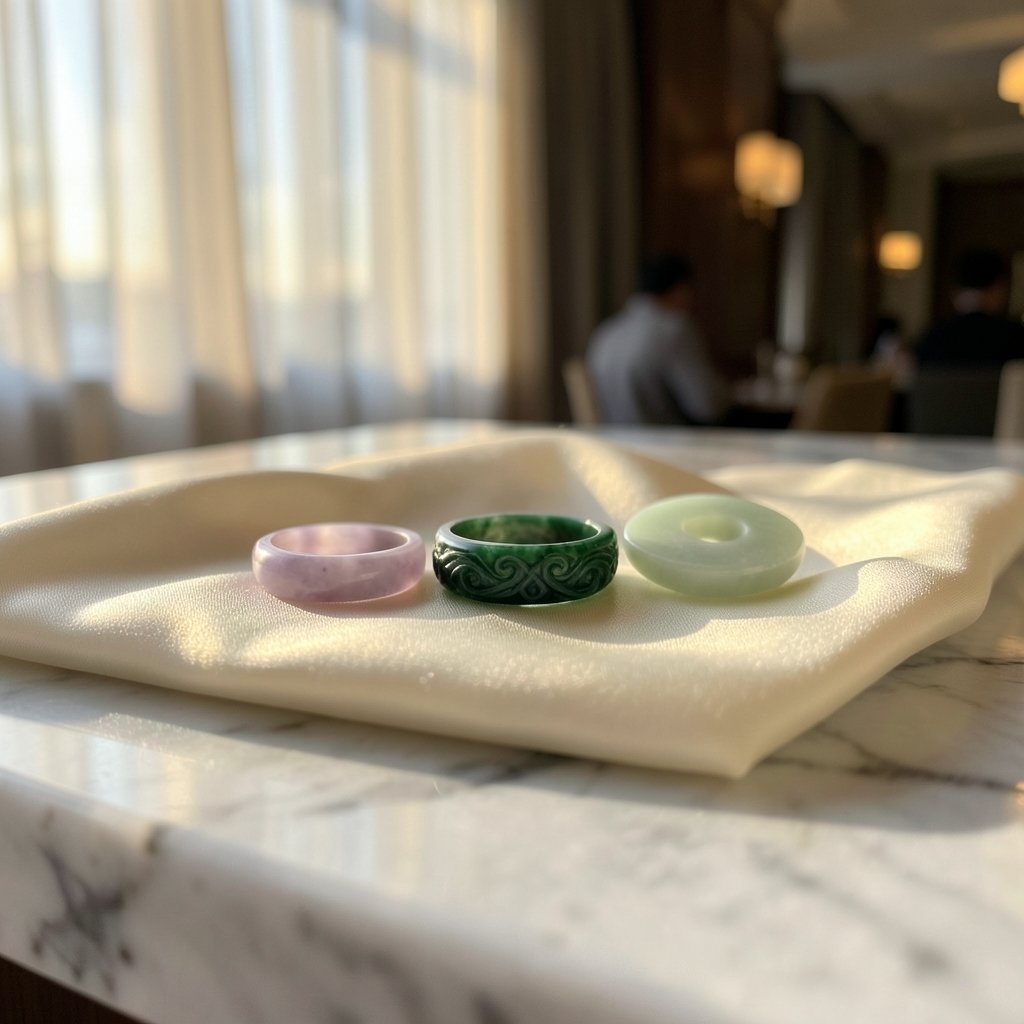
What is actually wrapped around your finger when you slip on a jade ring? The answer is more complicated than most sellers admit. The word “jade” covers two completely different stones, a long history of ring-shaped objects that were never meant for fingers, and a modern market where simulants outnumber the real thing. This guide sorts through all of it, from mineralogy to the awkward practicalities of wearing a stone that chips if you look at it wrong.
Two Stones, One Word
In Chinese usage, yù covers two distinct materials. Nephrite is a calcium-magnesium silicate amphibole. Jadeite is a sodium-aluminium pyroxene. They look similar enough that centuries of carvers treated them as the same substance, but they are chemically unrelated.
The timeline matters for buyers. Jadeite was not widely used in China until roughly the late 18th century, when Burmese sources became available during the Qing dynasty. The exact onset is debated among historians, but the broad picture holds: if a ring is presented as an ancient Chinese heirloom carved from vivid green jadeite, that claim deserves hard scrutiny.
Hardness gives you a practical way to tell them apart. Jadeite rates about 6.5 to 7 on the Mohs scale. Nephrite sits around 6 to 6.5. Values shift slightly depending on the source, but jadeite is the harder of the two. Neither is tough enough to shrug off a knock against a door frame, which is why ring settings matter so much.
Rings That Were Never Finger Rings
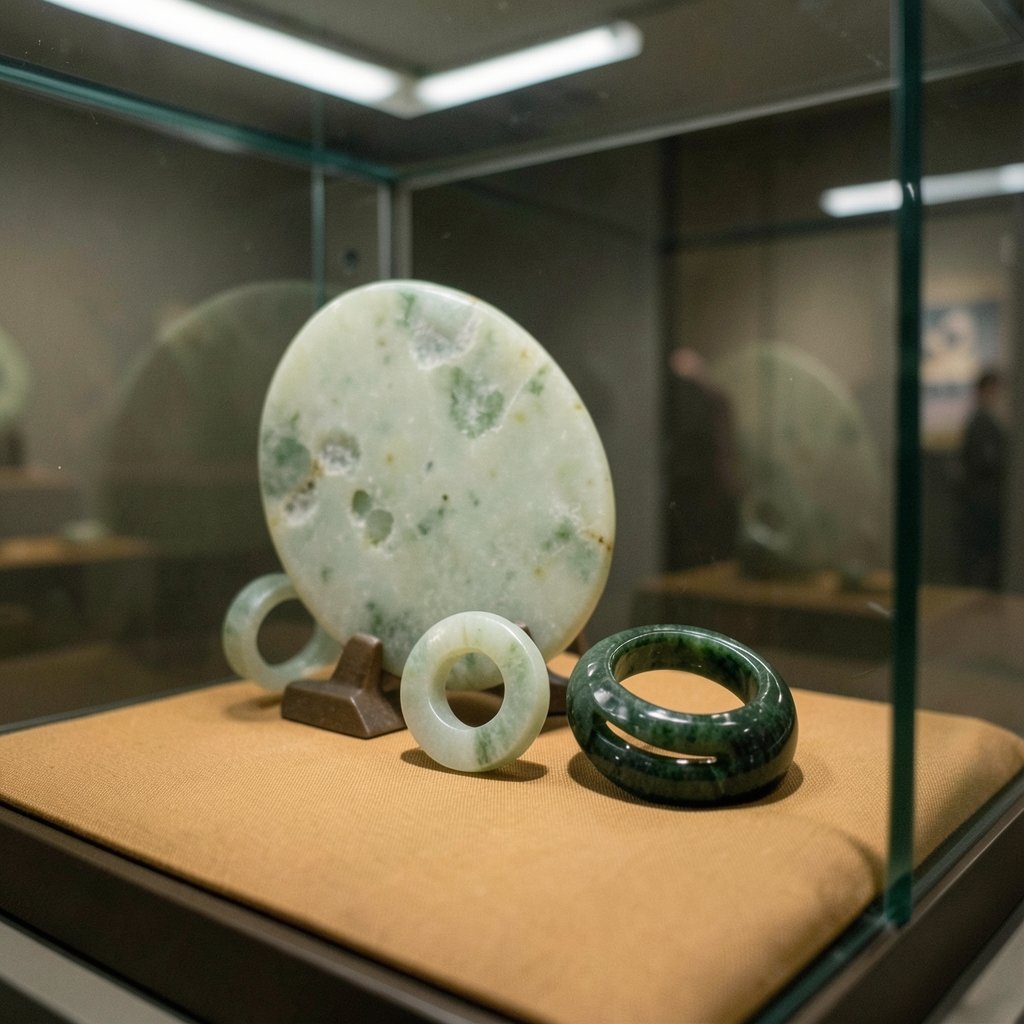
Here is where most searches go sideways. A huge share of “jade ring” objects in museums are not jewelry at all. Chinese jade ring-shaped forms include bi discs (flat, with a central hole, often Neolithic through Han), other ring types known as yuan and huan, and archer’s thumb rings called banzhi. Thumb rings became decorative and were carved from jade especially during the Qing period, which ran from 1644 to 1912. (Ea may sell mass effect dragon age jade empire darrah 2026)
Terminology varies by source, so treat any single label with caution. A seller describing a “traditional jade ring” might mean a finger ring, a bi disc, or a thumb ring, and those are three different objects with three different price structures. Ask for dimensions and a photo of the profile before assuming anything.
Circular jade forms carry symbolic weight in Chinese culture. They are associated with heaven and continuity, and rings can symbolize completeness. That interpretive layer is real but soft: sources differ on specifics, and sellers lean on it heavily. Enjoy the symbolism, but do not let it substitute for a grading report.
Jade Around the World
China does not hold a monopoly on the material. The Maya valued jade, often jadeite and frequently called Maya greenstone, for rings, beads, and plaques, associating it with maize, water, and breath. Classic period dates run roughly 250 to 900 CE, with broader use stretching earlier.
In Aotearoa New Zealand, pounamu (nephrite or greenstone) is carved into rings and other ornaments and holds status as a taonga, a treasure of cultural significance to Māori. The tradition is long-standing with no single founding date. If you are buying pounamu, provenance and the carver’s identity carry more weight than any certificate, and respectful buying means asking who made it and where the stone came from.
Three traditions, three sets of expectations. A Chinese jadeite ring is judged on color, translucency, and carving. A pounamu ring is judged on stone source and craftsmanship. A Maya-style piece is often a modern reproduction, which is fine as long as nobody markets it as an artifact.
What You Are Probably Being Sold
In gemology, “jade” strictly means nephrite or jadeite. Many jade rings sold today are simulants such as serpentine, dyed quartz, or glass, or they are treated stone. Market claims vary wildly, so treat this as a general caution rather than a statistic.
The most common mistakes buyers make, in rough order of frequency:
- Trusting a word like “jade” or “jade green” on a tag as a mineral identification. It is a color description at least as often as a stone name.
- Buying from a photo under studio lighting. Jade is translucent, and backlighting flatters everything.
- Skipping the question of treatment. Dyeing and polymer impregnation are widespread and change both value and care requirements.
- Assuming green means jadeite. Serpentine, aventurine, and dyed quartz all show up in green rings.
- Ignoring the setting. A fragile stone in a thin bezel is a repair bill waiting to happen.
What actually works is boring and reliable: buy from a seller who states the mineral name, the treatment status, and the origin in writing, and who accepts returns. If a listing will not name the stone beyond “jade,” assume it is not the real thing until proven otherwise.
Reading a Grading Report
Museum and gemological labs authenticate jade using refractive index, specific gravity, and spectroscopy. You will not run these tests at home, but knowing the vocabulary helps you read a report and spot a fake one.
| Test | What it measures | Why it matters |
|---|---|---|
| Refractive index | How light bends through the stone | Separates jadeite from nephrite and from simulants |
| Specific gravity | Density relative to water | Jadeite and nephrite differ; glass and serpentine fall elsewhere |
| Spectroscopy | How the stone absorbs light | Detects dyes and some treatments |
A legitimate report names the testing lab, the date, the stone’s dimensions and weight, and a clear conclusion. A PDF with a logo and the word “certified” but no measurements is decoration. Note too that a report on a loose stone does not automatically apply to the finished ring, so confirm the report matches the piece you are holding.
Fit and Wearability
Jade rings are rigid. There is no give, no sizing band, and no jeweler’s trick that resizes a stone circle without cutting it. That makes accurate sizing non-negotiable, and it is where a lot of online purchases fall apart. If you are ordering blind, learn to measure ring size at home without guessing before you commit, and measure at the end of the day when fingers are at their largest.
Width changes everything. A wide band feels tighter than a narrow one at the same internal diameter, so a 10mm jade band may need to run a half size up from what you normally wear. Knuckle size matters as much as finger circumference: if your knuckles are prominent, a ring that fits the base of your finger may not clear the joint.
Wear habits deserve honest thought. Jade is hard but not tough, meaning it resists scratching better than it resists impact. Garden work, gym sessions, and moving furniture are all opportunities to crack a ring. Many owners keep jade for social wear and switch to something else for rough tasks, which is not fussiness but sensible risk management.
Style and Setting Choices
The classic jade ring is a plain polished band, either a solid carved circle or a stone set into metal. Both have trade-offs.
A solid jade band shows the stone continuously and needs no metal, but it cannot be resized and any chip is permanent. A set stone allows a softer, more protected seat and easier replacement, but introduces metal into the design and a bezel or prong that can catch on clothing.
Bezel settings protect the stone’s edges and suit daily wear. Prong settings show more stone but expose the girdle to knocks. For a first jade ring, a low-profile bezel in a warm metal is the lower-risk choice, and it photographs well without exaggerating translucency.
Color expectations should stay realistic. Fine imperial green jadeite is scarce and priced accordingly. Most affordable green rings are nephrite, treated jadeite, or a simulant, and there is no shame in any of those as long as the price and the description match the reality.
Care That Actually Works
Jade care is simple, and most damage comes from good intentions.
- Clean with lukewarm water and a soft cloth. Skip ultrasonic cleaners and steam.
- Avoid household chemicals, chlorine, and long soaks. Treated stones can change over time with repeated exposure.
- Store separately from harder stones such as diamond and sapphire, which will scratch jade in a shared pouch.
- Take the ring off before lifting weights, gardening, or moving furniture.
- Check prongs and bezels annually if the ring is worn often.
One persistent myth deserves retiring: jade does not need to be “fed” with body oils to keep its color. Handling a stone does nothing chemically useful. What keeps a ring looking good is avoiding impact and abrasion.
Buying Checklist
Before money changes hands, confirm five things in writing: the mineral name (nephrite or jadeite), the treatment status (none, dyed, polymer-impregnated), the origin if claimed, the exact dimensions including band width, and the return window. Ask for photos in daylight without backlighting. Ask whether the ring has been repaired or had chips polished out, since polishing can flatten a carved surface.
If the seller cannot answer these questions, that is your answer. The same discipline applies to any wearable purchase, whether it is a ring or a wrist device, which is why comparisons like whoop vs oura ring vs apple watch which wearable fits your hinge on the same principle: match the object to your actual habits rather than the marketing story.
Where Jade Rings Fit in a Collection
A jade ring is a commitment piece. It will not resize, it will not forgive a drop on tile, and it will not look like the listing photo under office lighting. What it offers instead is a genuine link to traditions that stretch from Neolithic Chinese discs to Maya greenstone to Māori pounamu, plus a color and surface that no metal can imitate.
Buy the stone, not the story. Get the mineral name in writing, size your finger properly, choose a protective setting, and accept that the ring will need to come off for yard work. Done that way, a jade ring earns its place in a jewelry box for decades rather than sitting in a drawer because it never quite fit.
Frequently Asked Questions
Is a jade ring worth buying?
It depends entirely on what you are buying. A documented nephrite or jadeite ring from a seller who states the mineral and treatment in writing can be a sound purchase with real longevity. An unlabeled green ring sold as “jade” with no grading information is a costume piece, and it should be priced like one. Value comes from the stone’s identity, not the word on the tag.
How can I tell real jade from fake jade?
At home, you cannot do it reliably. Hardness and heft give weak clues at best, and simulants like serpentine or dyed quartz fool experienced eyes in photos. Proper identification relies on refractive index, specific gravity, and spectroscopy performed by a gemological lab. The practical move is to buy from sellers who provide a report naming the mineral and confirming treatment status.
What is the difference between jadeite and nephrite?
They are two different minerals that share a name. Jadeite is a sodium-aluminium pyroxene and is the harder of the two, around 6.5 to 7 on the Mohs scale. Nephrite is a calcium-magnesium silicate amphibole at roughly 6 to 6.5. Jadeite only became widely used in China around the late 18th century, when Burmese sources reached the Qing court, while nephrite has a much longer history there.
Can a jade ring be resized?
No. A solid jade band cannot be stretched, cut down, or reshaped the way metal can, and cutting it usually destroys the piece. If a stone is set in metal, the setting might be resized, but the stone itself stays fixed. This is why getting the size right before purchase matters more for jade than for almost any other ring material.
Is a jade ring the same as a Chinese bi disc?
Usually not. A bi is a flat disc with a central hole, often dating from the Neolithic through Han periods, and it was not worn on a finger. Chinese jade ring-shaped objects also include yuan and huan forms and archer’s thumb rings called banzhi, which became decorative in the Qing period. Terminology varies by source, so ask for dimensions and profile photos.
How should I care for a jade ring?
Use lukewarm water and a soft cloth, and avoid ultrasonic cleaners, steam, chlorine, and household chemicals. Store the ring away from harder stones that can scratch it, and remove it for gardening, gym work, or moving furniture, since jade resists scratching better than it resists impact. Have the setting checked once a year if you wear it often, and ignore advice about feeding the stone with oils, which does nothing.



