
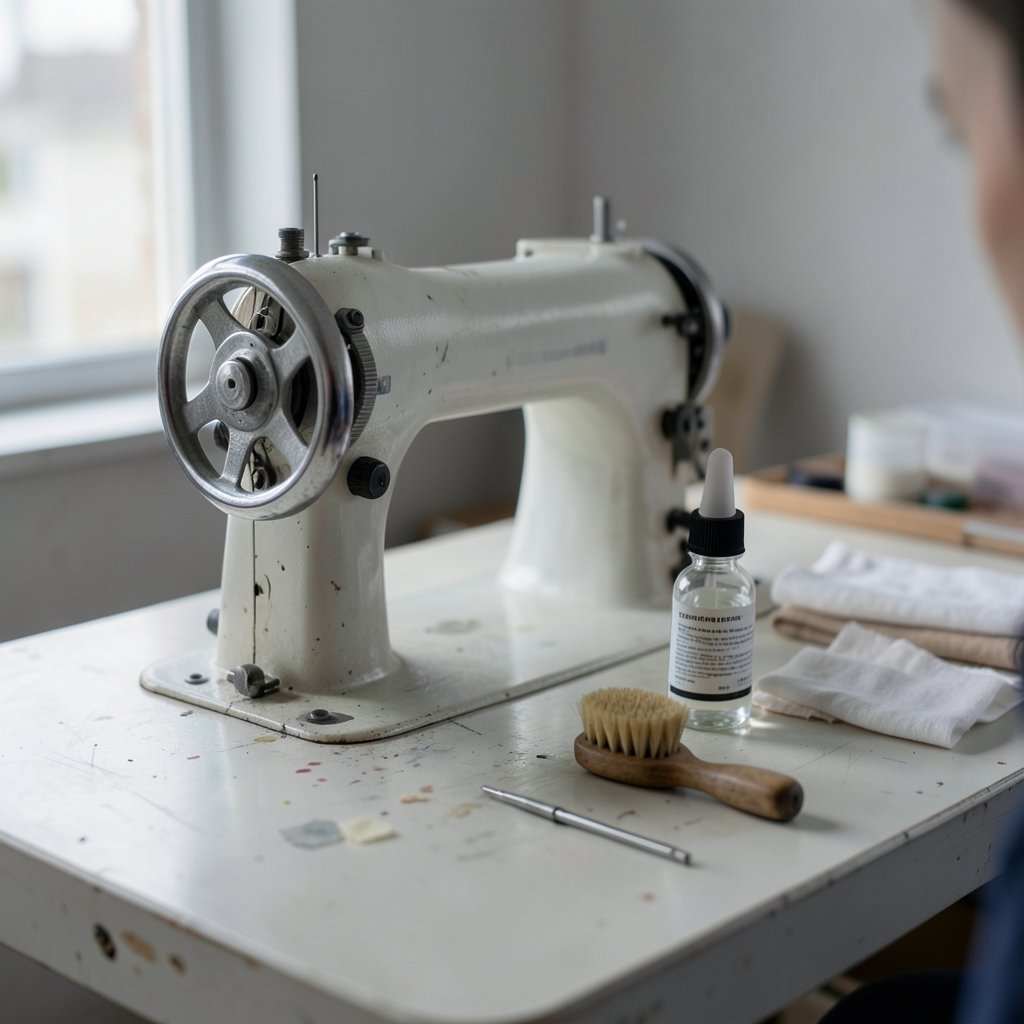
What happens when a sewing machine starts to sound like a tiny cement mixer? Nine times out of ten, the answer involves a dry hook, a neglected bobbin case, or a bottle of the wrong lubricant sitting on the shelf. Sewing machine oil is one of those products that seems boring until it quietly decides whether your machine runs smoothly for twenty years or seizes up in the middle of a quilt.
This guide covers what the oil actually is, why thin beats thick, where the drops belong, and which common substitutes do more harm than good. It also tackles the awkward parts: disposal, skin contact, and the fact that no single standard defines the product at all.
What sewing machine oil actually is
Sewing machine oil is a light, low-viscosity lubricant, usually a highly refined mineral oil that is clear or faintly amber. It is sold specifically for domestic and industrial sewing machines, though it also works well on knitting machines, clippers, and other small mechanisms with tight clearances.
The defining trait is thinness. Most sewing machine oils fall in the range of roughly ISO VG 10 to 22, or about 10 to 20 cSt at 40 °C. That is noticeably lighter than general-purpose machine oil. Exact grades vary by brand, so a specific number on a bottle should be treated as brand-dependent rather than universal.
There is no single international standard that defines “sewing machine oil.” Formulations differ from maker to maker in viscosity, additive packages, and safety data. Anyone claiming otherwise, whether a blogger or a salesperson, is oversimplifying. The honest answer is that the category describes a purpose, not a fixed recipe.
Why thin oil wins in a sewing machine
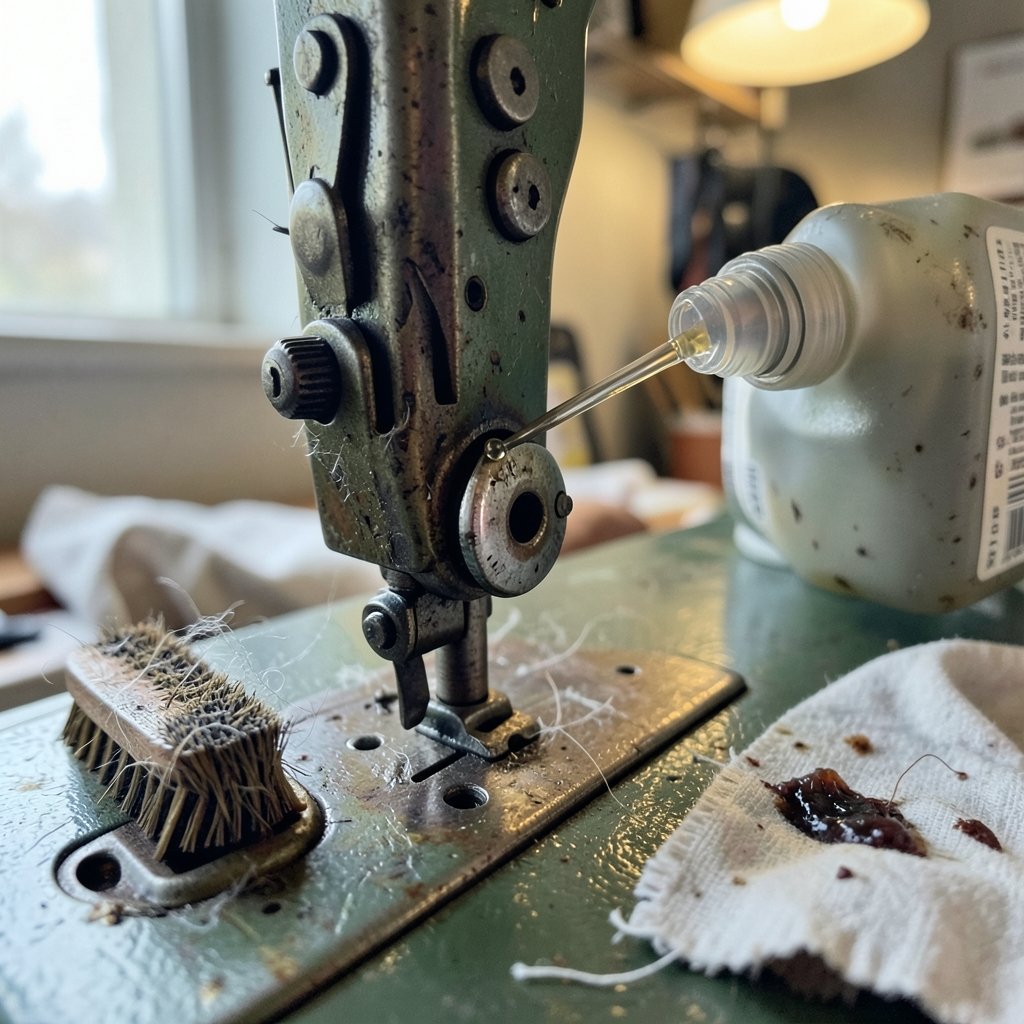
A sewing machine packs a lot of motion into a small space. The hook rotates at high speed, the needle bar travels up and down thousands of times per hour, and the bobbin case sits in a housing with clearances measured in fractions of a millimeter. Thin oil penetrates those gaps. Thick oil sits on top and does nothing useful.
There is a second reason. Heavy oils attract and hold lint. Sewing generates an astonishing amount of fuzz, and a sticky lubricant turns into a felt-like paste that clogs the works. Light oil migrates away from the surface after doing its job, which keeps lint from accumulating in the same spots.
This rationale is common shop guidance rather than a formal engineering standard, but it holds up in practice. Anyone who has opened a machine that ran on the wrong oil knows the look: dark, gummy residue in the hook area and stiff movement in the handwheel.
Where the oil goes: a practical lubrication routine
Manufacturers differ, so the machine manual always wins. That said, most domestic machines share a similar lubrication map. A sensible routine looks like this:
- Unplug the machine and remove the needle, presser foot, and bobbin. Working around a live machine with oil on your fingers is how people get hurt.
- Clean first. Brush out lint from the bobbin case, hook race, and feed dogs. Oil applied over lint just creates sludge.
- Place one or two drops in the bobbin case and hook race. This is the highest-wear area on most machines and the one people forget.
- Oil the needle bar and presser bar points if the manual calls for it. Many modern machines have sealed bearings here and need nothing.
- Add a drop where the manual shows the handwheel or arm shaft points. Older all-metal machines usually need this; newer computerized models often do not.
- Run the machine without thread for thirty seconds. This distributes the oil and flushes out loosened debris.
- Wipe away excess with a lint-free cloth and stitch on scrap fabric to absorb any residue before starting a real project.
A common mistake is over-oiling. More is not better. Excess oil drips onto fabric, stains it, and collects lint. Two or three small drops per point is plenty. Another frequent error is oiling a machine that has never been cleaned, which pushes grit deeper into the mechanism.
Frequency depends on use. A machine run daily for hours may want a drop every week or two. A hobby machine used monthly might need oiling two or three times a year. Industrial machines running full shifts follow their own schedule, often daily.
How sewing machine oil compares to common substitutes
The internet is full of advice to use whatever is in the garage. Some of it is fine. Much of it is not. Here is how the usual candidates stack up.
| Lubricant | Suitable? | Why |
|---|---|---|
| Purpose-made sewing machine oil | Yes | Correct viscosity, low lint attraction, designed for tight clearances |
| WD-40 (standard formula) | No | Solvent-based water displacer, not a lasting lubricant; can strip existing oil |
| Cooking oil (olive, vegetable) | No | Gums up, goes rancid, attracts pests, hard to remove |
| General machine oil (heavier grades) | Usually no | Too thick for tight clearances, stiffens in cool rooms |
| Silicone spray | Rarely | Can migrate onto fabric and cause staining and stitch problems |
| Graphite powder | No | Abrasive in the wrong places, messy, hard to clean out |
Manufacturers commonly warn against WD-40 and cooking oil specifically. The WD-40 point confuses people because the brand now sells actual lubricants, but the classic blue-and-yellow can is a water displacer, not a long-term lubricant. It will free a stuck mechanism and then leave it drier than before.
Cooking oil deserves a special mention because it seems harmless. It is not. Vegetable oils polymerize and turn sticky, and they can go rancid inside a machine. Removing that residue takes real work.
Safety, skin contact, and the fine print
Highly refined, additive-free mineral oils of this type are generally not classified as hazardous. That does not make them inert. A few practical points matter.
Aspiration hazard. Low-viscosity hydrocarbons can cause serious lung injury if swallowed, because they can be drawn into the lungs. This is why such products carry “do not induce vomiting” guidance and why they belong out of reach of children. Store the bottle capped and labeled.
Skin contact. Prolonged contact is generally low-irritancy but can cause dermatitis in some people. Refined mineral oils are not considered skin carcinogens, unlike some less-refined oils historically linked to occupational illness in machine operators during the early to mid-1900s. Wipe hands rather than washing with solvent, and wear gloves during long oiling sessions.
Oil mist. In industrial settings, mineral oil mist is an inhalation concern. The U.S. occupational exposure limit for mineral oil mist is 5 mg/m³ as an eight-hour time-weighted average. Home sewists will never approach that, but factory floors with high-speed machinery need ventilation.
Food and medical grades are different. Medicinal and food-grade white oils are related but distinct specifications. A bottle of sewing machine oil is not automatically food-grade, which matters if you sew food-contact items or use the oil near kitchen equipment.
One more distinction worth knowing: sewing machine oil is not the same product as the oil used in some other small machines. If a household has a money counting machine, for instance, its maintenance guidance is a separate topic entirely, and the mistakes buyers make with that equipment follow their own logic.
Buying wisely: what to look for on the label
A good bottle of sewing machine oil is cheap, which makes the decision easy. Look for a few things:
- Clear or pale color and no strong solvent smell.
- A stated viscosity or grade, even a rough one, rather than vague “premium quality” language.
- A safety data sheet available from the seller, which signals a serious manufacturer.
- A needle applicator or precision spout, which matters more than most buyers expect. Precise delivery is half the battle.
- A sensible size. A 100 ml bottle lasts a hobby sewist for years. Buying a liter is a waste unless the machine runs daily.
Avoid unlabeled bottles from market stalls and unmarked syringes of unknown oil. The savings are trivial and the risk to an expensive machine is not.
For readers who enjoy comparing machines and their maintenance needs, resources like this guide to the best espresso machine for home show how lubrication and descaling logic differ across appliance types, while a breakdown of the best nespresso machine covers a category where sealed systems remove the oiling question entirely. The principle is the same everywhere: match the lubricant to the mechanism, not to whatever is closest at hand.
Storage, shelf life, and disposal
Sewing machine oil does not really expire in the way food does, but it does degrade. Keep it capped, upright, and away from direct sunlight and heat. Dust and lint getting into an open bottle is a real problem, so wipe the spout after use. A bottle left open in a sewing room for a year will collect more fuzz than the machine it was meant to protect.
Disposal matters more than people think. Waste sewing machine oil should be treated as used oil and taken to a household hazardous waste facility or recycling point. It should never go down a drain or into household trash. Check local rules, because collection options vary widely by region.
Small quantities on rags should be allowed to dry in a ventilated area before disposal, following local guidance. Rags soaked in any oil deserve care, since spontaneous combustion is a known risk with oil-soaked textiles left in piles.
When oil does not fix the problem
Oil is not a cure-all. If a machine is noisy after oiling and cleaning, the cause is usually something else: a bent needle, a burr on the hook, incorrect threading, or a worn belt. Adding more oil to a machine with a mechanical fault just makes a mess.
Similarly, if the handwheel is stiff even after lubrication, the machine likely needs service rather than more lubricant. Old hardened grease in the gears of vintage machines is a common culprit, and it needs to be removed, not diluted with fresh oil.
A useful diagnostic habit: oil, then run, then listen. If the sound improves and then returns within a day or two, the oil is migrating away from a worn part that needs replacement. If the sound never changes, the problem is not lubrication.
Conclusion
Sewing machine oil is a small purchase with an outsized effect on how a machine ages. The rules are simple: use a light, purpose-made mineral oil, clean before lubricating, apply a couple of drops rather than a puddle, and keep the bottle sealed and labeled. Skip the cooking oil and the classic WD-40, respect the aspiration and skin-contact warnings, and dispose of waste oil properly.
None of this is glamorous. But a machine that gets the right oil at the right intervals runs quieter, stitches cleaner, and lasts long enough to justify the space it takes up. That is a fair return on a bottle that costs less than a spool of good thread.
Frequently asked questions
How often should a sewing machine be oiled?
It depends on use. A machine run daily may need a drop or two every week or two, while a hobby machine used a few times a month might need oiling two or three times a year. Always follow the manual, since many modern computerized machines have sealed bearings and need little or no oiling.
Can I use WD-40 instead of sewing machine oil?
No. Standard WD-40 is a solvent-based water displacer, not a lasting lubricant. It can free a stuck part but leaves the mechanism drier than before and can strip existing oil. Manufacturers commonly warn against it for this reason.
Is sewing machine oil the same as mineral oil?
It is usually a highly refined mineral oil, but the two are not interchangeable in every context. Food-grade and medicinal white oils are separate specifications with their own requirements. A bottle of sewing machine oil should not be assumed safe for food-contact use.
What happens if I use too much oil?
Excess oil drips onto fabric, stains it, and traps lint, which turns into a gummy paste in the hook area. Over-oiling is one of the most common maintenance mistakes. Two or three small drops per lubrication point is generally enough.
Is sewing machine oil dangerous?
Highly refined mineral oils are generally not classified as hazardous, but low-viscosity oils carry an aspiration hazard if swallowed, so they must be kept away from children and never induce vomiting after ingestion. Prolonged skin contact can cause dermatitis in some people.
Can I use sewing machine oil on other machines?
Often yes. It works well on knitting machines, clippers, and other small mechanisms with tight clearances. It is not a universal lubricant, though. Heavier machinery, high-load gears, and sealed appliances each call for their own specified lubricant.



