
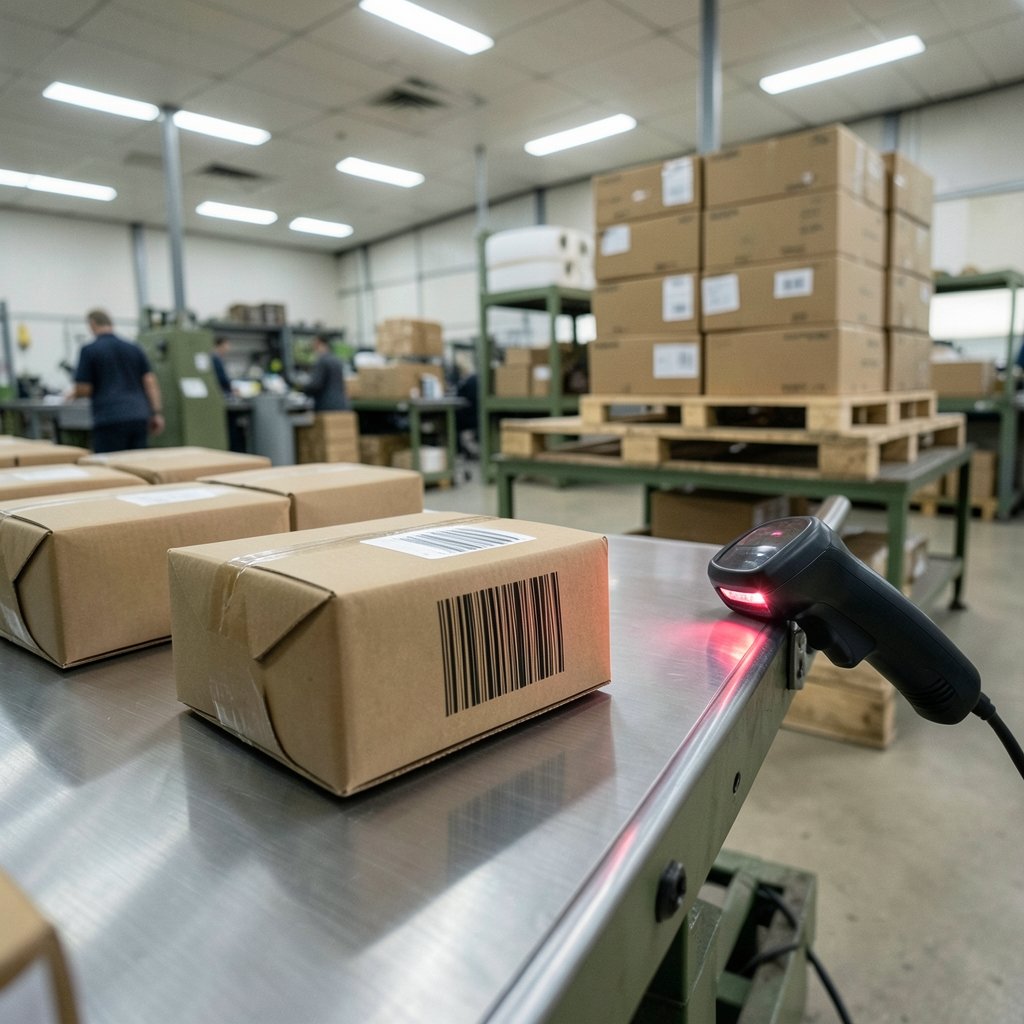
What do a blood bag in a hospital, a parcel on a delivery truck, and a pallet in a warehouse have in common? In a surprising number of cases, the answer is a barcode symbology that debuted more than four decades ago and has never really been replaced. Code 128 is the quiet workhorse behind modern logistics, and understanding how it works explains a lot about why scanning at scale is so reliable.
This guide breaks down the structure, the character sets, the checksum math, and the practical mistakes that cause barcode failures. It also separates plain Code 128 from its famous cousin, GS1-128, which trips up plenty of people who think the two are interchangeable.
What Is Code 128?
Code 128 is a linear barcode symbology that can encode all 128 ASCII characters, from control codes to uppercase and lowercase letters, digits, and punctuation. It was introduced in 1981 by Computer Identics, with Ted Williams usually credited as its designer. It later became an industry standard and is now specified internationally as ISO/IEC 15417.
The name comes from its character range, not from its density or length. That is a common point of confusion. People assume “128” refers to something about the bars. It refers to the ASCII character set.
What makes Code 128 special is efficiency. It uses three interchangeable code sets that let a single symbol switch between uppercase-heavy data, mixed-case text, and compressed numeric pairs. For a shipping label packed with digits, that compression matters enormously.
The Three Code Sets and How They Switch

Code 128 has three code sets, labeled A, B, and C. Each one maps symbol values to different characters, and the encoder switches between them using control symbols embedded in the data.
| Code Set | Best For | Notable Coverage |
|---|---|---|
| Code Set A | Uppercase and control characters | ASCII 0–95 plus control codes |
| Code Set B | Mixed-case alphanumeric text | ASCII 32–127 |
| Code Set C | Long numeric strings | Digit pairs, two digits per symbol |
Code Set C is where the real speed comes from. Instead of one digit per symbol character, it packs two digits into each. A 20-digit tracking number that would take 20 symbol characters in Code Set A takes only 10 in Code Set C. On a high-volume packing line, that difference shrinks label width and speeds up scanning.
The switching is automatic in good barcode software. The encoder evaluates the data and inserts shift or latch characters where they save space. A latch switches code sets permanently until the next latch. A shift applies to just one character and then reverts. This is why a well-encoded Code 128 symbol can look unpredictable to the eye but be perfectly optimized for the scanner.
A Practical Tip on Code Set Selection
If you are generating barcodes yourself, do not force a code set manually unless you have a reason. Let the encoder choose. The most common mistake is locking everything into Code Set B because it handles mixed text, then wondering why a 30-digit serial number produces a barcode that barely fits the label. Modern libraries handle the optimization correctly if you leave them alone.
Anatomy of a Code 128 Symbol
Every Code 128 barcode follows the same structure, start to finish:
- Start character. One of three start codes (Start A, Start B, or Start C), which tells the scanner which code set is active at the beginning.
- Data characters. The actual encoded content, with any code set switches embedded.
- Check character. A single modulo-103 checksum value.
- Stop character. A distinctive 13-module pattern that signals the end.
- Termination bar. A final bar that completes the symbol.
Here is the detail that catches people out: all symbol characters are 11 modules wide, but the stop pattern is 13 modules. That extra width is deliberate. It makes the stop pattern visually distinct so a scanner can recognize the end of the symbol even from a partial scan. If you are drawing barcodes by hand or debugging a rendering engine, getting the stop pattern width wrong produces symbols that look fine to a human and fail on every scanner.
Each character is built from six elements, three bars and three spaces, totaling 11 modules. The stop character adds a seventh element. The pattern set is designed so that no character is a reversed version of another, which keeps scanners from misreading a symbol that is scanned backwards.
The Modulo-103 Checksum, Step by Step
Code 128 uses a modulo-103 check character to catch errors. The math is simple once you see it laid out:
- Take the value of the start character (Start A, B, or C).
- For each data character, multiply its value by its position in the sequence, starting at 1 for the first data character.
- Add the start value and all the multiplied values together.
- Divide the total by 103 and take the remainder.
- That remainder is the check character value.
The scanner performs the same calculation on read and rejects the symbol if the result does not match. This single check character is remarkably effective at catching single-character substitutions and most transposition errors, which is a big part of why Code 128 is trusted in environments where a misread has real consequences.
If you have ever built a barcode generator and found that your symbols scan on one device but fail on another, the checksum is the first thing to verify. A single off-by-one in the position indexing will produce a symbol that looks completely normal and is rejected everywhere.
Why Code 128 Dominates Shipping and Logistics
Density is the headline reason. Code 128 is one of the densest general-purpose linear barcodes available, and in Code Set C it encodes two digits per symbol character. Shipping labels are full of digits: tracking numbers, postal codes, weights, and reference numbers. A symbology that compresses digit pairs is a natural fit.
Compare it with alternatives and the trade-offs become clear:
| Symbology | Character Set | Density | Typical Use |
|---|---|---|---|
| Code 128 | Full ASCII plus FNC characters | High | Shipping, ID, healthcare |
| Code 39 | Limited uppercase and digits | Lower | Legacy industrial, asset tags |
| EAN/UPC | Fixed numeric | Fixed length | Retail point of sale |
Code 39 is simpler and more forgiving of poor print quality, which is why it persists in older industrial settings. But it cannot encode lowercase text without extensions, and it takes noticeably more space for the same data. EAN/UPC is designed for retail and is fixed-length, so it is not a general-purpose option at all.
The practical consequence is that when a team needs to encode arbitrary alphanumeric data in the smallest possible space, Code 128 usually wins. That is why it shows up on ID cards, in healthcare labeling, and across parcel networks.
GS1-128: The Same Symbology, Different Rules
GS1-128, formerly called UCC/EAN-128, is a Code 128 profile rather than a separate symbology. It uses a special function character, FNC1, to structure data into fields identified by Application Identifiers (AIs).
Here is how it works in practice. An AI is a short numeric prefix that tells the scanner what the following data means. A batch number, an expiry date, and a quantity each get their own AI. FNC1 placed in the first position marks the symbol as GS1-formatted. FNC1 placed later in the data acts as a field separator, so the scanner knows where one variable-length field ends and the next begins.
This is where a lot of real-world barcode failures originate. If you encode a GS1-128 label and place the separator incorrectly, the scanner will happily read the symbol and then parse the data into the wrong fields. The barcode is technically valid. The data is wrong. Nothing beeps, nothing fails, and the error surfaces three steps downstream when a warehouse receives the wrong quantity.
The fix is unglamorous: validate the parsed output in addition to the scan. Test your labels against the actual receiving system, not against a barcode verifier alone. A verifier confirms print quality and symbology correctness. It does not confirm that your field structure matches what the trading partner expects.
ISBT 128 Is a Different Standard
One clarification worth making, because the names invite confusion: ISBT 128 is a separate standard for blood and tissue labeling that is built on Code 128 but adds its own data structures and rules. It is not the same as plain Code 128, and it is not the same as GS1-128. Teams working in healthcare labeling need to follow the ISBT 128 specification specifically, not a generic Code 128 implementation.
Common Mistakes and What Actually Works
Plenty of Code 128 problems are not symbology problems at all. They are implementation problems. A few patterns show up again and again.
Skipping the quiet zone. Code 128 needs clear space on both sides of the symbol. Cramming a barcode against a label edge or a printed border causes scan failures that look random. Leave generous margins.
Printing too small. Density is a virtue until the print resolution cannot resolve the modules. A symbol that is technically valid but printed at low resolution will fail on laser scanners while working on imaging scanners, producing maddening inconsistency.
Forcing the wrong code set. As covered above, manual code set selection usually costs space. Let the encoder decide.
Confusing verification with validation. A verifier grades print quality. It does not check that your data structure matches a trading partner’s requirements. Both steps matter.
Ignoring the human-readable text. The numbers printed below the barcode are not decoration. When a scanner fails, someone types those digits. Keep them legible and correctly placed.
If you are building tooling around barcode generation, the same discipline that applies to any developer workflow applies here: test the output beyond the code path. Teams comparing editors and toolchains for this kind of work often weigh workflow differences carefully, as covered in this comparison of positron vs rstudio vs vs code workflow differences, and the same logic holds for barcode libraries.
Where Code 128 Fits in a Modern Stack
Code 128 remains the default choice for general-purpose linear barcoding, but it is not always the right one. Two-dimensional symbologies like QR Code and Data Matrix hold far more data and tolerate damage better. If your use case needs to encode a URL, a long serialized record, or data that must survive scuffing, 2D is usually the better answer.
Where Code 128 still wins is in environments built around laser scanners, high-speed line scanning, and legacy infrastructure. A warehouse with thousands of handheld laser scanners is not going to swap symbologies because 2D is technically superior. Code 128 reads fast, reads reliably at a distance, and every scanner on earth supports it.
There is also a regulatory dimension. Because GS1-128 is tied to the GS1 system used across retail and logistics supply chains, choosing it aligns your labels with trading partners who already expect that structure. That interoperability is worth more than raw technical performance in many supply chains.
For teams thinking about tooling and platform choices more broadly, the same principle applies: the best choice is the one that fits the environment you actually operate in. That is the thread running through comparisons like this look at the best code editor for mac and through discussions of how big tech earnings oct 2829 copilot kiro gemini code assist shape the tools developers end up using day to day.
Conclusion
Code 128 has survived for over four decades because it solves a specific problem extremely well: packing arbitrary alphanumeric data into a compact, fast, reliable linear symbol. Its three code sets, its modulo-103 checksum, and its distinctive stop pattern are not arbitrary design choices. Each one exists to make scanning faster or more trustworthy.
The lessons for anyone implementing it are practical. Let the encoder choose code sets. Verify the checksum logic. Respect the quiet zone. Validate parsed data as well as scan success. And keep GS1-128, plain Code 128, and ISBT 128 clearly separated in your mind, because confusing them is the fastest route to a label that scans perfectly and still causes a downstream error.
Get those basics right, and Code 128 will keep doing what it has done since 1981: quietly moving the world’s packages, products, and patients through systems that depend on getting the data right the first time.
Frequently Asked Questions
What does the 128 in Code 128 mean?
The number refers to the character set, not the barcode’s size or density. Code 128 can encode all 128 ASCII characters, values 0 through 127, plus four function characters labeled FNC1 through FNC4. That full ASCII coverage is what separates it from simpler symbologies like Code 39, which handles a much narrower range without extensions.
Is GS1-128 the same as Code 128?
No, though they are closely related. GS1-128 is a profile built on top of Code 128. It uses the FNC1 function character to mark the symbol as GS1-formatted and to separate fields identified by Application Identifiers. A plain Code 128 symbol can hold any ASCII data. A GS1-128 symbol follows specific structural rules that trading partners expect.
How does the Code 128 checksum work?
It uses a modulo-103 calculation. The start character’s value is added to each data character’s value multiplied by its position, starting at position one. The total is divided by 103, and the remainder becomes the check character. The scanner repeats the calculation and rejects the symbol if the values do not match.
Why is Code 128 so common on shipping labels?
Density is the main reason. Code Set C encodes two digits per symbol character, so long numeric strings like tracking numbers take up far less space than they would in Code Set A or B. Shipping labels are digit-heavy, so this compression directly reduces label width and speeds up scanning on high-volume lines.
Can Code 128 encode lowercase letters?
Yes, using Code Set B, which covers ASCII 32 through 127 including lowercase letters and punctuation. Code Set A covers uppercase letters and control characters, while Code Set C handles digit pairs. A single symbol can switch between all three code sets to fit the data being encoded.
What is the most common Code 128 mistake?
Forcing a code set manually instead of letting the encoder choose is a frequent mistake, and it usually wastes space. The other big mistake is confusing barcode verification with data validation. A verifier confirms print quality and symbology correctness, but it will not tell you that your GS1-128 field structure does not match what the receiving system expects.



