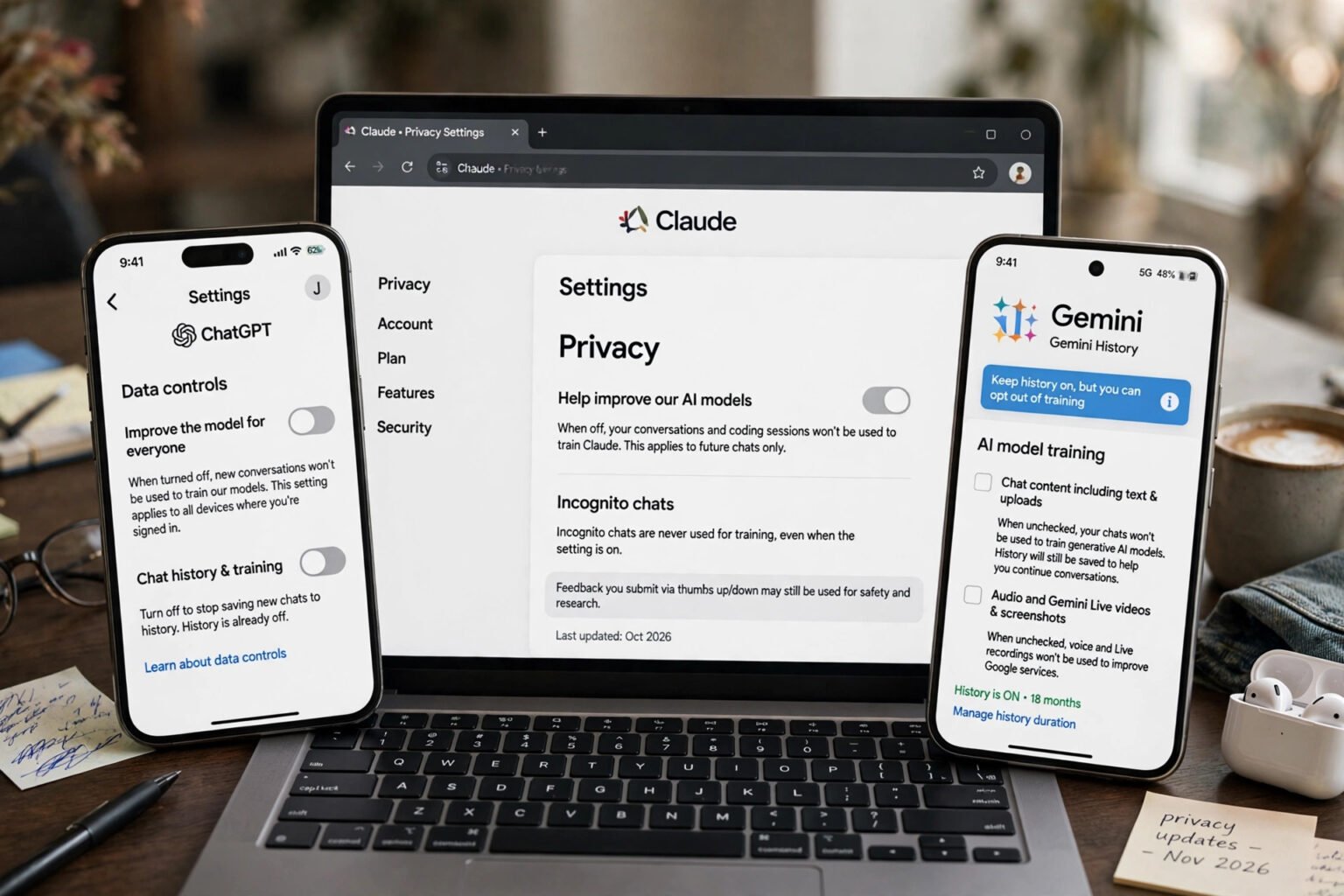
Quick Answer: Why Businesses Are Switching From ChatGPT to Claude in 2027?
Businesses are moving work from ChatGPT to Claude because procurement teams now treat AI models like any other vendor: they want predictable output quality, clear data-handling terms, and a model that follows long instructions without drifting. The shift shows up in three places: enterprise contracts, developer tooling, and internal review workflows where a second model checks the first.
That does not mean ChatGPT is being abandoned. Many organizations run both, routing sensitive drafting to one model and high-volume chat to another. The real decision is rarely “which model is best” but which combination survives an audit, a budget review, and a bad week of outputs.
Before committing, compare context limits, data retention terms, per-seat pricing, audit logging, integration depth, output consistency on your own test set, and vendor roadmap risk.
Why This Migration Talk Got Loud

Ask a room of operations leads what changed in their AI stack this year, and the honest answer is usually “less than the headlines suggest, but more than our lawyers expected.” The ChatGPT-to-Claude story is real, but it is not a story about one model suddenly becoming smarter. It is a story about procurement maturity.
In the early rush, teams picked a chatbot, liked the answers, and rolled it out. Two years later those same teams have audit requirements, a security questionnaire, a budget line, and a growing pile of outputs that nobody checked. That is the moment vendor loyalty gets tested. When a tool moves from “fun experiment” to “part of the workflow,” the questions change from “how good are the answers?” to “how consistently good are they, and who is accountable when they aren’t?”
Claude’s pitch lands well in that environment. It emphasizes long-document handling, instruction-following, and a safety-forward posture. Those are not glamorous features. They are exactly the features a risk committee asks about.
The Real Drivers Behind the Switch
Long documents stopped being a niche need
Contracts, policy manuals, research reports, and technical specs are long. A model that loses track of page nine by the time it reaches page forty is a liability, not an assistant. Teams doing document-heavy work consistently report that context handling is the single biggest reason they test alternatives. When a model can hold an entire filing in view, reviewers spend less time re-feeding context and more time judging the answer.
Instruction-following beats cleverness
Here is a pattern that shows up again and again in practice: a model that writes beautifully but ignores the format spec is worse than a duller model that follows the spec exactly. Businesses run on formats. A report must have a specific structure, a summary must be a specific length, a table must have specific columns. Teams that measure this carefully often find meaningful differences between vendors, which is why serious buyers now run structured comparisons rather than trusting demos. If you want a sense of how that evaluation is done, the breakdown of Claude vs ChatGPT output quality evaluation walks through the criteria buyers actually score.
Data handling became a board-level topic
Once AI touches customer data, legal gets involved. Questions about retention, training on customer inputs, and regional data residency move from the IT ticket queue to the executive meeting. Vendors that answer those questions clearly and in writing win deals. Vendors that answer vaguely lose them, regardless of benchmark scores.
Cost predictability
Per-seat pricing is easy to budget. Token-based pricing is not, especially when usage grows faster than headcount. Many teams now run a two-vendor setup precisely so they can shift volume between providers as pricing and rate limits change. That is less about ideology and more about leverage.
The second-opinion habit
Perhaps the most underrated driver: teams learned that one model grading its own work is a weak control. Using a second model as a reviewer catches errors the first model is blind to. This habit alone pushes many organizations to keep at least two vendors active, and it is why guides on judging output quality across Claude, Gemini and ChatGPT have become standard reading for teams building review pipelines.
Where Claude Wins and Where ChatGPT Still Holds
A balanced look matters here, because the migration is not universal and the reasons are not uniform.
| Dimension | Claude’s typical strength | ChatGPT’s typical strength |
|---|---|---|
| Long documents | Strong at holding large context and summarizing faithfully | Good, but teams often chunk documents manually |
| Instruction adherence | Consistent formatting and constraint-following | Creative and flexible, occasionally loose on format |
| Tone | Measured, cautious, good for policy and legal drafting | Conversational, good for marketing and brainstorming |
| Ecosystem | Growing integrations, strong developer tooling | Very broad plugin and app ecosystem |
| Enterprise controls | Clear documentation on data handling | Mature admin console and compliance features |
| Cost model | Predictable for document-heavy work | Attractive for high-volume conversational use |
The pattern is clear: Claude tends to win document-heavy, compliance-adjacent, format-strict work. ChatGPT tends to win breadth, creativity, and consumer familiarity. Most large organizations end up with both, and the “switch” is often a partial reallocation rather than a clean break.
What Actually Happens Inside a Company That Switches
The messy truth is that migrations are rarely announced. They happen quietly, one team at a time.
A typical sequence looks like this. A team hits a wall with output consistency. Someone tests an alternative on real work, not a demo prompt. The test goes well for a specific task. That task moves over. Then a second task moves. Six months later, finance notices the seat count on the old vendor has dropped by a third.
Common mistakes in that process are worth naming, because they cost real money:
- Testing with toy prompts. Demos flatter every model. Real work exposes weaknesses.
- Skipping the baseline. Teams switch without recording how the old model performed, so they cannot prove the new one is better.
- Ignoring prompt portability. Prompts tuned for one model often underperform on another. Budget time for re-tuning.
- Forgetting the humans. Reviewers need new guidance on what to trust and what to double-check.
- Switching everything at once. Phased moves preserve institutional knowledge and limit blast radius.
What works in practice is boring: define a scoring rubric, test on your own documents, run both models in parallel for a month, and keep the loser available for edge cases. Teams that do this rarely regret the move, whichever direction it goes. For a deeper look at how model families differ in practice, the comparison of Claude Opus, Sonnet and Haiku output quality is useful, since picking the wrong tier inside a family causes as many problems as picking the wrong vendor.
The Developer Angle
Engineering teams drive a large share of these decisions, and their reasoning is different from the business side. They care about API behavior, rate limits, tooling, and how well a model behaves inside an editor or agent loop.
This is where the switching conversation gets concrete. Coding assistants built on different models behave differently on refactors, test generation, and multi-file changes. Teams evaluating them tend to compare not just raw code quality but how often the assistant needs correction, which is the metric that actually affects delivery speed. Comparisons like Claude Code vs GitHub Copilot output quality reflect that shift toward workflow-level judgment rather than single-prompt benchmarks.
The same logic applies to agentic tools. When a tool runs for twenty minutes and touches a dozen files, the cost of a wrong turn is high, and reviewers start caring about restraint as much as capability. That is a meaningful change in how models get judged, and it shows up in head-to-head reviews such as Amp vs Claude Code vs Cursor output quality.
How to Run the Switch Without Regret
If a team is seriously considering a move, a disciplined process beats enthusiasm every time.
- Pick three real tasks that represent your highest-volume work. Not the flashiest use case, the most common one.
- Write a rubric with five to seven criteria and a simple scoring scale. Include at least one criterion about format compliance.
- Run both models blind. Strip identifying details from outputs before reviewers score them.
- Measure the correction rate. How many edits does a human make before the output is usable? This single number predicts cost better than any benchmark.
- Check the boring stuff. Data retention, audit logs, admin controls, regional hosting, contract terms.
- Pilot with one team for a month, then decide on expansion.
- Keep a fallback. Never let a single vendor become a single point of failure for a critical workflow.
The teams that get this right treat model selection as an ongoing evaluation, not a one-time purchase. They re-run their rubric every quarter, because the products change and so does the work.
What to Watch Going Forward
Three things will shape this story more than any single model release.
First, evaluation standards. As more organizations publish internal rubrics, the conversation shifts from vibes to measurable criteria. That favors vendors with consistent behavior over vendors with flashy demos.
Second, regulatory clarity. Rules around AI use in sensitive sectors will push buyers toward vendors that can document their practices clearly. Vague answers will become a sales problem.
Third, cost pressure. As usage scales, the difference between a cheap model and an expensive one becomes a budget line someone has to defend. Expect more volume-shifting between vendors and more multi-model architectures.
The honest summary is that the ChatGPT-to-Claude migration is less a stampede and more a rebalancing. Businesses are not falling out of love with ChatGPT. They are growing up about how they buy, test, and govern AI, and that maturity naturally produces a more diversified stack.
Conclusion
The switch from ChatGPT to Claude in 2027 is best understood as a symptom rather than a trend in itself. Businesses are not chasing a better chatbot. They are applying procurement discipline to a tool that has become operationally important, and that discipline rewards predictable output, clear data terms, and strong performance on long, format-strict documents. Claude benefits from that shift, but so does every vendor that takes enterprise requirements seriously.
For teams weighing the move, the practical advice is unglamorous: test on your own work, score blind, measure correction rates, pilot with one team, and keep a second vendor available. Do that, and the choice of model becomes a manageable decision instead of a bet. Skip it, and you will end up migrating again in eighteen months, with no better evidence than the last time.
FAQ
Is Claude actually better than ChatGPT for business use?
Neither is universally better. Claude tends to perform well on long documents, strict formatting, and cautious drafting, which suits legal, policy, and research work. ChatGPT tends to be stronger for brainstorming, marketing copy, and broad ecosystem integrations. Most organizations get the best results by matching the model to the task rather than standardizing on one.
How long does a typical migration take?
A single team can pilot a switch in two to four weeks. A company-wide move usually takes three to six months, mostly because of security review, contract negotiation, prompt re-tuning, and retraining reviewers. Phased rollouts consistently produce fewer problems than big-bang cutovers.
Do we have to choose one vendor?
No, and many organizations do not. Running two vendors gives you a fallback if one has an outage, leverage in pricing talks, and a built-in second opinion for quality review. The tradeoff is more administrative overhead, so it works best when at least one team owns the evaluation process.
What should we measure before switching?
Measure correction rate first: how many human edits an output needs before it is usable. Then track format compliance, factual accuracy on your own documents, time saved per task, and cost per completed task. Benchmarks from public leaderboards are useful context but rarely predict performance on your specific work.
How do we handle data security concerns?
Ask each vendor in writing about retention periods, whether customer inputs are used for training, where data is stored, and what audit logs are available. Get the answers into the contract, not just the sales deck. Then verify that your internal access controls match what the vendor offers.
Will switching break our existing prompts and workflows?
Often, yes, at least partially. Prompts tuned for one model frequently underperform on another because the models respond differently to phrasing, structure, and length. Budget time to re-test and re-tune your most important prompts, and keep the old versions documented so you can compare results.