

Walk into any appliance showroom and you’ll see them lined up like a matched family: fridge, range, dishwasher, and microwave all wearing the same brushed steel finish and the same handle shape. It looks effortless. So why do so many people who buy a matching kitchen appliance set end up frustrated six months later?
The answer is usually that they shopped for a look instead of a system. A kitchen appliance set is a bundle of machines that share a finish and a design language, but each machine inside that bundle has its own energy rules, its own dimensions, and its own repair story. Understanding those parts is what separates a set that feels smart for a decade from one that quietly annoys you every single day.
What a Kitchen Appliance Set Really Is
Here is the first thing worth knowing: a kitchen appliance set is a retail concept, not an engineering one. Manufacturers group products into “collections” or “suites” so the handles line up and the finishes match. There is no international standard that defines what belongs in a set, and no rule that says the fridge and the oven have to come from the same brand to work together.
That matters because the marketing around sets is strong. Brands sell the idea of a unified kitchen, and it is genuinely appealing. But the moment you treat a set as a single product, you stop asking the questions that matter per appliance: How much energy does this use? Will it fit my cabinet opening? Can I get it repaired in seven years?
A set is really a shopping shortcut. It saves you from mixing finishes and handle styles. It does not save you from doing the homework on each machine.
The Four Appliances Most Sets Include
Most bundles follow a predictable pattern:
- Refrigerator – the biggest energy user in most kitchens.
- Range or cooktop plus oven – the machine with the most safety and ventilation considerations.
- Dishwasher – the appliance most affected by water hardness and loading habits.
- Microwave or over-the-range unit – often the cheapest item and the easiest to mismatch on mounting.
Some sets add a range hood, a wine cooler, or a warming drawer. The more items in the bundle, the more likely one of them is a compromise. (Bose headphones actually sets them apart real use)
Matching Looks Versus Matching Performance
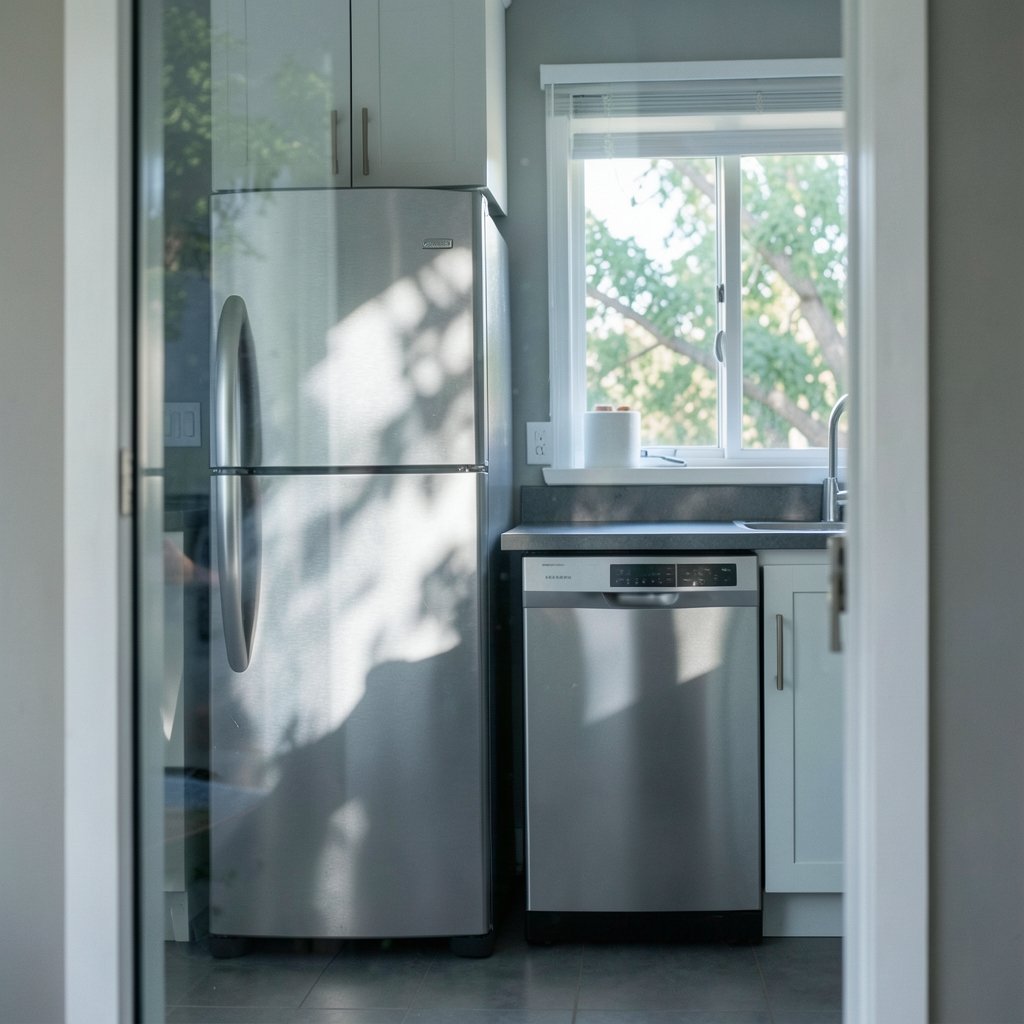
A set that looks unified but performs unevenly is a common outcome. The fridge might be excellent, the dishwasher average, and the microwave an afterthought. That is normal, because brands are rarely equally strong across every category.
A practical approach is to rank the four appliances by how much they affect your daily life, then protect the top two. For most households the order looks like this:
| Priority | Appliance | Why it matters most |
|---|---|---|
| 1 | Refrigerator | Runs 24/7, biggest energy draw, hardest to replace |
| 2 | Range or cooktop | Core cooking tool, hardest to swap without cabinetry work |
| 3 | Dishwasher | Daily convenience, repairable, moderate energy use |
| 4 | Microwave | Cheap to replace, easy to match later |
If the fridge and range come from one brand and the dishwasher and microwave come from another, almost nobody will notice. Finishes across brands have converged enough that a brushed stainless fridge and a brushed stainless dishwasher from different makers often read as a matched pair, especially if the handle profiles are similar.
Common mistake: buying the whole set on a single showroom visit because the floor model looked cohesive. Floor lighting flatters everything, and the display units are usually the top trim level, not the mid-range model most people actually buy.
Read the Energy Label Like It’s the Spec Sheet
Energy labels are where sets quietly differ, and where a lot of money is won or lost over ten years.
In the EU, the old A+++ to D scale was replaced by a simpler A to G scale under Regulation (EU) 2017/1369, which also created the EPREL product database. Dishwashers, washing machines, and refrigerators were among the first categories rescaled in 2021. Ovens and hobs were not part of that first wave, which is why you can still see older-style labels on cooking appliances in some shops. The practical takeaway: an “A” on a fridge label today is not the same as an “A” from 2018. Compare within the current scale, not across years.
In the US, the yellow EnergyGuide label shows estimated yearly energy use or cost for major appliances. It is a comparison tool, not a guarantee. Energy Star is a separate voluntary certification programme with criteria set per product category and updated periodically, so a model that qualified three years ago may not qualify today.
Two habits that pay off:
- Compare the annual kWh figure, not the letter grade, when two models sit in the same class.
- Check the standby power story. EU rules on standby and off-mode consumption, tightened by Regulation (EU) 2023/826 for networked standby from May 2025, mean a “smart” appliance that stays connected can still be designed to sip power rather than gulp it. Ask whether the network connection can be switched off.
Dimensions, Cabinetry, and the Fit Problem
Nothing derails a kitchen appliance set faster than a fridge that does not fit the opening. Dimensions are not harmonised globally. Much of Europe works around 600 mm cabinet widths; the US commonly uses 24-inch and 30-inch appliance widths. Built-in appliances follow regional conventions rather than one worldwide standard, so a set bought in one market will not necessarily slot into cabinets built for another. (Led strip diffuser kitchen cabinets fix dots glare hotspots)
Before ordering anything, measure and write down:
- The finished opening width, height, and depth, not the cabinet box size.
- Door swing clearance and whether doors can be reversed.
- Ventilation gaps required around the fridge and range.
- The path from the front door to the kitchen, including stair turns and doorway widths.
That last one sounds silly until a fridge gets stuck in a hallway. Delivery teams deal with it constantly, and some retailers charge for a failed delivery.
If the kitchen is small, the set decision gets harder, because every millimetre counts and full-size matching suites often will not fit. Practical, budget-conscious upgrades tend to beat big matching bundles in tight spaces, and the same logic applies to lighting and layout choices that make a compact kitchen feel intentional rather than cramped. (Small kitchen remodeling ideas budget smart upgrades that)
Smart Features: Useful, Gimmicky, or Somewhere Between
Connected appliances are the newest front in set marketing. A fridge with a screen, an oven you can preheat from a phone, a dishwasher that messages you when the salt runs low.
The honest assessment: some of it is genuinely useful, and some of it is a subscription waiting to happen. Before paying a premium for connectivity, ask three questions:
- Does it work without the app? Every core function should be usable with the Wi-Fi off.
- What happens when the app is discontinued? Smart features have a shorter lifespan than the machine.
- Does it add standby load? Networked standby is regulated in the EU, but a connected appliance still uses more at rest than an unconnected one.
A useful rule of thumb: buy smart features for the appliance’s main job, not as a substitute for it. A fridge that cools evenly and holds temperature matters more than one that suggests recipes.
Repair, Warranty, and the Long Game
A kitchen appliance set is a ten-year relationship, and the terms of that relationship are set before you buy.
In the EU, consumer goods carry a minimum two-year legal guarantee under the Sale of Goods Directive (EU) 2019/771. That is a legal floor, not a favour from the retailer. Separately, Directive (EU) 2024/1799 on promoting the repair of goods was adopted in 2024, with member states required to transpose it by 31 July 2026. It pushes toward repair over replacement for certain products, which should gradually make spare parts and repair information easier to obtain.
In the US, there is no general federal minimum warranty; coverage is contractual, and manufacturer warranties vary widely. Several states have enacted right-to-repair laws, and the coverage is still changing, so check your state’s current status rather than assuming.
Extended warranties deserve skepticism. They often cost 10 to 20 percent of the appliance price and overlap with the manufacturer’s warranty period. Before buying one, check what the legal guarantee or manufacturer warranty already covers and how long spare parts are promised.
Buying a Set Without Regret: A Practical Sequence
This order of operations works for most households:
- Measure the space and note every opening, including the fridge alcove.
- Set a budget per appliance, not one lump sum. Bundles hide weak links.
- Pick the fridge and range first, since they are the hardest to change later.
- Compare energy figures across the shortlist using the current label scale.
- Check repair terms and spare-part availability for each model.
- Match finishes last, choosing from what survived the first five steps.
- Confirm delivery access before you pay.
That sequence flips the usual showroom experience, where the finish comes first. It also tends to produce sets that look just as cohesive, because finishes are the easiest thing to align at the end.
Where Sets Make Sense and Where They Don’t
Sets make the most sense in new builds and full renovations, where you are choosing cabinetry and appliances together and can plan ventilation, power, and clearances around the bundle. They also work well when a household wants a fast, low-decision purchase and is willing to accept mid-range performance across the board.
They make less sense in partial replacements. If only the dishwasher has failed, forcing a new fridge and microwave into the purchase to keep the set intact is rarely good value. A single well-chosen appliance that matches closely enough is usually the smarter move.
They also make less sense for serious cooks, who tend to have strong opinions about one or two appliances and should buy those on merit, then fill in around them.
Conclusion
A kitchen appliance set is a design decision dressed up as a single purchase. The finish is the easy part. The parts that actually shape your next decade are the energy figures on the label, the millimetres of your cabinet openings, and the repair terms buried in the paperwork.
Buy the set if it simplifies your renovation and the individual machines hold up on their own merits. Skip it if matching handles are the only thing holding the bundle together. Either way, the household that measures first, reads the label second, and picks the finish last tends to end up with a kitchen that looks unified and works like it too.
Frequently Asked Questions
Do all appliances in a kitchen set have to be the same brand?
No. There is no technical requirement, and no standard that defines a set. Mixing brands is common and usually invisible once installed, as long as the finishes and handle profiles are close. Many households buy the fridge and range from one maker and fill in the dishwasher and microwave from another.
Is a matching appliance set cheaper than buying separately?
Sometimes, but not reliably. Bundle pricing often applies to mid-range models and can hide a weak appliance in the group. Compare the per-model price against the same appliance bought alone, and check whether the bundled models are the trim level you actually want rather than a stripped-down version.
How do I compare energy use across a set?
Use the current label scale in your market and compare the annual consumption figure rather than the letter grade alone. In the EU, the A to G scale replaced the older A+++ system for several categories from 2021, so grades from different years are not directly comparable. In the US, the EnergyGuide label gives an estimated yearly cost.
Can I replace one appliance later without breaking the look?
Usually yes. Finishes have converged across brands, and a close match is often good enough, especially for appliances placed apart from each other. Measure the opening before ordering, and keep a note of the original model numbers and finish names so you can search for a close match years later.
Do smart appliances in a set cost more to run?
They can use slightly more power at rest because of networked standby, though EU rules now cap that consumption for many product types. The bigger risk is functional: if the companion app is discontinued, the smart features may stop working. Check that every core function works with the connection switched off.
What warranty protection should I expect with a set?
In the EU, a minimum two-year legal guarantee applies to consumer goods, and repair rights are being strengthened under rules member states must transpose by 31 July 2026. In the US, protection comes from the manufacturer’s warranty, which varies by brand and product, so read the terms per appliance rather than assuming the set shares one policy.



