

What if the hardest part of buying a new kitchen isn’t choosing the fridge, but figuring out why four appliances sold together cost less than the same four bought one at a time?
That question sits at the heart of the 4 piece kitchen appliance package, a retail concept that has quietly become the default way Americans buy kitchens. Bundles promise savings, matched finishes, and one delivery truck instead of four. But a package is not a product. It is a marketing wrapper around four separate machines, each with its own warranty, its own installation quirks, and its own fine print. Understanding what is actually inside the wrapper is the difference between a smart purchase and a headache that arrives on a pallet.
What a 4 Piece Kitchen Appliance Package Really Means
There is no formal industry definition of a “4 piece kitchen appliance package.” No standards body governs it, no regulation defines it, and no two retailers necessarily agree on the contents. The term is a retail and marketing convention, which means the shopper has to read the list rather than trust the label.
In U.S. retail practice, the four pieces most often include:
| Piece | Typical Role in the Bundle |
|---|---|
| Refrigerator | The anchor appliance, often the largest share of the price |
| Range or cooktop plus wall oven | The cooking center; freestanding ranges dominate bundles |
| Over-the-range or countertop microwave | The fourth piece, chosen to fit the range hood space |
| Dishwasher | Usually 24 inches wide in North America, tucked under the counter |
The microwave is the piece that varies most. Over-the-range microwaves are the common fourth item in U.S. bundles because they slot into the space above the range and double as a vent hood. Countertop microwaves are cheaper but usually are not built-in, and they often do not match the finish or trim of the rest of the package. A shopper who assumes “microwave” means the built-in look may be disappointed at delivery.
Why Bundles Exist, and Where the Savings Come From
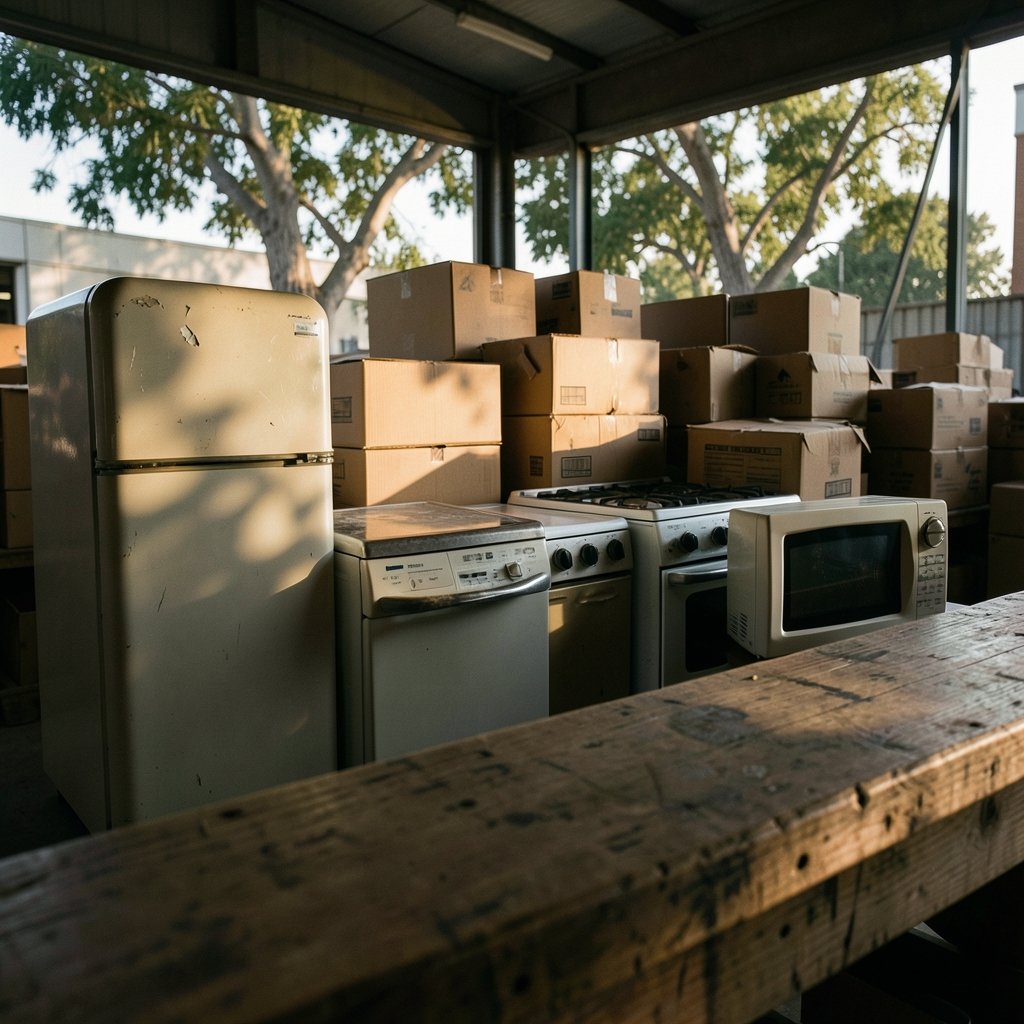
Appliance packages are not charity. They are a volume strategy. A retailer that sells four machines to one household books a bigger sale, spends less on marketing per unit, and moves inventory that might otherwise sit in a warehouse. Manufacturers benefit too, because a matched suite locks a buyer into one brand’s finish family, which makes future replacement purchases more likely to stay in the family.
The savings are real but uneven. Discounts tend to be deepest on the pieces with the fattest margins, and shallowest on the refrigerator, which is often priced close to cost to get shoppers in the door. That is why comparing a bundle price to the sum of its parts is worth the effort. Sometimes the package is genuinely cheaper. Sometimes the “savings” come from substituting a lower-tier microwave or a smaller dishwasher than the shopper would have chosen alone.
There is a second, quieter source of value: finish matching. Buying four pieces from one brand in one finish family means the stainless steel grain, the handle style, and the control panel typography actually agree. Mismatched finishes are one of the most common regrets in kitchen updates, and a package solves that problem by default.
The Efficiency Question: Labels, Standards, and What They Tell You
Efficiency is where appliance shopping gets genuinely technical, and where a little knowledge pays off.
In the United States, the Energy Star program, run jointly by the EPA and the Department of Energy, is the main public benchmark. It sets specifications for refrigerators, dishwashers, and microwaves. Cooking products such as ranges, cooktops, and ovens generally do not carry Energy Star ratings, because cooking energy use is hard to standardize across households and recipes. That asymmetry matters: a package can advertise “Energy Star certified” while two of its four pieces were never eligible in the first place.
Separately, the FTC EnergyGuide label is mandatory on many major appliances sold in the U.S. under the Appliance Labeling Rule, 16 CFR Part 305. That is the yellow label showing estimated annual energy use and cost. It appears on refrigerators, dishwashers, and similar covered products, and it is the single most useful piece of paper in the showroom. Federal minimum efficiency standards, set by the DOE under the Energy Policy and Conservation Act, sit underneath all of this as a floor.
In the European Union, the picture changed on 1 March 2021, when the energy label for dishwashers, refrigerators, washing machines, and similar products returned to a simple A–G scale. The old A+/A++/A+++ grades were retired, and measurement methods got stricter. A shopper comparing an older listing to a newer one may see what looks like a downgrade in rating that is really just a rescaling.
The practical takeaway: read the EnergyGuide numbers, do not just look for the star logo. A package where the fridge is genuinely efficient and the dishwasher is merely average may still be a better buy than one where every box wears a badge but the annual kilowatt-hour figures are mediocre.
Sizing: The Mistake That Sinks More Packages Than Anything Else
The most common failure in appliance packages is not brand, price, or finish. It is measurement.
Appliance widths follow conventions rather than universal standards, and those conventions differ by market. In North America, freestanding ranges are commonly 30 inches wide, dishwashers 24 inches, and refrigerators typically 30 to 36 inches. In Europe, 60 centimeters is the common module. These are habits, not laws, and a package built for one market will not necessarily fit a kitchen built for another.
The measurement mistakes that show up again and again:
- Measuring the old appliance instead of the opening. Cabinets settle, trim gets added, and the gap is rarely the same as the machine that came out.
- Forgetting the door swing. A fridge that fits the cavity can still block a walkway or fail to open past a wall.
- Ignoring the delivery path. A 36-inch refrigerator has to pass through doorways, hallways, and stair turns before it ever reaches the kitchen.
- Skipping the clearance spec. Ranges and refrigerators need breathing room for ventilation, and built-in microwaves need trim kit dimensions, not just cabinet dimensions.
The fix is boring and effective: measure the opening at three points (top, middle, bottom), write the numbers down, and check them against the manufacturer’s spec sheet rather than the retailer’s summary. If a kitchen is small enough that every inch matters, the same discipline that guides small kitchen remodeling ideas with budget-smart upgrades applies directly to appliance selection.
Installation, Delivery, and the Costs Bundles Leave Out
A package price is rarely the final price. Delivery, installation, and haul-away of old appliances are frequently excluded or priced separately, and the exclusions are where budgets quietly break.
Gas range installation and any hardwired connection typically require licensed trades, which adds cost and scheduling. Dishwashers need a water line, a drain, and often a new supply hose. Over-the-range microwaves need mounting hardware and, in many cases, ductwork or a recirculating filter setup. None of this is exotic, but all of it is billable.
A sensible pre-purchase checklist:
- Ask what the delivery includes: threshold drop, room of choice, or full install.
- Confirm whether haul-away is free, fee-based, or unavailable in the area.
- Ask who supplies the connection kit, cord, and hoses.
- Get the installation window in writing, especially for gas.
- Confirm the return window and whether returns require the original packaging.
One more caution: a package is usually a sum of separately warranted items, not a single warranty. Each appliance typically carries its own manufacturer warranty, commonly one year parts and labor in the U.S., and bundle discounts do not usually extend those terms. Keeping four warranty documents organized sounds trivial until the ice maker fails in month fourteen.
Rebates, Incentives, and the Fine Print Worth Reading
Efficient appliances can qualify for utility rebates, and since the Inflation Reduction Act of 2022, state-administered home electrification and appliance rebate programs have rolled out gradually across the country. Availability varies enormously by state and by year, so the only reliable approach is to check the current program status before purchase rather than relying on what a neighbor qualified for last spring.
The fine print that deserves a slow read:
- Delivery damage policy. Who is responsible if the fridge arrives dented, and how long does the buyer have to report it?
- Finish warranty versus mechanical warranty. Cosmetic coverage is often shorter or excluded.
- Bundle substitution rules. If one piece is out of stock, can it be swapped, and does the discount survive?
- Price-match terms. Many retailers exclude bundle pricing from price-match guarantees.
Matching a Package to How the Kitchen Actually Works
The best package is not the one with the most features. It is the one that fits the cooking habits of the household.
A household that cooks rarely and reheats often gets more value from a strong microwave and a quiet dishwasher than from a high-output range. A household that bakes weekly will regret a package whose oven runs small. A household with a dark kitchen corner may care more about lighting than about the range, which is why LED strip diffusers for kitchen cabinets that fix dots, glare, and hotspots become part of the same conversation. And anyone who has ever stood in front of a recipe card mid-cook knows that unit conversions cause real errors, whether it is how many tablespoons are in a cup or how many teaspoons make a tablespoon. A kitchen that works is a system, and the appliances are only part of it.
Common Mistakes That Turn a Good Deal Into a Bad One
The pattern repeats often enough to be predictable. Shoppers buy on the headline price and discover the rest later.
The most frequent errors include choosing a package before measuring the openings, assuming all four pieces carry the same warranty length, skipping the EnergyGuide numbers because the Energy Star logo looked reassuring, forgetting that a countertop microwave will not match a built-in suite, and buying a package with a delivery date that lands before the cabinets are actually installed. That last one is more common than it sounds, and appliances that sit in a garage for six weeks can fall outside a return window before they are ever plugged in.
A less obvious mistake is buying the package all at once when the kitchen is being renovated in stages. Sometimes it makes more sense to buy the anchor pieces first and the microwave later, once the final cabinet layout is confirmed.
Conclusion
A 4 piece kitchen appliance package is a convenience, not a category. It bundles four separate machines under one price tag, and the value of that bundle depends entirely on whether the pieces fit the kitchen, the cooking habits, and the fine print. The shopper who measures carefully, reads the EnergyGuide numbers, asks what delivery actually includes, and keeps four warranty documents in one folder will almost always come out ahead of the shopper who buys on the headline discount. The package is the starting point. The diligence is what makes it a good deal.
Frequently Asked Questions
What usually comes in a 4 piece kitchen appliance package?
Most U.S. bundles include a refrigerator, a range or cooktop-and-oven combination, an over-the-range or countertop microwave, and a dishwasher. The microwave is the piece that varies most between retailers, and countertop models often do not match the finish of the rest of the suite. Always read the itemized list rather than trusting the package name.
Is a 4 piece package actually cheaper than buying separately?
Often, but not always. Bundle discounts tend to be deepest on higher-margin pieces and shallowest on refrigerators, which are frequently priced near cost. Comparing the package price against the sum of the four individual prices, using the exact model numbers, is the only reliable way to know whether the savings are real.
Do all four appliances carry the same warranty?
No. Each appliance typically carries its own manufacturer warranty, commonly one year parts and labor in the U.S., and bundle discounts usually do not extend those terms. Cosmetic or finish coverage is often shorter than mechanical coverage, so it is worth confirming each piece individually before purchase.
Does an Energy Star logo on the package mean all four pieces are certified?
Not necessarily. Energy Star sets specifications for refrigerators, dishwashers, and microwaves, but cooking products such as ranges, cooktops, and ovens generally do not carry ratings because cooking energy use is difficult to standardize. Check the yellow EnergyGuide label on each covered appliance for the actual estimated annual energy use and cost.
What should be measured before ordering a package?
Measure each appliance opening at the top, middle, and bottom, then check those numbers against the manufacturer’s spec sheet rather than the retailer’s summary. Also account for door swing, ventilation clearance, and the delivery path through doorways and stair turns. Common North American widths are 30 inches for ranges, 24 inches for dishwashers, and 30 to 36 inches for refrigerators, but these are conventions rather than standards.
Does delivery include installation and haul-away?
Frequently not. Delivery, installation, and removal of old appliances are often excluded or priced separately, and gas range or hardwired connections typically require licensed trades. Ask specifically what the delivery tier covers, who supplies connection kits and hoses, and whether haul-away carries a fee before committing to the order.



