
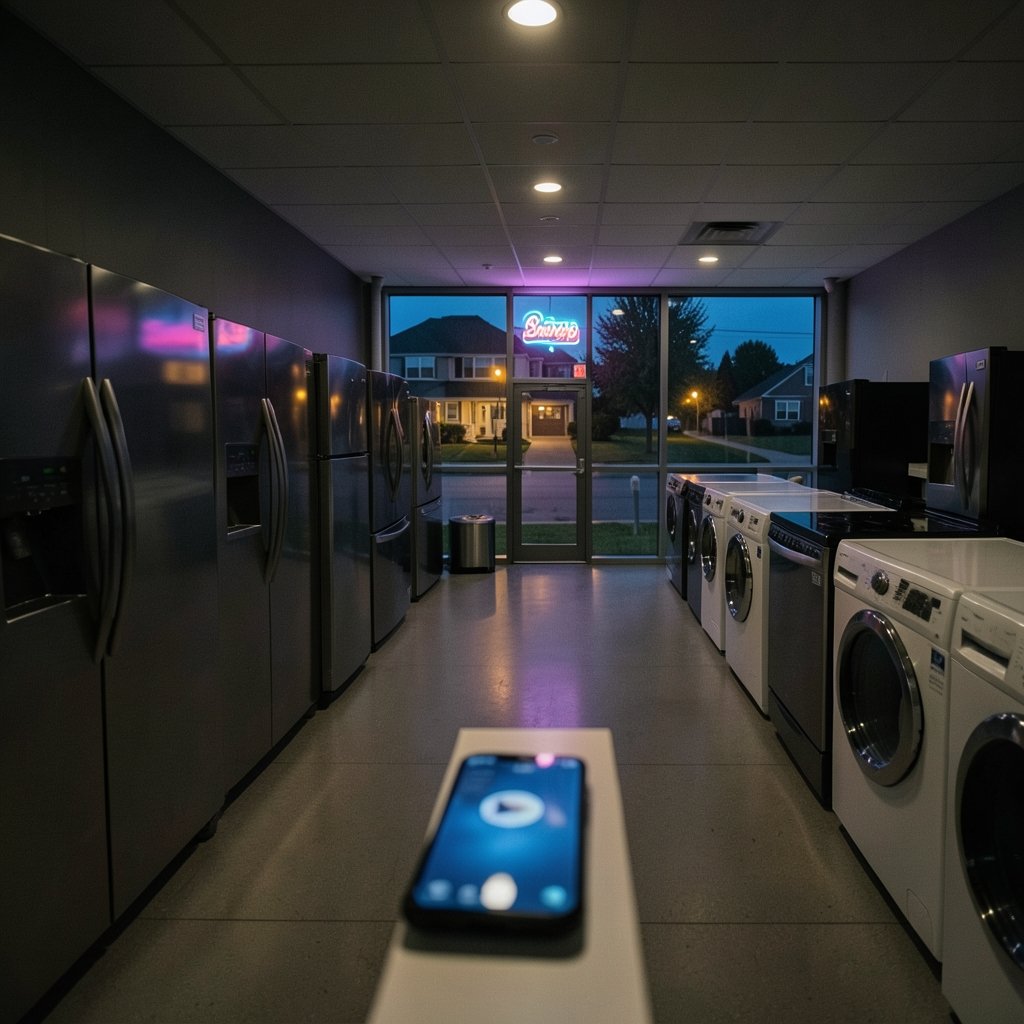
What happens when your refrigerator dies on a Tuesday night and the nearest appliance store is a mystery? Most people grab their phone, type “appliance stores near me within 5 mi,” and hope for the best. That search feels simple, but what comes back is a mix of big-box chains, small independent dealers, and listings that may or may not actually be five miles away.
The good news is that finding a nearby appliance store is easier than it used to be, as long as you know what the search is really doing and what to check before you drive over. This guide walks through how local search works, how to compare stores fairly, and the mistakes that cost shoppers time and money.
What “Within 5 Mi” Actually Means in a Search
Here is a detail that surprises a lot of shoppers: there is no official five-mile default for “near me” searches. Neither Google nor the major map apps publish a fixed radius that kicks in when you type those words. The distance is usually set by you, through a filter in the app, or by the app’s own guess about what counts as close.
That matters because two people on the same street can get different results. Search engines treat “near me” as a proximity signal and blend it with other factors. Local ranking guidance describes three broad ingredients: relevance (does the store match what you typed), distance (how far it is from the spot the search thinks you are), and prominence (how well known and well reviewed the business is). The exact weighting is not public, and it changes.
So when a store shows up in your results, it is not a guarantee that it sits inside five miles. It is a suggestion that the store is relevant and reasonably close. The only way to confirm distance is to check the address and measure it yourself, or use the map’s distance filter.
Why your location settings matter
If your phone’s location services are off, or your browser is using an old home address, your results can be way off. A quick fix: open your map app, confirm the blue dot is where you actually are, then search again. Many people blame the search engine when the real problem is a stale location setting.
How to Run a Smarter Local Search

The search box rewards specificity. A vague query returns a vague list. A few small tweaks make a real difference.
- Add a category to the word “store.” Try “appliance store,” “refrigerator dealer,” or “washer and dryer shop.” Each pulls a slightly different set of listings.
- Use the map’s distance filter. In most map apps you can set a radius, then pan around to see what falls inside it. This is the closest thing to a true five-mile search.
- Check the hours on the listing, then call. Hours get edited and sometimes go stale, especially around holidays. A 30-second call saves a wasted trip.
- Read the recent reviews, not the star average. A 4.2-star store with detailed recent reviews tells you more than a 4.8-star store with three reviews from years ago.
- Search for the specific brand if you have one in mind. Authorized dealers for a particular brand often do not rank for the generic term.
If you enjoy the hunt for a good local find, the same skills carry over to other errands, like tracking down the best thrift stores near me or finding takeout food near me when you want good food fast. Local search is local search.
The Main Types of Appliance Stores You Will Find
Within a five-mile radius, most people see a mix of three store types. Each has trade-offs.
| Store type | Typical strengths | Typical weak spots |
|---|---|---|
| Big-box chains | Wide inventory, price matching, easy returns, delivery scheduling | Busy floors, limited product depth per brand, installation subcontracted |
| Independent dealers | Brand expertise, personal service, flexibility on delivery, repairs | Smaller showrooms, fewer units in stock, hours can be shorter |
| Specialty and scratch-and-dent shops | Deep discounts, open-box and dented units, bargaining | Limited selection, final-sale policies, warranty terms vary |
Independent appliance dealers often band together through buying groups so they can compete on price with the chains. That structure is worth knowing about, because it explains why a small shop sometimes quotes a number that matches a big-box sale price.
There is also a structural point worth keeping in mind: household appliance retail is a recognized industry category in official government data, which means you can look up how many such stores operate in your area if you are curious about local competition. It will not tell you which store is good, but it does confirm that appliance retail is a real, tracked sector rather than a scattering of random shops.
What to Compare Before You Buy
Once you have three or four candidates, compare them on the same set of questions. This is where most shoppers get sloppy, and where the money is won or lost.
Delivery and installation
Ask three things: what the delivery fee is, whether installation is included or extra, and who hauls away the old unit. Delivery terms vary a lot by retailer, and they are one of the most common sources of consumer complaints. Get the total in writing before you pay.
The energy label
Most new appliances carry a yellow EnergyGuide label showing estimated annual energy use or cost. It is required on many categories, including refrigerators, washers, and dryers. Read it. Two models that look identical on the showroom floor can differ by a meaningful amount over ten years.
Separately, the ENERGY STAR mark is a voluntary program that began in 1992 and flags products meeting efficiency criteria. It is not the same as the EnergyGuide label. One is mandatory disclosure, the other is a certification.
Warranty terms
Written warranties on consumer products are governed by federal disclosure rules under the Magnuson–Moss Warranty Act, enacted in 1975. In plain terms, the written warranty has to tell you what is covered, for how long, and what the seller will do about it. Ask for the warranty document before purchase, not after. A store that hesitates to show it is telling you something.
Return policy
Return windows on large appliances are often shorter than people expect, and restocking fees are common. Ask specifically: how many days, what condition must the unit be in, and who pays for return shipping.
Price matching
Chains often match competitors, but the fine print usually requires the same model number, in stock, from an authorized dealer. Independent shops may match too, especially if you ask directly. It never hurts to ask.
Mistakes That Cost Shoppers Time and Money
A few patterns show up again and again.
Measuring after buying. The single most common expensive mistake is not measuring the doorway, the stairwell, and the alcove before purchase. A refrigerator that fits the kitchen but not the hall is a problem no delivery crew can solve. Measure twice, write the numbers down, and bring the tape measure to the store.
Skipping the model number. Two units with similar names can be different builds made for different retailers. Note the exact model number on the floor tag and confirm the delivered unit matches.
Trusting a listing’s hours. Call ahead. Store hours on aggregator sites drift out of date.
Ignoring the repair question. Ask who services the unit locally and how long a typical repair takes. A store with an in-house service team is often worth a small price premium.
Forgetting the old unit. Removal is sometimes free, sometimes a fee, sometimes not offered. Confirm before the truck arrives.
When a Nearby Store Beats Shopping Online
Online shopping wins on selection and often on price. But local stores win in situations that matter more than people expect.
If you need the appliance this week, a store within a few miles can often deliver faster than a warehouse. If the unit arrives damaged, a local store is a physical place you can walk into. If you want to see the finish, feel the door weight, and check whether the ice maker is where you want it, a showroom still does that better than a product photo.
There is also the service relationship. Appliances break. When they do, a dealer who knows your name tends to pick up the phone. That is not a small thing at 9 p.m. on a Sunday.
For shoppers who like comparing options before committing, the same logic applies to retail categories well beyond appliances. The tools that help small stores convert browsers into buyers are evolving fast, and a look at how AI tools are reshaping e-commerce store conversions shows why even local shops now invest in better online listings. A store with accurate hours, real photos, and current inventory online is easier to trust before you drive over. The same principle explains why shoppers care about who owns Aldi grocery stores when they want to understand a retailer’s service model. Ownership and structure shape how a store treats you after the sale.
A Practical Checklist for the Day You Shop
Bring this with you, or keep it on your phone.
- Exact measurements: width, height, depth, plus doorway and stairwell clearance
- The old unit’s model and age, in case trade-in or removal applies
- Photos of the installation space, including outlets and water lines
- A list of must-have features versus nice-to-have
- Your delivery window and whether you need haul-away
- The warranty document, requested in writing
- The return policy, in writing
- The exact model number you are buying
That list takes ten minutes to assemble and prevents most of the headaches people describe after an appliance purchase.
Conclusion
Searching for appliance stores near me within 5 mi is really two tasks in one: finding candidates and then vetting them properly. The search engine will hand you a starting list, but the five-mile radius is yours to set, and the ranking is a blend of relevance, distance, and reputation rather than a strict measurement. Treat the results as leads, not answers.
From there, the work is ordinary and effective. Confirm the address, call about hours, compare delivery and installation terms, read the energy label, ask for the warranty in writing, and measure your space before you fall in love with a finish. Big-box chains, independent dealers, and scratch-and-dent shops each have a role, and the right pick depends on whether you value speed, price, or a service relationship.
Do those things and the search stops being a gamble. You end up with a working appliance, a fair price, and a store you would actually call again.
FAQ
How do I find appliance stores within exactly 5 miles?
Use a map app rather than a plain search box. Set the distance filter to five miles, confirm your location dot is accurate, then pan around the map to see which stores fall inside the circle. A standard “near me” search does not guarantee a five-mile radius, so verify each store’s address yourself.
Why do my “near me” results show stores farther than five miles?
Local results blend relevance, distance, and prominence, and the exact weighting is not public. A well-reviewed store slightly outside your radius can outrank a closer, less relevant one. Your device location may also be stale, which shifts the results. Check your location settings first, then confirm distances manually.
Is it better to buy appliances from a big-box store or a local dealer?
It depends on your priorities. Big-box chains offer wide inventory, easy returns, and price matching. Independent dealers often provide deeper brand knowledge, more flexible delivery, and in-house service. For a fast replacement or a complex installation, a local dealer is frequently the smoother experience.
What should I check before buying a large appliance?
Measure your doorway, stairwell, and installation space first. Then confirm the delivery fee, whether installation is included, who removes the old unit, the exact model number, the written warranty, and the return window. Read the yellow EnergyGuide label for estimated annual energy use.
Do appliance stores have to show an energy label?
Many new appliances must carry the yellow EnergyGuide label showing estimated annual energy use or cost, including categories like refrigerators, washers, and dryers. The ENERGY STAR mark is separate and voluntary. If you do not see the label, ask for it.
How long do I have to return a large appliance?
Return windows vary widely by store and are often shorter than shoppers expect, and restocking fees are common on large items. Ask for the policy in writing before purchase, including the condition requirements and who covers return shipping. Do not assume the standard retail return window applies.



