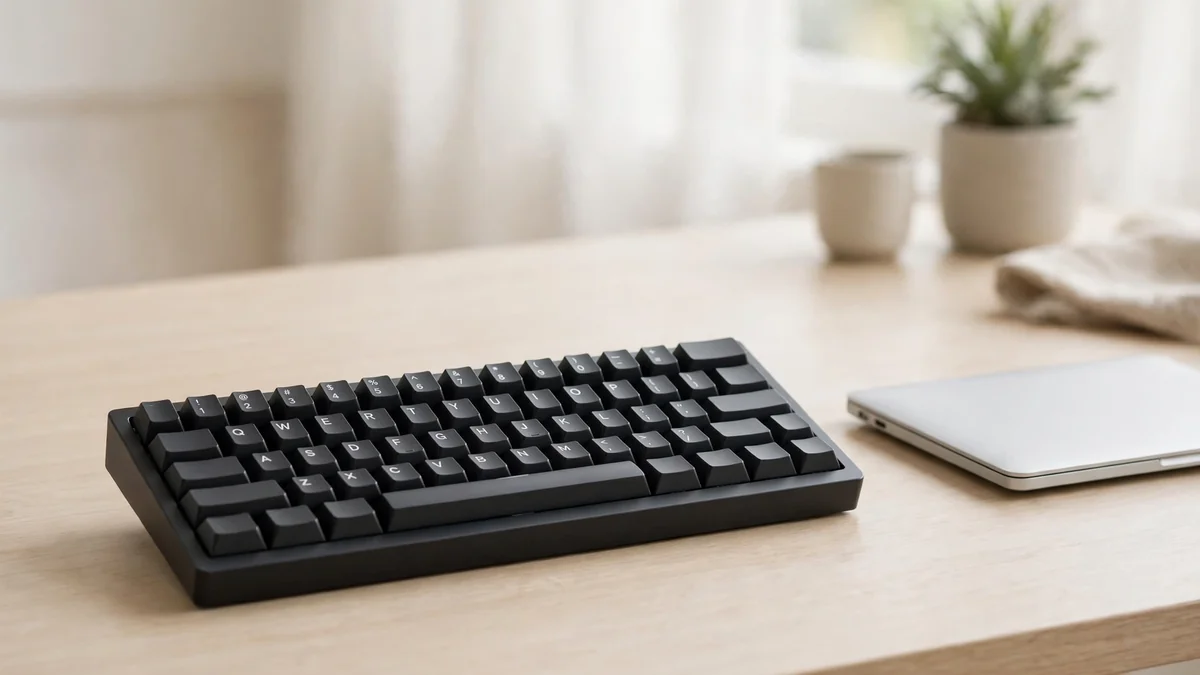
Tactile switches are the middle ground of the mechanical keyboard world, and for many typists they are the sweet spot. A tactile switch gives you a small bump partway through the keypress, a physical signal that the key has registered, without the loud click of a clicky switch. That feedback helps you type accurately without bottoming out every key, which is why tactile switches are the default recommendation for people who type for a living.
The best tactile mechanical keyboards in 2027 pair that feedback with solid build quality and layouts that fit real desks. A good tactile switch in a rattling plastic board still feels cheap, while a well-built board makes the bump feel crisp and deliberate.
We picked seven keyboards covering the main decisions: a best overall board, a quiet office option, a hot-swappable favourite, and a budget compact pick. Every board below ships with tactile switches or a tactile option, and every starting price is approximate, so check current pricing before you buy.
Key takeaways
- Keychron Q1 is the best tactile mechanical keyboard overall, with a crisp tactile bump, a solid aluminium case, and hot-swappable sockets.
- Tactile switches suit typists who want feedback on every keypress without the noise of clicky switches.
- Office workers should look at the Logitech MX Mechanical, which pairs quiet tactile switches with a low-profile design.
- Hot-swappable boards are worth the premium because you can try different tactile switches without soldering.
- Avoid boards with mushy stabilisers, since a wobbly spacebar hides the tactile bump you are paying for.
At a glance: the shortlist
| Keyboard | Best for | Starting price | Standout limit |
|---|---|---|---|
| Keychron Q1 | Best overall | From $179 | Heavy aluminium case |
| Logitech MX Mechanical | Office work | From $149 | Low-profile keycaps only |
| Keychron K8 | Hot-swappable value | From $89 | Plastic case |
| Ducky One 3 TKL | Typing feel | From $129 | No wireless option |
| Razer BlackWidow V4 | Gaming | From $179 | Software needed for full features |
| Royal Kludge RK61 | Compact budget | From $49 | 60 percent layout loses arrow keys |
| Corsair K70 Core TKL | Mainstream pick | From $99 | Stabilisers are average |
Keychron Q1 — Best overall
The Keychron Q1 is the best tactile mechanical keyboard you can buy in 2027. Its gasket-mounted design and full aluminium case give every keypress a solid, satisfying feel, and the stock Keychron Brown tactile switches deliver a clear bump at around 55 grams of actuation force. The bump is noticeable without being heavy, which makes the Q1 comfortable for long typing sessions.
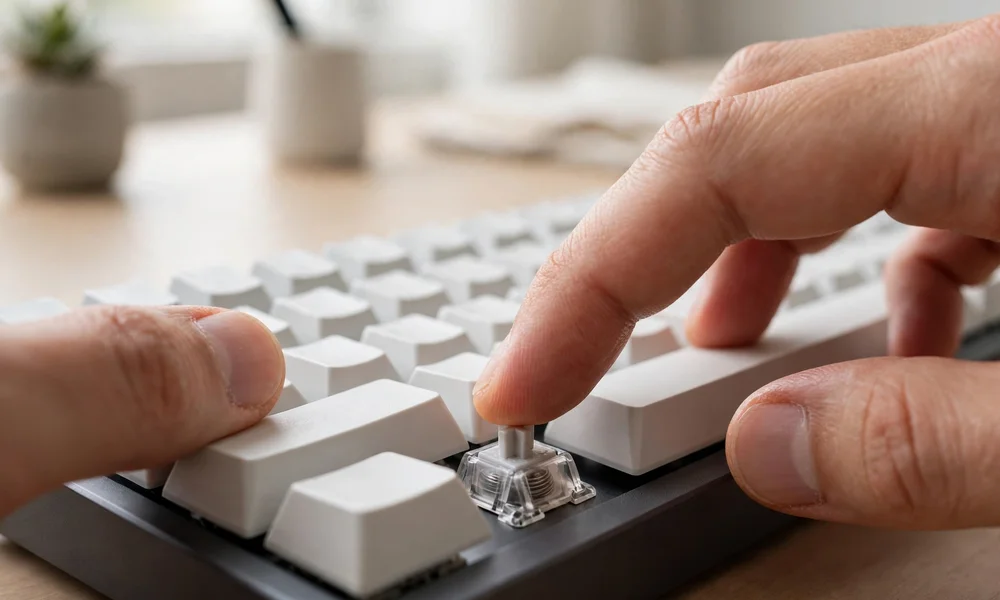
Typing on the Q1 feels deliberate in the best sense. Each keypress gives clear feedback, the stabilisers are lubed from the factory, and the thick PBT keycaps feel premium. If you want one tactile keyboard that excels at typing and looks good doing it, this is the board to buy, and it sits comfortably alongside our guide to the best 75% mechanical keyboards if you want a smaller layout with the same feel.
Pros: Crisp tactile switches, gasket-mounted aluminium case, hot-swappable sockets, QMK and VIA support, thick PBT keycaps.
Cons: Heavy to move around, premium price, no wireless option in the base model.
Logitech MX Mechanical — Best for office work
The Logitech MX Mechanical is the tactile keyboard for people who work in shared spaces. Its low-profile Tactile Quiet switches give a gentle bump with very little noise, so you get feedback on every keypress without disturbing colleagues on calls. The low-profile design also keeps your wrists in a more natural position during long days.
The MX Mechanical is not a board for switch swapping or heavy customisation: it is built to work well out of the box. For office workers who want a tactile feel without the bulk or noise of a traditional mechanical board, it is the most practical choice available.
Pros: Quiet tactile switches, low-profile ergonomic design, pairs with three devices, smart backlighting, solid aluminium case.
Cons: Not hot-swappable, low-profile keycaps limit replacements, premium price for an office board.
Keychron K8 — Best hot-swappable value
The Keychron K8 is the best-value hot-swappable tactile keyboard, and a favourite for first-time buyers. It ships with Gateron Brown switches, the classic light tactile switch, in a tenkeyless layout that fits most desks. Hot-swappable sockets mean you can try other tactile switches later without buying a new board, which makes the K8 a good platform for learning what you like.
The plastic case and basic ABS keycaps are the visible compromises, but neither affects the typing experience much, and the keycaps are standard size for easy replacement. For the price, the K8 offers more flexibility than any other tactile board.
Pros: Hot-swappable Gateron Brown switches, Bluetooth and wired modes, affordable, tenkeyless layout, works with Windows and macOS.
Cons: Plastic case, ABS keycaps show shine over time, stabilisers are decent rather than great.
Ducky One 3 TKL — Best typing feel
Ducky’s One 3 TKL is built for people who judge a keyboard by how it types, and with Cherry MX Brown switches it types beautifully. The tactile bump is clean and consistent, the thick PBT keycaps feel substantial, and the factory-lubed stabilisers keep the spacebar and Enter key quiet and steady. There is no flex in the case and no hollow sound.
If you want a tactile board that prioritises feel above everything else, the One 3 TKL is the pick. It skips wireless and flashy extras in favour of fundamentals done well, and the result is a keyboard that feels better after months of use than most boards feel on day one.
Pros: Excellent typing feel, Cherry MX Brown switches, thick PBT keycaps, lubed stabilisers, no software required.
Cons: No wireless option, understated design, limited software features.
Razer BlackWidow V4 — Best for gaming
The Razer BlackWidow V4 brings tactile switches to a gaming-first board. Choose the Orange tactile switch option for a quiet bump with a 2 mm actuation point, which gives feedback on every press without the click that annoys teammates on voice chat. The board includes six macro keys, a multi-function roller, and bright per-key RGB lighting.
For gamers who type a lot, the BlackWidow V4 is a strong combination. The tactile switches give feedback in games and in documents alike, and the macro keys are useful for productivity shortcuts as well as in-game commands. Full features depend on Synapse, so it suits Windows users best, and it complements our guide to the best mechanical keyboards for programming if your gaming board also doubles as a coding keyboard.
Pros: Quiet Orange tactile switches, bright per-key RGB, six macro keys, media roller, dampening foam, wrist rest included.
Cons: Synapse software needed for full features, ABS keycaps rather than PBT, best suited to Windows.
Royal Kludge RK61 — Best compact budget
The Royal Kludge RK61 is the cheapest good way into tactile switches. This 60 percent board ships with RK Brown tactile switches, offers Bluetooth, 2.4 GHz wireless, and wired USB-C, and costs less than a night out. The compact layout drops the function row, number pad, and dedicated arrow keys, which saves a large amount of desk space.
The 60 percent layout takes adjustment, since arrow keys and function keys live on layers you reach with a function key. If you can live with that, the RK61 is a remarkable value, and a good travel or secondary board even for people who own a larger keyboard. It also pairs well with our guide to the best mechanical keyboards for office work if you want to compare compact and full-size options.
Pros: Very affordable, RK Brown tactile switches, triple-mode connectivity, compact 60 percent layout, hot-swappable on many versions.
Cons: No dedicated arrow keys, thinner keycaps, basic software, small layout takes adjustment.
Corsair K70 Core TKL — Best mainstream pick
The Corsair K70 Core TKL is the mainstream tactile board for people who want a known brand, a solid build, and no fuss. It ships with a tactile switch option that delivers a clear bump, and the tenkeyless layout suits both work and gaming desks. The aluminium top plate and the board’s weight give it a stable, premium feel.
The K70 Core TKL is a safe, capable choice. It will not excite enthusiasts who want hot-swappable sockets and gasket mounts, but for a reliable tactile board from a major brand at a fair price, it delivers.
Pros: Clear tactile switch option, aluminium top plate, bright per-key RGB, dedicated media controls, tenkeyless layout.
Cons: Not hot-swappable, stabilisers are average, iCUE software can feel heavy.
How to choose
Start with the bump. Light tactile switches such as Cherry MX Brown and Gateron Brown suit most typists, with a gentle bump that is easy to feel. Heavier tactile switches suit people who press keys firmly, while quiet tactile switches suit shared offices.
Next, decide on layout and connectivity. Tenkeyless boards suit most desks, 75 percent boards save space while keeping the function row, and 60 percent boards are the most compact but need layer shortcuts for arrow keys. Wireless matters if you switch between devices, and hot-swappable sockets matter if you want to try different switches later.
Finally, check the build details: PBT keycaps last longer than ABS, lubed stabilisers keep large keys quiet, and a heavier case reduces flex and hollow sound. Prices shift often, so treat the starting prices as approximate and check current pricing before you buy.
Checklist: before you pay
- Confirm the board ships with tactile switches, not linear or clicky ones, since listings often mix switch options.
- Check the layout fits your desk and your work, especially whether you need arrow keys and a function row.
- Look for hot-swappable sockets if you want to change switches without soldering.
- Check connectivity: wired only, Bluetooth, or 2.4 GHz wireless, and whether it supports your devices.
- Read the return policy so you can send the board back if the tactile bump does not suit you.
- Confirm the starting price and check current pricing, since keyboard prices change with sales and new models.
Frequently asked questions
Are tactile switches good for typing?
Yes. Tactile switches are the most popular choice for typists because the bump confirms each keypress without the noise of a clicky switch, and the feedback helps you avoid bottoming out every key.
Are tactile switches quiet?
Tactile switches are much quieter than clicky switches, though not silent. The bump itself makes no noise; the sound comes from the key bottoming out, and quiet tactile switches can make a board suitable for shared offices.
What is the difference between tactile and linear switches?
Tactile switches have a small bump partway through the keypress, while linear switches travel smoothly with no bump. Tactile switches suit typists who want feedback; linear switches suit fast, repeated presses.
Can I change the switches on a tactile keyboard?
Only if the board is hot-swappable. Hot-swappable boards let you pull switches out and push new ones in without soldering, while soldered boards need desoldering tools and skill.
Do tactile switches wear out faster?
No. Most tactile switches are rated for 50 to 100 million keystrokes, which is years of heavy daily use, and keycaps usually show wear long before the switches do.
Which tactile switch should a beginner choose?
Cherry MX Brown and Gateron Brown are the safest starting points. Both are light and widely available. Try them first, then explore heavier or quieter tactile options once you know what you like.
The bottom line
For most buyers, the Keychron Q1 is the best tactile mechanical keyboard in 2027. It combines a crisp tactile bump, a solid gasket-mounted aluminium case, and hot-swappable sockets in a board that feels premium every time you type. Office workers should pick the Logitech MX Mechanical, and budget buyers should choose the Royal Kludge RK61.
Whichever board you choose, prioritise the switch feel, the layout, and the build quality over extra features. A clear tactile bump in a solid case will serve you well for years, and a hot-swappable board keeps your options open. Prices shift regularly, so check current pricing before you buy.