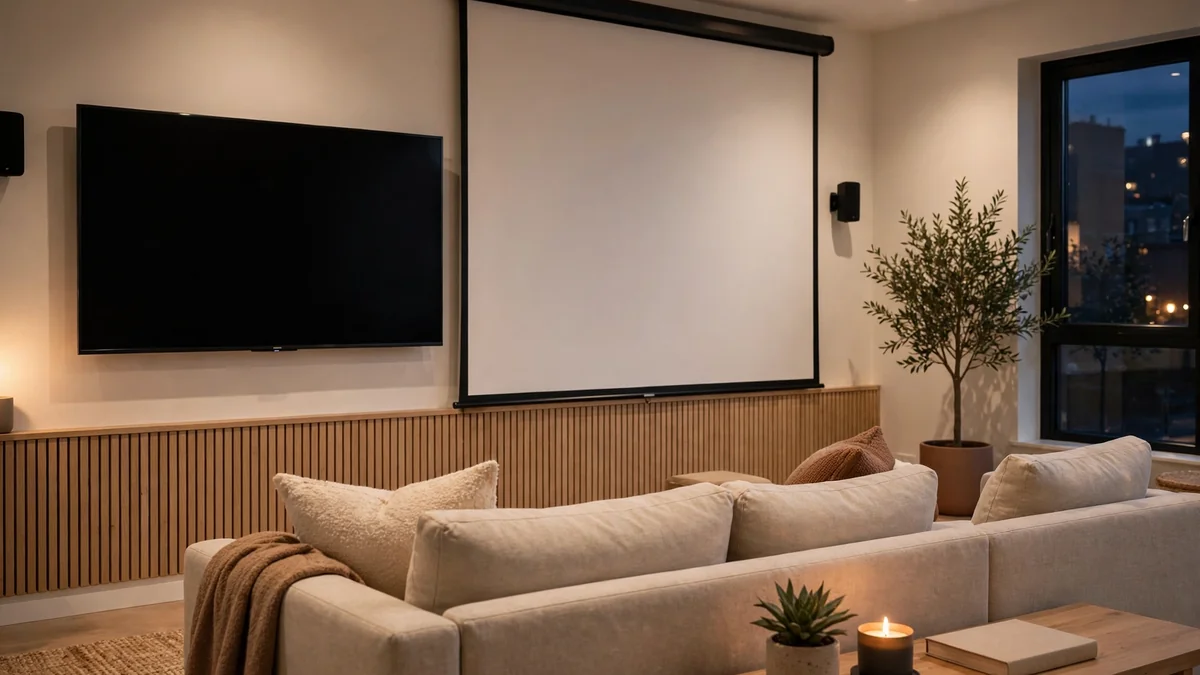
Smart TV vs projector for home theater comes down to your room more than your budget. A smart TV gives you a bright, sharp picture that works in any light, with apps, speakers, and setup built in. A projector gives you a far bigger image for similar money, and a genuine cinema feeling that no TV under $2,000 can match. In 2027 both are better than ever, and the wrong pick usually comes from buying for the screen size you want instead of the room you have.
The deciding factors are light control, viewing distance, and how much setup you are willing to do. A projector needs a dark room and a clear throw distance to look its best, while a TV looks good the moment you plug it in, even with the curtains open. A projector also needs a screen, a mount, and usually a separate sound system, while a TV is a single box that handles everything. Those extras change the real price of a projector setup.
This comparison tests both on picture quality, screen size, brightness, sound, setup, running costs, and price. Prices below are approximate starting prices for decent home theater models in 2027, so check current pricing before buying, since TVs and projectors are among the most heavily discounted tech products of the year.
Key takeaways
- Smart TVs are the better pick for bright rooms and easy setup, with a sharp picture that needs no light control.
- Projectors are the better pick for a true cinema experience, with 100-inch-plus images for less than a large premium TV.
- Room darkness matters more than resolution: a projector in a bright room looks washed out, whatever its specs say.
- A good 65-inch smart TV starts around $500; a decent 4K projector starts around $600 before screen and sound.
- If you want movie nights in a dark room, buy a projector; if you want everyday TV in a normal living room, buy a smart TV.
At a glance: smart TV vs projector for home theater
| Factor | Smart TV | Projector |
|---|---|---|
| Screen size | 55 to 85 inches typical | 100 to 150 inches typical |
| Best for | Bright rooms, everyday viewing | Dark rooms, movie nights |
| Picture in daylight | Bright and sharp | Washed out without blackout |
| Resolution | 4K standard, 8K on premium | 4K on mid-range and up |
| Built-in sound | Decent speakers included | Weak speakers, soundbar needed |
| Setup | Plug in and watch | Mount, screen, alignment |
| Lamp or panel life | 50,000 hours or more | 20,000 to 30,000 hours laser |
| Starting price | Around $500 for 65-inch 4K | Around $600 before extras |
Smart TV for home theater
A smart TV is the simplest route to a home theater, and for most living rooms it is the right one. A 65-inch 4K TV costs around $500, a 75-inch model around $800, and both arrive as a single unit with streaming apps and speakers already built in. Setup takes under an hour: mount it, connect to Wi-Fi, sign in to your apps, and you are watching. There is no alignment, no focus, and no screen to buy.
Picture quality is where a TV earns its place. Modern LED and OLED panels reach 1,000 nits of brightness or more, which means HDR highlights pop and the picture stays punchy with the lights on and the curtains open. OLED models add perfect blacks and wide viewing angles. A TV also handles mixed use better: daytime news, sports with friends, gaming, and late-night films all look good on the same screen, with no room preparation between them.
Gaming is another quiet TV advantage. Most mid-range and premium TVs now support 120 Hz refresh rates, variable refresh rate, and auto low-latency mode, which makes them a strong match for current consoles. Input lag on a good gaming TV is under 10 milliseconds, while many projectors sit at 20 to 30 milliseconds or higher. If the home theater doubles as a gaming setup, the TV is the safer choice. Our roundup of the best gaming monitors covers the same refresh-rate and latency trade-offs, and the same logic applies when choosing a big screen.
The limits of a TV are size and price per inch. An 85-inch TV is a serious piece of furniture that needs a wide wall and a strong mount, and a 98-inch model costs several thousand dollars. Beyond 85 inches, the price climbs steeply for every extra inch, while a projector reaches 120 inches for a fraction of the cost. A TV also leaves a black rectangle on the wall when off.
Pros: Bright picture in any light, simplest setup, apps and speakers built in, excellent for gaming with low input lag, no extra purchases needed.
Cons: Much more expensive per inch above 85 inches, fixed black rectangle on the wall, largest sizes need a wide wall and strong mount.
Projector for home theater
A projector is the only way to get a true cinema screen at home without spending several thousand dollars. A decent 4K projector starts around $600, and with a $150 screen it produces a 100 to 120-inch image that makes a 65-inch TV feel small. That scale changes how films feel: the picture fills your field of vision in a way no TV can match. For dedicated movie nights, nothing else at this price comes close.
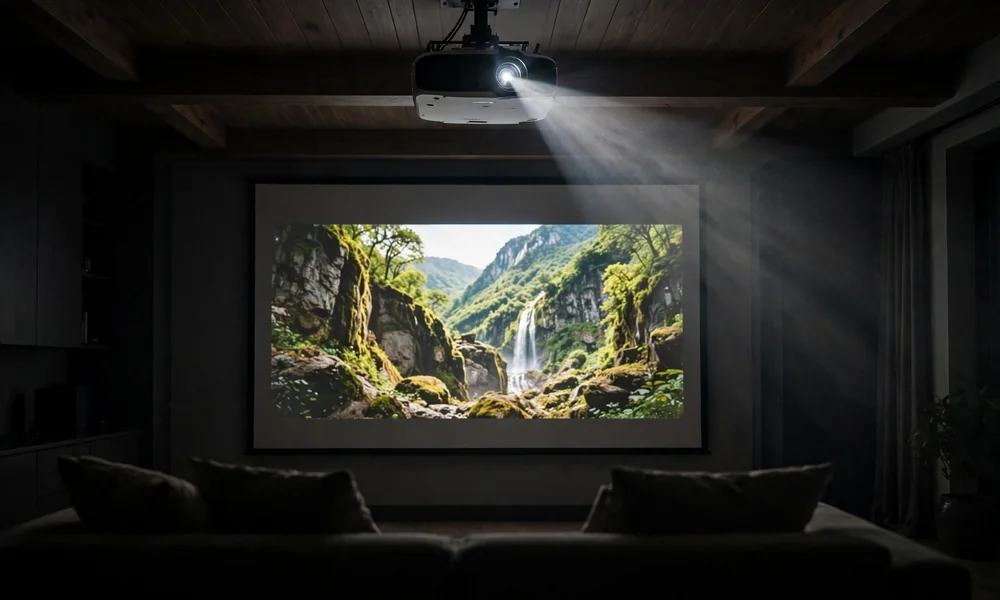
Light control is the price of that scale. A projector image is reflected light, so any daylight or lamp light washes it out, flattening blacks and dulling colours. A projector in a bright living room looks grey and tired, even with a bright 3,000-lumen model. To get the best from one you need a dark room and blackout curtains or evening-only viewing. Laser models handle moderate ambient light better than old lamp models, but still cannot match a TV in a bright room.
Setup is the other real cost. A projector needs a ceiling mount or shelf at the right throw distance, a screen or a smooth white wall, and cable runs for power and HDMI. Alignment, focus, and keystone correction take time, and moving the projector means doing it again. Sound is almost always separate too, since built-in projector speakers are weak: budget at least $200 for a soundbar, and more for a proper surround setup. Our guide to the best home theater systems compares the speaker setups that pair well with a projector, including soundbars and surround kits.
Running costs have improved a lot. Modern laser projectors last 20,000 to 30,000 hours, which is a decade or more of evening viewing, and there is no expensive lamp to replace every few years as there was with older models. For most buyers, a laser model is worth the extra cost because it removes the main running expense entirely.
Pros: Huge 100-inch-plus image for the price, genuine cinema feeling, screen disappears when not in use, laser models last 20,000 hours or more.
Cons: Needs a dark room to look its best, setup takes time and planning, weak built-in sound, screen and audio extras add to the real price.
The verdict
For most homes, the smart TV wins the overall comparison, because it works in any room, needs no setup, and handles everyday viewing, sports, and gaming without compromise. A projector is a specialist tool that is unbeatable in the right room and disappointing in the wrong one. If your room has big windows and daytime viewing, a projector will frustrate you no matter how much you spend.
The projector wins one category decisively: dedicated movie nights in a dark room. If you have a room you can black out, a wall for a 100-inch screen, and the patience to set it up, a projector delivers a cinema experience that a TV at the same price cannot touch. Buy the TV for a normal living room, and the projector for a dark room built around film.
How to choose
Start with your room, not the spec sheet. Measure the viewing distance and the light: if you sit 10 feet or more from the screen and can make the room properly dark, a projector is realistic. If you sit closer, or the room has windows you cannot black out, a TV is the right call. A screen used daily for news, sport, and casual viewing suits a TV, while one used two or three evenings a week for films suits a projector.
Then add up the true cost of the projector route. A $600 projector plus a $150 screen, a $50 mount, and a $200 soundbar is really a $1,000 purchase, which buys a very good 75-inch TV with money to spare. If that total still buys you a bigger, better film experience than the TV at the same price, and your room is dark enough, the projector is worth it. For better audio, our roundup of the best smart speakers is a useful starting point.
Checklist: before you buy
- Measure your viewing distance and the screen size that fits it.
- Test the room darkness at the time you will actually watch.
- For a projector, add screen, mount, and sound to the price before comparing.
- Check the throw distance: the projector must fit your room.
- Confirm the inputs you need: HDMI 2.1 for gaming, eARC for a soundbar.
- Buy from a retailer with easy returns, so a wrong size is a swap.
Frequently asked questions
Is a projector better than a TV for movies?
Yes, in a dark room. A projector gives you a 100-inch-plus image that fills your field of vision, which feels far more like a cinema than a TV at the same price. In a bright room, though, a TV is better, because the projector image washes out and loses contrast.
Can you use a projector in a bright room?
You can, but the picture suffers. A bright laser projector with 3,000 lumens and a high-gain screen looks watchable with moderate light, but blacks turn grey and colours flatten. Blackout curtains or evening viewing make a far bigger difference than a brighter projector.
Do projectors need a screen?
A screen is strongly recommended. A smooth, matte white wall works in a pinch, but a proper screen gives better brightness, more even colour, and a cleaner edge. Budget screens start around $100 to $150.
How long do projector lamps last?
Laser projectors last 20,000 to 30,000 hours, which is many years of evening viewing with no replacement needed. Older lamp projectors last 3,000 to 6,000 hours per lamp, and a replacement costs $100 to $200, so a laser model is usually cheaper over its lifetime.
Is a smart TV better for gaming than a projector?
Yes. Most good gaming TVs offer 120 Hz, variable refresh rate, and input lag under 10 milliseconds, while projectors usually sit at 20 to 30 milliseconds or higher. A projector can still be fun for casual gaming, but competitive players should choose a TV.
What size TV is best for a home theater?
For most living rooms, 65 to 75 inches is the sweet spot, with a viewing distance of 8 to 10 feet. Go larger if you sit further back: a 75-inch TV suits 9 to 11 feet, and an 85-inch TV suits 10 to 12 feet.
The bottom line
A smart TV is the better home theater pick for most people, because it works in any light, sets up in an hour, and handles films, sport, and gaming without compromise. A projector is the better pick for a dark room built around movie nights, where its huge image delivers a cinema feeling no TV at the same price can match. Choose by your room first, add up the true cost of the projector route, and check current pricing before buying, since both see deep discounts.
Get the light control right, budget for sound, and the screen will feel like an upgrade every night.