
The best AI tools for procurement teams in 2027 do more than digitise purchase orders. They read contracts, compare supplier quotes, flag risky vendors, and spot savings hidden in years of spend data. The result is faster sourcing, cleaner compliance, and buyers who spend time negotiating instead of chasing paperwork.
Choosing well matters because procurement software touches every department that buys anything. A tool that cannot read your contracts, connect to your finance system, or enforce approval rules will create workarounds within weeks. The tools below were picked for proven AI capability, honest pricing, and real integration with ERP, finance, and supplier systems.
The shortlist covers eight platforms, from full source-to-pay suites to focused intake and spend tools that sit alongside systems you already own. Coupa leads overall, SAP Ariba for large enterprises, and Zip is the strongest pick for fast-growing companies that need intake and approvals without a long implementation. Prices are approximate starting prices, so check current pricing before you buy.
Key takeaways
- Coupa is the best overall choice for teams that want AI across sourcing, spend, and supplier management.
- SAP Ariba is the strongest pick for large enterprises already running SAP.
- Zip is the best choice for fast-growing companies that need intake and approvals live in weeks.
- Expect roughly $30 to $150 per user per month, with enterprise suites priced by spend under management.
- No AI tool should approve spend or sign off on a supplier without a human check and a clear audit trail.
At a glance: the shortlist
| Product | Best for | Starting price | Standout limit |
|---|---|---|---|
| Coupa | Full source-to-pay | Custom pricing | No public starting price |
| SAP Ariba | Large SAP enterprises | Custom pricing | Needs SAP expertise |
| Jaggaer | Complex sourcing | Custom pricing | Long implementation |
| Ivalua | Configurable suites | Custom pricing | Needs admin effort |
| GEP SMART | Unified procurement | Custom pricing | Enterprise focus |
| Zip | Fast intake and approvals | From $30 per user/month | Less deep sourcing |
| Procurify | Mid-sized teams | From $30 per user/month | Smaller supplier network |
| Precoro | Small teams on a budget | From $35 per user/month | Basic AI features |
Coupa — Best overall
Coupa is the most complete AI procurement platform on this list, covering sourcing, contracts, purchasing, invoicing, and supplier management in one system. Its AI reads contracts and extracts payment terms, flags risky clauses, compares supplier quotes, and recommends the best-value option based on price, delivery, and past performance. It analyses company-wide spend to surface savings most teams never find.
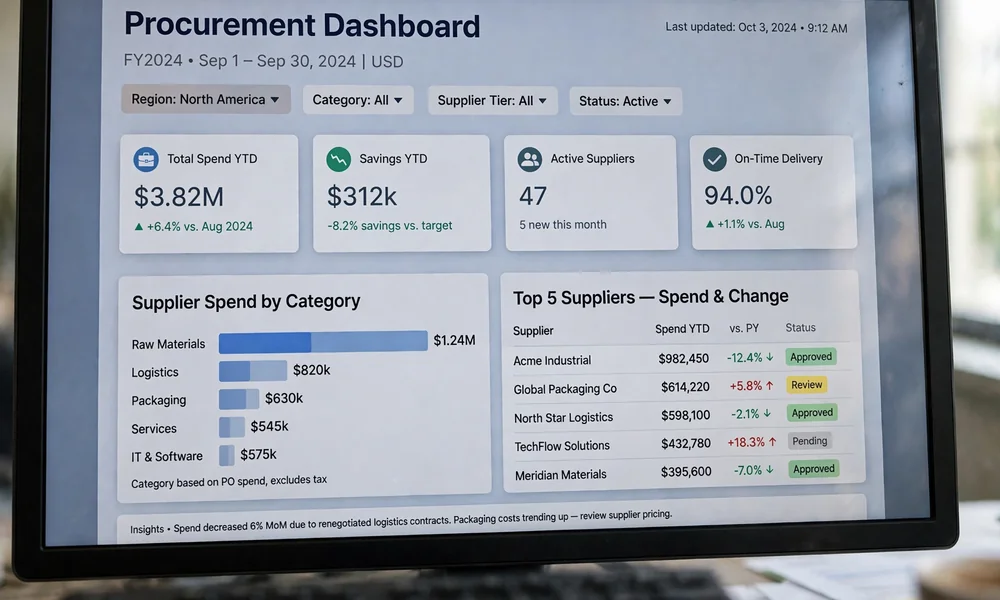
The spend analytics are why many teams choose Coupa first. Its community data benchmarks your prices against similar buyers, giving negotiators real leverage instead of guesswork. Our guide to AI tools for spend analytics explains how that kind of benchmarking works in practice. The trade-off is price: Coupa is an enterprise platform with custom pricing, so smaller teams should expect a sales process.
Pros: Full source-to-pay coverage, strong contract AI, spend benchmarking, huge supplier network. Cons: Custom pricing only, long rollout, and more than small teams need.
SAP Ariba — Best for large SAP enterprises
SAP Ariba is the natural pick for large companies already running SAP. Its AI guides buyers to preferred suppliers, checks purchases against contracts and budgets in real time, and flags maverick spend before it happens. Because it shares data with SAP finance and logistics, purchase orders, invoices, and payments stay in sync without manual reconciliation.
The Ariba Network is the other half of the value. It connects buyers with millions of suppliers, so sourcing, quoting, and invoicing happen in one place. The cost is complexity: Ariba needs SAP expertise to configure well, and smaller companies will find the implementation heavy.
Pros: Deep SAP integration, huge supplier network, strong compliance controls, proven at enterprise scale. Cons: Custom pricing, needs SAP expertise, and heavy for smaller companies.
Jaggaer — Best for complex sourcing
Jaggaer is built for teams that run complex sourcing events, from multi-round tenders to category strategy across regions. Its AI builds supplier shortlists from performance data, drafts request-for-proposal documents, scores bids against weighted criteria, and tracks savings against the business case. It monitors suppliers for financial, operational, and compliance risk.
Jaggaer suits manufacturing, healthcare, and public-sector buyers with strict sourcing rules and long supplier lists. It is less suited to simple purchase-order automation, where lighter tools are faster and cheaper. Expect a long implementation and a custom price, but a platform that handles complexity few rivals match.
Pros: Strong sourcing and tendering, bid scoring, supplier risk monitoring, good for regulated industries. Cons: Long implementation, custom pricing, and overkill for simple buying.
Ivalua — Best configurable suite
Ivalua stands out for configurability. Its AI assists with sourcing, contracts, procurement, and supplier management, and almost every workflow can be adapted to the way a team already works, rather than forcing the team to adapt to the software. That flexibility makes it popular with companies that have unusual approval chains, local compliance rules, or multiple business units buying differently.
The price of that flexibility is admin effort. Ivalua needs skilled administrators to configure and maintain, and teams without them will not get full value. For organisations willing to invest in setup, it is one of the most adaptable procurement suites available.
Pros: Highly configurable, full source-to-pay coverage, strong contract tools, good for multi-unit companies. Cons: Needs skilled admins, custom pricing, and slower to set up.
GEP SMART — Best unified procurement
GEP SMART combines sourcing, procurement, and supplier management in one AI-assisted platform. Its AI recommends suppliers, flags contract risks, predicts delivery delays, and analyses spend patterns for savings. It also includes guided buying that steers employees to approved suppliers and catalogues, cutting maverick spend without adding friction.
GEP pairs the software with managed services, so teams can outsource parts of sourcing or category management if short-staffed. That suits large companies that want one partner for the platform and the expertise behind it. Smaller teams will find it enterprise-priced.
Pros: Unified platform, guided buying, delivery prediction, optional managed services. Cons: Enterprise focus, custom pricing, and heavy for small teams.
Zip — Best for fast intake and approvals
Zip focuses on the front door of procurement: intake, approvals, and vendor onboarding. Its AI reads purchase requests, routes them to the right approvers, checks them against budget and policy, and flags duplicate or risky vendors. Teams report going live in weeks rather than months, which is why fast-growing companies choose it.
Zip does not try to replace a full sourcing suite, and that focus is its strength. It connects to finance, legal, IT, and security tools, so a single request can collect every approval it needs without email chains. For companies drowning in intake requests, Zip is often the fastest fix.
Pros: Fast to deploy, clear intake and approvals, strong integrations, good for growing companies. Cons: Less deep on sourcing, and per-user pricing grows with the team.
Procurify — Best for mid-sized teams
Procurify is built for mid-sized teams that need control over spending without enterprise complexity. Its AI-assisted tools track budgets in real time, flag unusual purchases, and route approvals based on amount, department, and category. Managers see exactly what has been spent, committed, and requested, which ends the month-end surprise of unapproved orders.
Procurify integrates with common accounting systems such as QuickBooks and NetSuite, so approved purchases flow into finance without retyping. The supplier network is smaller than the enterprise suites and the AI is lighter, but for teams of ten to five hundred people it hits a practical balance of control and simplicity.
Pros: Real-time budget tracking, simple approvals, good accounting integrations, fair pricing. Cons: Smaller supplier network, lighter AI, and less suited to complex sourcing.
Precoro — Best for small teams on a budget
Precoro gives small procurement teams the essentials at a fair price. It handles purchase requests, approvals, budgets, and supplier records, with AI-assisted features such as duplicate detection, budget alerts, and smart document matching. The interface is clean enough that non-procurement staff can raise a request without training.
Precoro is not a sourcing suite, and its AI is more basic than the enterprise platforms. For a small team that mainly needs to stop uncontrolled spending and keep an audit trail, that is enough. It also offers a free trial, so teams can test the approval flow on real requests.
Pros: Low price, easy to learn, good budget controls, free trial available. Cons: Basic AI features, no deep sourcing, and limited supplier management.
How to choose
Start with your biggest pain. If sourcing events and tenders dominate, look at Jaggaer or Ivalua. If uncontrolled intake and approvals are the problem, trial Zip. If spend visibility is the gap, Coupa and GEP SMART lead. The best AI will not help if aimed at a problem your team does not have.
Next, test each shortlisted tool on your own data. Feed it real contracts, supplier lists, and a month of purchase orders, then check whether its savings suggestions, risk flags, and approval routing work. Supplier risk deserves special attention, and our guide to AI tools for vendor risk assessment covers what to check. Finally, confirm the total cost, including implementation, training, and any charges based on spend under management.
Checklist: before you pay
- Trial the tool on real contracts, suppliers, and purchase orders from your own company.
- Confirm whether pricing is per user, per spend, or custom, and what is included.
- Check that the tool connects to your ERP and finance system without custom development.
- Test the approval flow end to end, including budget checks and policy exceptions.
- Ask how supplier data is sourced, updated, and used for AI training.
- Confirm audit trails, data export, and what happens to your records if you leave.
Frequently asked questions
Can AI tools replace procurement staff?
No. The best tools automate routine checks, drafting, and data analysis, while buyers still negotiate, build supplier relationships, and make judgement calls. Teams that remove human review from approvals and supplier decisions take on risk they cannot see until too late.
How much does AI procurement software cost?
Smaller tools start at roughly $30 to $35 per user per month. Enterprise suites such as Coupa, SAP Ariba, and Jaggaer use custom pricing, often based on spend under management, so expect a sales conversation and a quote. Always check current pricing before buying.
Which AI procurement tool is best for small teams?
Precoro and Procurify are the strongest picks, starting at roughly $35 and $30 per user per month. Both cover requests, approvals, and budgets without an enterprise contract, and both are easy for non-procurement staff to use.
Does procurement AI work with our ERP?
Usually, yes. Coupa, SAP Ariba, and GEP SMART integrate with ERP and finance systems, and Zip and Procurify connect to accounting tools. Confirm the exact integration for your ERP version before signing, and ask if it needs custom development.
How does AI check supplier risk?
It monitors financial data, news, sanctions lists, and delivery performance, then flags suppliers that show warning signs. Human review is still essential, since an AI flag is a prompt to investigate, not a verdict.
Can procurement AI help with invoices too?
Yes. Most suites on this list match invoices to purchase orders automatically and flag mismatches for review. For deeper invoice automation, many teams pair their procurement platform with AI tools for accounts payable automation to handle the full payment flow.
The bottom line
For most procurement teams, Coupa is the safest overall pick, SAP Ariba is the best choice for large SAP enterprises, and Zip is the best option for fast-growing companies that need intake live quickly. The right answer depends on your sourcing complexity, ERP, and budget, so trial two tools on real data before you commit.
Whichever platform you choose, treat the AI as an analyst that needs supervision, not a decision-maker. Teams that verify its savings claims, review its risk flags, and keep humans on approvals get steadily better results; teams that automate approvals blindly get steadily worse ones.