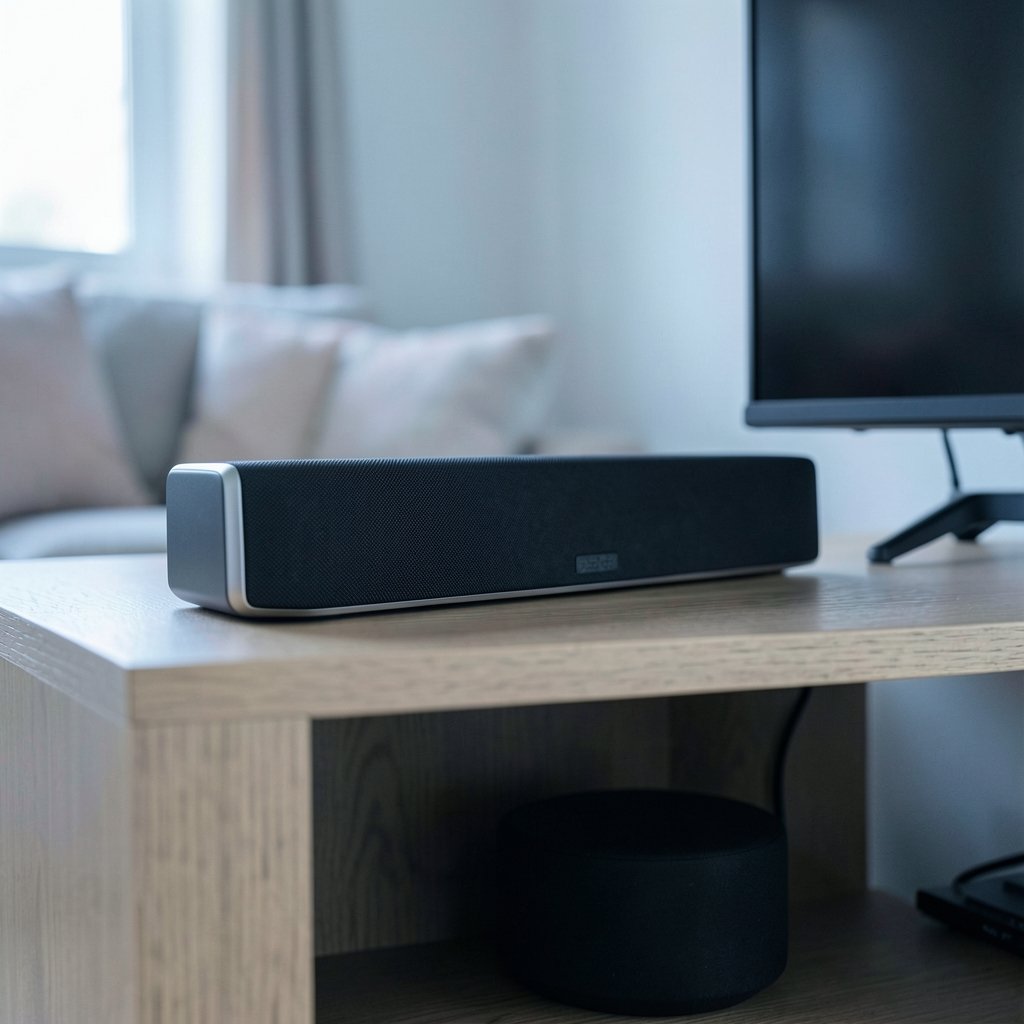
Most people who buy a new TV never touch the built-in speakers again, and the numbers back that up: industry tracking consistently shows that soundbars outsell every other home audio category combined. The reason is simple. Flat panels keep getting thinner, and thin panels have no room for a speaker cabinet that can move air. A budget soundbar fixes the worst of that problem for less than the cost of a decent pair of running shoes. The trick is knowing which corners are safe to cut in 2026 and which ones will annoy you every single night. (Soundbar)
Why Budget Soundbars Matter More in 2026
TV makers have spent a decade chasing slim bezels and paper-thin profiles. Physics has not cooperated. The speakers inside a mid-range TV are typically tiny downward-firing drivers in a plastic shell, and they produce exactly the sound you would expect from that description: thin dialogue, no bass, and a harsh top end that gets fatiguing after an hour.
A soundbar solves three problems at once. It puts drivers in a wider cabinet, so stereo separation exists. It adds a dedicated woofer or a port for one. And it usually brings HDMI eARC, which lets the TV pass uncompressed audio to the bar with a single cable and lets your TV remote control the volume. (Soundbar Reviews)
The budget tier in 2026 is genuinely better than it was three years ago. Features that used to cost $500 or more, like Dolby Atmos decoding, room calibration, and wireless subwoofer pairing, now show up on bars that cost a fraction of that. The catch is that “supports Atmos” and “sounds good with Atmos” are two very different claims, and plenty of cheap bars lean hard on the first one.
What “Budget” Actually Means Now

Price bands have shifted. Here is a realistic map of the entry-level market heading into 2026.
| Price band | What you typically get | What you give up |
|---|---|---|
| Under $100 | 2.0 channel bar, Bluetooth, optical input | No subwoofer, no HDMI eARC, weak bass |
| $100–$200 | 2.1 with wireless sub, HDMI ARC, sometimes eARC | Limited EQ, no room correction |
| $200–$350 | 3.1 with center channel, eARC, virtual surround | Real Atmos height effects are minimal |
| $350–$500 | 5.1 with rear speakers or up-firing drivers | Diminishing returns start here |
The sweet spot for most rooms is the $150 to $300 range. That is where you get a real subwoofer, clean dialogue, and enough connectivity to not fight with your TV every time you switch inputs. If you are also upgrading the screen itself, it helps to pair the purchase with a look at the best laptops 2026 top picks for every budget today if you stream from a computer, or check what the best phone to buy 2026 expert picks for every budget offers if your phone is your main music source. The same budget logic applies across categories: spend where the hardware actually changes the experience.
The Features That Actually Change Your Night
Marketing sheets are long. Here is what genuinely matters, ranked by how much you will notice it.
HDMI eARC beats everything else
If your TV has an eARC port, buy a bar that supports it. eARC carries full-resolution audio and handles lip-sync automatically. Optical connections cap out at compressed surround formats and often introduce delay you have to fix by hand. A bar with eARC and CEC means one cable, one remote, and no menu diving.
A real subwoofer, not a “bass radiator”
Passive radiators can add thump to a small cabinet, but they cannot reproduce the low rumble of an explosion or the foundation of a bass line. A wireless subwoofer included in the box is the single biggest upgrade in the budget tier. Check whether the sub needs its own power outlet, because that affects placement.
Dialogue clarity over surround claims
The most common complaint about any soundbar is that dialogue gets buried under music and effects. Look for a center channel driver or a dedicated dialogue-enhancement mode. A 3.1 bar with a real center channel will beat a 5.1 bar with virtual surround for most living rooms.
Room calibration
Some budget bars now include a microphone-based setup that measures your room and adjusts the EQ. It sounds like a gimmick until you hear the difference in a room with hard floors and bare walls. It is not essential, but it is a genuine plus at this price.
Where Cheap Soundbars Quietly Fail
This is the part most buying guides skip. The failures in the budget tier are predictable, and knowing them saves you a return.
Fake Atmos. A bar with two tiny up-firing drivers and no calibration will not create convincing overhead sound. It will create a slightly taller-sounding wall of noise. If Atmos matters to you, save for a bar with rear speakers or accept that virtual processing is a mood, not a format.
App-only controls. Some budget bars put basic functions like input switching and EQ behind a phone app. When the app is abandoned after two years, you are stuck. Physical buttons and a real remote still matter.
Bluetooth lag on video. Bluetooth is fine for music. It is miserable for movies because of latency. Always use HDMI or optical for video sources.
Weak HDMI switching. A bar with only one HDMI input forces you to choose between a console and a streaming stick. Two inputs is the practical minimum for a household with more than one device.
Subwoofer dropouts. Cheap wireless subwoofers can lose connection in apartments with crowded Wi-Fi. Read owner reports specifically about this alongside professional reviews.
Matching the Bar to the Room
A soundbar that sounds thin in a store can sound great at home, and vice versa. Three variables dominate.
Room size. A 2.1 bar with a sub fills a typical apartment living room comfortably. Open-plan spaces with high ceilings need more output, and a budget bar will run out of headroom before it runs out of volume.
Placement. Soundbars want to sit at ear height or slightly below, with a clear path to the listener. Burying one in a TV stand cubby turns it into a muffled mess. Wall-mounting helps, but check whether the bar’s drivers fire upward, because mounting can block them.
Walls and furniture. Hard surfaces reflect sound and make cheap bars sound harsh. A rug, curtains, and a bookshelf do more for audio quality than an extra $100 on the bar itself. This is the cheapest upgrade in home audio and almost nobody does it deliberately.
Getting the Setup Right on Day One
Most soundbar disappointment happens in the first hour, not the first year. A short, boring checklist prevents it.
- Connect by HDMI eARC if available, and enable eARC and CEC in the TV’s audio menu.
- Set the TV’s digital audio output to bitstream or passthrough, not PCM, so surround formats reach the bar intact.
- Run any built-in calibration routine with the room quiet and furniture in its normal place.
- Place the subwoofer on the floor near a wall, then move it a foot at a time while playing a bass-heavy track until the low end sounds even.
- Raise the center or dialogue level a few notches above default. Almost every bar ships with dialogue set too low.
- Turn off the TV’s own speakers entirely so you are not hearing two sources at once.
If you skip step two, you will get stereo from every source and wonder why the surround modes do nothing. It is the single most common setup mistake.
Budget Soundbars vs. the Alternatives
A soundbar is not the only way to spend $250 on better TV audio, and it is worth being honest about the trade-offs.
| Option | Strength | Weakness |
|---|---|---|
| Budget soundbar + sub | Simple, one cable, TV remote works | Limited stereo width, weak upgrade path |
| Powered bookshelf speakers | Better music fidelity per dollar | No HDMI eARC on most models, two remotes |
| Used mid-range bar | More hardware for the money | No warranty, older HDMI standards |
| Headphones | Best sound per dollar, no room issues | Solo listening only |
For a shared living room, the soundbar wins on convenience. For a desk or a music-first setup, powered speakers usually beat a bar at the same price. There is no universal answer, only the right answer for how you actually watch.
Shopping Smart in a Crowded Market
Timing matters as much as specs. Discount events move budget audio more than almost any other category, and the Black Friday car deals coverage on this site shows that big promotional windows reshape pricing across every product category, vehicles included. If you can wait for a sale window, a $300 bar frequently drops into the $200 range.
Two other habits pay off. First, buy from a retailer with a real return window, because room acoustics are impossible to judge in a store. Second, check the warranty on the subwoofer specifically, since it is the component most likely to fail.
It also helps to think about the wider setup you are building. If your household is juggling a console, a streaming box, and a laptop, the connectivity decisions you make now echo for years. The same forward-looking logic shows up in coverage of the Tesla website robotaxi semi roadster three hardware bets 2026, where platform choices made early determine what you can do later. Audio works the same way: buy the bar with the ports you will need in three years, in addition to the ones you need today.
Common Mistakes That Cost Real Money
- Buying on channel count alone. A well-tuned 2.1 beats a badly tuned 5.1 every time.
- Ignoring the TV’s audio settings. Half of all “my soundbar sounds bad” complaints trace back to a PCM output setting.
- Skipping the subwoofer crawl. Sub placement changes bass response more than sub quality does at this price.
- Assuming all HDMI ports are equal. ARC and eARC are not the same, and some budget bars label them confusingly.
- Not checking for lip-sync adjustment. A bar without audio delay control can be unusable with some TVs.
Conclusion
The best budget soundbar in 2026 is not the one with the longest feature list. It is the one that matches your room, your TV’s ports, and the way you actually watch. Aim for the $150 to $300 range, insist on HDMI eARC and a real wireless subwoofer, and treat Atmos claims at this price with healthy skepticism. Spend fifteen minutes on setup, run the calibration, and raise the dialogue channel. Do that, and a modest bar will outperform a much more expensive one that was never configured properly. The upgrade is real, and it does not require a premium budget.
Frequently Asked Questions
Do budget soundbars actually sound better than TV speakers?
Yes, in almost every case. TV speakers are tiny and boxed into a thin chassis, which limits bass and stereo separation. Even a basic 2.1 soundbar with a subwoofer delivers fuller low end and clearer dialogue. The improvement is largest on action films and dialogue-heavy shows, where built-in speakers struggle most.
Is Dolby Atmos worth it on a cheap soundbar?
Usually not on its own. Budget bars with up-firing drivers rarely create convincing overhead effects without calibration and favorable room layout. Atmos decoding is a nice bonus, but prioritize a real center channel and a good subwoofer first. Those deliver a bigger, more consistent improvement.
What is the difference between HDMI ARC and eARC?
ARC passes compressed surround audio over HDMI and is common on older TVs. eARC carries full-resolution formats like Dolby TrueHD and supports automatic lip-sync. If your TV has an eARC port, buy a bar that supports it. The difference matters most with modern consoles and streaming boxes.
Do I need a subwoofer with a budget soundbar?
For movies and games, yes. Passive radiators in slim bars cannot reproduce deep bass, so explosions and soundtracks feel thin without a sub. For a bedroom or a music-light setup, a good 2.0 bar can be enough. Check that the sub has its own power outlet before you commit to placement.
How do I fix muffled dialogue on a soundbar?
Raise the center channel level a few notches, enable dialogue enhancement if the bar has it, and confirm the TV is outputting bitstream rather than PCM. Also check placement: a bar sitting inside a closed cabinet will sound muddy no matter what settings you use. Small adjustments usually solve it.
When is the best time to buy a budget soundbar?
Major promotional windows consistently produce the deepest discounts in audio, often dropping a $300 bar into the $200 range. Outside those windows, watch for model rollovers, when last year’s version gets cleared out. Buying from a retailer with a generous return policy matters just as much, since room acoustics cannot be judged in a store.