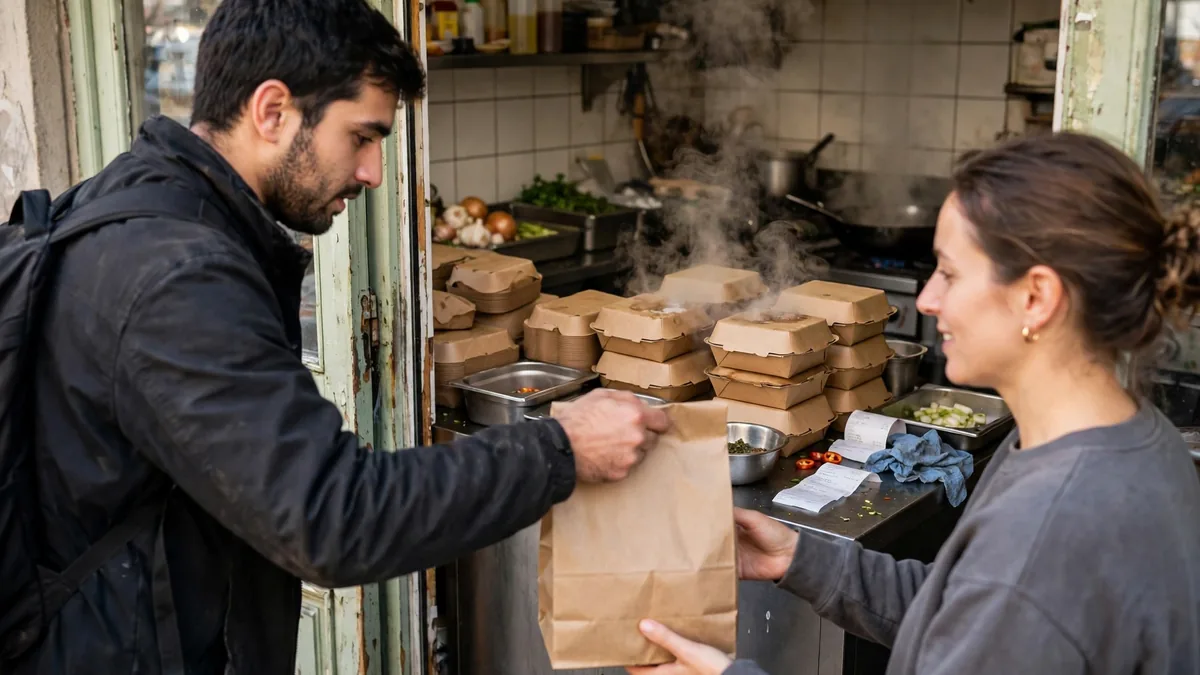
The best software for food delivery businesses in 2027 does more than take orders. It connects the menu, the kitchen, the courier, and the customer in one flow, so an order placed on a phone reaches the kitchen screen in seconds, gets packed, and leaves with a rider whose route is already planned. For restaurants and small delivery fleets, that flow is now the business itself.
Choosing badly is expensive. High commission eats a margin that is already thin, a system that cannot handle a Friday-night rush drops orders at the worst moment, and a tool that does not connect to the point of sale forces staff to retype every order, which is where mistakes start. The right choice depends on whether the business runs its own riders, relies on marketplace couriers, or mixes both.
This list covers six platforms that fit different versions of that problem, from all-in-one restaurant systems to courier networks and order-aggregation tools, each judged on ordering, dispatch, kitchen flow, fees, and how well it plays with the rest of the stack.
Key takeaways
- There is no single best platform: own-fleet restaurants, marketplace sellers, and multi-brand kitchens need different tools.
- Commission and per-order fees matter more than monthly subscriptions for most small food businesses.
- Kitchen display integration and live courier tracking most reduce mistakes and late orders.
- Order aggregation pays for itself quickly when a restaurant sells on three or more marketplaces.
- Test the full order flow, from customer checkout to courier handoff, before signing a contract.
Best food delivery software at a glance
| Software | Best for | Standout feature |
|---|---|---|
| Toast | Full-service restaurants | POS, ordering, and kitchen display in one system |
| DoorDash Drive | Own-channel delivery | On-demand couriers without marketplace commission |
| Uber Direct | Fast courier fulfilment | Large courier network with live tracking |
| ChowNow | Commission-free ordering | Branded online ordering with flat monthly pricing |
| Deliverect | Multi-marketplace sellers | All marketplace orders in one kitchen screen |
| Flipdish | Branded apps and web ordering | Custom ordering apps with loyalty built in |
1. Toast
Toast bundles the point of sale, online ordering, and kitchen display into one system, which is why it leads this list for full-service restaurants that also deliver. Orders from the dining room, the website, and delivery channels land in the same queue, and the kitchen display shows them in firing order. That single queue removes the retyping and missed tickets behind most delivery errors.

Toast also handles payments, loyalty, and reporting, so a restaurant can see which dishes sell best for delivery and when demand peaks. Its delivery features include driver dispatch and tracking, and it connects to third-party delivery services for restaurants without their own riders. The trade-off is scope: as a full restaurant system it is heavier and pricier than a focused delivery tool, and setup and hardware costs add up, so smaller operations should check the monthly bill against their order volume.
Pros: one system for POS, ordering, and kitchen display; strong reporting; dispatch included.
Cons: heavier and costlier than a delivery-only tool; hardware and setup fees add up for small operations.
2. DoorDash Drive
DoorDash Drive is for restaurants that take orders through their own website or app but do not want to employ riders. The restaurant keeps its own storefront and customer relationship, and DoorDash supplies the courier per order, on demand, with live tracking. The restaurant pays a per-delivery fee instead of marketplace commission, so orders stay off the marketplace and the business keeps its customer data.
That model suits restaurants with a loyal local base that already orders direct, and it scales well, since couriers are summoned per order rather than scheduled in shifts. The limits are coverage and control: Drive depends on local courier availability, so remote areas may see slower pickups, and the courier works for the network rather than the restaurant. Readers comparing options may also want our roundup of the best food delivery apps.
Pros: on-demand couriers without marketplace commission; restaurant keeps its customer data.
Cons: pickup speed depends on local courier availability; less control over the courier handoff.
3. Uber Direct
Uber Direct works like Drive: the business takes the order through its own channel, and Uber’s courier network handles delivery. Its strength is the network’s size, covering many cities with fast pickups even at peak hours. Live tracking is built in, with the arrival estimates customers already know from ride-hailing and food apps.
Uber Direct also suits grocers, pharmacies, and retailers needing same-day local delivery, useful for a food business that also sells pantry goods or meal kits. Pricing is per delivery, so costs rise and fall with volume and there is no need to schedule rider shifts. The downsides are familiar: per-order fees add up at high volume, and the restaurant has limited say in who delivers.
Pros: large courier network with fast pickups; live tracking; also covers groceries and retail.
Cons: per-delivery fees add up at high volume; limited control over which courier takes an order.
4. ChowNow
ChowNow takes the opposite approach to the marketplace model: branded online ordering for a flat monthly fee and no commission on orders. Customers order from the restaurant’s own website or app, the restaurant keeps the full value of the sale, and ChowNow charges for the software rather than taking a cut. For a busy takeaway doing hundreds of orders a week, that difference is worth far more than the monthly fee.
The platform includes menu management, order-ahead, loyalty, and marketing tools, and it connects to point-of-sale systems so orders flow into the kitchen without retyping. It provides no couriers, so restaurants use their own riders or plug in a courier service such as Drive or Direct. That makes ChowNow a strong pairing rather than a standalone delivery solution, and one of the cleanest tools for shifting regulars from marketplaces to direct ordering.
Pros: no commission on orders; branded ordering and loyalty; flat monthly fee.
Cons: no couriers included, so delivery needs a separate service; monthly fee suits busier restaurants best.
5. Deliverect
Deliverect solves a different headache: the restaurant selling on several marketplaces at once. Instead of a separate tablet for each marketplace, it pulls every order into one kitchen screen and one set of menus. Change a price or mark a dish out of stock once, and the change applies everywhere. For a kitchen juggling three or four channels during a rush, that single screen is the difference between smooth service and missed orders.
The platform also centralises reporting, so the business can compare channel performance, and it connects to point-of-sale and kitchen display systems. Pricing is a monthly fee, which makes sense once marketplace volume is high but is hard to justify for a single-channel takeaway. Restaurants using AI tools elsewhere can also look at our guide to the best AI tools for restaurants.
Pros: one screen for all marketplace orders; menus and stock sync across channels.
Cons: monthly fee is hard to justify at low volume; aimed at multi-channel sellers, not single-channel takeaways.
6. Flipdish
Flipdish builds branded ordering websites and apps for restaurants, with loyalty and marketing built in, charging a subscription rather than commission. The pitch is ownership: the restaurant’s own app, customer list, and brand, rather than a listing inside someone else’s marketplace. Repeat customers reorder in a few taps, earn loyalty points, and receive offers, which is where the lifetime value of direct ordering comes from.
The platform covers web and app ordering, kiosk ordering, and point-of-sale integrations, and it can connect to courier services for delivery. It suits restaurant groups wanting a consistent branded experience across locations, though single-site takeaways can use web ordering without the full app. The cost is the consideration: a branded app is a bigger commitment than a simple ordering page, so the business needs the volume and repeat customers to make it pay.
Pros: branded apps and websites with loyalty built in; no commission.
Cons: bigger commitment than a simple ordering page; best value at higher volumes and multiple sites.
How to choose the right software
Start with the delivery model, not the feature list. A restaurant with its own riders needs ordering, kitchen display, and dispatch, pointing toward an all-in-one system such as Toast or a ChowNow plus courier pairing. A restaurant with no riders needs a courier network, pointing toward Drive or Direct. A kitchen selling on several marketplaces needs aggregation first, pointing toward Deliverect. The model decides the category, and only then do the features matter.
Next, work out the true cost per order: add the monthly fee, the per-order fee, and any commission, then divide by a realistic monthly order count. A flat-fee tool can look expensive until the maths shows the commission tool costs more at volume. Small businesses weighing the wider software budget should also check our guide to the best AI tools for small businesses, covering admin, marketing, and customer contact.
Finally, test the full flow before signing: place a test order, watch it reach the kitchen screen, pack it, hand it to a courier, and follow the tracking link as a customer would. Check how refunds and failed deliveries are handled, and ask what happens when the internet drops or a courier cancels.
Checklist: choosing food delivery software honestly
Use these checks before signing a contract or switching platforms.
- Does the software match the delivery model: own riders, courier network, marketplace, or a mix?
- What is the true cost per order, including monthly fees, per-order fees, and commission?
- Do orders flow into the kitchen display without staff retyping them?
- Can customers track their order live, and can the restaurant see the courier?
- Does it connect to the point of sale, and what happens when the connection drops?
- Can the business leave with its menu, customer list, and order history, without a penalty?
Frequently asked questions
What is the cheapest software for a small food delivery business?
It depends on volume. At low volume, a commission-free tool with a modest monthly fee is usually cheapest, while at high volume, per-order courier fees can overtake a flat subscription. Work out the cost per order first.
Do restaurants need their own riders to offer delivery?
No. Courier networks such as DoorDash Drive and Uber Direct supply riders per order, so a restaurant can offer delivery without employing drivers.
Is it better to sell on a marketplace or take orders direct?
Marketplaces bring new customers, while direct ordering keeps the full sale and the customer data. Most restaurants do both.
Can one system handle dine-in, takeaway, and delivery together?
Yes. All-in-one platforms such as Toast run dine-in, takeaway, and delivery through the same point of sale and kitchen display, their main advantage over single-purpose tools.
What happens to orders when the internet goes down?
Good systems queue orders locally or fall back to a backup connection. Ask the vendor how offline mode works before signing, since a dropped connection during a rush can lose orders.
How long does it take to switch delivery software?
A simple ordering tool can be live in days, while a full point-of-sale and kitchen system can take weeks, including menu setup, training, and hardware. Plan the switch for a quiet period and run both systems in parallel for a few days.
The bottom line
The best software for food delivery businesses in 2027 is the one that fits how the business actually delivers. Full-service restaurants get the most from an all-in-one system such as Toast, direct-ordering takeaways from a commission-free front end such as ChowNow paired with a courier network, and multi-marketplace kitchens from an aggregator such as Deliverect. There is no winner for every business, only the right fit for each model.
Before committing, run the cost-per-order maths, test the full flow from checkout to handoff, and check the exit terms. The platform cheapest at today’s volume may not be cheapest at double the volume. Choose for the business as it will be in a year, not only as it is today.