
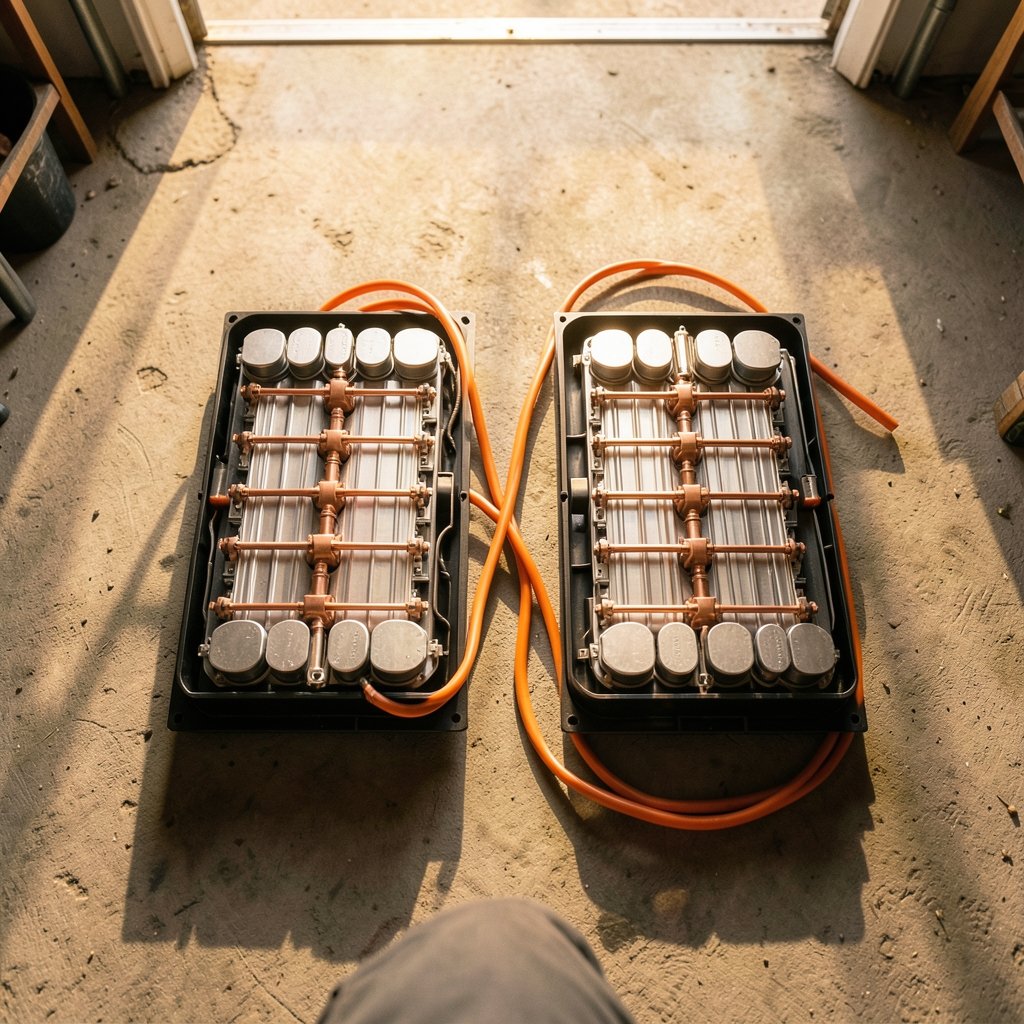
A single electric vehicle battery pack can hold roughly 60 to 100 kWh of energy, enough to keep a typical home running for several days. That same pack, weighing in around 400 to 500 kilograms, is expected to survive a decade of charging, discharging, and temperature swings. How it manages all that comes down to some elegant chemistry and a lot of clever engineering.
Quick Answer: How do ev batteries work?
EV batteries work by storing and releasing electrical energy through the movement of lithium ions between two electrodes inside thousands of small cells. When you accelerate, ions and electrons flow one way to send power to the motor; when you plug in, the flow reverses and the battery recharges. You can see the results in your daily driving range, charging speed, and how the pack holds up over the years.
Most modern packs use lithium-ion chemistry, though the exact mix of metals varies. Some cells favor nickel-manganese-cobalt for energy density, while others use lithium iron phosphate for longer life and lower cost. The trade-offs show up in range, weight, and price rather than in the basic principle.
Before buying or judging an EV, compare usable battery capacity, charging speed, chemistry type, thermal management, warranty terms, and real-world range, since those factors determine how the pack behaves in daily use.
The first time you watch an EV charge, it can feel almost anticlimactic. No roar of an engine, no smell of fuel, just a quiet cable and a rising number on a screen. Yet behind that calm display sits one of the most carefully engineered systems in any consumer product. Understanding how EV batteries work helps drivers make smarter choices about charging habits, vehicle selection, and long-term ownership costs. It also explains why two cars with the same range figure can behave very differently after five years on the road. (Batteries for Electric Vehicles)
The Basic Chemistry: Ions on the Move

An EV battery is a chemical energy storage device built around lithium-ion cells. Each cell has three main parts: a cathode (the positive electrode), an anode (the negative electrode), and an electrolyte that lets ions travel between them. A thin separator keeps the two electrodes from touching directly.
When the battery discharges, lithium ions move from the anode to the cathode through the electrolyte. Electrons take a different path, flowing through an external circuit to power the electric motor. During charging, the process reverses: ions and electrons travel back to the anode, storing energy for later. This back-and-forth shuttle is often called the “rocking chair” mechanism, and it is the heart of how the whole system functions. (Electric vehicle battery)
The cathode chemistry is where most of the variation happens. Common formulations include:
| Chemistry | Strengths | Trade-offs |
|---|---|---|
| NMC (nickel-manganese-cobalt) | High energy density, good range | Higher cost, cobalt supply concerns |
| LFP (lithium iron phosphate) | Long cycle life, thermal stability, cheaper | Lower energy density, heavier packs |
| NCA (nickel-cobalt-aluminum) | Strong energy density | Cost and thermal sensitivity |
Each chemistry shapes how the vehicle performs. For a deeper look at the broader tech behind modern vehicles, see what is edge ai and how does it work, since onboard computing increasingly manages battery behavior in real time.
From Cell to Pack: Building the Battery
A single cell produces only a few volts, so manufacturers stack and connect thousands of them. The structure usually follows a cell → module → pack hierarchy, though some designs skip modules entirely to save weight and space.
- Cells are manufactured in cylindrical, prismatic, or pouch formats.
- Modules group cells together with cooling channels and structural framing.
- The pack houses all modules in a sealed enclosure, often forming part of the vehicle’s floor.
That floor placement lowers the center of gravity, which improves handling and stability. It also means the pack must be rugged enough to survive impacts, water exposure, and vibration over many years.
The Battery Management System: The Quiet Brain
If the cells are the muscles, the battery management system (BMS) is the brain. This electronic control unit constantly monitors voltage, current, and temperature across every module. It balances charge between cells so none works harder than the others, and it can throttle charging or output if conditions get risky.
The BMS also communicates with the vehicle’s computers, estimating state of charge (how full the battery is) and state of health (how much capacity remains compared with when it was new). These estimates drive the range figure on your dashboard, and they are rarely perfect. Drivers often notice the guess dropping faster in cold weather or at highway speeds.
In many ways, the BMS behaves like the security layer of a computer network, quietly managing access and safety. If you are curious about how such systems protect data and devices, what is malware and how does it work offers a useful parallel on defense in depth.
Why Temperature Matters So Much
Lithium-ion cells are sensitive to heat and cold. High temperatures accelerate chemical side reactions that permanently reduce capacity, while freezing conditions temporarily slow ion movement, cutting available range.
That is why most packs include thermal management: liquid cooling loops, heating elements, or both. A well-designed system keeps cells in a comfortable band, often roughly 15 to 35 degrees Celsius. In practice, this is why pre-conditioning the battery before fast charging makes such a difference. It is also why cars parked overnight in freezing weather may show reduced range the next morning. The capacity is still there; the chemistry is simply moving more slowly.
Charging Explained: Slow, Fast, and Everything Between
Charging speed depends on several factors working together: the charger’s power output, the onboard converter, the battery’s temperature, and the state of charge. Most EVs accept alternating current (AC) for home charging and direct current (DC) for rapid public charging.
DC fast charging bypasses the onboard converter and feeds power directly to the pack. But the BMS limits how much current flows, especially above roughly 80 percent state of charge. This tapering protects cell life. Pushing a battery to 100 percent repeatedly at high speed would shorten its useful lifespan.
A common mistake among new owners is treating fast charging like refueling a petrol car: arriving empty and filling to full every time. In practice, the fastest road-trip strategy is to arrive with a moderate charge, stop in the 10 to 60 percent window, and move on. The charging curve, not the peak rate, determines real journey times.
How Long Do EV Batteries Last?
Degradation is gradual and driven by three main forces: cycling (each charge and discharge), high temperatures, and aggressive fast charging. Modern packs are designed to retain a substantial share of their original capacity after many years of normal use.
Most manufacturers in the United States offer warranties covering around eight years or 100,000 miles, whichever comes first, with a guaranteed minimum capacity retention. Terms vary by brand, so buyers should read the specific warranty document rather than assume.
Practical habits that genuinely help include:
- Keeping the battery in the middle of its charge range for daily driving
- Avoiding prolonged parking in extreme heat
- Using fast charging when needed rather than as a default
- Letting the thermal system precondition before rapid charging in cold weather
What does not help is obsessing over every percentage point. Modern BMS software already buffers the top and bottom of the pack, so ordinary use is far more forgiving than early EV owners feared.
The Software Layer: Where Cars Meet Computing
Modern EVs are effectively computers on wheels, and the battery is one of many systems managed by software. Over-the-air updates can refine charging curves, improve range estimates, and adjust thermal strategies long after purchase. This is part of a broader trend in which vehicles rely on sophisticated onboard intelligence, similar to how an ai agent coordinates tasks across connected systems.
Connectivity also raises questions. Every charge session, diagnostic ping, and app command travels across a network, which means each vehicle has a digital identity much like any other connected device. Understanding what is an ip address and how does it work helps explain how cars authenticate to charging networks and manufacturer servers.
How EV Batteries Compare With Other Technologies
Buyers sometimes wonder why alternatives have not replaced lithium-ion. The table below summarizes the main contenders.
| Technology | Status in passenger EVs | Key limitation |
|---|---|---|
| Lithium-ion (NMC/LFP) | Dominant today | Cost, supply chain pressure |
| Solid-state | Emerging, limited production | Manufacturing scale, cost |
| Sodium-ion | Early commercial use | Lower energy density |
| Nickel-metal hydride | Legacy hybrids only | Heavy, low energy density |
Solid-state designs promise higher energy density and improved safety by replacing the liquid electrolyte with a solid material. They remain expensive and difficult to mass-produce, so most analysts expect a gradual rollout rather than an overnight switch.
Second Life and Recycling
Batteries that no longer suit a vehicle often retain 70 to 80 percent of their capacity. Those packs can be repurposed for stationary storage, backing up homes or smoothing demand on the grid. When they finally wear out, recycling recovers lithium, nickel, cobalt, and copper.
Recycling remains a work in progress. Collection networks are still maturing, and processes vary widely in efficiency. Still, the economic case strengthens as raw material demand grows, and regulators in several regions are pushing for higher recovery rates.
What Actually Matters When Choosing an EV
Shoppers often fixate on the headline range figure. A more useful approach is to compare usable capacity, charging speed at realistic conditions, chemistry, thermal management design, and warranty terms. A car with a slightly smaller pack but a strong charging curve can be far more convenient on long trips than one with a bigger pack that charges slowly.
It also pays to check real-world reports from owners in your climate. Cold-weather performance and highway efficiency vary considerably between models, and those differences matter more than laboratory figures.
Conclusion
EV batteries are not mysterious black boxes. They are carefully engineered systems built on a simple principle: lithium ions shuttling between two electrodes, managed by software that keeps everything safe and efficient. The chemistry determines the character of the pack, the BMS protects it, and thermal management keeps it comfortable.
For drivers, the practical lessons are straightforward. Charge sensibly, respect temperature, read the warranty, and judge a vehicle by its real-world charging behavior rather than its marketing range. Do that, and the battery stops being a source of anxiety and becomes what it was designed to be: a durable, predictable part of everyday life.
Frequently Asked Questions
What happens to an EV battery when it gets old?
Capacity gradually declines as cells accumulate charge cycles and exposure to heat. Most packs retain the majority of their original capacity after many years of normal use, and manufacturers typically guarantee a minimum retention level under warranty.
Can EV batteries be replaced?
Yes. Packs are designed to be serviced, and replacement is possible, though it is expensive outside warranty. Some manufacturers offer module-level repair, which can reduce costs compared with swapping the entire pack.
Do fast chargers damage EV batteries?
Occasional DC fast charging is fine and does not meaningfully shorten battery life. Frequent high-speed charging to full, especially in hot conditions, adds stress over time. Using fast charging when needed and slower charging at home is the balanced approach.
Why does EV range drop in winter?
Cold temperatures slow the chemical reactions inside cells and increase internal resistance, temporarily reducing usable capacity. Cabin heating also draws energy. Preconditioning the battery and cabin while still plugged in helps offset much of the loss.
Are EV batteries safe in a crash?
Packs are built with reinforced enclosures, fuses, contactors, and monitoring systems that disconnect power in a collision. Engineering standards require extensive crash and fire testing before a vehicle reaches the market.
How much does it cost to charge an EV?
Cost depends on electricity prices and charging location. Home charging is generally the cheapest option per mile, while public fast charging costs more. Comparing local electricity rates with public charging tariffs gives the clearest picture for any driver.



