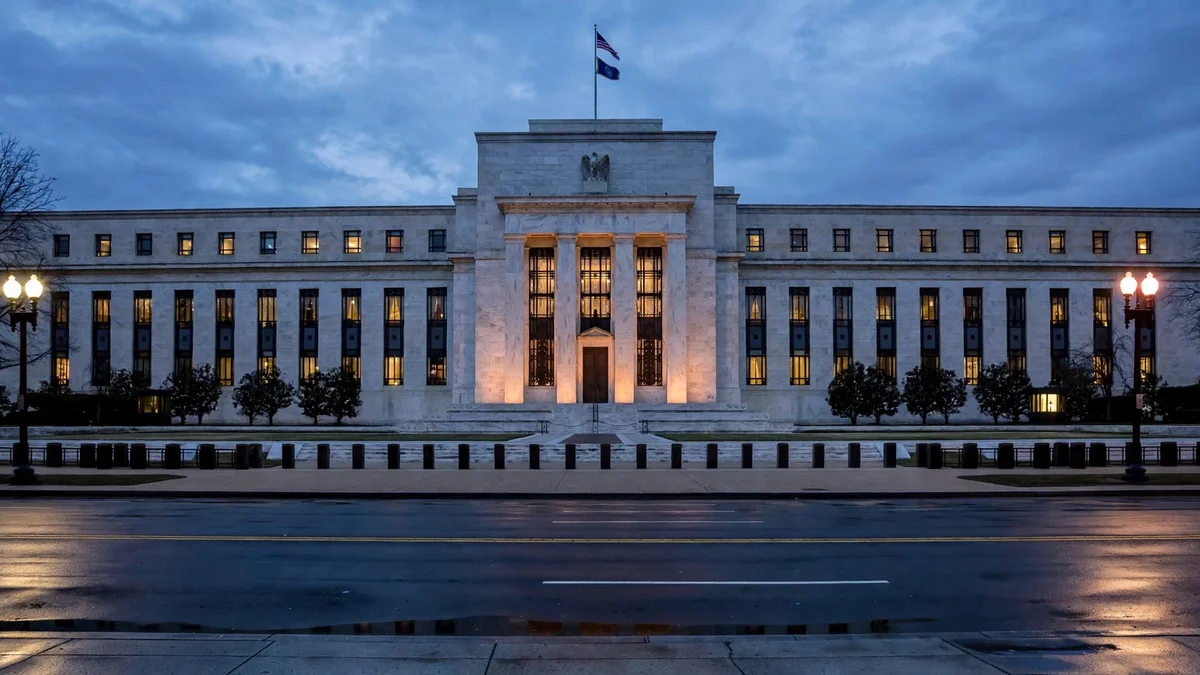
The Federal Reserve has put a number on the financial risk sitting behind the artificial intelligence boom. In its Financial Stability Report, published on 13 November 2026, the central bank counts more than $3 trillion in off-balance-sheet commitments tied to the AI build-out at seven large technology companies. The figure was highlighted by Forbes on 29 November, and it has quickly become the most talked-about number in the debate over whether AI stocks are priced for a future the financing cannot support.
The number is striking, but it is not a prediction of losses. It is a measure of promises already made: leases signed but not yet started, take-or-pay contracts, and guarantees that could come due if the AI build-out slows. The seven companies named are Amazon, Alphabet, Broadcom, Meta, Microsoft, Nvidia and Oracle. Their spending has powered the fastest infrastructure build-out in modern business history, and the Fed is now asking what happens if the returns arrive more slowly than the bills.
That question matters beyond technology shares. The same report found artificial intelligence had become the most-cited risk to financial stability among the market participants the Fed surveys, and that the largest American banks hold close to $1 trillion in exposures linked to these companies and to data-centre developers. The risk, in the Fed’s telling, is not that one company spends too much. It is that a whole chain of lenders, developers, utilities and investors has been built on the same bet.
Key takeaways
- The Fed’s November 2026 Financial Stability Report counts more than $3 trillion in off-balance-sheet commitments at seven large technology companies.
- More than $1 trillion is data-centre leases signed but not yet started, and more than $2 trillion is take-or-pay contracts and guarantees.
- The figures are undiscounted maximum values from company filings, not directly comparable with ordinary debt.
- In a survey of 23 market contacts, 87% named AI as a salient risk, up from about 50% in May.
- The largest US banks hold close to $1 trillion in exposures linked to the seven firms and data-centre developers.
| Item | What the Fed found |
|---|---|
| Report | November 2026, box “Leverage in the Data Center Buildout” |
| Total commitments | More than $3 trillion in off-balance-sheet obligations |
| Leases not yet started | More than $1 trillion |
| Contracts and guarantees | More than $2 trillion |
| Companies covered | Amazon, Alphabet, Broadcom, Meta, Microsoft, Nvidia and Oracle |
| On-balance-sheet debt | Projected to pass $800 billion by the end of 2026 |
| Bank exposure | Close to $1 trillion held by the largest US banks |
What the $3 trillion actually is
The first thing to get right about the Fed’s number is what it is not: not debt the seven companies owe today, and not a forecast of losses. It is the maximum nominal value of obligations the companies have committed to, drawn from their own 10-K and 10-Q filings. The Fed splits the total into two parts: leases signed but not yet commenced, worth more than $1 trillion, and other obligations, mainly take-or-pay contracts and residual value guarantees, worth more than $2 trillion.
A lease not yet commenced is a promise to pay rent on a data centre that may still be under construction. A take-or-pay contract is a promise to pay for power or capacity whether or not it is used. A residual value guarantee is a promise to cover the shortfall if equipment or a facility is worth less than expected at the end of a deal. None of these appears as a liability on the balance sheet, which is why the Fed calls them off-balance-sheet commitments. The obligations are disclosed, not hidden: “off the balance sheet” is accurate, and “hidden” is not.
There is a second caveat. The amounts are undiscounted maximum values, so they are not directly comparable with debt, which is reported at a discounted value. The Fed gives no breakdown by company, and no estimate of how much would be paid out in a downturn. What the number shows is the scale of the promises: the seven companies have committed to pay sums that dwarf their reported borrowing. Fed Governor Michael Barr, speaking in Milan on 16 November, said on-balance-sheet debt at the same seven firms is projected to pass $800 billion before the end of the year. The off-balance-sheet total is nearly four times that.
How the financing works, and where it can wobble

The mechanism is straightforward. A hyperscaler signs a long-term lease with an outside data-centre developer, and the developer uses that lease to borrow the money to build. The developer’s lenders are comfortable because a giant technology company has promised years of rent, and the hyperscaler because it has not borrowed the money itself. The building goes up, the servers go in, and everyone’s balance sheet looks lighter than the economics suggest.
That is the point the Fed keeps returning to: when a lease sits with a developer, a loan with a bank and a guarantee with a supplier, no single balance sheet shows the whole exposure. The October minutes warned that leveraged hedge funds, bond mutual funds and even target-date retirement funds could face pressure to sell assets during severe market disruptions. Investors who have been rotating away from the biggest AI names have already been asking the same question, as covered in our look at the stocks analysts are turning to as the AI trade falters.
What the Fed’s survey found
The survey of market participants is where the mood shift is clearest. The Federal Reserve Bank of New York surveyed 23 market contacts in September and October, and 87% named artificial intelligence as a salient risk to the financial system, up from about 50% in the spring. That puts AI ahead of a broad market correction and higher long-term interest rates as the most-cited concern.
Respondents pointed to three channels of risk: stretched equity valuations that could correct if AI-driven earnings slow; new cyber and operational threats from sophisticated actors and frontier models; and complex financing that links hyperscalers, lenders and special-purpose vehicles in ways that make losses harder to trace.
Borrowing has already happened at scale: debt issuance tied to advanced computing had reached $680 billion by October 2026, about five times the $130 billion issued in all of 2023. The Fed drew an explicit parallel with the broadband telecom investment cycle of the late 1990s, which ended with a wave of defaults when capacity outran demand, while noting the current cycle may soon surpass that era.
The report is two-sided: the largest firms may absorb losses in a downturn and shield the rest of the financial system, but their own exposure may be substantially larger than their balance sheets suggest.
The Bank of England saw the same pattern
The Fed is not alone. The Bank of England’s own Financial Stability Report, also published in November 2026, put total potential exposure to AI-related financing at just over $4 trillion, using a broader definition that adds SpaceX to Alphabet, Amazon, Microsoft, Meta and Oracle. The two central banks count different things, so the numbers are not directly comparable, but the direction is the same: the world’s most important financial supervisors now treat AI infrastructure finance as a stability question, not just a technology story.
The Bank of England’s figure covers a wider net, which is part of why it is larger, but it reflects the same build-out: enormous capital spending financed by corporate borrowing, leases, guarantees and private credit. That two central banks reached similar conclusions in the same month turned a technical box in a Fed report into a mainstream market story. The latest sharp move in an AI-linked stock, with Anthropic stock down 33% as AI spending risks mount, shows how quickly that story can move prices.
Why this is different from a normal market wobble
Markets correct all the time, and technology stocks correct more than most. What makes the Fed’s warning different is the plumbing underneath the prices. In a normal correction, a company’s shares fall and its lenders are largely unaffected. In this build-out, the lenders are part of the story: the largest US banks hold close to $1 trillion in exposures linked to the seven firms and to data-centre developers, and private credit funds and other non-bank lenders have joined in.
The third difference is concentration. Seven companies account for the bulk of the $3 trillion, and a small number of suppliers, developers and lenders sit on the other side. Concentration is not the same as fragility, and the biggest firms have the cash flow to absorb losses. But it means a single disappointment lands in a few places all at once, which is exactly the pattern financial stability reports are written to catch. The nervousness has been building for some time, and fears over the AI boom haven’t gone away even as the spending has accelerated.
What to watch next
- Hyperscaler earnings: watch capital spending guidance and free cash flow, not revenue growth.
- Lease disclosures: check the commitments notes in 10-K and 10-Q filings for changes in leases not yet started.
- Bank earnings: listen for what large banks say about exposure to technology firms and data-centre developers.
- Data-centre utilisation: watch for signs new capacity is filling more slowly than planned.
- Private credit: follow reports on lending to data-centre developers and neoclouds.
- Central bank reports: the next Financial Stability Reports will show whether the $3 trillion keeps growing.
Frequently asked questions
What is the $3 trillion figure the Fed reported?
It is the maximum nominal value of off-balance-sheet commitments tied to the AI build-out at seven technology companies: Amazon, Alphabet, Broadcom, Meta, Microsoft, Nvidia and Oracle. It comes from the Fed’s November 2026 Financial Stability Report and covers leases signed but not yet started, take-or-pay contracts and guarantees.
Does the $3 trillion mean these companies owe $3 trillion?
No. The figure is an undiscounted maximum of future commitments, not debt owed today, and the Fed gives no estimate of how much would actually be paid out in a downturn.
Which companies are included?
Amazon, Alphabet, Broadcom, Meta, Microsoft, Nvidia and Oracle. The Fed gives no breakdown of the total by company.
Why does the Fed care about data-centre leases?
Because the leases let developers borrow to build, linking the technology companies to banks, private credit funds and other lenders. If demand disappoints, the losses could travel through that chain rather than staying with one company.
What did the Fed’s survey of market contacts find?
In a survey of 23 market contacts in September and October 2026, 87% named AI as a salient risk, up from about 50% in May, making it the most-cited risk.
Is the Fed saying AI stocks will fall?
No. The report is a financial stability assessment, not a market forecast. It says the financing behind the AI build-out is large and complex enough to matter for the wider financial system.
Bottom line
The Fed has not called the top of the AI boom, nor said the spending is wasted. What it has done is put a number on the promises behind the boom: more than $3 trillion in commitments that do not appear as debt, from seven companies whose fortunes shape the whole market. The figure is a maximum, not a loss, and the obligations are disclosed in filings rather than hidden. But it is large enough, and the chain of lenders behind it long enough, that the central bank now counts AI finance among the top risks to financial stability.
For anyone following the AI story, the useful shift is in what to watch. Share prices move daily, but leases, contracts and bank exposures move slowly, and they are where the Fed is now looking. The next filings and stability reports will show whether the commitments keep growing, and whether the returns are catching up with the promises.